PLANNING THEORY AND
TECHNIQUES
Planning Theory & Techniques, Ar
Prakruthi S K
2
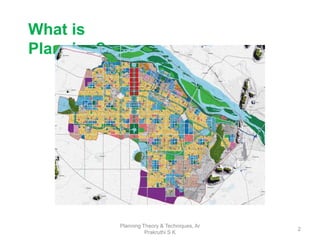
What is
Planning?
Planning Theory & Techniques, Ar
Prakruthi S K
3
•An over arching response to changes
•future-oriented decision making
•Planning is a cyclic process – Identify options – assess options –
develop strategies – goals – implement - evaluate impact
•Physical planning
•Economic planning
•Strategic planning
•Regional, urban and rural planning
•Land use planning
What is Planning?
Planning Theory & Techniques, Ar
Prakruthi S K
4
“A city should be built to give its inhabitants security and happiness” –
Aristotle
Convenience – Environment – Health - Beauty
•The art and science of ordering the use of land and locating of buildings
and communication routes so as to secure the maximum practicable
degree of economy, convenience, and beauty.
•shaping and guiding the physical growth
•To meet various needs such as social, cultural, economic and recreational
etc.
•To provide healthy conditions for both rich and poor to live, to work, and to
play or relax, thus bringing about the social and economic well-being
Town Planning
Planning Theory & Techniques, Ar
Prakruthi S K
5
Principles of Town Planning
•No haphazard method in planning process
•Housing provided for all classes
•Civic amenities like shopping centres, dispensaries, schools, etc should
be provided to all residents
•Adequate open spaces should be reserved for public recreation centre
and also for future expansion of the city
•Public and semi-public buildings should be grouped and distributed
neatly across the city
•Growth of the town may be controlled by provision of green belt which
is an open strip of land reserved for special purpose limiting the growth
of the city – primary use agriculture and agricultural related activities.
Planning Theory & Techniques, Ar
Prakruthi S K
6
Land Use Planning
•Zoning of land based on nature of use
•Regulations to determine intensity of use
•Legal frame work for plan implementation
Planning Theory & Techniques, Ar
Prakruthi S K
7
Physical planning uses the land use plan as a framework to propose
the optimal physical infrastructure for a settlement or area, including
infrastructure for public services, transport, economic activities,
recreation, and environmental protection.
A physical plan may be prepared for an urban area or a rural area. A
physical plan for an urban region can have both rural and urban
components, although the latter usually predominates.
A physical plan at a regional scale can also deal with the provision of
specific regional infrastructure, such as a regional road or a bulk water
supply system. physical plans are outcome-oriented.
Physical Planning
Planning Theory & Techniques, Ar
Prakruthi S K
8
• To enhance the Economic and social needs of people while safeguarding
future resources so that people enjoy the highest achievable degree of
efficiency in resource utilization, functionality of places and aesthetic
quality.
• To use the reconstruction process as an opportunity to improve if existing
instruments are not realistic with the base of law, regulations, plans &
instituted frame work.
• To implement the plans while involving local communities to encourage a
lifestyle that has low impact on the environment
• To integrate residential, ecological & economic land use by mixed land
use.
• Prioritize concerns in site planning to attain Environmental setting and
ecological footprint of neighborhood for better quality of life.
Physical Planning – Aims and Objectives
Planning Theory & Techniques, Ar
Prakruthi S K
9
•Union of neighbouring settlements with a common meeting place
•A composite of cells, neighbourhoods, communities where people work
together for the common good
•Opportunity for diversified living environment and diverse lifestyles
•Cities
•The Crossroad
•The Primary Agricultural Community
•The Commercial City
•The Industrial City
•The Transportation City
•The Recreational City
•Educational Cities
•Mining Communities
•Retirement Communities
•Governmental Centres
•Combination (Regional) Cities
Urban Area
Planning Theory & Techniques, Ar
Prakruthi S K
10
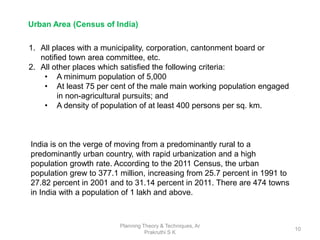
Urban Area (Census of India)
India is on the verge of moving from a predominantly rural to a
predominantly urban country, with rapid urbanization and a high
population growth rate. According to the 2011 Census, the urban
population grew to 377.1 million, increasing from 25.7 percent in 1991 to
27.82 percent in 2001 and to 31.14 percent in 2011. There are 474 towns
in India with a population of 1 lakh and above.
1. All places with a municipality, corporation, cantonment board or
notified town area committee, etc.
2. All other places which satisfied the following criteria:
• A minimum population of 5,000
• At least 75 per cent of the male main working population engaged
in non-agricultural pursuits; and
• A density of population of at least 400 persons per sq. km.
Planning Theory & Techniques, Ar
Prakruthi S K
11
Rural Area
•A population of less than 5,000
•Density of population less than 400 per sq km and
•more than "25 % of the male working population" is engaged in agricultural
pursuits.
•Infrastructure – Not as advanced and dense as in the urban fabric.
Planning Theory & Techniques, Ar
Prakruthi S K
12
References, Sources
1. The Urban Pattern, Arthur B Gallion
2. Town Planning, S C Rangwala
3. Urban and Regional Development Plan Formulation Guidelines (URDPFI),
TCPO, MoUD, GoI
4. Cities in Evolution, Patrick Geddes
5. Making City Planning Work, Allen B Jacob
6. Urban and Regional Planning, Peter Hall
7. The Culture of Cities, Lewis Mumford

Planning Theory Intro.pptx

  • 1.
  • 2.
    Planning Theory &Techniques, Ar Prakruthi S K 2 What is Planning?
  • 3.
    Planning Theory &Techniques, Ar Prakruthi S K 3 •An over arching response to changes •future-oriented decision making •Planning is a cyclic process – Identify options – assess options – develop strategies – goals – implement - evaluate impact •Physical planning •Economic planning •Strategic planning •Regional, urban and rural planning •Land use planning What is Planning?
  • 4.
    Planning Theory &Techniques, Ar Prakruthi S K 4 “A city should be built to give its inhabitants security and happiness” – Aristotle Convenience – Environment – Health - Beauty •The art and science of ordering the use of land and locating of buildings and communication routes so as to secure the maximum practicable degree of economy, convenience, and beauty. •shaping and guiding the physical growth •To meet various needs such as social, cultural, economic and recreational etc. •To provide healthy conditions for both rich and poor to live, to work, and to play or relax, thus bringing about the social and economic well-being Town Planning
  • 5.
    Planning Theory &Techniques, Ar Prakruthi S K 5 Principles of Town Planning •No haphazard method in planning process •Housing provided for all classes •Civic amenities like shopping centres, dispensaries, schools, etc should be provided to all residents •Adequate open spaces should be reserved for public recreation centre and also for future expansion of the city •Public and semi-public buildings should be grouped and distributed neatly across the city •Growth of the town may be controlled by provision of green belt which is an open strip of land reserved for special purpose limiting the growth of the city – primary use agriculture and agricultural related activities.
  • 6.
    Planning Theory &Techniques, Ar Prakruthi S K 6 Land Use Planning •Zoning of land based on nature of use •Regulations to determine intensity of use •Legal frame work for plan implementation
  • 7.
    Planning Theory &Techniques, Ar Prakruthi S K 7 Physical planning uses the land use plan as a framework to propose the optimal physical infrastructure for a settlement or area, including infrastructure for public services, transport, economic activities, recreation, and environmental protection. A physical plan may be prepared for an urban area or a rural area. A physical plan for an urban region can have both rural and urban components, although the latter usually predominates. A physical plan at a regional scale can also deal with the provision of specific regional infrastructure, such as a regional road or a bulk water supply system. physical plans are outcome-oriented. Physical Planning
  • 8.
    Planning Theory &Techniques, Ar Prakruthi S K 8 • To enhance the Economic and social needs of people while safeguarding future resources so that people enjoy the highest achievable degree of efficiency in resource utilization, functionality of places and aesthetic quality. • To use the reconstruction process as an opportunity to improve if existing instruments are not realistic with the base of law, regulations, plans & instituted frame work. • To implement the plans while involving local communities to encourage a lifestyle that has low impact on the environment • To integrate residential, ecological & economic land use by mixed land use. • Prioritize concerns in site planning to attain Environmental setting and ecological footprint of neighborhood for better quality of life. Physical Planning – Aims and Objectives
  • 9.
    Planning Theory &Techniques, Ar Prakruthi S K 9 •Union of neighbouring settlements with a common meeting place •A composite of cells, neighbourhoods, communities where people work together for the common good •Opportunity for diversified living environment and diverse lifestyles •Cities •The Crossroad •The Primary Agricultural Community •The Commercial City •The Industrial City •The Transportation City •The Recreational City •Educational Cities •Mining Communities •Retirement Communities •Governmental Centres •Combination (Regional) Cities Urban Area
  • 10.
    Planning Theory &Techniques, Ar Prakruthi S K 10 Urban Area (Census of India) India is on the verge of moving from a predominantly rural to a predominantly urban country, with rapid urbanization and a high population growth rate. According to the 2011 Census, the urban population grew to 377.1 million, increasing from 25.7 percent in 1991 to 27.82 percent in 2001 and to 31.14 percent in 2011. There are 474 towns in India with a population of 1 lakh and above. 1. All places with a municipality, corporation, cantonment board or notified town area committee, etc. 2. All other places which satisfied the following criteria: • A minimum population of 5,000 • At least 75 per cent of the male main working population engaged in non-agricultural pursuits; and • A density of population of at least 400 persons per sq. km.
  • 11.
    Planning Theory &Techniques, Ar Prakruthi S K 11 Rural Area •A population of less than 5,000 •Density of population less than 400 per sq km and •more than "25 % of the male working population" is engaged in agricultural pursuits. •Infrastructure – Not as advanced and dense as in the urban fabric.
  • 12.
    Planning Theory &Techniques, Ar Prakruthi S K 12 References, Sources 1. The Urban Pattern, Arthur B Gallion 2. Town Planning, S C Rangwala 3. Urban and Regional Development Plan Formulation Guidelines (URDPFI), TCPO, MoUD, GoI 4. Cities in Evolution, Patrick Geddes 5. Making City Planning Work, Allen B Jacob 6. Urban and Regional Planning, Peter Hall 7. The Culture of Cities, Lewis Mumford