Digital Graphic Narrative Planning
Use this booklet to help structure your planning and collate your planning documents.
Considerations:
There are lots of things to consider in this project. Fill out each section in detail to show you have thought about each one. You
should imagine that this is a live project, so considerations like cost, quantity and codes of practice must be thought about in that
context rather than just as a college project.
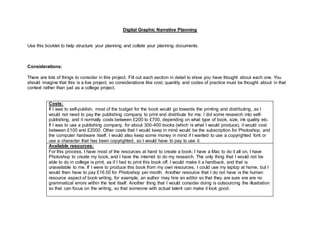
Costs:
If I was to self-publish, most of the budget for the book would go towards the printing and distributing, as I
would not need to pay the publishing company to print and distribute for me. I did some research into self-
publishing, and it normally costs between £200 to £700, depending on what type of book, size, ink quality etc.
If I was to use a publishing company, for about 300-400 books (which is what I would produce), it would cost
between £100 and £2000. Other costs that I would keep in mind would be the subscription for Photoshop, and
the computer hardware itself. I would also keep some money in mind if I wanted to use a copyrighted font or
use a character that has been copyrighted, so I would have to pay to use it.
Available resources:
For this process, I have most of the resources at hand to create a book; I have a Mac to do it all on, I have
Photoshop to create my book, and I have the internet to do my research. The only thing that I would not be
able to do in college is print, as if I had to print this book off, I would make it a hardback, and that is
unavailable to me. If I were to produce this book from my own resources, I could use my laptop at home, but I
would then have to pay £16.50 for Photoshop per month. Another resource that I do not have is the human
resource aspect of book writing, for example, an author may hire an editor so that they are sure ere are no
grammatical errors within the text itself. Another thing that I would consider doing is outsourcing the illustration
so that can focus on the writing, so that someone with actual talent can make it look good.
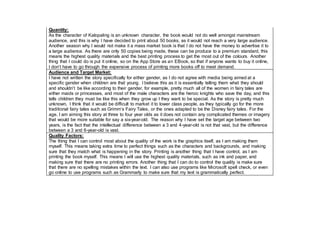
Quantity:
As the character of Kalopaling is an unknown character, the book would not do well amongst mainstream
audience, and this is why I have decided to print about 50 books, as it would not reach a very large audience.
Another season why I would not make it a mass market book is that I do not have the money to advertise it to
a large audience. As there are only 50 copies being made, these can be produce to a premium standard, this
means the highest quality materials and the best printing process to get the most out of the colours. Another
thing that I could do is put it online, so on the App Store as an EBook, so that if anyone wants to buy it online,
I don’t have to go through the expensive process of printing more books off to meet demand.
Audience and Target Market:
I have not written the story specifically for either gender, as I do not agree with media being aimed at a
specific gender when children are that young. I believe this as it is essentially telling them what they should
and shouldn’t be like according to their gender, for example, pretty much all of the women in fairy tales are
either maids or princesses, and most of the male characters are the heroic knights who save the day, and this
tells children they must be like this when they grow up I they want to be special. As the story is pretty much
unknown, I think that it would be difficult to market it to lower class people, as they typically go for the more
traditional fairy tales such as Grimm’s Fairy Tales, or the ones adapted to be the Disney fairy tales. For the
age, I am aiming this story at three to four year olds as it does not contain any complicated themes or imagery
that would be more suitable for say a six-year-old. The reason why I have set the target age between two
years, is the fact that the intellectual difference between a 3 and 4-year-old is not that vast, but the difference
between a 3 and 6-year-old is vast.
Quality Factors:
The thing that I can control most about the quality of the work is the graphics itself, as I am making them
myself. This means taking extra time to perfect things such as the characters and backgrounds, and making
sure that they match what is happening in the story. Printing is another thing that I have control, as I am
printing the book myself. This means I will use the highest quality materials, such as ink and paper, and
making sure that there are no printing errors. Another thing that I can do to control the quality is make sure
that there are no spelling mistakes within the text. I can also use programs like Microsoft spell check, or even
go online to use programs such as Grammarly to make sure that my text is grammatically perfect.
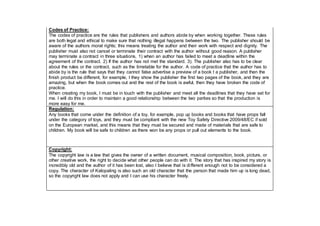
Codes of Practice:
The codes of practice are the rules that publishers and authors abide by when working together. These rules
are both legal and ethical to make sure that nothing illegal happens between the two. The publisher should be
aware of the authors moral rights; this means treating the author and their work with respect and dignity. The
publisher must also not cancel or terminate their contract with the author without good reason. A publisher
may terminate a contract in three situations, 1) when an author has failed to meet a deadline within the
agreement of the contract. 2) If the author has not met the standard. 3). The publisher also has to be clear
about the rules or the contract, such as the timetable for the author. A code of practice that the author has to
abide by is the rule that says that they cannot false advertise a preview of a book t a publisher, and then the
finish product be different, for example, I they show the publisher the first two pages of the book, and they are
amazing, but when the book comes out and the rest of the book is awful, then they have broken the code of
practice.
When creating my book, I must be in touch with the publisher and meet all the deadlines that they have set for
me. I will do this in order to maintain a good relationship between the two parties so that the production is
more easy for me.
Regulation:
Any books that come under the definition of a toy, for example, pop up books and books that have props fall
under the category of toys, and they must be compliant with the new Toy Safety Directive 2009/48/EC if sold
on the European market, and this means that they must be secured and made of materials that are safe to
children. My book will be safe to children as there won be any props or pull out elements to the book.
Copyright:
The copyright law is a law that gives the owner of a written document, musical composition, book, picture, or
other creative work, the right to decide what other people can do with it. The story that has inspired my story is
incredibly old and the author of it has been lost, also I believe that is different enough not to be considered a
copy. The character of Kalopaling is also such an old character that the person that made him up is long dead,
so the copyright law does not apply and I can use his character freely.
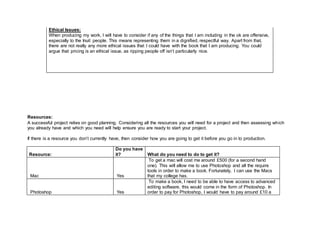
Ethical Issues:
When producing my work, I will have to consider if any of the things that I am including in the ok are offensive,
especially to the Inuit people. This means representing them in a dignified, respectful way. Apart from that,
there are not really any more ethical issues that I could have with the book that I am producing. You could
argue that pricing is an ethical issue, as ripping people off isn’t particularly nice.
Resources:
A successful project relies on good planning. Considering all the resources you will need for a project and then assessing which
you already have and which you need will help ensure you are ready to start your project.
If there is a resource you don’t currently have, then consider how you are going to get it before you go in to production.
Resource:
Do you have
it? What do you need to do to get it?
Mac Yes
To get a mac will cost me around £500 (for a second hand
one). This will allow me to use Photoshop and all the require
tools in order to make a book. Fortunately, I can use the Macs
that my college has.
Photoshop Yes
To make a book, I need to be able to have access to advanced
editing software, this would come in the form of Photoshop. In
order to pay for Photoshop, I would have to pay around £10 a
month for a student account. Fortunately, I can use the
Photoshop at college on their Macs.
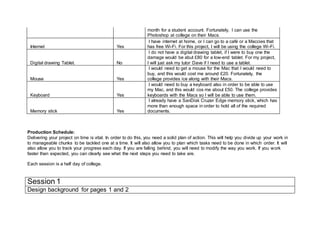
Internet Yes
I have internet at home, or I can go to a café or a Maccies that
has free Wi-Fi. For this project, I will be using the college Wi-Fi.
Digital drawing Tablet. No
I do not have a digital drawing tablet, if I were to buy one the
damage would be abut £80 for a low-end tablet. For my project,
I will just ask my tutor Dave if I need to use a tablet.
Mouse Yes
I would need to get a mouse for the Mac that I would need to
buy, and this would cost me around £20. Fortunately, the
college provides ice along with their Macs.
Keyboard Yes
I would need to buy a keyboard also in order to be able to use
my Mac, and this would cos me about £50. The college provides
keyboards with the Macs so I will be able to use them.
Memory stick Yes
I already have a SanDisk Cruzer Edge memory stick, which has
more than enough space in order to hold all of the required
documents.
Production Schedule:
Delivering your project on time is vital. In order to do this, you need a solid plan of action. This will help you divide up your work in
to manageable chunks to be tackled one at a time. It will also allow you to plan which tasks need to be done in which order. It will
also allow you to track your progress each day. If you are falling behind, you will need to modify the way you work. If you work
faster than expected, you can clearly see what the next steps you need to take are.
Each session is a half day of college.
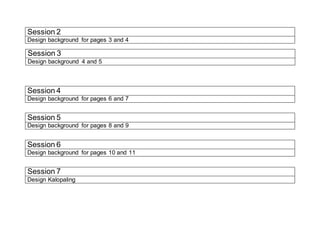
Session 1
Design background for pages 1 and 2
Session 2
Design background for pages 3 and 4
Session 4
Design background for pages 6 and 7
Session 5
Design background for pages 8 and 9
Session 6
Design background for pages 10 and 11
Session 7
Design Kalopaling
Session 3
Design background 4 and 5
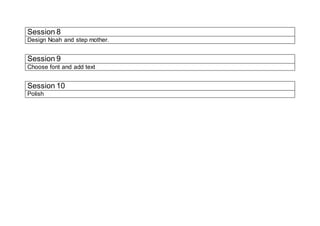
Session 8
Design Noah and step mother.
Session 9
Choose font and add text
Session 10
Polish
Health and safety:
Your health and safety and that of those around you is very important. Just like in industry, an accident could prevent you from
working. Whilst we don’t work in a highly dangerous environment, there are still risks. Some are short term, such as trips and
spillages whilst others, such as long term damage to eyesight or back problems, may affect you much later in life.
Consider the risks based on the activities you will be undertaking during the project. Explain how you could prevent them from
happening.
Ensure you reference appropriate pieces of legislation, design to protect people at work.
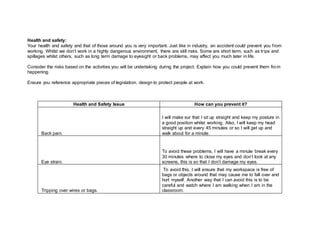
Health and Safety Issue How can you prevent it?
Back pain.
I will make sur that I sit up straight and keep my posture in
a good position whilst working. Also, I will keep my head
straight up and every 45 minutes or so I will get up and
walk about for a minute.
Eye strain.
To avoid these problems, I will have a minute break every
30 minutes where to close my eyes and don’t look at any
screens, this is so that I don’t damage my eyes.
Tripping over wires or bags.
To avoid this, I will ensure that my workspace is free of
bags or objects around that may cause me to fall over and
hurt myself. Another way that I can avoid this is to be
careful and watch where I am walking when I am in the
classroom.
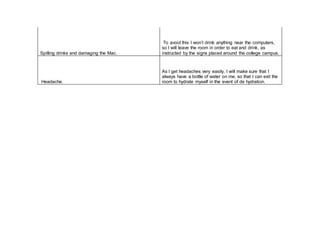
Spilling drinks and damaging the Mac.
To avoid this I won’t drink anything near the computers,
so I will leave the room in order to eat and drink, as
instructed by the signs placed around the college campus.
Headache.
As I get headaches very easily, I will make sure that I
always have a bottle of water on me, so that I can exit the
room to hydrate myself in the event of de hydration.

Planning booklet

  • 1.
    Digital Graphic NarrativePlanning Use this booklet to help structure your planning and collate your planning documents. Considerations: There are lots of things to consider in this project. Fill out each section in detail to show you have thought about each one. You should imagine that this is a live project, so considerations like cost, quantity and codes of practice must be thought about in that context rather than just as a college project. Costs: If I was to self-publish, most of the budget for the book would go towards the printing and distributing, as I would not need to pay the publishing company to print and distribute for me. I did some research into self- publishing, and it normally costs between £200 to £700, depending on what type of book, size, ink quality etc. If I was to use a publishing company, for about 300-400 books (which is what I would produce), it would cost between £100 and £2000. Other costs that I would keep in mind would be the subscription for Photoshop, and the computer hardware itself. I would also keep some money in mind if I wanted to use a copyrighted font or use a character that has been copyrighted, so I would have to pay to use it. Available resources: For this process, I have most of the resources at hand to create a book; I have a Mac to do it all on, I have Photoshop to create my book, and I have the internet to do my research. The only thing that I would not be able to do in college is print, as if I had to print this book off, I would make it a hardback, and that is unavailable to me. If I were to produce this book from my own resources, I could use my laptop at home, but I would then have to pay £16.50 for Photoshop per month. Another resource that I do not have is the human resource aspect of book writing, for example, an author may hire an editor so that they are sure ere are no grammatical errors within the text itself. Another thing that I would consider doing is outsourcing the illustration so that can focus on the writing, so that someone with actual talent can make it look good.
  • 2.
    Quantity: As the characterof Kalopaling is an unknown character, the book would not do well amongst mainstream audience, and this is why I have decided to print about 50 books, as it would not reach a very large audience. Another season why I would not make it a mass market book is that I do not have the money to advertise it to a large audience. As there are only 50 copies being made, these can be produce to a premium standard, this means the highest quality materials and the best printing process to get the most out of the colours. Another thing that I could do is put it online, so on the App Store as an EBook, so that if anyone wants to buy it online, I don’t have to go through the expensive process of printing more books off to meet demand. Audience and Target Market: I have not written the story specifically for either gender, as I do not agree with media being aimed at a specific gender when children are that young. I believe this as it is essentially telling them what they should and shouldn’t be like according to their gender, for example, pretty much all of the women in fairy tales are either maids or princesses, and most of the male characters are the heroic knights who save the day, and this tells children they must be like this when they grow up I they want to be special. As the story is pretty much unknown, I think that it would be difficult to market it to lower class people, as they typically go for the more traditional fairy tales such as Grimm’s Fairy Tales, or the ones adapted to be the Disney fairy tales. For the age, I am aiming this story at three to four year olds as it does not contain any complicated themes or imagery that would be more suitable for say a six-year-old. The reason why I have set the target age between two years, is the fact that the intellectual difference between a 3 and 4-year-old is not that vast, but the difference between a 3 and 6-year-old is vast. Quality Factors: The thing that I can control most about the quality of the work is the graphics itself, as I am making them myself. This means taking extra time to perfect things such as the characters and backgrounds, and making sure that they match what is happening in the story. Printing is another thing that I have control, as I am printing the book myself. This means I will use the highest quality materials, such as ink and paper, and making sure that there are no printing errors. Another thing that I can do to control the quality is make sure that there are no spelling mistakes within the text. I can also use programs like Microsoft spell check, or even go online to use programs such as Grammarly to make sure that my text is grammatically perfect.
  • 3.
    Codes of Practice: Thecodes of practice are the rules that publishers and authors abide by when working together. These rules are both legal and ethical to make sure that nothing illegal happens between the two. The publisher should be aware of the authors moral rights; this means treating the author and their work with respect and dignity. The publisher must also not cancel or terminate their contract with the author without good reason. A publisher may terminate a contract in three situations, 1) when an author has failed to meet a deadline within the agreement of the contract. 2) If the author has not met the standard. 3). The publisher also has to be clear about the rules or the contract, such as the timetable for the author. A code of practice that the author has to abide by is the rule that says that they cannot false advertise a preview of a book t a publisher, and then the finish product be different, for example, I they show the publisher the first two pages of the book, and they are amazing, but when the book comes out and the rest of the book is awful, then they have broken the code of practice. When creating my book, I must be in touch with the publisher and meet all the deadlines that they have set for me. I will do this in order to maintain a good relationship between the two parties so that the production is more easy for me. Regulation: Any books that come under the definition of a toy, for example, pop up books and books that have props fall under the category of toys, and they must be compliant with the new Toy Safety Directive 2009/48/EC if sold on the European market, and this means that they must be secured and made of materials that are safe to children. My book will be safe to children as there won be any props or pull out elements to the book. Copyright: The copyright law is a law that gives the owner of a written document, musical composition, book, picture, or other creative work, the right to decide what other people can do with it. The story that has inspired my story is incredibly old and the author of it has been lost, also I believe that is different enough not to be considered a copy. The character of Kalopaling is also such an old character that the person that made him up is long dead, so the copyright law does not apply and I can use his character freely.
  • 4.
    Ethical Issues: When producingmy work, I will have to consider if any of the things that I am including in the ok are offensive, especially to the Inuit people. This means representing them in a dignified, respectful way. Apart from that, there are not really any more ethical issues that I could have with the book that I am producing. You could argue that pricing is an ethical issue, as ripping people off isn’t particularly nice. Resources: A successful project relies on good planning. Considering all the resources you will need for a project and then assessing which you already have and which you need will help ensure you are ready to start your project. If there is a resource you don’t currently have, then consider how you are going to get it before you go in to production. Resource: Do you have it? What do you need to do to get it? Mac Yes To get a mac will cost me around £500 (for a second hand one). This will allow me to use Photoshop and all the require tools in order to make a book. Fortunately, I can use the Macs that my college has. Photoshop Yes To make a book, I need to be able to have access to advanced editing software, this would come in the form of Photoshop. In order to pay for Photoshop, I would have to pay around £10 a
  • 5.
    month for astudent account. Fortunately, I can use the Photoshop at college on their Macs. Internet Yes I have internet at home, or I can go to a café or a Maccies that has free Wi-Fi. For this project, I will be using the college Wi-Fi. Digital drawing Tablet. No I do not have a digital drawing tablet, if I were to buy one the damage would be abut £80 for a low-end tablet. For my project, I will just ask my tutor Dave if I need to use a tablet. Mouse Yes I would need to get a mouse for the Mac that I would need to buy, and this would cost me around £20. Fortunately, the college provides ice along with their Macs. Keyboard Yes I would need to buy a keyboard also in order to be able to use my Mac, and this would cos me about £50. The college provides keyboards with the Macs so I will be able to use them. Memory stick Yes I already have a SanDisk Cruzer Edge memory stick, which has more than enough space in order to hold all of the required documents. Production Schedule: Delivering your project on time is vital. In order to do this, you need a solid plan of action. This will help you divide up your work in to manageable chunks to be tackled one at a time. It will also allow you to plan which tasks need to be done in which order. It will also allow you to track your progress each day. If you are falling behind, you will need to modify the way you work. If you work faster than expected, you can clearly see what the next steps you need to take are. Each session is a half day of college. Session 1 Design background for pages 1 and 2
  • 6.
    Session 2 Design backgroundfor pages 3 and 4 Session 4 Design background for pages 6 and 7 Session 5 Design background for pages 8 and 9 Session 6 Design background for pages 10 and 11 Session 7 Design Kalopaling Session 3 Design background 4 and 5
  • 7.
    Session 8 Design Noahand step mother. Session 9 Choose font and add text Session 10 Polish
  • 8.
    Health and safety: Yourhealth and safety and that of those around you is very important. Just like in industry, an accident could prevent you from working. Whilst we don’t work in a highly dangerous environment, there are still risks. Some are short term, such as trips and spillages whilst others, such as long term damage to eyesight or back problems, may affect you much later in life. Consider the risks based on the activities you will be undertaking during the project. Explain how you could prevent them from happening. Ensure you reference appropriate pieces of legislation, design to protect people at work. Health and Safety Issue How can you prevent it? Back pain. I will make sur that I sit up straight and keep my posture in a good position whilst working. Also, I will keep my head straight up and every 45 minutes or so I will get up and walk about for a minute. Eye strain. To avoid these problems, I will have a minute break every 30 minutes where to close my eyes and don’t look at any screens, this is so that I don’t damage my eyes. Tripping over wires or bags. To avoid this, I will ensure that my workspace is free of bags or objects around that may cause me to fall over and hurt myself. Another way that I can avoid this is to be careful and watch where I am walking when I am in the classroom.
  • 9.
    Spilling drinks anddamaging the Mac. To avoid this I won’t drink anything near the computers, so I will leave the room in order to eat and drink, as instructed by the signs placed around the college campus. Headache. As I get headaches very easily, I will make sure that I always have a bottle of water on me, so that I can exit the room to hydrate myself in the event of de hydration.