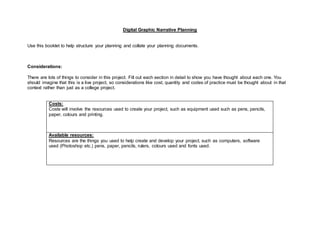
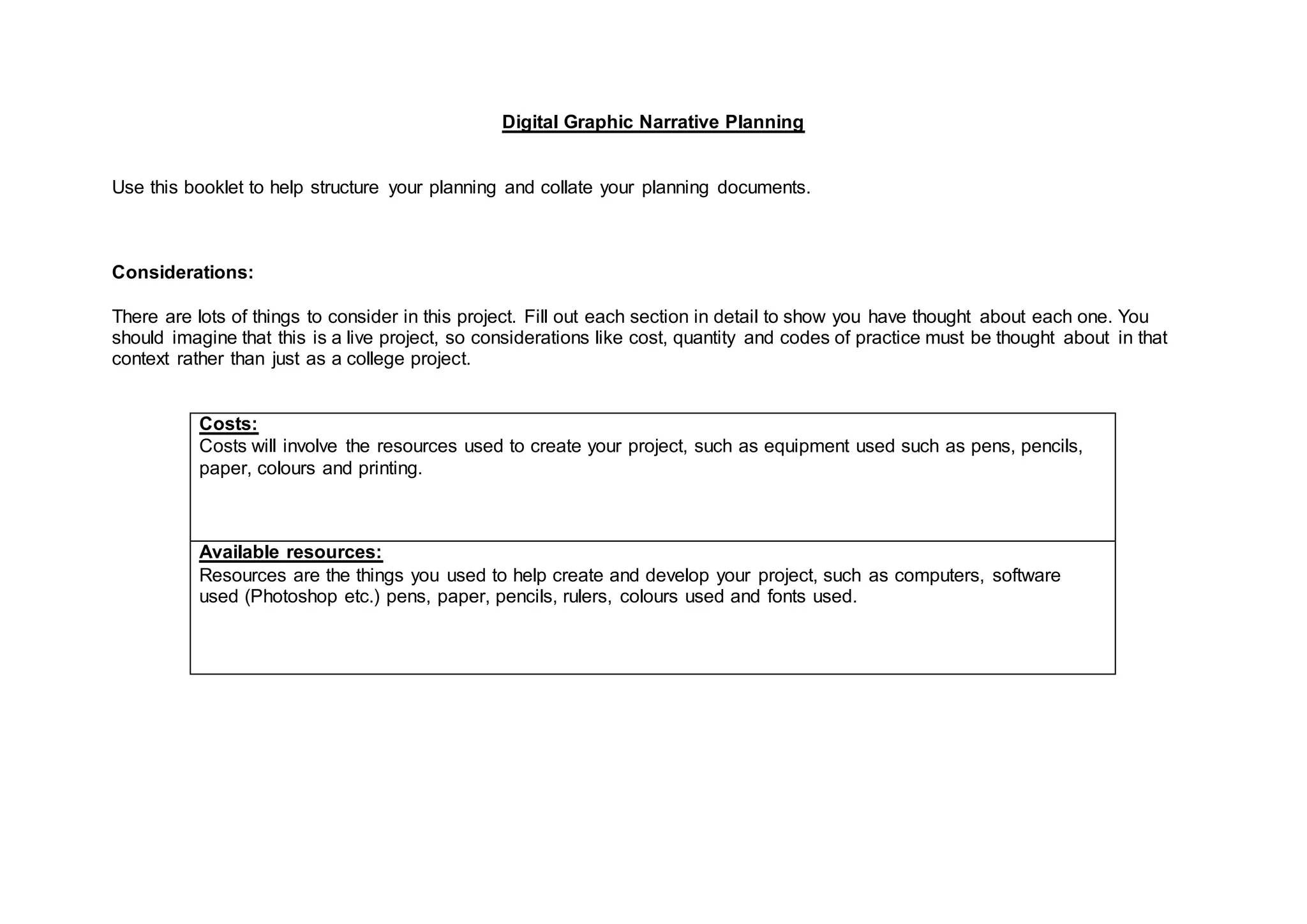
Digital Graphic Narrative Planning
Use this booklet to help structure your planning and collate your planning documents.
Considerations:
There are lots of things to consider in this project. Fill out each section in detail to show you have thought about each one. You
should imagine that this is a live project, so considerations like cost, quantity and codes of practice must be thought about in that
context rather than just as a college project.
Costs:
Costs will involve the resources used to create your project, such as equipment used such as pens, pencils,
paper, colours and printing.
Available resources:
Resources are the things you used to help create and develop your project, such as computers, software
used (Photoshop etc.) pens, paper, pencils, rulers, colours used and fonts used.
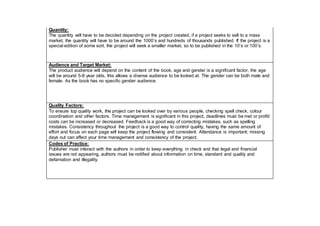
Quantity:
The quantity will have to be decided depending on the project created, if a project seeks to sell to a mass
market, the quantity will have to be around the 1000’s and hundreds of thousands published. If the project is a
special edition of some sort, the project will seek a smaller market, so to be published in the 10’s or 100’s.
Audience and Target Market:
The product audience will depend on the content of the book, age and gender is a significant factor, the age
will be around 5-8 year olds, this allows a diverse audience to be looked at. The gender can be both male and
female. As the book has no specific gender audience.
Quality Factors:
To ensure top quality work, the project can be looked over by various people, checking spell check, colour
coordination and other factors. Time management is significant in this project, deadlines must be met or profit/
costs can be increased or decreased. Feedback is a good way of correcting mistakes, such as spelling
mistakes. Consistency throughout the project is a good way to control quality, having the same amount of
effort and focus on each page will keep the project flowing and consistent. Attendance is important; missing
days out can affect your time management and consistency of the project.
Codes of Practice:
Publisher must interact with the authors in order to keep everything in check and that legal and financial
issues are not appearing, authors must be notified about information on time, standard and quality and
defamation and illegality.
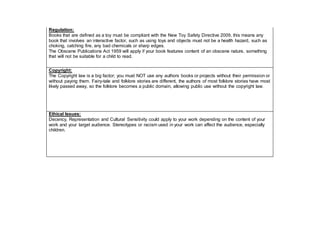
Regulation:
Books that are defined as a toy must be compliant with the New Toy Safety Directive 2009, this means any
book that involves an interactive factor, such as using toys and objects must not be a health hazard, such as
choking, catching fire, any bad chemicals or sharp edges.
The Obscene Publications Act 1959 will apply if your book features content of an obscene nature, something
that will not be suitable for a child to read.
Copyright:
The Copyright law is a big factor; you must NOT use any authors books or projects without their permission or
without paying them. Fairy-tale and folklore stories are different, the authors of most folklore stories have most
likely passed away, so the folklore becomes a public domain, allowing public use without the copyright law.
Ethical Issues:
Decency, Representation and Cultural Sensitivity could apply to your work depending on the content of your
work and your target audience. Stereotypes or racism used in your work can affect the audience, especially
children.
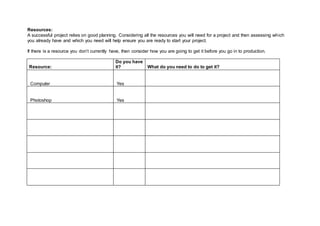
Resources:
A successful project relies on good planning. Considering all the resources you will need for a project and then assessing which
you already have and which you need will help ensure you are ready to start your project.
If there is a resource you don’t currently have, then consider how you are going to get it before you go in to production.
Resource:
Do you have
it? What do you need to do to get it?
Computer Yes
Photoshop Yes
Production Schedule:
Delivering your project on time is vital. In order to do this, you need a solid plan of action. This will help you divide up your work in
to manageable chunks to be tackled one at a time. It will also allow you to plan which tasks need to be done in which order. It will
also allow you to track your progress each day. If you are falling behind, you will need to modify the way you work. If you work
faster than expected, you can clearly see what the next steps you need to take are.
Each session is a half day of college.
Session 1:
Design a title page for my book [complete]
Develop characters for my book [complete]
Session 2:
Develop a story line for my book [complete]
Start on the first page of my book. [Complete]
Session 3:
Get feedback from the tutor and classmates for my first page to see if I can improve. [Complete]
Develop a 2nd and 3rd page, keeping the story and quality consistent, depending on the first
page.[complete]
Session 4:
Over look the 1st 2nd and 3rd pages, see if my story can develop in a different way then I intended it too,
make changes. [Complete]
Develop a 4th 5th and 6th page for my book [complete]
Session 5:
Develop a 7th 8th and 9th page for my book, changing backgrounds and angles. [Complete]
Session 6:
Develop the 10th page [Complete]
Thoroughly check the book over and over to see any mistakes or issues. [Complete]
Session 7:
Bring the pages together [Complete]
Put pages in correct order and check all the pages are useful. [Complete]
Session 8:
Get classmates and tutor to view the pages, checking for any issues or incorrect placement. [Complete]
Session 9:
Go over all regulations and copyright law, checking for no illegality. [Complete]
Session 10:
Finish development pro forma [Complete]
Check all work is correct and complete. [Complete]
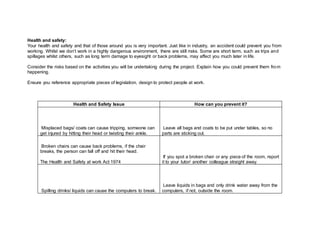
Health and safety:
Your health and safety and that of those around you is very important. Just like in industry, an accident could prevent you from
working. Whilst we don’t work in a highly dangerous environment, there are still risks. Some are short term, such as trips and
spillages whilst others, such as long term damage to eyesight or back problems, may affect you much later in life.
Consider the risks based on the activities you will be undertaking during the project. Explain how you could prevent them from
happening.
Ensure you reference appropriate pieces of legislation, design to protect people at work.
Health and Safety Issue How can you prevent it?
Misplaced bags/ coats can cause tripping, someone can
get injured by hitting their head or twisting their ankle.
Leave all bags and coats to be put under tables, so no
parts are sticking out.
Broken chairs can cause back problems, if the chair
breaks, the person can fall off and hit their head.
The Health and Safety at work Act 1974
If you spot a broken chair or any piece of the room, report
it to your tutor/ another colleague straight away.
Spilling drinks/ liquids can cause the computers to break.
Leave liquids in bags and only drink water away from the
computers, if not, outside the room.
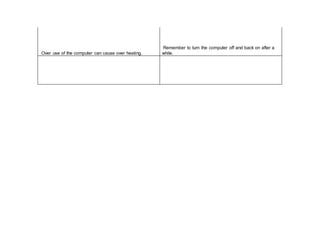
Over use of the computer can cause over heating.
Remember to turn the computer off and back on after a
while.

Planning booklet

  • 1.
    Digital Graphic NarrativePlanning Use this booklet to help structure your planning and collate your planning documents. Considerations: There are lots of things to consider in this project. Fill out each section in detail to show you have thought about each one. You should imagine that this is a live project, so considerations like cost, quantity and codes of practice must be thought about in that context rather than just as a college project. Costs: Costs will involve the resources used to create your project, such as equipment used such as pens, pencils, paper, colours and printing. Available resources: Resources are the things you used to help create and develop your project, such as computers, software used (Photoshop etc.) pens, paper, pencils, rulers, colours used and fonts used.
  • 2.
    Quantity: The quantity willhave to be decided depending on the project created, if a project seeks to sell to a mass market, the quantity will have to be around the 1000’s and hundreds of thousands published. If the project is a special edition of some sort, the project will seek a smaller market, so to be published in the 10’s or 100’s. Audience and Target Market: The product audience will depend on the content of the book, age and gender is a significant factor, the age will be around 5-8 year olds, this allows a diverse audience to be looked at. The gender can be both male and female. As the book has no specific gender audience. Quality Factors: To ensure top quality work, the project can be looked over by various people, checking spell check, colour coordination and other factors. Time management is significant in this project, deadlines must be met or profit/ costs can be increased or decreased. Feedback is a good way of correcting mistakes, such as spelling mistakes. Consistency throughout the project is a good way to control quality, having the same amount of effort and focus on each page will keep the project flowing and consistent. Attendance is important; missing days out can affect your time management and consistency of the project. Codes of Practice: Publisher must interact with the authors in order to keep everything in check and that legal and financial issues are not appearing, authors must be notified about information on time, standard and quality and defamation and illegality.
  • 3.
    Regulation: Books that aredefined as a toy must be compliant with the New Toy Safety Directive 2009, this means any book that involves an interactive factor, such as using toys and objects must not be a health hazard, such as choking, catching fire, any bad chemicals or sharp edges. The Obscene Publications Act 1959 will apply if your book features content of an obscene nature, something that will not be suitable for a child to read. Copyright: The Copyright law is a big factor; you must NOT use any authors books or projects without their permission or without paying them. Fairy-tale and folklore stories are different, the authors of most folklore stories have most likely passed away, so the folklore becomes a public domain, allowing public use without the copyright law. Ethical Issues: Decency, Representation and Cultural Sensitivity could apply to your work depending on the content of your work and your target audience. Stereotypes or racism used in your work can affect the audience, especially children.
  • 4.
    Resources: A successful projectrelies on good planning. Considering all the resources you will need for a project and then assessing which you already have and which you need will help ensure you are ready to start your project. If there is a resource you don’t currently have, then consider how you are going to get it before you go in to production. Resource: Do you have it? What do you need to do to get it? Computer Yes Photoshop Yes
  • 5.
    Production Schedule: Delivering yourproject on time is vital. In order to do this, you need a solid plan of action. This will help you divide up your work in to manageable chunks to be tackled one at a time. It will also allow you to plan which tasks need to be done in which order. It will also allow you to track your progress each day. If you are falling behind, you will need to modify the way you work. If you work faster than expected, you can clearly see what the next steps you need to take are. Each session is a half day of college. Session 1: Design a title page for my book [complete] Develop characters for my book [complete] Session 2: Develop a story line for my book [complete] Start on the first page of my book. [Complete]
  • 6.
    Session 3: Get feedbackfrom the tutor and classmates for my first page to see if I can improve. [Complete] Develop a 2nd and 3rd page, keeping the story and quality consistent, depending on the first page.[complete] Session 4: Over look the 1st 2nd and 3rd pages, see if my story can develop in a different way then I intended it too, make changes. [Complete] Develop a 4th 5th and 6th page for my book [complete] Session 5: Develop a 7th 8th and 9th page for my book, changing backgrounds and angles. [Complete]
  • 7.
    Session 6: Develop the10th page [Complete] Thoroughly check the book over and over to see any mistakes or issues. [Complete] Session 7: Bring the pages together [Complete] Put pages in correct order and check all the pages are useful. [Complete]
  • 8.
    Session 8: Get classmatesand tutor to view the pages, checking for any issues or incorrect placement. [Complete] Session 9: Go over all regulations and copyright law, checking for no illegality. [Complete]
  • 9.
    Session 10: Finish developmentpro forma [Complete] Check all work is correct and complete. [Complete]
  • 10.
    Health and safety: Yourhealth and safety and that of those around you is very important. Just like in industry, an accident could prevent you from working. Whilst we don’t work in a highly dangerous environment, there are still risks. Some are short term, such as trips and spillages whilst others, such as long term damage to eyesight or back problems, may affect you much later in life. Consider the risks based on the activities you will be undertaking during the project. Explain how you could prevent them from happening. Ensure you reference appropriate pieces of legislation, design to protect people at work. Health and Safety Issue How can you prevent it? Misplaced bags/ coats can cause tripping, someone can get injured by hitting their head or twisting their ankle. Leave all bags and coats to be put under tables, so no parts are sticking out. Broken chairs can cause back problems, if the chair breaks, the person can fall off and hit their head. The Health and Safety at work Act 1974 If you spot a broken chair or any piece of the room, report it to your tutor/ another colleague straight away. Spilling drinks/ liquids can cause the computers to break. Leave liquids in bags and only drink water away from the computers, if not, outside the room.
  • 11.
    Over use ofthe computer can cause over heating. Remember to turn the computer off and back on after a while.