IN THE ALMIGHTY GOD NAME
Through the Mother of God mediation
I do this research
Gerges Francis Tawadrous/
2nd
Course student – physics Faculty – People's Friendship University – Moscow –Russia..
mrwaheid1@yahoo.com mrwaheid@gmail.com +201022532292
1
Planet Orbital Period Definition
2nd
Course Student – Physics Department - Physics & Math Faculty –
Peoples' Friendship University – Moscow – Russia -2010-2013
TEL +201022532292 mrwaheid@gmail.com / gergesgerges@yandex.ru
The Assumption Of S. Virgin Mary -Written in Cairo – Egypt – 29th
October 2019
Abstract
Paper Hypothesis
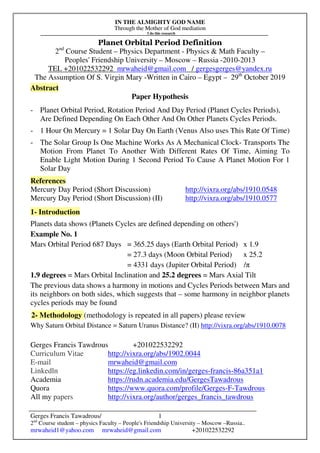
- Planet Orbital Period, Rotation Period And Day Period (Planet Cycles Periods),
Are Defined Depending On Each Other And On Other Planets Cycles Periods.
- 1 Hour On Mercury = 1 Solar Day On Earth (Venus Also uses This Rate Of Time)
- The Solar Group Is One Machine Works As A Mechanical Clock- Transports The
Motion From Planet To Another With Different Rates Of Time, Aiming To
Enable Light Motion During 1 Second Period To Cause A Planet Motion For 1
Solar Day
References
Mercury Day Period (Short Discussion) http://vixra.org/abs/1910.0548
Mercury Day Period (Short Discussion) (II) http://vixra.org/abs/1910.0577
1- Introduction
Planets data shows (Planets Cycles are defined depending on others')
Example No. 1
Mars Orbital Period 687 Days = 365.25 days (Earth Orbital Period) x 1.9
= 27.3 days (Moon Orbital Period) x 25.2
= 4331 days (Jupiter Orbital Period) /π
1.9 degrees = Mars Orbital Inclination and 25.2 degrees = Mars Axial Tilt
The previous data shows a harmony in motions and Cycles Periods between Mars and
its neighbors on both sides, which suggests that – some harmony in neighbor planets
cycles periods may be found
2- Methodology (methodology is repeated in all papers) please review
Why Saturn Orbital Distance = Saturn Uranus Distance? (II) http://vixra.org/abs/1910.0078
Gerges Francis Tawdrous +201022532292
Curriculum Vitae http://vixra.org/abs/1902.0044
E-mail mrwaheid@gmail.com
Linkedln https://eg.linkedin.com/in/gerges-francis-86a351a1
Academia https://rudn.academia.edu/GergesTawadrous
Quora https://www.quora.com/profile/Gerges-F-Tawdrous
All my papers http://vixra.org/author/gerges_francis_tawdrous
IN THE ALMIGHTY GOD NAME
Through the Mother of God mediation
I do this research
Gerges Francis Tawadrous/
2nd
Course student – physics Faculty – People's Friendship University – Moscow –Russia..
mrwaheid1@yahoo.com mrwaheid@gmail.com +201022532292
2
3- Mercury, Venus & Earth Moon Cycles Periods
3-1 Planets Cooperation
These 3 planets have specific cycle periods relative to the other planets – So we will
discuss them at first in following…
I- Data
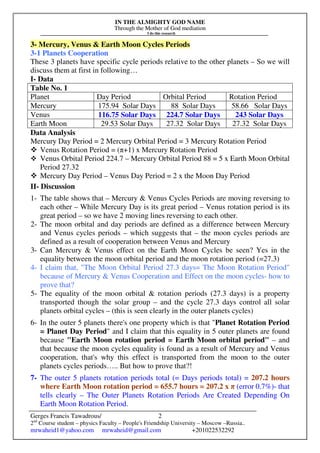
Table No. 1
Planet Day Period Orbital Period Rotation Period
Mercury 175.94 Solar Days 88 Solar Days 58.66 Solar Days
Venus 116.75 Solar Days 224.7 Solar Days 243 Solar Days
Earth Moon 29.53 Solar Days 27.32 Solar Days 27.32 Solar Days
Data Analysis
Mercury Day Period = 2 Mercury Orbital Period = 3 Mercury Rotation Period
Venus Rotation Period = (π+1) x Mercury Rotation Period
Venus Orbital Period 224.7 – Mercury Orbital Period 88 = 5 x Earth Moon Orbital
Period 27.32
Mercury Day Period – Venus Day Period = 2 x the Moon Day Period
II- Discussion
1- The table shows that – Mercury & Venus Cycles Periods are moving reversing to
each other – While Mercury Day is its great period – Venus rotation period is its
great period – so we have 2 moving lines reversing to each other.
2- The moon orbital and day periods are defined as a difference between Mercury
and Venus cycles periods – which suggests that – the moon cycles periods are
defined as a result of cooperation between Venus and Mercury
3- Can Mercury & Venus effect on the Earth Moon Cycles be seen? Yes in the
equality between the moon orbital period and the moon rotation period (=27.3)
4- I claim that, "The Moon Orbital Period 27.3 days= The Moon Rotation Period"
because of Mercury & Venus Cooperation and Effect on the moon cycles- how to
prove that?
5- The equality of the moon orbital & rotation periods (27.3 days) is a property
transported though the solar group – and the cycle 27.3 days control all solar
planets orbital cycles – (this is seen clearly in the outer planets cycles)
6- In the outer 5 planets there's one property which is that "Planet Rotation Period
= Planet Day Period" and I claim that this equality in 5 outer planets are found
because "Earth Moon rotation period = Earth Moon orbital period" – and
that because the moon cycles equality is found as a result of Mercury and Venus
cooperation, that's why this effect is transported from the moon to the outer
planets cycles periods….. But how to prove that?!
7- The outer 5 planets rotation periods total (= Days periods total) = 207.2 hours
where Earth Moon rotation period = 655.7 hours = 207.2 x π (error 0.7%)- that
tells clearly – The Outer Planets Rotation Periods Are Created Depending On
Earth Moon Rotation Period.
IN THE ALMIGHTY GOD NAME
Through the Mother of God mediation
I do this research
Gerges Francis Tawadrous/
2nd
Course student – physics Faculty – People's Friendship University – Moscow –Russia..
mrwaheid1@yahoo.com mrwaheid@gmail.com +201022532292
3
3-2 Earth Orbital Period
Earth Orbital Period Is Defined Based On Mercury Day Period
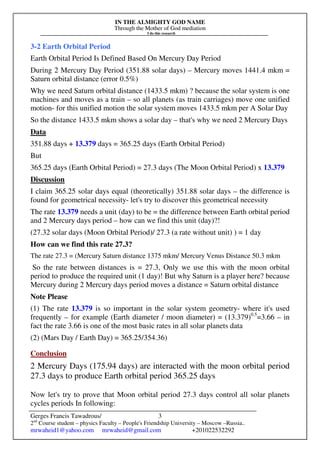
During 2 Mercury Day Period (351.88 solar days) – Mercury moves 1441.4 mkm =
Saturn orbital distance (error 0.5%)
Why we need Saturn orbital distance (1433.5 mkm) ? because the solar system is one
machines and moves as a train – so all planets (as train carriages) move one unified
motion- for this unified motion the solar system moves 1433.5 mkm per A Solar Day
So the distance 1433.5 mkm shows a solar day – that's why we need 2 Mercury Days
Data
351.88 days + 13.379 days = 365.25 days (Earth Orbital Period)
But
365.25 days (Earth Orbital Period) = 27.3 days (The Moon Orbital Period) x 13.379
Discussion
I claim 365.25 solar days equal (theoretically) 351.88 solar days – the difference is
found for geometrical necessity- let's try to discover this geometrical necessity
The rate 13.379 needs a unit (day) to be = the difference between Earth orbital period
and 2 Mercury days period – how can we find this unit (day)?!
(27.32 solar days (Moon Orbital Period)/ 27.3 (a rate without unit) ) = 1 day
How can we find this rate 27.3?
The rate 27.3 = (Mercury Saturn distance 1375 mkm/ Mercury Venus Distance 50.3 mkm
So the rate between distances is = 27.3, Only we use this with the moon orbital
period to produce the required unit (1 day)! But why Saturn is a player here? because
Mercury during 2 Mercury days period moves a distance = Saturn orbital distance
Note Please
(1) The rate 13.379 is so important in the solar system geometry- where it's used
frequently – for example (Earth diameter / moon diameter) = (13.379)0.5
=3.66 – in
fact the rate 3.66 is one of the most basic rates in all solar planets data
(2) (Mars Day / Earth Day) = 365.25/354.36)
Conclusion
2 Mercury Days (175.94 days) are interacted with the moon orbital period
27.3 days to produce Earth orbital period 365.25 days
Now let's try to prove that Moon orbital period 27.3 days control all solar planets
cycles periods In following:
IN THE ALMIGHTY GOD NAME
Through the Mother of God mediation
I do this research
Gerges Francis Tawadrous/
2nd
Course student – physics Faculty – People's Friendship University – Moscow –Russia..
mrwaheid1@yahoo.com mrwaheid@gmail.com +201022532292
4
3-3 Earth Moon Orbital Period
Mars (Revision)
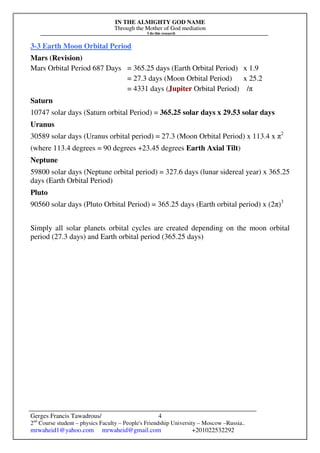
Mars Orbital Period 687 Days = 365.25 days (Earth Orbital Period) x 1.9
= 27.3 days (Moon Orbital Period) x 25.2
= 4331 days (Jupiter Orbital Period) /π
Saturn
10747 solar days (Saturn orbital Period) = 365.25 solar days x 29.53 solar days
Uranus
30589 solar days (Uranus orbital period) = 27.3 (Moon Orbital Period) x 113.4 x π2
(where 113.4 degrees = 90 degrees +23.45 degrees Earth Axial Tilt)
Neptune
59800 solar days (Neptune orbital period) = 327.6 days (lunar sidereal year) x 365.25
days (Earth Orbital Period)
Pluto
90560 solar days (Pluto Orbital Period) = 365.25 days (Earth orbital period) x (2π)3
Simply all solar planets orbital cycles are created depending on the moon orbital
period (27.3 days) and Earth orbital period (365.25 days)
IN THE ALMIGHTY GOD NAME
Through the Mother of God mediation
I do this research
Gerges Francis Tawadrous/
2nd
Course student – physics Faculty – People's Friendship University – Moscow –Russia..
mrwaheid1@yahoo.com mrwaheid@gmail.com +201022532292
5
3-4 Mercury 1 Hour = 1 Solar Day On Earth
As we have discussed in my previous paper
Why Mercury Day Period = 2 Mercury Orbital Periods = 3 Mercury Rotation
Periods? (Theoretical Analysis) http://vixra.org/abs/1910.0592
1 hour on Mercury = 1 solar day on Earth
Let's summarize this idea in following:
8 Mercury Days = 1407.6 solar days – and Mercury rotation period =1407.6 hours –
based on this data I have concluded that 1 solar day on Earth = 1 hour on Mercury
But why the number 8 is so specific one?
To pass Mercury Jupiter Diameter (1441 mkm) – Mercury moves along 2 Mercury
Days period (= 351.88 solar days)
Now I have supposed that 351.88 solar days = Earth sidereal year 365.25 solar days
(theoretically) as we have seen in the previous discussion-
But Earth has a cycle of 4 years (365+365+365+366 = 1461 solar days)
Means the full cycle needs 2 Mercury Days x 4 = 1407.6 Solar Days
So – the product 1407.6 solar days (Earth Rate of time) will be used as input Mercury
rotation period (1407.6 hours) (Mercury Rate of Time)
Venus Uses This Same Rate
224.7 days (Venus Orbital Period) x 2π = 1407.6 solar days (error .3%)
Means
Venus uses this same rate 1 hour on Mercury = 1 day on Earth
But
The factor 2π tells us that – Venus deals with the value 1407.6 as a distance and not
a period of time – because we have light motions with planets motions- so easily we
can find relativistic effects in the solar system – that's why the time & distance values
become exchangeable…
So Venus uses the same rate but – time and distance values many be exchangeable
between Venus and Mercury… for example
Mercury during its rotation period 58.66 solar days move a distance near to 243 mkm
where Venus rotation period = 243 solar days … the time value is used as a distance
Also
Venus during 365.25 solar days moves a distance = 1106 mkm = 2π x 175.94 mkm
But 175.94 days = Mercury Day Period – the values similarity isn't found by any pure
coincidences – it's found because the time and distance values becomes exchangeable
resulting of the high velocity motions which we deal with
Let's see more examples
IN THE ALMIGHTY GOD NAME
Through the Mother of God mediation
I do this research
Gerges Francis Tawadrous/
2nd
Course student – physics Faculty – People's Friendship University – Moscow –Russia..
mrwaheid1@yahoo.com mrwaheid@gmail.com +201022532292
6
Time and distance values equivalence
(1)
687days (Mars Orbital Distance)=3.02 mkm/day (Venus Velocity daily) x 227.9 days
But 227.9 mkm= Mars orbital distance
That means Venus sees Mars orbital distance as a period of time – also the result
should be a distance 687 mkm but Mars sees as period 687 days
(2)
2.082 mkm/day (Mars velocity daily) x 116.7 days (Venus Day Period) = 243 mkm
(During Venus Day Mars moves 243 mkm but Venus rotation period =243 days-
please remember – this same period 243 days is produced by Mercury as a distance
passed by Mercury during Mercury rotation period- that means this point 243 is a
connection point between many planets)
Please Note
Mercury Data still has great puzzles
For example
Mercury orbital period (π+1) x 1mkm = Mercury orbital distance x 2π !
We need more deep discussion in Mercury Data…let's try to do that in next papers
Research Hypotheses (Revision)
Hypothesis No.1:The Solar System is One building (or one machine) and each planet
is a part of this same building.
Hypothesis No.2: The Solar System moves as a train. i.e. A train moves with its
carriages together, similar to that – Solar Planets move together as one train in one
unified motion - So all planets move together in one unified motion – regardless the
planets velocities differences - Based on that No Planet moves individually or
independently from other planets motions ("The Train Motion Concept")
Hypothesis No.3: Planet motion for 1 solar day depends on energy of light motion
for 1 second period – that means – Planet moves following light motion – so we have
2 motions (1st) Light Motion (2nd) Its Follower Planet Motion - 2 motions are done
by 2 different rates of time while (the passing distance) almost be the same for both
motions
Hypothesis No.4: The Solar System Unified Motion depends On Solar Day Period
and 1433.5 mkm as a distance should be passed per solar day (1433.5 mkm = Saturn
orbital distance)
Hypothesis No.5: Matter Creation process depends on solar day period of time – that
means – Matter creation process depends the time as a basic component of it.
My Research Hypotheses http://vixra.org/abs/1909.0406
Research 1st Hypothesis Discussion http://vixra.org/abs/1909.0562
Thanks for reading Kind regards
Gerges Francis Tawdrous +201022532292

Planet Orbital Period Definition

  • 1.
    IN THE ALMIGHTYGOD NAME Through the Mother of God mediation I do this research Gerges Francis Tawadrous/ 2nd Course student – physics Faculty – People's Friendship University – Moscow –Russia.. mrwaheid1@yahoo.com mrwaheid@gmail.com +201022532292 1 Planet Orbital Period Definition 2nd Course Student – Physics Department - Physics & Math Faculty – Peoples' Friendship University – Moscow – Russia -2010-2013 TEL +201022532292 mrwaheid@gmail.com / gergesgerges@yandex.ru The Assumption Of S. Virgin Mary -Written in Cairo – Egypt – 29th October 2019 Abstract Paper Hypothesis - Planet Orbital Period, Rotation Period And Day Period (Planet Cycles Periods), Are Defined Depending On Each Other And On Other Planets Cycles Periods. - 1 Hour On Mercury = 1 Solar Day On Earth (Venus Also uses This Rate Of Time) - The Solar Group Is One Machine Works As A Mechanical Clock- Transports The Motion From Planet To Another With Different Rates Of Time, Aiming To Enable Light Motion During 1 Second Period To Cause A Planet Motion For 1 Solar Day References Mercury Day Period (Short Discussion) http://vixra.org/abs/1910.0548 Mercury Day Period (Short Discussion) (II) http://vixra.org/abs/1910.0577 1- Introduction Planets data shows (Planets Cycles are defined depending on others') Example No. 1 Mars Orbital Period 687 Days = 365.25 days (Earth Orbital Period) x 1.9 = 27.3 days (Moon Orbital Period) x 25.2 = 4331 days (Jupiter Orbital Period) /π 1.9 degrees = Mars Orbital Inclination and 25.2 degrees = Mars Axial Tilt The previous data shows a harmony in motions and Cycles Periods between Mars and its neighbors on both sides, which suggests that – some harmony in neighbor planets cycles periods may be found 2- Methodology (methodology is repeated in all papers) please review Why Saturn Orbital Distance = Saturn Uranus Distance? (II) http://vixra.org/abs/1910.0078 Gerges Francis Tawdrous +201022532292 Curriculum Vitae http://vixra.org/abs/1902.0044 E-mail mrwaheid@gmail.com Linkedln https://eg.linkedin.com/in/gerges-francis-86a351a1 Academia https://rudn.academia.edu/GergesTawadrous Quora https://www.quora.com/profile/Gerges-F-Tawdrous All my papers http://vixra.org/author/gerges_francis_tawdrous
  • 2.
    IN THE ALMIGHTYGOD NAME Through the Mother of God mediation I do this research Gerges Francis Tawadrous/ 2nd Course student – physics Faculty – People's Friendship University – Moscow –Russia.. mrwaheid1@yahoo.com mrwaheid@gmail.com +201022532292 2 3- Mercury, Venus & Earth Moon Cycles Periods 3-1 Planets Cooperation These 3 planets have specific cycle periods relative to the other planets – So we will discuss them at first in following… I- Data Table No. 1 Planet Day Period Orbital Period Rotation Period Mercury 175.94 Solar Days 88 Solar Days 58.66 Solar Days Venus 116.75 Solar Days 224.7 Solar Days 243 Solar Days Earth Moon 29.53 Solar Days 27.32 Solar Days 27.32 Solar Days Data Analysis Mercury Day Period = 2 Mercury Orbital Period = 3 Mercury Rotation Period Venus Rotation Period = (π+1) x Mercury Rotation Period Venus Orbital Period 224.7 – Mercury Orbital Period 88 = 5 x Earth Moon Orbital Period 27.32 Mercury Day Period – Venus Day Period = 2 x the Moon Day Period II- Discussion 1- The table shows that – Mercury & Venus Cycles Periods are moving reversing to each other – While Mercury Day is its great period – Venus rotation period is its great period – so we have 2 moving lines reversing to each other. 2- The moon orbital and day periods are defined as a difference between Mercury and Venus cycles periods – which suggests that – the moon cycles periods are defined as a result of cooperation between Venus and Mercury 3- Can Mercury & Venus effect on the Earth Moon Cycles be seen? Yes in the equality between the moon orbital period and the moon rotation period (=27.3) 4- I claim that, "The Moon Orbital Period 27.3 days= The Moon Rotation Period" because of Mercury & Venus Cooperation and Effect on the moon cycles- how to prove that? 5- The equality of the moon orbital & rotation periods (27.3 days) is a property transported though the solar group – and the cycle 27.3 days control all solar planets orbital cycles – (this is seen clearly in the outer planets cycles) 6- In the outer 5 planets there's one property which is that "Planet Rotation Period = Planet Day Period" and I claim that this equality in 5 outer planets are found because "Earth Moon rotation period = Earth Moon orbital period" – and that because the moon cycles equality is found as a result of Mercury and Venus cooperation, that's why this effect is transported from the moon to the outer planets cycles periods….. But how to prove that?! 7- The outer 5 planets rotation periods total (= Days periods total) = 207.2 hours where Earth Moon rotation period = 655.7 hours = 207.2 x π (error 0.7%)- that tells clearly – The Outer Planets Rotation Periods Are Created Depending On Earth Moon Rotation Period.
  • 3.
    IN THE ALMIGHTYGOD NAME Through the Mother of God mediation I do this research Gerges Francis Tawadrous/ 2nd Course student – physics Faculty – People's Friendship University – Moscow –Russia.. mrwaheid1@yahoo.com mrwaheid@gmail.com +201022532292 3 3-2 Earth Orbital Period Earth Orbital Period Is Defined Based On Mercury Day Period During 2 Mercury Day Period (351.88 solar days) – Mercury moves 1441.4 mkm = Saturn orbital distance (error 0.5%) Why we need Saturn orbital distance (1433.5 mkm) ? because the solar system is one machines and moves as a train – so all planets (as train carriages) move one unified motion- for this unified motion the solar system moves 1433.5 mkm per A Solar Day So the distance 1433.5 mkm shows a solar day – that's why we need 2 Mercury Days Data 351.88 days + 13.379 days = 365.25 days (Earth Orbital Period) But 365.25 days (Earth Orbital Period) = 27.3 days (The Moon Orbital Period) x 13.379 Discussion I claim 365.25 solar days equal (theoretically) 351.88 solar days – the difference is found for geometrical necessity- let's try to discover this geometrical necessity The rate 13.379 needs a unit (day) to be = the difference between Earth orbital period and 2 Mercury days period – how can we find this unit (day)?! (27.32 solar days (Moon Orbital Period)/ 27.3 (a rate without unit) ) = 1 day How can we find this rate 27.3? The rate 27.3 = (Mercury Saturn distance 1375 mkm/ Mercury Venus Distance 50.3 mkm So the rate between distances is = 27.3, Only we use this with the moon orbital period to produce the required unit (1 day)! But why Saturn is a player here? because Mercury during 2 Mercury days period moves a distance = Saturn orbital distance Note Please (1) The rate 13.379 is so important in the solar system geometry- where it's used frequently – for example (Earth diameter / moon diameter) = (13.379)0.5 =3.66 – in fact the rate 3.66 is one of the most basic rates in all solar planets data (2) (Mars Day / Earth Day) = 365.25/354.36) Conclusion 2 Mercury Days (175.94 days) are interacted with the moon orbital period 27.3 days to produce Earth orbital period 365.25 days Now let's try to prove that Moon orbital period 27.3 days control all solar planets cycles periods In following:
  • 4.
    IN THE ALMIGHTYGOD NAME Through the Mother of God mediation I do this research Gerges Francis Tawadrous/ 2nd Course student – physics Faculty – People's Friendship University – Moscow –Russia.. mrwaheid1@yahoo.com mrwaheid@gmail.com +201022532292 4 3-3 Earth Moon Orbital Period Mars (Revision) Mars Orbital Period 687 Days = 365.25 days (Earth Orbital Period) x 1.9 = 27.3 days (Moon Orbital Period) x 25.2 = 4331 days (Jupiter Orbital Period) /π Saturn 10747 solar days (Saturn orbital Period) = 365.25 solar days x 29.53 solar days Uranus 30589 solar days (Uranus orbital period) = 27.3 (Moon Orbital Period) x 113.4 x π2 (where 113.4 degrees = 90 degrees +23.45 degrees Earth Axial Tilt) Neptune 59800 solar days (Neptune orbital period) = 327.6 days (lunar sidereal year) x 365.25 days (Earth Orbital Period) Pluto 90560 solar days (Pluto Orbital Period) = 365.25 days (Earth orbital period) x (2π)3 Simply all solar planets orbital cycles are created depending on the moon orbital period (27.3 days) and Earth orbital period (365.25 days)
  • 5.
    IN THE ALMIGHTYGOD NAME Through the Mother of God mediation I do this research Gerges Francis Tawadrous/ 2nd Course student – physics Faculty – People's Friendship University – Moscow –Russia.. mrwaheid1@yahoo.com mrwaheid@gmail.com +201022532292 5 3-4 Mercury 1 Hour = 1 Solar Day On Earth As we have discussed in my previous paper Why Mercury Day Period = 2 Mercury Orbital Periods = 3 Mercury Rotation Periods? (Theoretical Analysis) http://vixra.org/abs/1910.0592 1 hour on Mercury = 1 solar day on Earth Let's summarize this idea in following: 8 Mercury Days = 1407.6 solar days – and Mercury rotation period =1407.6 hours – based on this data I have concluded that 1 solar day on Earth = 1 hour on Mercury But why the number 8 is so specific one? To pass Mercury Jupiter Diameter (1441 mkm) – Mercury moves along 2 Mercury Days period (= 351.88 solar days) Now I have supposed that 351.88 solar days = Earth sidereal year 365.25 solar days (theoretically) as we have seen in the previous discussion- But Earth has a cycle of 4 years (365+365+365+366 = 1461 solar days) Means the full cycle needs 2 Mercury Days x 4 = 1407.6 Solar Days So – the product 1407.6 solar days (Earth Rate of time) will be used as input Mercury rotation period (1407.6 hours) (Mercury Rate of Time) Venus Uses This Same Rate 224.7 days (Venus Orbital Period) x 2π = 1407.6 solar days (error .3%) Means Venus uses this same rate 1 hour on Mercury = 1 day on Earth But The factor 2π tells us that – Venus deals with the value 1407.6 as a distance and not a period of time – because we have light motions with planets motions- so easily we can find relativistic effects in the solar system – that's why the time & distance values become exchangeable… So Venus uses the same rate but – time and distance values many be exchangeable between Venus and Mercury… for example Mercury during its rotation period 58.66 solar days move a distance near to 243 mkm where Venus rotation period = 243 solar days … the time value is used as a distance Also Venus during 365.25 solar days moves a distance = 1106 mkm = 2π x 175.94 mkm But 175.94 days = Mercury Day Period – the values similarity isn't found by any pure coincidences – it's found because the time and distance values becomes exchangeable resulting of the high velocity motions which we deal with Let's see more examples
  • 6.
    IN THE ALMIGHTYGOD NAME Through the Mother of God mediation I do this research Gerges Francis Tawadrous/ 2nd Course student – physics Faculty – People's Friendship University – Moscow –Russia.. mrwaheid1@yahoo.com mrwaheid@gmail.com +201022532292 6 Time and distance values equivalence (1) 687days (Mars Orbital Distance)=3.02 mkm/day (Venus Velocity daily) x 227.9 days But 227.9 mkm= Mars orbital distance That means Venus sees Mars orbital distance as a period of time – also the result should be a distance 687 mkm but Mars sees as period 687 days (2) 2.082 mkm/day (Mars velocity daily) x 116.7 days (Venus Day Period) = 243 mkm (During Venus Day Mars moves 243 mkm but Venus rotation period =243 days- please remember – this same period 243 days is produced by Mercury as a distance passed by Mercury during Mercury rotation period- that means this point 243 is a connection point between many planets) Please Note Mercury Data still has great puzzles For example Mercury orbital period (π+1) x 1mkm = Mercury orbital distance x 2π ! We need more deep discussion in Mercury Data…let's try to do that in next papers Research Hypotheses (Revision) Hypothesis No.1:The Solar System is One building (or one machine) and each planet is a part of this same building. Hypothesis No.2: The Solar System moves as a train. i.e. A train moves with its carriages together, similar to that – Solar Planets move together as one train in one unified motion - So all planets move together in one unified motion – regardless the planets velocities differences - Based on that No Planet moves individually or independently from other planets motions ("The Train Motion Concept") Hypothesis No.3: Planet motion for 1 solar day depends on energy of light motion for 1 second period – that means – Planet moves following light motion – so we have 2 motions (1st) Light Motion (2nd) Its Follower Planet Motion - 2 motions are done by 2 different rates of time while (the passing distance) almost be the same for both motions Hypothesis No.4: The Solar System Unified Motion depends On Solar Day Period and 1433.5 mkm as a distance should be passed per solar day (1433.5 mkm = Saturn orbital distance) Hypothesis No.5: Matter Creation process depends on solar day period of time – that means – Matter creation process depends the time as a basic component of it. My Research Hypotheses http://vixra.org/abs/1909.0406 Research 1st Hypothesis Discussion http://vixra.org/abs/1909.0562 Thanks for reading Kind regards Gerges Francis Tawdrous +201022532292