1CEA LIST – MaRK’09 – 1st
of September, 2009
DTSI
The Papyrus tool as an Eclipse UML2-modelingThe Papyrus tool as an Eclipse UML2-modeling
environment for requirementsenvironment for requirements
Hubert DUBOISHubert DUBOIS, Fadoi LAKHAL and Sébastien GERARD, Fadoi LAKHAL and Sébastien GERARD
CEA LISTCEA LIST
The Papyrus tool as an Eclipse UML2-modeling environment for requirements – MaRK’09 2DTSI
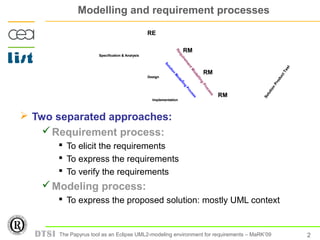
Modelling and requirement processes
 Two separated approaches:
Requirement process:
 To elicit the requirements
 To express the requirements
 To verify the requirements
Modeling process:
 To express the proposed solution: mostly UML context
RE
RM
Specification & Analysis
Design
Implementation
Solution
M
odelling
Process
Requirem
entM
odelling
Process
RM
RM
Solution
ProductTest
RE
RM
Specification & Analysis
Design
Implementation
Solution
M
odelling
Process
Requirem
entM
odelling
Process
RM
RM
Solution
ProductTest
The Papyrus tool as an Eclipse UML2-modeling environment for requirements – MaRK’09 3DTSI
A need to combine the approaches
 Different solutions in the UML-like model-based
approaches:
 SysML [from 2001]
 Integration of requirements in specific modeling:
 Automotive domain (EAST-ADL, MeMVaTEx profiles)
 Generic domain requirement metamodel (CESAR
project)
 Why so many recent propositions in this domain?
 A difficulty to associate models and requirements to
better verify the models
 A need to ensure the requirements for normative
reasons (safety considerations, certification, etc.)
 Uncompleteness of existing approaches & tools:
 UML modelling, Reqtify, DOORS, etc.
 An adaptation of the Papyrus tool for requirement
The Papyrus tool as an Eclipse UML2-modeling environment for requirements – MaRK’09 4DTSI
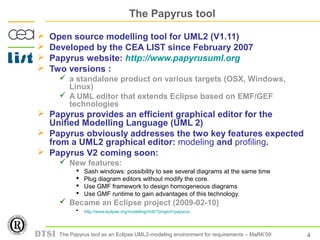
The Papyrus tool
 Open source modelling tool for UML2 (V1.11)
 Developed by the CEA LIST since February 2007
 Papyrus website: http://www.papyrusuml.org
 Two versions :
 a standalone product on various targets (OSX, Windows,
Linux)
 A UML editor that extends Eclipse based on EMF/GEF
technologies
 Papyrus provides an efficient graphical editor for the
Unified Modelling Language (UML 2)
 Papyrus obviously addresses the two key features expected
from a UML2 graphical editor: modeling and profiling.
 Papyrus V2 coming soon:
 New features:
 Sash windows: possibility to see several diagrams at the same time
 Plug diagram editors without modify the core.
 Use GMF framework to design homogeneous diagrams
 Use GMF runtime to gain advantages of this technology.
 Became an Eclipse project (2009-02-10)
 http://www.eclipse.org/modeling/mdt/?project=papyrus
The Papyrus tool as an Eclipse UML2-modeling environment for requirements – MaRK’09 5DTSI
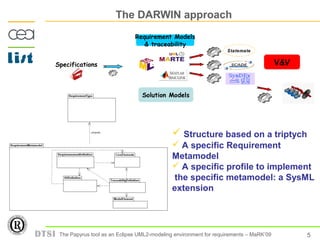
The DARWIN approach
Specifications
Statemate
Solution Models
Requirement Models
& traceability
V&V
 Structure based on a triptych
 A specific Requirement
Metamodel
 A specific profile to implement
the specific metamodel: a SysML
extension
The Papyrus tool as an Eclipse UML2-modeling environment for requirements – MaRK’09 6DTSI
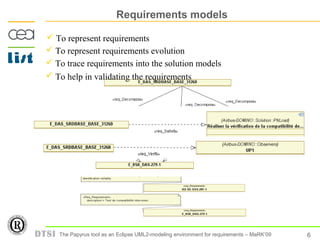
Requirements models
 To represent requirements
 To represent requirements evolution
 To trace requirements into the solution models
 To help in validating the requirements
The Papyrus tool as an Eclipse UML2-modeling environment for requirements – MaRK’09 7DTSI
 New functionalities in Papyrus to manage
requirements in UML-models:
Based on a specific Requirement
Metamodel
Done in Papyrus V1 – In Papyrus V2
 Tested in industrial contexts: automotive,
aeronautic, transportation.
 Some inputs in other related approaches:
EAST-ADL
CESAR
 Relation with safety considerations
Conclusion & Perspectives

04 The Papyrus tool as an Eclipse UML2-modeling environment for requirements

  • 1.
    1CEA LIST –MaRK’09 – 1st of September, 2009 DTSI The Papyrus tool as an Eclipse UML2-modelingThe Papyrus tool as an Eclipse UML2-modeling environment for requirementsenvironment for requirements Hubert DUBOISHubert DUBOIS, Fadoi LAKHAL and Sébastien GERARD, Fadoi LAKHAL and Sébastien GERARD CEA LISTCEA LIST
  • 2.
    The Papyrus toolas an Eclipse UML2-modeling environment for requirements – MaRK’09 2DTSI Modelling and requirement processes  Two separated approaches: Requirement process:  To elicit the requirements  To express the requirements  To verify the requirements Modeling process:  To express the proposed solution: mostly UML context RE RM Specification & Analysis Design Implementation Solution M odelling Process Requirem entM odelling Process RM RM Solution ProductTest RE RM Specification & Analysis Design Implementation Solution M odelling Process Requirem entM odelling Process RM RM Solution ProductTest
  • 3.
    The Papyrus toolas an Eclipse UML2-modeling environment for requirements – MaRK’09 3DTSI A need to combine the approaches  Different solutions in the UML-like model-based approaches:  SysML [from 2001]  Integration of requirements in specific modeling:  Automotive domain (EAST-ADL, MeMVaTEx profiles)  Generic domain requirement metamodel (CESAR project)  Why so many recent propositions in this domain?  A difficulty to associate models and requirements to better verify the models  A need to ensure the requirements for normative reasons (safety considerations, certification, etc.)  Uncompleteness of existing approaches & tools:  UML modelling, Reqtify, DOORS, etc.  An adaptation of the Papyrus tool for requirement
  • 4.
    The Papyrus toolas an Eclipse UML2-modeling environment for requirements – MaRK’09 4DTSI The Papyrus tool  Open source modelling tool for UML2 (V1.11)  Developed by the CEA LIST since February 2007  Papyrus website: http://www.papyrusuml.org  Two versions :  a standalone product on various targets (OSX, Windows, Linux)  A UML editor that extends Eclipse based on EMF/GEF technologies  Papyrus provides an efficient graphical editor for the Unified Modelling Language (UML 2)  Papyrus obviously addresses the two key features expected from a UML2 graphical editor: modeling and profiling.  Papyrus V2 coming soon:  New features:  Sash windows: possibility to see several diagrams at the same time  Plug diagram editors without modify the core.  Use GMF framework to design homogeneous diagrams  Use GMF runtime to gain advantages of this technology.  Became an Eclipse project (2009-02-10)  http://www.eclipse.org/modeling/mdt/?project=papyrus
  • 5.
    The Papyrus toolas an Eclipse UML2-modeling environment for requirements – MaRK’09 5DTSI The DARWIN approach Specifications Statemate Solution Models Requirement Models & traceability V&V  Structure based on a triptych  A specific Requirement Metamodel  A specific profile to implement the specific metamodel: a SysML extension
  • 6.
    The Papyrus toolas an Eclipse UML2-modeling environment for requirements – MaRK’09 6DTSI Requirements models  To represent requirements  To represent requirements evolution  To trace requirements into the solution models  To help in validating the requirements
  • 7.
    The Papyrus toolas an Eclipse UML2-modeling environment for requirements – MaRK’09 7DTSI  New functionalities in Papyrus to manage requirements in UML-models: Based on a specific Requirement Metamodel Done in Papyrus V1 – In Papyrus V2  Tested in industrial contexts: automotive, aeronautic, transportation.  Some inputs in other related approaches: EAST-ADL CESAR  Relation with safety considerations Conclusion & Perspectives