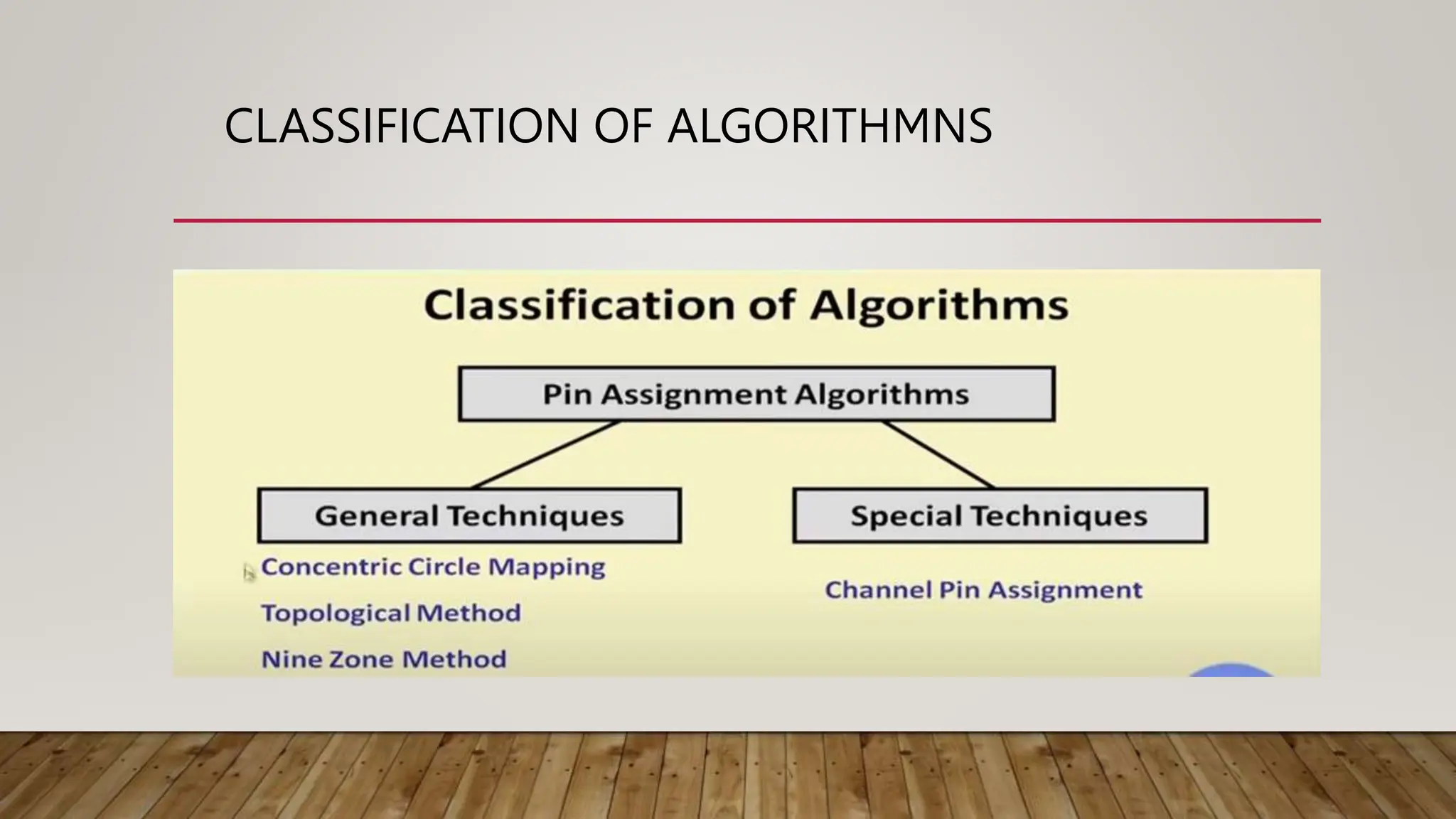
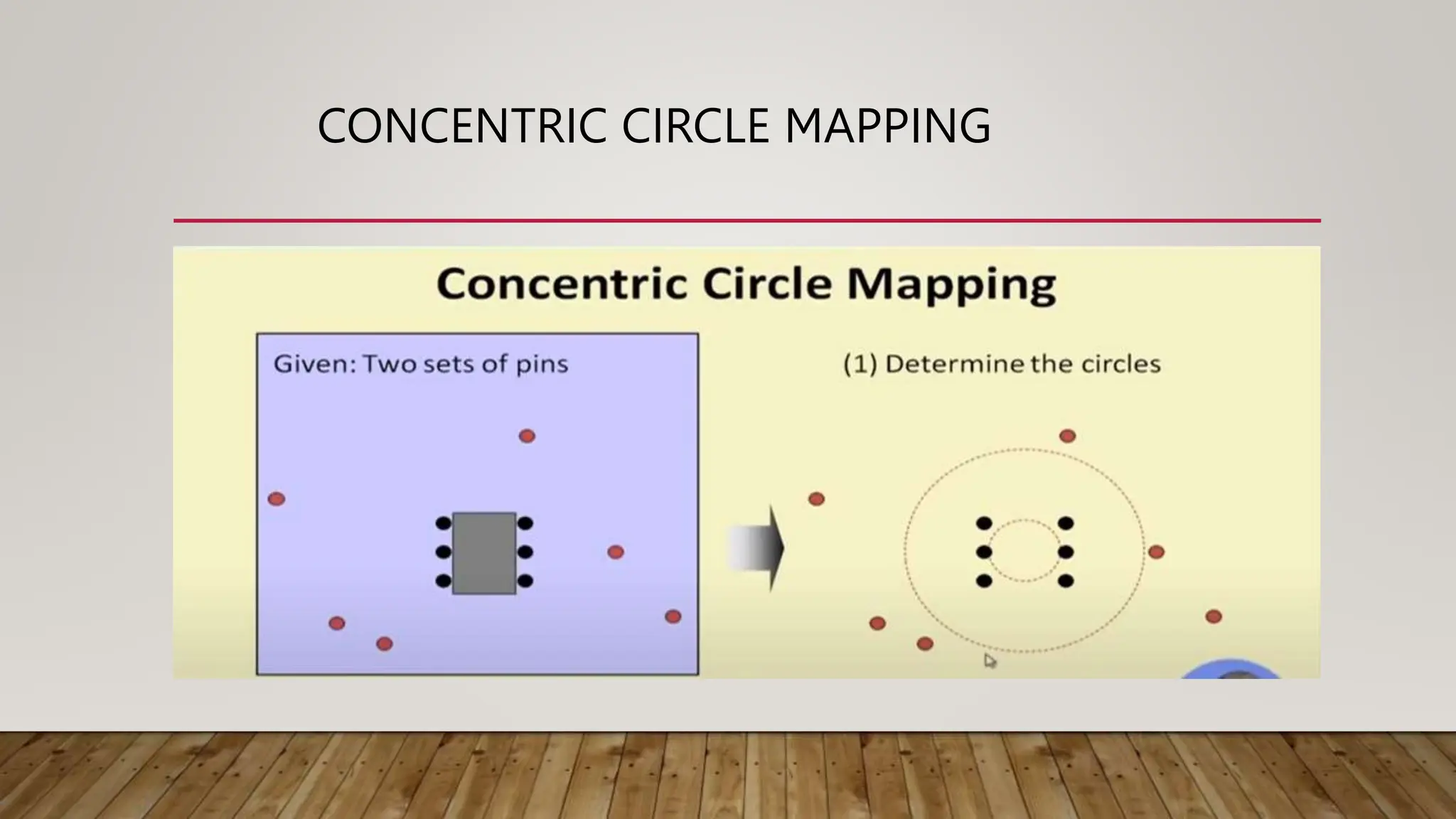
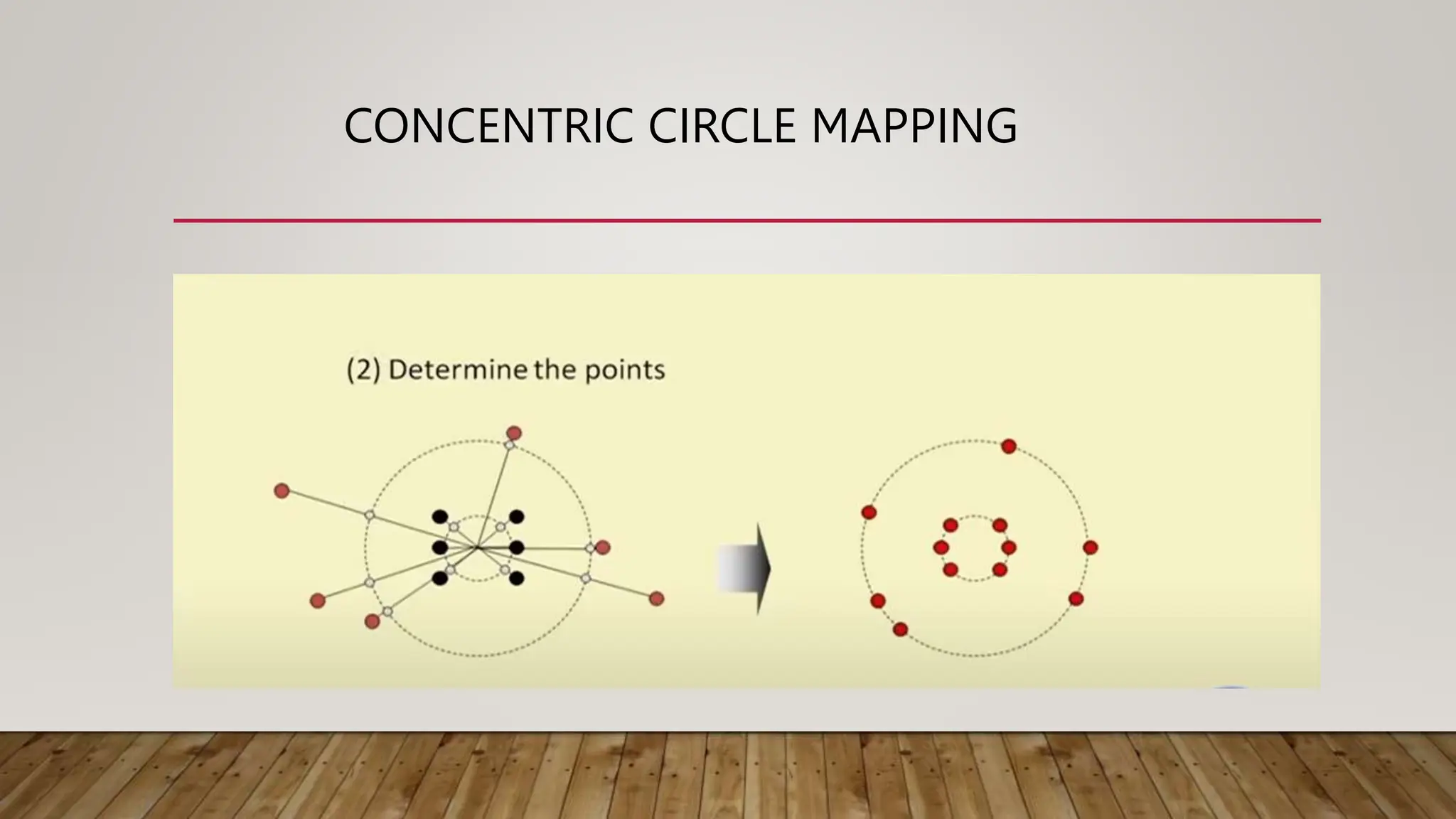
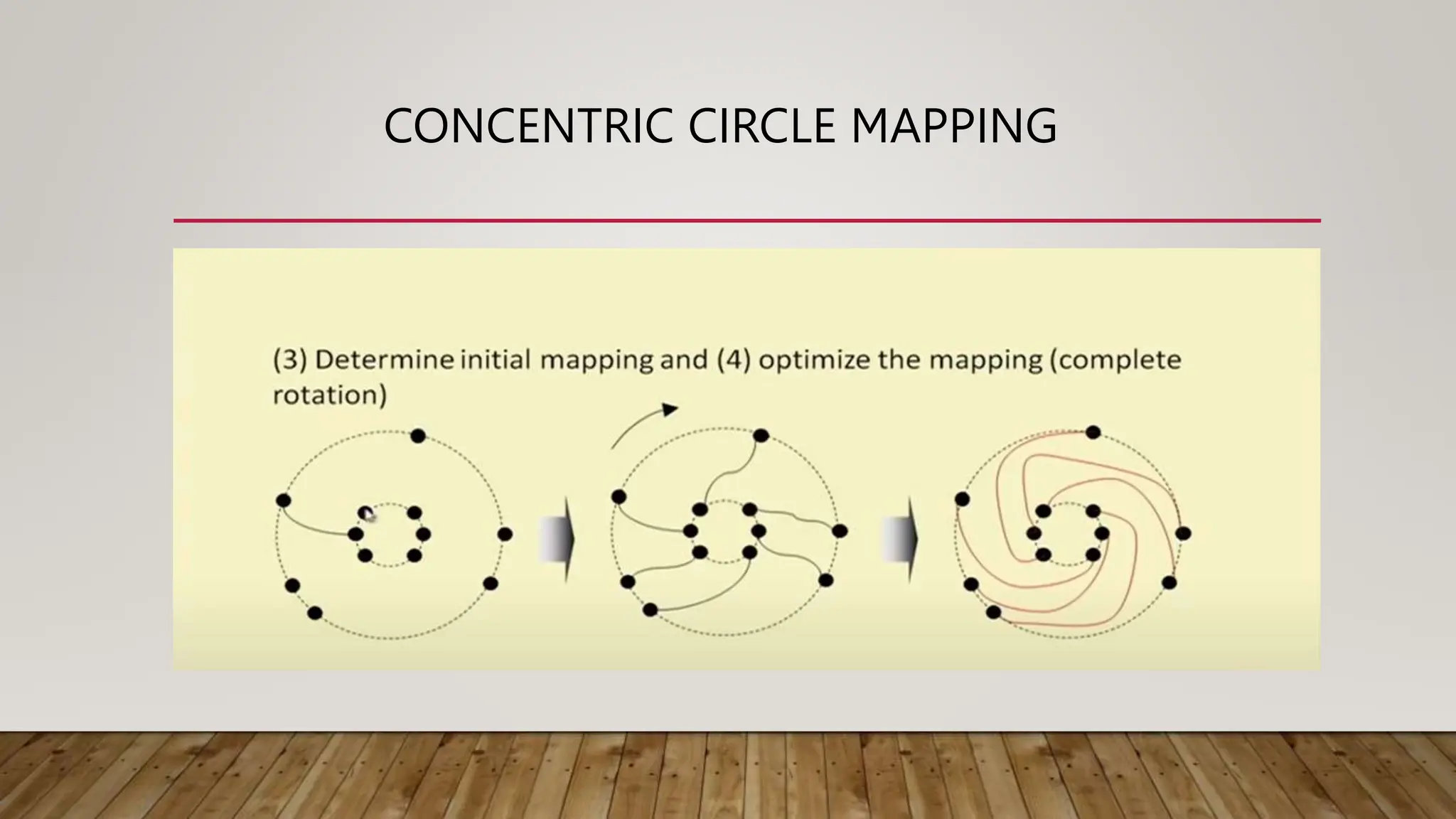
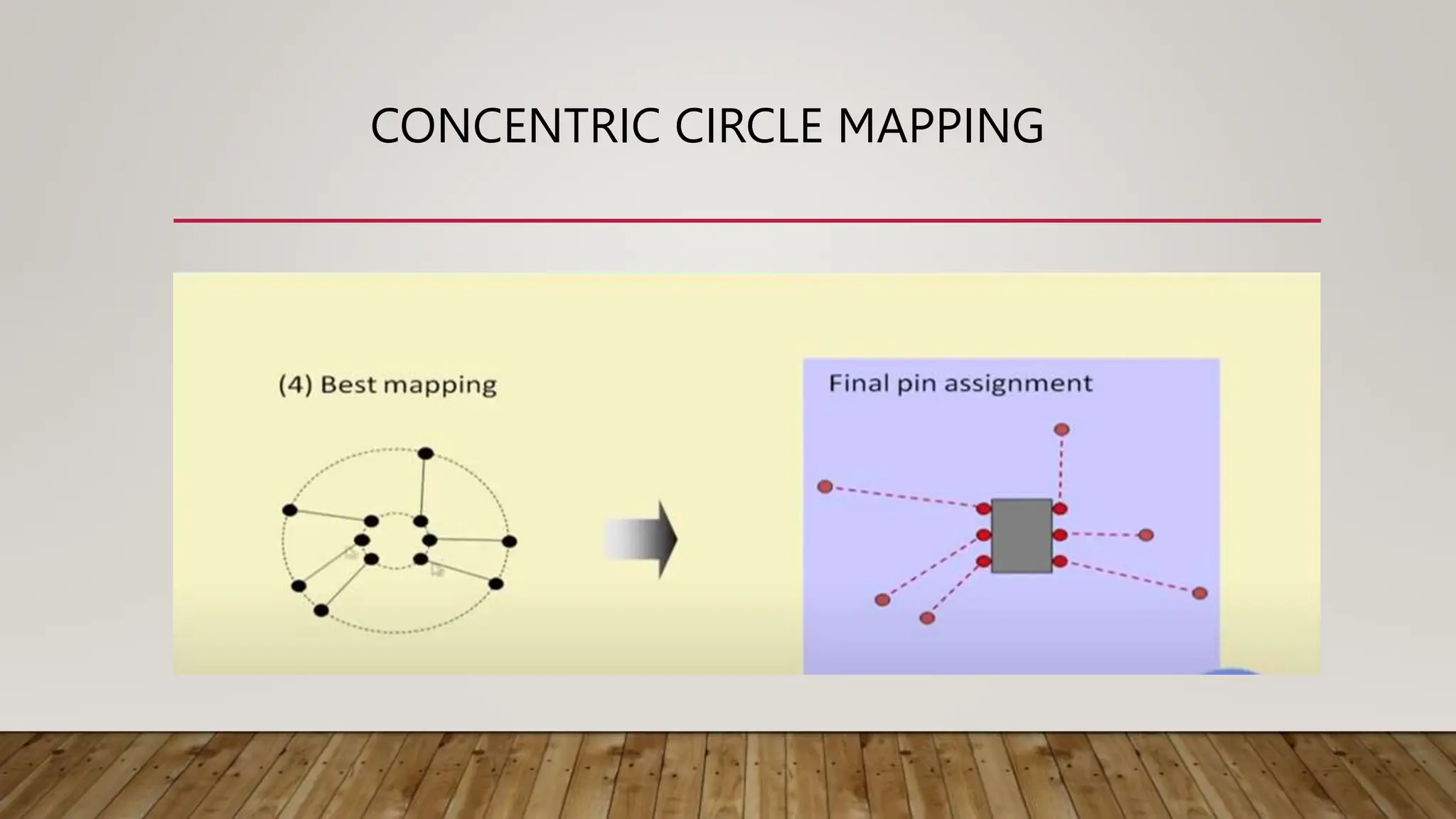
This document discusses pin assignment techniques used during circuit design. It describes pin assignment as defining which signals each pin on a block will receive. The goals are to minimize net length and reduce congestion. Several algorithms are described for performing pin assignment, including concentric circle mapping, topological pin assignment, the nine zone method, and channel pin assignment using dynamic programming.
Introduction to pin assignment, its purpose in signal definition, and relevant stages. Importance in improving block placement.
Details on pin assignment inputs, objectives to minimize net lengths, and problem formulation focused on optimizing net assignments.
Various mapping techniques including concentric circle mapping, topological placement, nine zone method, and channel pin assignment for optimizing chip layout.
INTRODUCTION
• The purposeis to define the signal that each pin will receive.
• It can be done
1.during floorplanning
2.during placement
3.after placement is fixed
• For un-designed blocks, a good assignment of pins improves placement.
• If the blocks are already designed,still some pins can be exchanged.
3.
PIN ASSIGNMENT
Input
A placementof blocks
Number of pins on each block,possibly an ordering.
A netlist
Requirements
To determine the pin locations on the blocks.
Objectives
To minimize net length.
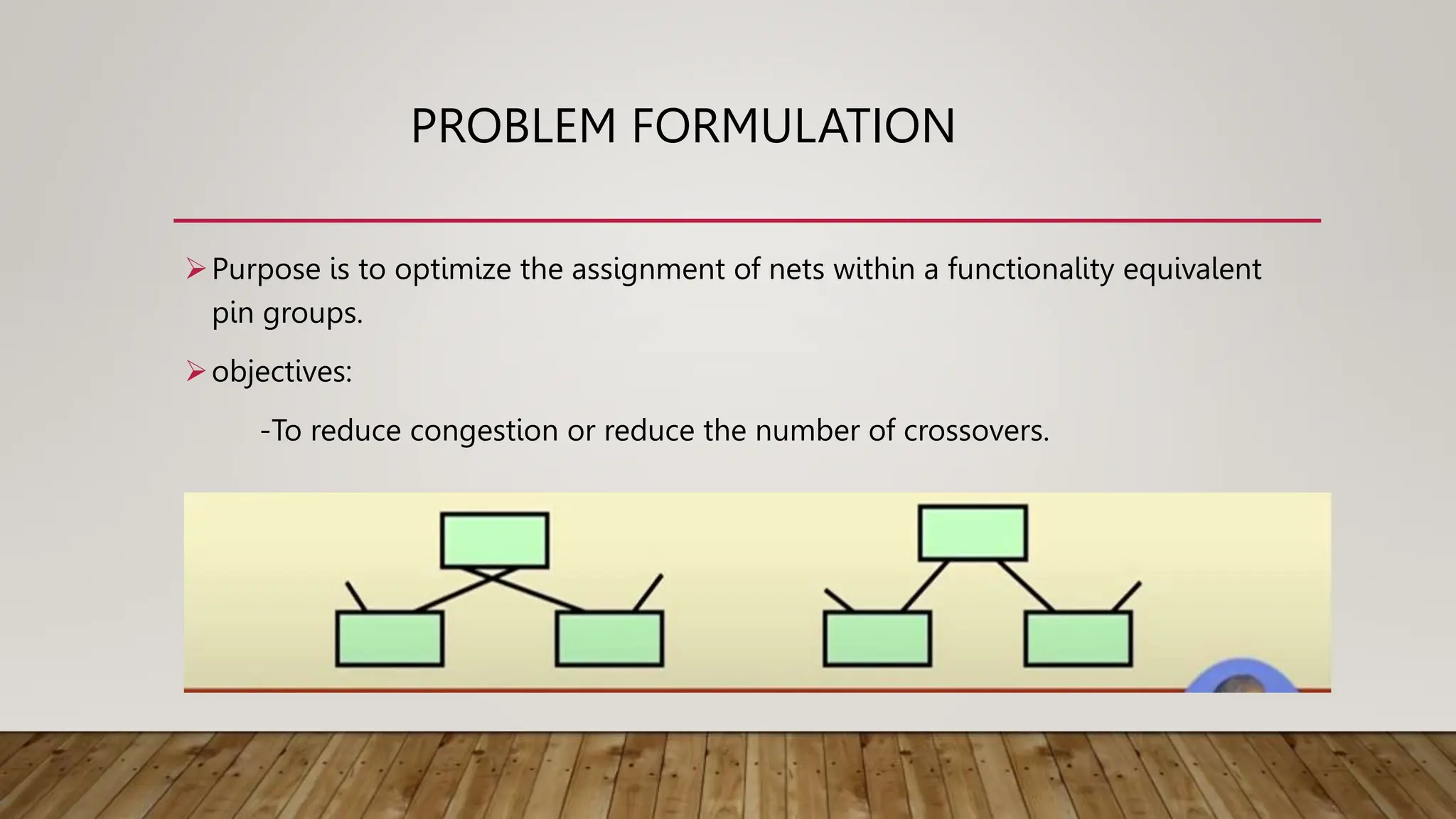
PROBLEM FORMULATION
Purpose isto optimize the assignment of nets within a functionality equivalent
pin groups.
objectives:
-To reduce congestion or reduce the number of crossovers.
TOPOLOGICAL PIN ASSIGNMENT
Similarto concentric circle mapping.
Easier to complete pin assignment.
-when there is interference from other compounds and barriers.
- for nets connected to more than two pins.
If a net has been assigned to more than two pins,then the pin closest to the
center of the primary component is chosen.
Beginning at the bottom of the circle and moving clockwise,the pins are assigned
to nets.
12.
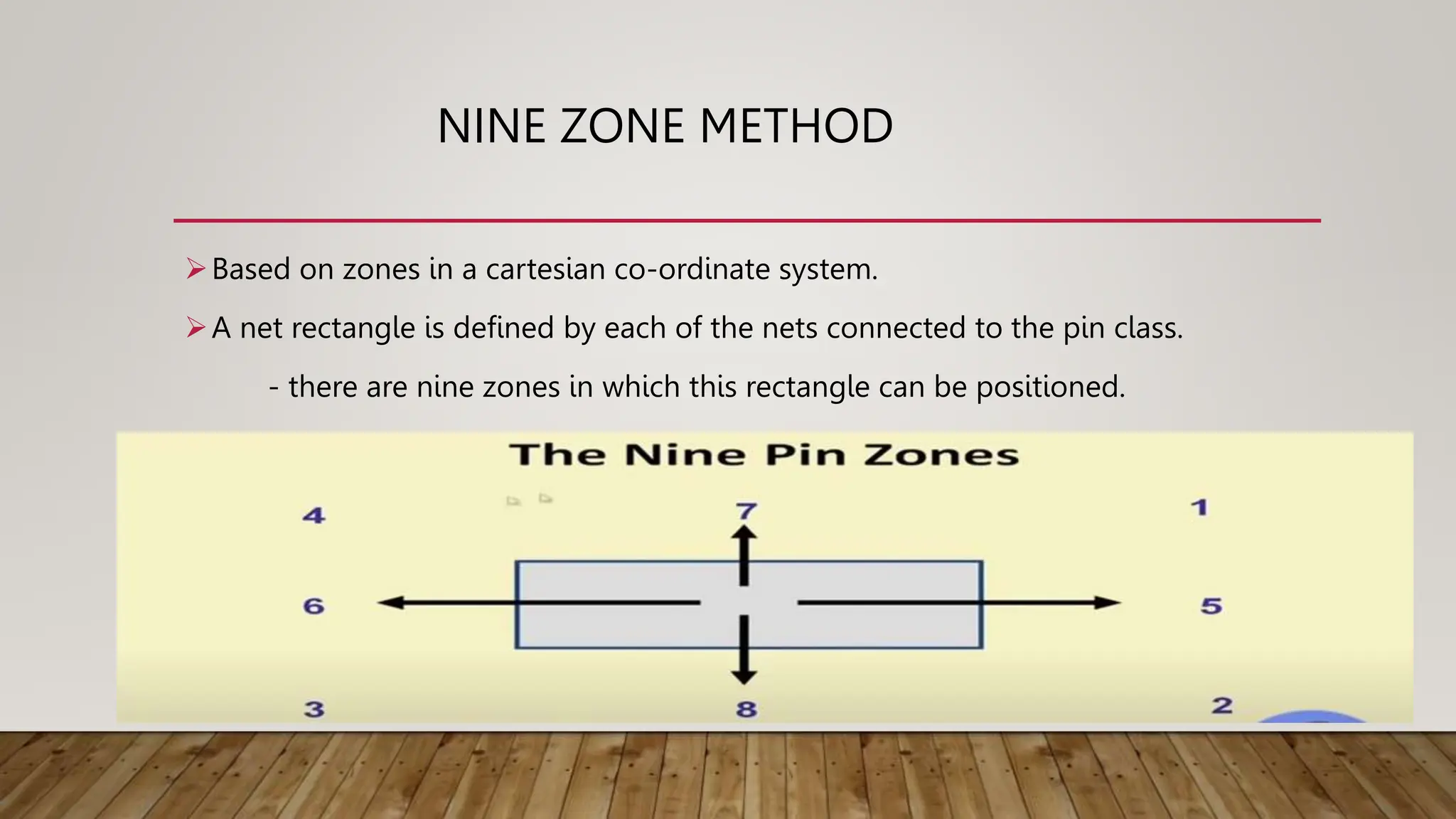
NINE ZONE METHOD
Basedon zones in a cartesian co-ordinate system.
A net rectangle is defined by each of the nets connected to the pin class.
- there are nine zones in which this rectangle can be positioned.
13.
CHANNEL PIN ASSIGNMENT
Asignificant portion of the chip area is used for channel routing .
- after the placement phase,the position of terminals on the boundaries of a
block are not fixed.
-they may be moved before routing begins.
yang & wong proposed a dynamic programming formulation to the channel pin
assignment problem.