PARTURITION is defined as the process of bringing forth of
young which comprises of multiple transformations in
both uterine and cervical functions
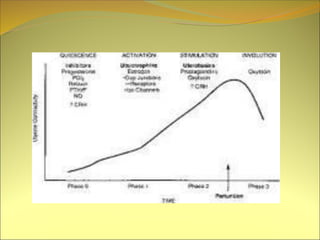
There are four phases :
 Quiescence
 Activation phase
 Stimulation phase
 Involution phase.
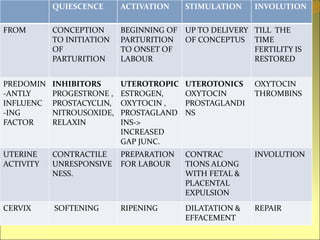
PHASES OF PARTURITION
QUIESCENCE ACTIVATION STIMULATION INVOLUTION
FROM CONCEPTION
TO INITIATION
OF
PARTURITION
BEGINNING OF
PARTURITION
TO ONSET OF
LABOUR
UP TO DELIVERY
OF CONCEPTUS
TILL THE
TIME
FERTILITY IS
RESTORED
PREDOMIN
-ANTLY
INFLUENC
-ING
FACTOR
INHIBITORS
PROGESTRONE ,
PROSTACYCLIN,
NITROUSOXIDE,
RELAXIN
UTEROTROPIC
ESTROGEN,
OXYTOCIN ,
PROSTAGLAND
INS->
INCREASED
GAP JUNC.
UTEROTONICS
OXYTOCIN
PROSTAGLANDI
NS
OXYTOCIN
THROMBINS
UTERINE
ACTIVITY
CONTRACTILE
UNRESPONSIVE
NESS.
PREPARATION
FOR LABOUR
CONTRAC
TIONS ALONG
WITH FETAL &
PLACENTAL
EXPULSION
INVOLUTION
CERVIX SOFTENING RIPENING DILATATION &
EFFACEMENT
REPAIR
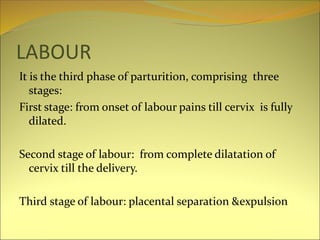
LABOUR
It is the third phase of parturition, comprising three
stages:
First stage: from onset of labour pains till cervix is fully
dilated.
Second stage of labour: from complete dilatation of
cervix till the delivery.
Third stage of labour: placental separation &expulsion
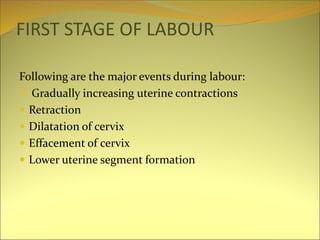
FIRST STAGE OF LABOUR
Following are the major events during labour:
 Gradually increasing uterine contractions
 Retraction
 Dilatation of cervix
 Effacement of cervix
 Lower uterine segment formation
UTERINE CONTRACTIONS IN
LABOUR
Characteristics of normal uterine contractions:
 Pace maker: situated in the region of tubal ostia from where
wave of contraction spread downwards.
Sometimes there is emergence of multiple pace maker foci
leading to less efficient contractions and hence causing
primary dysfunction labour
 Fundal dominance with gradual diminishing contractions
towards the lower segment.
 Polarity of uterus : when upper segment contracts, retracts
and pushes the fetus down the lower uterine segment and
cervix dilates in response.
Lack of fundal dominance and the reverse polarity leads to
spastic lower uterine segment. Here pacemaker does not
work in rhythm.
 Good synchronization of contraction waves from
both sides of uterus.
 Regular pattern of contractions
 Good relaxation in between the contractions
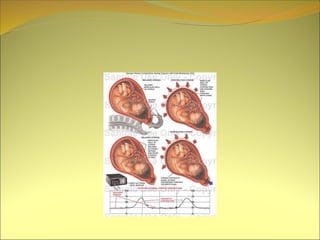
 Intra amniotic pressure during relaxation is 8mm
rising beyond 20mm during contraction
INTENSITY: describes degree of uterine systole.
increases with progress of labour.Maximum during 2nd
stage of labour
DURATION: initially last for 10-15 seconds gradually
increases up to 40-45 sec.
FREQUENCY: in the early stage of labour, contractions
come at the interval of 10-15min and increases to maximum
in 2nd stage of labour.
Clinically contractions are said to be good when they come
after interval of 3-5minutes and at the height of
contractions uterine wall can not be indented by fingers.
TONUS : intra uterine pressure in between the
contractions.
During Quiscent stage- 2-3mm Hg
During first stage of labour 8-10mmHg.
Factors governing tonus are:
 Contractility of uterine muscles
 Intra abdominal pressure
 Over distension of uterus as in twins and
hydramnios.
If the intensity diminishes, duration is shortened and
period between the increases it leads to hypotonic
uterine dysfunction. Here intrauterine pressure
during the contractions remains below 25mm of Hg.
if there is increased frequency and duration without
adequate relaxation in between it leads to inco-
ordinate uterine action.
It comprises a rise in the base line tone which and hence
diminishing the circulation in the intervillous space of
placenta
LABOUR PAINS
Pain during contractions is along the cutaneous nerve
distribution of T10 to L1
Pain of cervical dilatation is radiated to back through sacral
plexus
Causes of pain:
 Myometrial hypoxia
 Streching of peritonium over the fundus
 Streching of cervix during dilatation
 Compression of nerve ganglia
Retraction
Permanent shortening of uterine muscle.
net effects are :
 Formation of lower uterine segment.
 Maintain advancement of presenting part made during
contractions
 Reduce the surface area of uterus and hence favouring
placental separation.
 Effective haemostasis after separation of placenta.
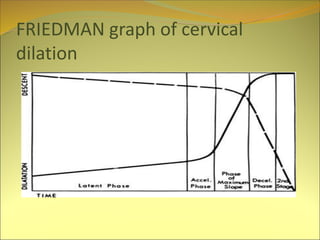
FRIEDMAN graph of cervical
dilation
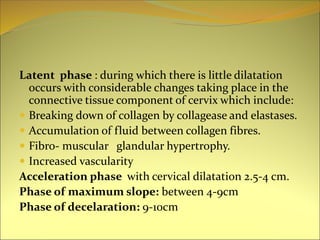
Latent phase : during which there is little dilatation
occurs with considerable changes taking place in the
connective tissue component of cervix which include:
 Breaking down of collagen by collagease and elastases.
 Accumulation of fluid between collagen fibres.
 Fibro- muscular glandular hypertrophy.
 Increased vascularity
Acceleration phase with cervical dilatation 2.5-4 cm.
Phase of maximum slope: between 4-9cm
Phase of decelaration: 9-10cm
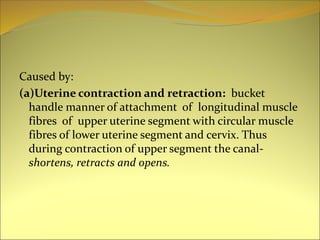
Caused by:
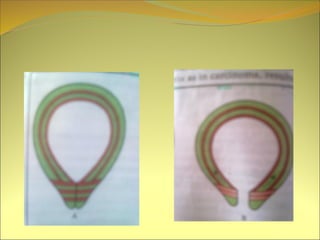
(a)Uterine contraction and retraction: bucket
handle manner of attachment of longitudinal muscle
fibres of upper uterine segment with circular muscle
fibres of lower uterine segment and cervix. Thus
during contraction of upper segment the canal-
shortens, retracts and opens.
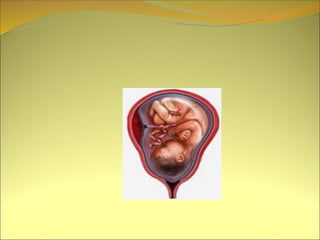
(b)Bag of membranes : during labour the membranes
attached to the lower uterine segment are detached
herniation of membranes through the cervical canal
due to ball valve action of well flexed head, during uterine
contraction hydrostaic pressure in forewaters increases
cervical dilatation
Fetal axis pressure: contractions of circular muscles of
body of uterus
Straightening of vertebral column of fetus
Fundal contractions transmit through podalic pole in to
fetal axis
Mechanical streching of lower uterine segment and
opening of cervical canal
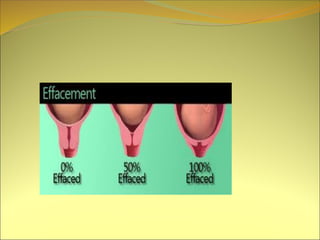
Effacement of cervix
Muscular Fibres of cervix are pulled upwards and merge with
lower uterine segment.
Effacement precedes the dilatation in primegravidae
While it occurs simultaneously with dilatation in multiparae
Lower uterine segment formation
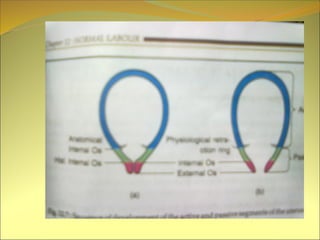
 During labour lower uterine segment is demarcated by
physiological retraction ring above and fibromuscular
junction of cervix and uterus below.
 formed maximally during labour.
 7.5-10 cm when fully formed and cylindrical during 2nd
stage of labour
 Poor retractile property as compared to upper uterine
segment.
 gradual thinning of lower uterine segment due to
relaxation of its muscle fibres to allow elongation and
descent of presenting part
 1)implantation of placenta of in lower uterine segment
leads to placenta praevia.
 2)poor decidual reaction in this segment facilitates
morbid adherent placenta.
 3)lower segment is entirely the passive segment of
uterus. Because of poor retractile property,there is
chance of post partum haemorrhage if placenta is
implanted over the area.
 Uterine tetany: when there is no physiological
differentiation between upper active and lower passive
segment of uterus whole of the uterus goes in to a
tonic muscular spasm holding the fetus inside.
 Poor decidual reaction in this segments facilitates
morbid adherent placenta if implanted here
 Poor retractile property leads to post partum
haemorrhage.
SECOND STAGE OF LABOUR
It two phases:
 (a)propulsive: from full dilatation until head
touches the pelvic floor.
 (b)expulsive: since the time there is irresistible
maternal desire to bear down until the baby is
delivered .
Factors leading to expulsion of fetus from uterine cavity are :
 Reduced volume due to escape of large amount of amniotic
fluid.
 Elongation of uterus due to contraction of circular muscle
fibers keeping the fetal axis straight.
 Reduced transverse or anterioposterior diameter.
 Downward thurst offered by uterine contractions
supplimented by voluntary contractions of abdominal
muscle.
 Retraction of uterus which counterbalance the resistance
offered by pelvic floor.
Third stage of labour
It comprises expulsion of placenta with membranes
SEPERATION OF PLACENTA: due to shearing force
instituted between the placenta and placental site due to
marked reduction in the surface area in the placental site
and inelasticity of placenta.
PLANE OF SEPERATION: runs through spongy layer of
decidua basalis.
METHODS OF SEPERATION :
Marginal separation Of Placenta(Mathew Duncan):
more frequent . Separation starts at the margins as it is
mostly unsupported.
Central separation (Schultze): detachment starts at
centre with opening of few uterine sinuses and
collection of retroplacental haematoma. Gradually due
to weight of placenta and retroplacental blood
collection more and more placenta separates.
 SEPARATION OF MEMBRANES: The membranes in
the upper part are thrown in to folds while those in the
lower part are already detached due to stretching.
 Expulsion of placenta : After complete separation the
placenta is forced in to the lower uterine segment and
then in the vagina.
 Complete expulsion occures due bearing down efforts
of by manual procedure.
HAEMOSTASIS
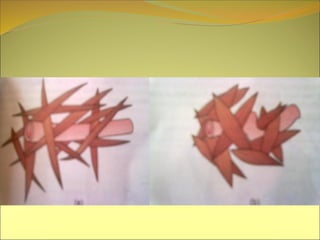
 Living ligature : as the arterioles pass tortuously through
interlacing intermediate layers of myometrium they are
actually clamped during uterine contractions.
 Thrombosis: occlude torn sinuses as pregnancy is
hypercoagulation state.
 Myotamponade: apposition of walls of uterus after
expulsion of placenta.
THANK YOU

physiologyofnormallabour in pregnancy...

  • 2.
    PARTURITION is definedas the process of bringing forth of young which comprises of multiple transformations in both uterine and cervical functions There are four phases :  Quiescence  Activation phase  Stimulation phase  Involution phase.
  • 3.
    PHASES OF PARTURITION QUIESCENCEACTIVATION STIMULATION INVOLUTION FROM CONCEPTION TO INITIATION OF PARTURITION BEGINNING OF PARTURITION TO ONSET OF LABOUR UP TO DELIVERY OF CONCEPTUS TILL THE TIME FERTILITY IS RESTORED PREDOMIN -ANTLY INFLUENC -ING FACTOR INHIBITORS PROGESTRONE , PROSTACYCLIN, NITROUSOXIDE, RELAXIN UTEROTROPIC ESTROGEN, OXYTOCIN , PROSTAGLAND INS-> INCREASED GAP JUNC. UTEROTONICS OXYTOCIN PROSTAGLANDI NS OXYTOCIN THROMBINS UTERINE ACTIVITY CONTRACTILE UNRESPONSIVE NESS. PREPARATION FOR LABOUR CONTRAC TIONS ALONG WITH FETAL & PLACENTAL EXPULSION INVOLUTION CERVIX SOFTENING RIPENING DILATATION & EFFACEMENT REPAIR
  • 5.
    LABOUR It is thethird phase of parturition, comprising three stages: First stage: from onset of labour pains till cervix is fully dilated. Second stage of labour: from complete dilatation of cervix till the delivery. Third stage of labour: placental separation &expulsion
  • 6.
    FIRST STAGE OFLABOUR Following are the major events during labour:  Gradually increasing uterine contractions  Retraction  Dilatation of cervix  Effacement of cervix  Lower uterine segment formation
  • 7.
    UTERINE CONTRACTIONS IN LABOUR Characteristicsof normal uterine contractions:  Pace maker: situated in the region of tubal ostia from where wave of contraction spread downwards. Sometimes there is emergence of multiple pace maker foci leading to less efficient contractions and hence causing primary dysfunction labour  Fundal dominance with gradual diminishing contractions towards the lower segment.  Polarity of uterus : when upper segment contracts, retracts and pushes the fetus down the lower uterine segment and cervix dilates in response. Lack of fundal dominance and the reverse polarity leads to spastic lower uterine segment. Here pacemaker does not work in rhythm.
  • 8.
     Good synchronizationof contraction waves from both sides of uterus.  Regular pattern of contractions  Good relaxation in between the contractions  Intra amniotic pressure during relaxation is 8mm rising beyond 20mm during contraction
  • 10.
    INTENSITY: describes degreeof uterine systole. increases with progress of labour.Maximum during 2nd stage of labour DURATION: initially last for 10-15 seconds gradually increases up to 40-45 sec. FREQUENCY: in the early stage of labour, contractions come at the interval of 10-15min and increases to maximum in 2nd stage of labour. Clinically contractions are said to be good when they come after interval of 3-5minutes and at the height of contractions uterine wall can not be indented by fingers.
  • 11.
    TONUS : intrauterine pressure in between the contractions. During Quiscent stage- 2-3mm Hg During first stage of labour 8-10mmHg. Factors governing tonus are:  Contractility of uterine muscles  Intra abdominal pressure  Over distension of uterus as in twins and hydramnios.
  • 12.
    If the intensitydiminishes, duration is shortened and period between the increases it leads to hypotonic uterine dysfunction. Here intrauterine pressure during the contractions remains below 25mm of Hg. if there is increased frequency and duration without adequate relaxation in between it leads to inco- ordinate uterine action. It comprises a rise in the base line tone which and hence diminishing the circulation in the intervillous space of placenta
  • 13.
    LABOUR PAINS Pain duringcontractions is along the cutaneous nerve distribution of T10 to L1 Pain of cervical dilatation is radiated to back through sacral plexus Causes of pain:  Myometrial hypoxia  Streching of peritonium over the fundus  Streching of cervix during dilatation  Compression of nerve ganglia
  • 14.
    Retraction Permanent shortening ofuterine muscle. net effects are :  Formation of lower uterine segment.  Maintain advancement of presenting part made during contractions  Reduce the surface area of uterus and hence favouring placental separation.  Effective haemostasis after separation of placenta.
  • 15.
    FRIEDMAN graph ofcervical dilation
  • 16.
    Latent phase :during which there is little dilatation occurs with considerable changes taking place in the connective tissue component of cervix which include:  Breaking down of collagen by collagease and elastases.  Accumulation of fluid between collagen fibres.  Fibro- muscular glandular hypertrophy.  Increased vascularity Acceleration phase with cervical dilatation 2.5-4 cm. Phase of maximum slope: between 4-9cm Phase of decelaration: 9-10cm
  • 17.
    Caused by: (a)Uterine contractionand retraction: bucket handle manner of attachment of longitudinal muscle fibres of upper uterine segment with circular muscle fibres of lower uterine segment and cervix. Thus during contraction of upper segment the canal- shortens, retracts and opens.
  • 19.
    (b)Bag of membranes: during labour the membranes attached to the lower uterine segment are detached herniation of membranes through the cervical canal due to ball valve action of well flexed head, during uterine contraction hydrostaic pressure in forewaters increases cervical dilatation
  • 21.
    Fetal axis pressure:contractions of circular muscles of body of uterus Straightening of vertebral column of fetus Fundal contractions transmit through podalic pole in to fetal axis Mechanical streching of lower uterine segment and opening of cervical canal
  • 22.
    Effacement of cervix MuscularFibres of cervix are pulled upwards and merge with lower uterine segment. Effacement precedes the dilatation in primegravidae While it occurs simultaneously with dilatation in multiparae
  • 24.
    Lower uterine segmentformation  During labour lower uterine segment is demarcated by physiological retraction ring above and fibromuscular junction of cervix and uterus below.  formed maximally during labour.  7.5-10 cm when fully formed and cylindrical during 2nd stage of labour  Poor retractile property as compared to upper uterine segment.  gradual thinning of lower uterine segment due to relaxation of its muscle fibres to allow elongation and descent of presenting part
  • 25.
     1)implantation ofplacenta of in lower uterine segment leads to placenta praevia.  2)poor decidual reaction in this segment facilitates morbid adherent placenta.  3)lower segment is entirely the passive segment of uterus. Because of poor retractile property,there is chance of post partum haemorrhage if placenta is implanted over the area.
  • 27.
     Uterine tetany:when there is no physiological differentiation between upper active and lower passive segment of uterus whole of the uterus goes in to a tonic muscular spasm holding the fetus inside.  Poor decidual reaction in this segments facilitates morbid adherent placenta if implanted here  Poor retractile property leads to post partum haemorrhage.
  • 28.
    SECOND STAGE OFLABOUR It two phases:  (a)propulsive: from full dilatation until head touches the pelvic floor.  (b)expulsive: since the time there is irresistible maternal desire to bear down until the baby is delivered .
  • 29.
    Factors leading toexpulsion of fetus from uterine cavity are :  Reduced volume due to escape of large amount of amniotic fluid.  Elongation of uterus due to contraction of circular muscle fibers keeping the fetal axis straight.  Reduced transverse or anterioposterior diameter.  Downward thurst offered by uterine contractions supplimented by voluntary contractions of abdominal muscle.  Retraction of uterus which counterbalance the resistance offered by pelvic floor.
  • 30.
    Third stage oflabour It comprises expulsion of placenta with membranes SEPERATION OF PLACENTA: due to shearing force instituted between the placenta and placental site due to marked reduction in the surface area in the placental site and inelasticity of placenta. PLANE OF SEPERATION: runs through spongy layer of decidua basalis.
  • 31.
    METHODS OF SEPERATION: Marginal separation Of Placenta(Mathew Duncan): more frequent . Separation starts at the margins as it is mostly unsupported. Central separation (Schultze): detachment starts at centre with opening of few uterine sinuses and collection of retroplacental haematoma. Gradually due to weight of placenta and retroplacental blood collection more and more placenta separates.
  • 32.
     SEPARATION OFMEMBRANES: The membranes in the upper part are thrown in to folds while those in the lower part are already detached due to stretching.  Expulsion of placenta : After complete separation the placenta is forced in to the lower uterine segment and then in the vagina.  Complete expulsion occures due bearing down efforts of by manual procedure.
  • 33.
    HAEMOSTASIS  Living ligature: as the arterioles pass tortuously through interlacing intermediate layers of myometrium they are actually clamped during uterine contractions.  Thrombosis: occlude torn sinuses as pregnancy is hypercoagulation state.  Myotamponade: apposition of walls of uterus after expulsion of placenta.
  • 35.