Series of events that take place in the genital organs in an effort to expel the viable
products of conception (fetus, placenta and the membranes) out of the womb through the vagina
into the outer world is called Labor. It may occur prior to 37 completed weeks, when it is called the
preterm labor. Expulsion of a previable live fetus occurs through the same process but in a miniature
form and is called mini-labor. Labor is characterized by the presence of regular uterine contractions with
effacement and dilatation of the cervix and fetal descent. A parturient is a patient in labor and parturition
is the process of giving birth. Delivery is the expulsion or extraction of a viable fetus out of the womb.
It is not synonymous with labor; delivery can take place without labor as in elective cesarean section.
Delivery may be vaginal, either spontaneous or aided, or it may be abdominal.
NORMAL LABOR (EUTOCIA): Labor is called normal if it fulfills the following criteria. (1) Sponta
neous in onset and at term. (2) With vertex presentation. (3) Without undue prolongation. (4) Natural
termination with minimal aids. (5) Without having any complications affecting the health of the mother
and/or the baby.
ABNORMAL LABOR (DYSTOCIA): Any deviation from the definition of normal labor is called
Abnormal labor. Thus, labor in a case with presentation other than vertex or having some complications
even with vertex presentation affecting the course of labor or modifying the nature of termination or
adversely affecting the maternal and/or fetal prognosis is called abnormal labor.
DATE OF ONSET OF LABOR: It is very much unpredictable to foretell precisely the exact date of onset
of labor. It not only varies from case to case but even in different pregnancies of the same individual.
Calculation based on Naegele’s formula can only give a rough guide.
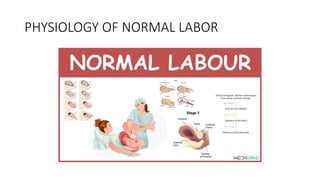
PHYSIOLOGY OF NORMAL LABOR
During pregnancy there is marked hypertrophy and hyperplasia of the uterine muscle and the
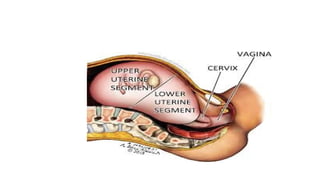
enlargement of the uterus. At term, the length of the uterus measures about 35 cm including cervix. The
fundus is wider both transversely and anteroposteriorly than the lower segment. The uterus assumes
pyriform or ovoid shape. The cervical canal is occluded by a thick, tenacious and mucus plug.
UTERINE CONTRACTION IN LABOR: Throughout pregnancy there is irregular involuntary spasmodic
uterine contractions which are painless (Braxton Hicks) and have no effect on dilatation of the cervix
Tonus: It is the intrauterine pressure in between contractions. During pregnancy, as the uterus is quiescent
(inactive), the tonus is of 2–3 mm Hg. During the first stage of labor, it varies from 8 mm Hg to 10 mm Hg. It is
inversely proportional to relaxation. The factors which govern the tonus are: (i) Contractility of uterine muscles,
(ii) intra-abdominal pressure, and (iii) overdistension of uterus as in twins and hydramnios.
. Probable causes of pain are:
(a) Myometrial hypoxia during contractions