Physics 121: Electricity &
Magnetism – Lecture 13
E-M Oscillations and AC Current
Dale E. Gary
Wenda Cao
NJIT Physics Department
December 5, 2007
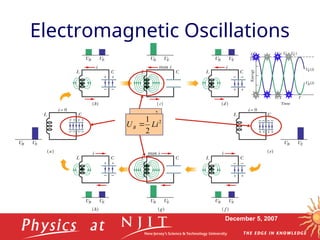
Electromagnetic Oscillations
C
q
UE
2
2
 2
2
1
Li
UB  C
q
UE
2
2
 2
2
1
Li
UB 
December 5, 2007
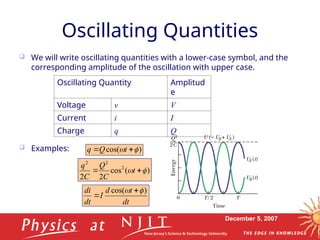
Oscillating Quantities
 We will write oscillating quantities with a lower-case symbol, and the
corresponding amplitude of the oscillation with upper case.
 Examples:
Oscillating Quantity Amplitud
e
Voltage v V
Current i I
Charge q Q
)
cos( 
 
 t
Q
q
)
(
cos
2
2
2
2
2

 
 t
C
Q
C
q
dt
t
d
I
dt
di )
cos( 
 

December 5, 2007
Derivation of Oscillation
Frequency
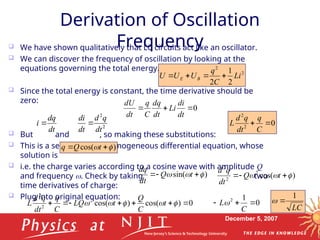
 We have shown qualitatively that LC circuits act like an oscillator.
 We can discover the frequency of oscillation by looking at the
equations governing the total energy.
 Since the total energy is constant, the time derivative should be
zero:
 But and , so making these substitutions:
 This is a second-order, homogeneous differential equation, whose
solution is
 i.e. the charge varies according to a cosine wave with amplitude Q
and frequency . Check by taking two
time derivatives of charge:
 Plug into original equation:
2
2
2
1
2
Li
C
q
U
U
U B
E 



0



dt
di
Li
dt
dq
C
q
dt
dU
dt
dq
i  2
2
dt
q
d
dt
di
 0
2
2


C
q
dt
q
d
L
)
cos( 
 
 t
Q
q
)
sin( 

 

 t
Q
dt
dq
)
cos(
2
2
2


 

 t
Q
dt
q
d
0
)
cos(
)
cos(
2
2
2






 



 t
C
Q
t
LQ
C
q
dt
q
d
L 0
1
2



C
L
LC
1


dt
dq
i  2
2
dt
q
d
dt
di

December 5, 2007
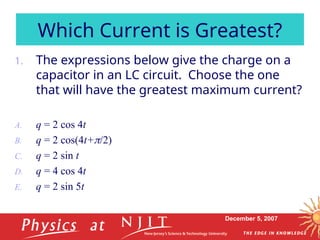
1. The expressions below give the charge on a
capacitor in an LC circuit. Choose the one
that will have the greatest maximum current?
A. q = 2 cos 4t
B. q = 2 cos(4t+/2)
C. q = 2 sin t
D. q = 4 cos 4t
E. q = 2 sin 5t
Which Current is Greatest?
December 5, 2007
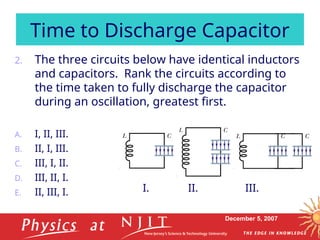
2. The three circuits below have identical inductors
and capacitors. Rank the circuits according to
the time taken to fully discharge the capacitor
during an oscillation, greatest first.
A. I, II, III.
B. II, I, III.
C. III, I, II.
D. III, II, I.
E. II, III, I.
Time to Discharge Capacitor
I. II. III.
December 5, 2007
Charge, Current & Energy
Oscillations
 The solution to the equation is , which gives
the charge oscillation.
 From this, we can determine the corresponding oscillation of current:
 And energy
 But recall that , so .
 That is why our graph for the energy oscillation
had the same amplitude for both UE and UB.
 Note that
)
cos( 
 
 t
Q
q
0
2
2


C
q
dt
q
d
L
)
sin( 

 


 t
Q
dt
dq
i
)
(
cos
2
2
2
2
2

 

 t
C
Q
C
q
UE
)
(
sin
2
1
2
1 2
2
2
2


 

 t
LQ
Li
UB
LC
1

 )
(
sin
2
2
2

 
 t
C
Q
UB
C
Q
t
t
C
Q
U
U B
E
2
)]
(
sin
)
(
[cos
2
2
2
2
2





 



Constant
December 5, 2007
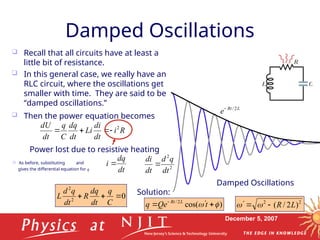
Damped Oscillations
 Recall that all circuits have at least a
little bit of resistance.
 In this general case, we really have an
RLC circuit, where the oscillations get
smaller with time. They are said to be
“damped oscillations.”
Damped Oscillations
 Then the power equation becomes
L
Rt
e 2
/

R
i
dt
di
Li
dt
dq
C
q
dt
dU 2




Power lost due to resistive heating
 As before, substituting and
gives the differential equation for q dt
dq
i  2
2
dt
q
d
dt
di

0
2
2



C
q
dt
dq
R
dt
q
d
L
2
2
)
2
/
( L
R


 

)
cos(
2
/

 

 
t
Qe
q L
Rt
Solution:
December 5, 2007
3. How does the resonant frequency  for an
ideal LC circuit (no resistance) compare with
’ for a non-ideal one where resistance
cannot be ignored?
A. The resonant frequency for the non-ideal circuit is
higher than for the ideal one (’ > ).
B. The resonant frequency for the non-ideal circuit is
lower than for the ideal one (’ < ).
C. The resistance in the circuit does not affect the
resonant frequency—they are the same (’ = ).
Resonant Frequency
December 5, 2007
Alternating Current
 The electric power out of a home or office power socket is in the form of
alternating current (AC), as opposed to the direct current (DC) of a battery.
 Alternating current is used because it is easier to transport, and easier to
“transform” from one voltage to another using a transformer.
 In the U.S., the frequency of oscillation of AC is 60 Hz. In most other
countries it is 50 Hz.
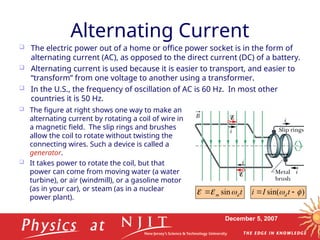
 The figure at right shows one way to make an
alternating current by rotating a coil of wire in
a magnetic field. The slip rings and brushes
allow the coil to rotate without twisting the
connecting wires. Such a device is called a
generator.
 It takes power to rotate the coil, but that
power can come from moving water (a water
turbine), or air (windmill), or a gasoline motor
(as in your car), or steam (as in a nuclear
power plant).
t
d
m 

 sin
 )
sin( 
 
 t
I
i d
December 5, 2007
RLC Circuits with AC Power
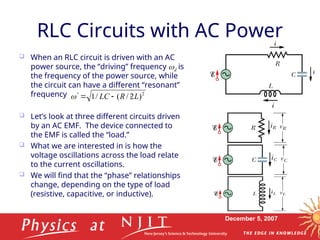
 When an RLC circuit is driven with an AC
power source, the “driving” frequency is
the frequency of the power source, while
the circuit can have a different “resonant”
frequency .
 Let’s look at three different circuits driven
by an AC EMF. The device connected to
the EMF is called the “load.”
 What we are interested in is how the
voltage oscillations across the load relate
to the current oscillations.
 We will find that the “phase” relationships
change, depending on the type of load
(resistive, capacitive, or inductive).
d

2
)
2
/
(
/
1 L
R
LC 



December 5, 2007
A Resistive Load
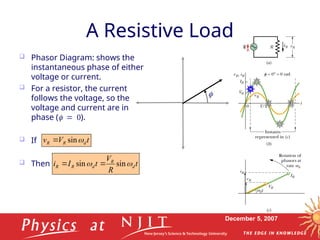
 Phasor Diagram: shows the
instantaneous phase of either
voltage or current.
 For a resistor, the current
follows the voltage, so the
voltage and current are in
phase ().
 If
 Then

t
R
V
t
I
i d
R
d
R
R 
 sin
sin 

t
V
v d
R
R 
sin

December 5, 2007
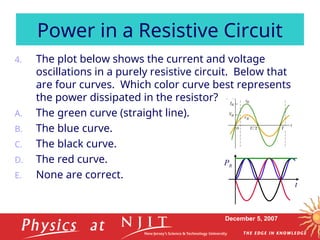
4. The plot below shows the current and voltage
oscillations in a purely resistive circuit. Below that
are four curves. Which color curve best represents
the power dissipated in the resistor?
A. The green curve (straight line).
B. The blue curve.
C. The black curve.
D. The red curve.
E. None are correct.
Power in a Resistive Circuit
PR
t
December 5, 2007
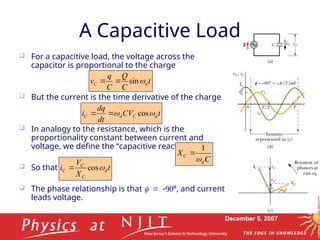
 For a capacitive load, the voltage across the
capacitor is proportional to the charge
 But the current is the time derivative of the charge
 In analogy to the resistance, which is the
proportionality constant between current and
voltage, we define the “capacitive reactance” as
 So that .
 The phase relationship is that º, and current
leads voltage.
A Capacitive Load
t
X
V
i d
C
C
C 
cos

C
X
d
C

1

t
C
Q
C
q
v d
C 
sin


t
CV
dt
dq
i d
C
d
C 
 cos


December 5, 2007
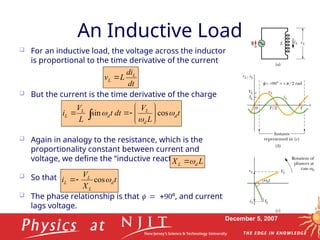
An Inductive Load
 For an inductive load, the voltage across the inductor
is proportional to the time derivative of the current
 But the current is the time derivative of the charge
 Again in analogy to the resistance, which is the
proportionality constant between current and
voltage, we define the “inductive reactance” as
 So that .
 The phase relationship is that º, and current
lags voltage.
t
X
V
i d
L
L
L 
cos


L
X d
L 

dt
di
L
v L
L 
t
L
V
dt
t
L
V
i d
d
L
d
L
L 

 cos
sin 









 
December 5, 2007
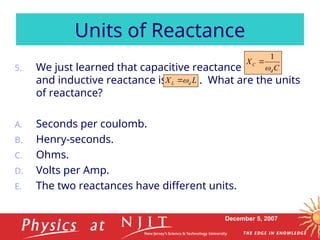
5. We just learned that capacitive reactance is
and inductive reactance is . What are the units
of reactance?
A. Seconds per coulomb.
B. Henry-seconds.
C. Ohms.
D. Volts per Amp.
E. The two reactances have different units.
Units of Reactance
L
X d
L 

C
X
d
C

1

December 5, 2007
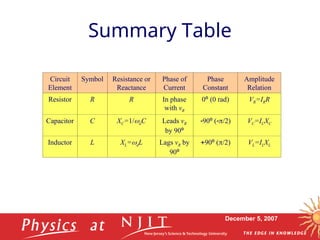
Summary Table
Circuit
Element
Symbol Resistance or
Reactance
Phase of
Current
Phase
Constant
Amplitude
Relation
Resistor R R In phase
with vR
0º (0 rad) VR=IRR
Capacitor C XC=1/dC Leads vR
by 90º
90º (/2) VC=ICXC
Inductor L XL=dL Lags vR by
90º
90º (/2) VL=ILXL
December 5, 2007
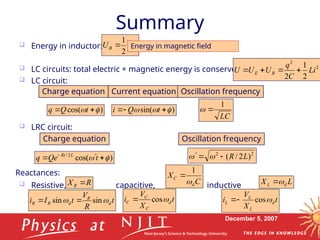
Summary
 Energy in inductor:
 LC circuits: total electric + magnetic energy is conserved
 LC circuit:
 LRC circuit:
 Resistive, capacitive, inductive
2
2
1
Li
UB  Energy in magnetic field
2
2
2
1
2
Li
C
q
U
U
U B
E 



)
cos( 
 
 t
Q
q
LC
1


Charge equation Current equation Oscillation frequency
)
sin( 

 

 t
Q
i
Charge equation Oscillation frequency
2
2
)
2
/
( L
R


 

)
cos(
2
/

 

 
t
Qe
q L
Rt
t
R
V
t
I
i d
R
d
R
R 
 sin
sin 
 t
X
V
i d
C
C
C 
cos
 t
X
V
i d
L
L
L 
cos


C
X
d
C

1

L
X d
L 

R
XR 
Reactances:
December 5, 2007
6. How did you like using the clickers in this class?
A. Great!
B. It had its moments.
C. I could take it or leave it.
D. I would rather leave it.
E. It was the worst!
Thoughts on Clickers
December 5, 2007
7. Which answer describes the most important way
that the clicker aided you in learning the material?
A. It helped me to think about the material presented
just before each question.
B. It broke up the lecture and kept me awake.
C. It tested my understanding.
D. It provided immediate feedback.
E. It showed me what others were thinking.
Thoughts on Clickers
December 5, 2007
8. Which answer describes the second most important
way that the clicker aided you in learning the
material?
A. It helped me to think about the material presented
just before each question.
B. It broke up the lecture and kept me awake.
C. It tested my understanding.
D. It provided immediate feedback.
E. It showed me what others were thinking.
Thoughts on Clickers
December 5, 2007
9. How would you react to clickers being used in other
classes at NJIT?
A. I think it would be excellent.
B. I think it is a good idea.
C. I wouldn’t mind.
D. I would rather not.
E. I definitely hope not.
Thoughts on Clickers
December 5, 2007
10. What problems did you have with your clicker?
A. I had no problems with my clicker.
B. It was too big or bulky, a pain to carry around.
C. I had trouble remembering to bring it to class.
D. My clicker had mechanical problems.
E. I lost or misplaced it (for all or part of the semester).
Thoughts on Clickers
December 5, 2007
11. If you had the choice between using a clicker versus
having a lecture quiz where you had to fill in a
scantron, which would you prefer?
A. I would prefer the clicker.
B. I would prefer the scantron quiz.
Thoughts on Clickers
December 5, 2007
12. Please click any button on your clicker as you turn
your clicker in. This will register your name as
having turned in your clicker.
Have a Nice Day
physics121_lecture13.oscillatoins and modern physics

  • 1.
    Physics 121: Electricity& Magnetism – Lecture 13 E-M Oscillations and AC Current Dale E. Gary Wenda Cao NJIT Physics Department
  • 2.
    December 5, 2007 ElectromagneticOscillations C q UE 2 2  2 2 1 Li UB  C q UE 2 2  2 2 1 Li UB 
  • 3.
    December 5, 2007 OscillatingQuantities  We will write oscillating quantities with a lower-case symbol, and the corresponding amplitude of the oscillation with upper case.  Examples: Oscillating Quantity Amplitud e Voltage v V Current i I Charge q Q ) cos(     t Q q ) ( cos 2 2 2 2 2     t C Q C q dt t d I dt di ) cos(    
  • 4.
    December 5, 2007 Derivationof Oscillation Frequency  We have shown qualitatively that LC circuits act like an oscillator.  We can discover the frequency of oscillation by looking at the equations governing the total energy.  Since the total energy is constant, the time derivative should be zero:  But and , so making these substitutions:  This is a second-order, homogeneous differential equation, whose solution is  i.e. the charge varies according to a cosine wave with amplitude Q and frequency . Check by taking two time derivatives of charge:  Plug into original equation: 2 2 2 1 2 Li C q U U U B E     0    dt di Li dt dq C q dt dU dt dq i  2 2 dt q d dt di  0 2 2   C q dt q d L ) cos(     t Q q ) sin(       t Q dt dq ) cos( 2 2 2       t Q dt q d 0 ) cos( ) cos( 2 2 2             t C Q t LQ C q dt q d L 0 1 2    C L LC 1   dt dq i  2 2 dt q d dt di 
  • 5.
    December 5, 2007 1.The expressions below give the charge on a capacitor in an LC circuit. Choose the one that will have the greatest maximum current? A. q = 2 cos 4t B. q = 2 cos(4t+/2) C. q = 2 sin t D. q = 4 cos 4t E. q = 2 sin 5t Which Current is Greatest?
  • 6.
    December 5, 2007 2.The three circuits below have identical inductors and capacitors. Rank the circuits according to the time taken to fully discharge the capacitor during an oscillation, greatest first. A. I, II, III. B. II, I, III. C. III, I, II. D. III, II, I. E. II, III, I. Time to Discharge Capacitor I. II. III.
  • 7.
    December 5, 2007 Charge,Current & Energy Oscillations  The solution to the equation is , which gives the charge oscillation.  From this, we can determine the corresponding oscillation of current:  And energy  But recall that , so .  That is why our graph for the energy oscillation had the same amplitude for both UE and UB.  Note that ) cos(     t Q q 0 2 2   C q dt q d L ) sin(        t Q dt dq i ) ( cos 2 2 2 2 2      t C Q C q UE ) ( sin 2 1 2 1 2 2 2 2       t LQ Li UB LC 1   ) ( sin 2 2 2     t C Q UB C Q t t C Q U U B E 2 )] ( sin ) ( [cos 2 2 2 2 2           Constant
  • 8.
    December 5, 2007 DampedOscillations  Recall that all circuits have at least a little bit of resistance.  In this general case, we really have an RLC circuit, where the oscillations get smaller with time. They are said to be “damped oscillations.” Damped Oscillations  Then the power equation becomes L Rt e 2 /  R i dt di Li dt dq C q dt dU 2     Power lost due to resistive heating  As before, substituting and gives the differential equation for q dt dq i  2 2 dt q d dt di  0 2 2    C q dt dq R dt q d L 2 2 ) 2 / ( L R      ) cos( 2 /       t Qe q L Rt Solution:
  • 9.
    December 5, 2007 3.How does the resonant frequency  for an ideal LC circuit (no resistance) compare with ’ for a non-ideal one where resistance cannot be ignored? A. The resonant frequency for the non-ideal circuit is higher than for the ideal one (’ > ). B. The resonant frequency for the non-ideal circuit is lower than for the ideal one (’ < ). C. The resistance in the circuit does not affect the resonant frequency—they are the same (’ = ). Resonant Frequency
  • 10.
    December 5, 2007 AlternatingCurrent  The electric power out of a home or office power socket is in the form of alternating current (AC), as opposed to the direct current (DC) of a battery.  Alternating current is used because it is easier to transport, and easier to “transform” from one voltage to another using a transformer.  In the U.S., the frequency of oscillation of AC is 60 Hz. In most other countries it is 50 Hz.  The figure at right shows one way to make an alternating current by rotating a coil of wire in a magnetic field. The slip rings and brushes allow the coil to rotate without twisting the connecting wires. Such a device is called a generator.  It takes power to rotate the coil, but that power can come from moving water (a water turbine), or air (windmill), or a gasoline motor (as in your car), or steam (as in a nuclear power plant). t d m    sin  ) sin(     t I i d
  • 11.
    December 5, 2007 RLCCircuits with AC Power  When an RLC circuit is driven with an AC power source, the “driving” frequency is the frequency of the power source, while the circuit can have a different “resonant” frequency .  Let’s look at three different circuits driven by an AC EMF. The device connected to the EMF is called the “load.”  What we are interested in is how the voltage oscillations across the load relate to the current oscillations.  We will find that the “phase” relationships change, depending on the type of load (resistive, capacitive, or inductive). d  2 ) 2 / ( / 1 L R LC    
  • 12.
    December 5, 2007 AResistive Load  Phasor Diagram: shows the instantaneous phase of either voltage or current.  For a resistor, the current follows the voltage, so the voltage and current are in phase ().  If  Then  t R V t I i d R d R R   sin sin   t V v d R R  sin 
  • 13.
    December 5, 2007 4.The plot below shows the current and voltage oscillations in a purely resistive circuit. Below that are four curves. Which color curve best represents the power dissipated in the resistor? A. The green curve (straight line). B. The blue curve. C. The black curve. D. The red curve. E. None are correct. Power in a Resistive Circuit PR t
  • 14.
    December 5, 2007 For a capacitive load, the voltage across the capacitor is proportional to the charge  But the current is the time derivative of the charge  In analogy to the resistance, which is the proportionality constant between current and voltage, we define the “capacitive reactance” as  So that .  The phase relationship is that º, and current leads voltage. A Capacitive Load t X V i d C C C  cos  C X d C  1  t C Q C q v d C  sin   t CV dt dq i d C d C   cos  
  • 15.
    December 5, 2007 AnInductive Load  For an inductive load, the voltage across the inductor is proportional to the time derivative of the current  But the current is the time derivative of the charge  Again in analogy to the resistance, which is the proportionality constant between current and voltage, we define the “inductive reactance” as  So that .  The phase relationship is that º, and current lags voltage. t X V i d L L L  cos   L X d L   dt di L v L L  t L V dt t L V i d d L d L L    cos sin            
  • 16.
    December 5, 2007 5.We just learned that capacitive reactance is and inductive reactance is . What are the units of reactance? A. Seconds per coulomb. B. Henry-seconds. C. Ohms. D. Volts per Amp. E. The two reactances have different units. Units of Reactance L X d L   C X d C  1 
  • 17.
    December 5, 2007 SummaryTable Circuit Element Symbol Resistance or Reactance Phase of Current Phase Constant Amplitude Relation Resistor R R In phase with vR 0º (0 rad) VR=IRR Capacitor C XC=1/dC Leads vR by 90º 90º (/2) VC=ICXC Inductor L XL=dL Lags vR by 90º 90º (/2) VL=ILXL
  • 18.
    December 5, 2007 Summary Energy in inductor:  LC circuits: total electric + magnetic energy is conserved  LC circuit:  LRC circuit:  Resistive, capacitive, inductive 2 2 1 Li UB  Energy in magnetic field 2 2 2 1 2 Li C q U U U B E     ) cos(     t Q q LC 1   Charge equation Current equation Oscillation frequency ) sin(       t Q i Charge equation Oscillation frequency 2 2 ) 2 / ( L R      ) cos( 2 /       t Qe q L Rt t R V t I i d R d R R   sin sin   t X V i d C C C  cos  t X V i d L L L  cos   C X d C  1  L X d L   R XR  Reactances:
  • 19.
    December 5, 2007 6.How did you like using the clickers in this class? A. Great! B. It had its moments. C. I could take it or leave it. D. I would rather leave it. E. It was the worst! Thoughts on Clickers
  • 20.
    December 5, 2007 7.Which answer describes the most important way that the clicker aided you in learning the material? A. It helped me to think about the material presented just before each question. B. It broke up the lecture and kept me awake. C. It tested my understanding. D. It provided immediate feedback. E. It showed me what others were thinking. Thoughts on Clickers
  • 21.
    December 5, 2007 8.Which answer describes the second most important way that the clicker aided you in learning the material? A. It helped me to think about the material presented just before each question. B. It broke up the lecture and kept me awake. C. It tested my understanding. D. It provided immediate feedback. E. It showed me what others were thinking. Thoughts on Clickers
  • 22.
    December 5, 2007 9.How would you react to clickers being used in other classes at NJIT? A. I think it would be excellent. B. I think it is a good idea. C. I wouldn’t mind. D. I would rather not. E. I definitely hope not. Thoughts on Clickers
  • 23.
    December 5, 2007 10.What problems did you have with your clicker? A. I had no problems with my clicker. B. It was too big or bulky, a pain to carry around. C. I had trouble remembering to bring it to class. D. My clicker had mechanical problems. E. I lost or misplaced it (for all or part of the semester). Thoughts on Clickers
  • 24.
    December 5, 2007 11.If you had the choice between using a clicker versus having a lecture quiz where you had to fill in a scantron, which would you prefer? A. I would prefer the clicker. B. I would prefer the scantron quiz. Thoughts on Clickers
  • 25.
    December 5, 2007 12.Please click any button on your clicker as you turn your clicker in. This will register your name as having turned in your clicker. Have a Nice Day