Physics class 12thstep down transformer project.pdf
1.
Step-Down Transformer: A
Class12 Physics Project
Unveiling the core principles of electricity through a hands-on
exploration of the step-down transformer.
2.
What is aTransformer?
Voltage Transformation
An electrical device that
changes AC voltage levels using
electromagnetic induction, a
fundamental principle of
physics.
Energy Transfer
Transfers electrical energy
between circuits efficiently
without any moving parts,
relying solely on magnetic
fields.
Key Types
Broadly categorized into two
main types: Step-up
transformers (increase voltage)
and Step-down transformers
(decrease voltage).
3.
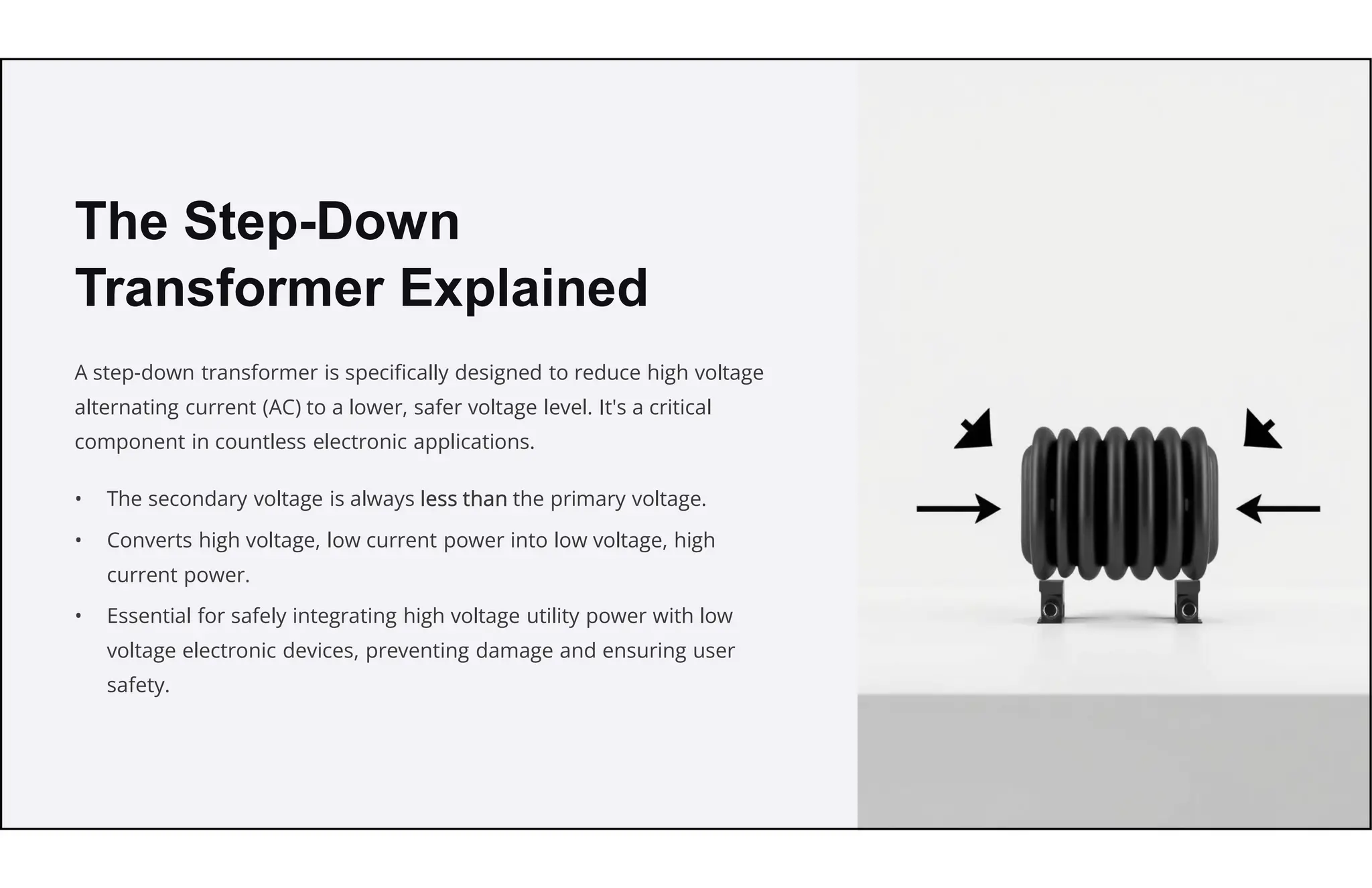
The Step-Down
Transformer Explained
Astep-down transformer is specifically designed to reduce high voltage
alternating current (AC) to a lower, safer voltage level. It's a critical
component in countless electronic applications.
• The secondary voltage is always less than the primary voltage.
• Converts high voltage, low current power into low voltage, high
current power.
• Essential for safely integrating high voltage utility power with low
voltage electronic devices, preventing damage and ensuring user
safety.
4.
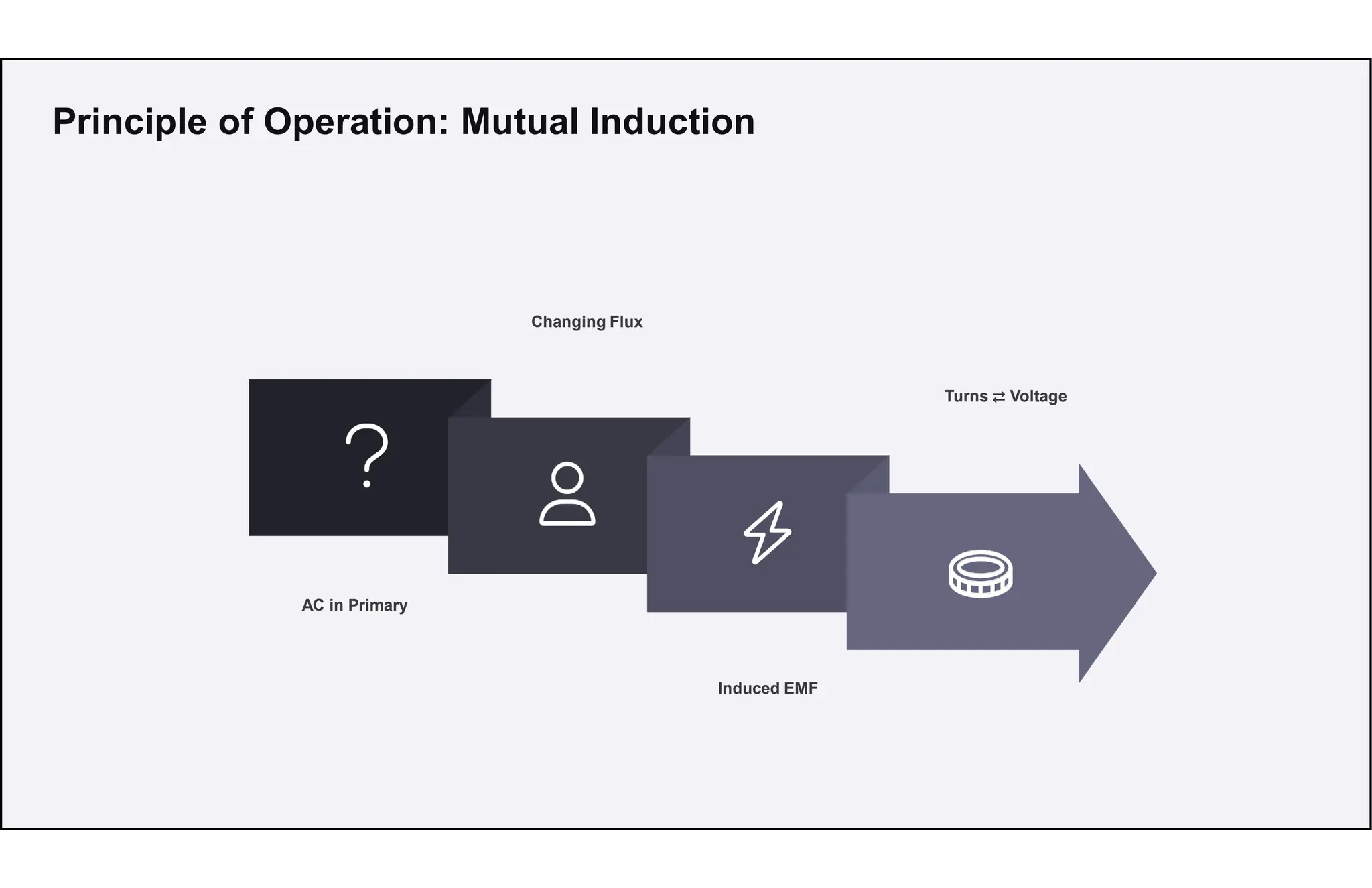
Principle of Operation:Mutual Induction
AC in Primary
Changing Flux
Induced EMF
Turns ⇄ Voltage
5.
Transformer Formula &Turns Ratio
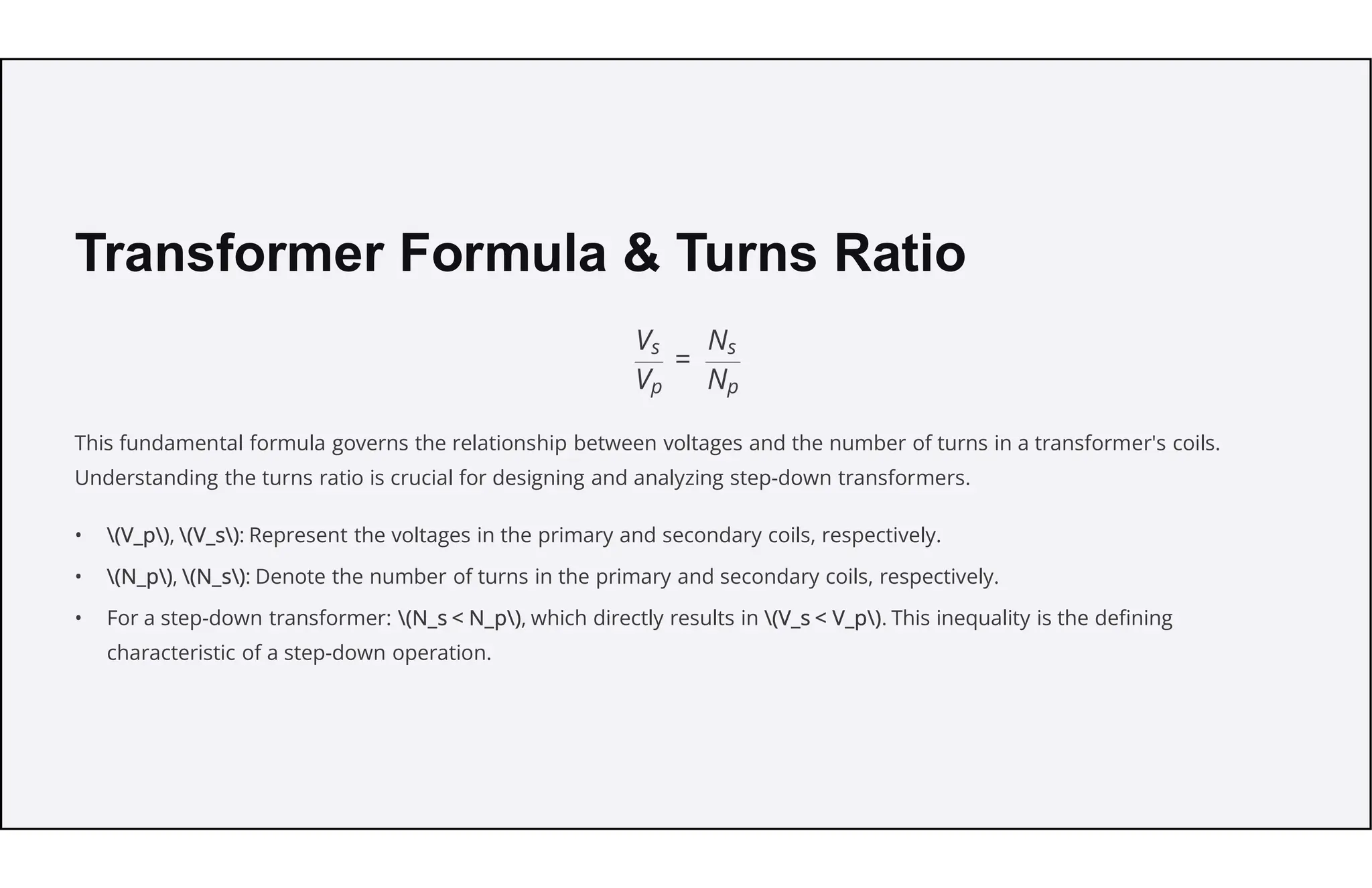
This fundamental formula governs the relationship between voltages and the number of turns in a transformer's coils.
Understanding the turns ratio is crucial for designing and analyzing step-down transformers.
• (V_p), (V_s): Represent the voltages in the primary and secondary coils, respectively.
• (N_p), (N_s): Denote the number of turns in the primary and secondary coils, respectively.
• For a step-down transformer: (N_s < N_p), which directly results in (V_s < V_p). This inequality is the defining
characteristic of a step-down operation.
6.
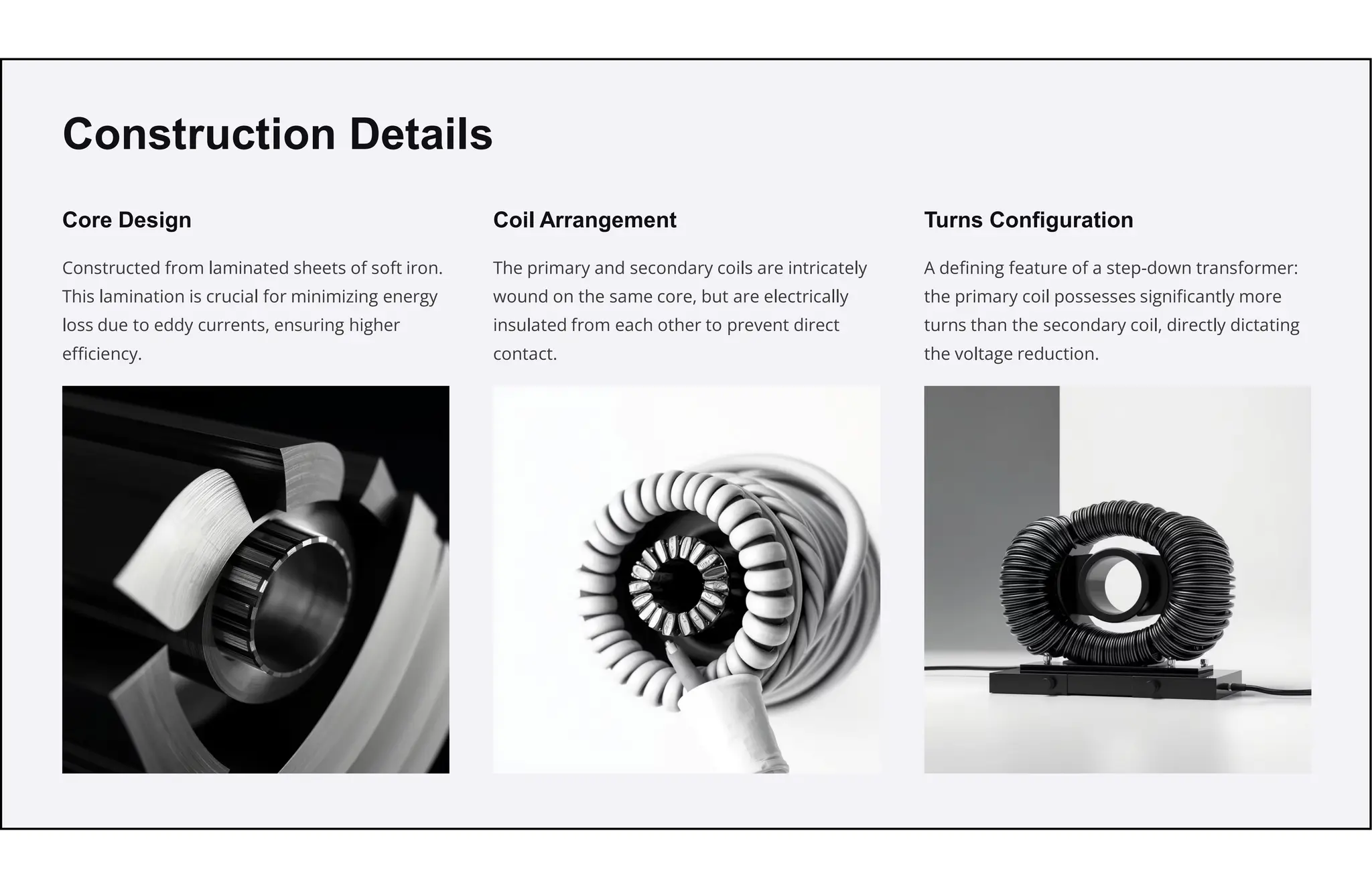
Construction Details
Core Design
Constructedfrom laminated sheets of soft iron.
This lamination is crucial for minimizing energy
loss due to eddy currents, ensuring higher
efficiency.
Coil Arrangement
The primary and secondary coils are intricately
wound on the same core, but are electrically
insulated from each other to prevent direct
contact.
Turns Configuration
A defining feature of a step-down transformer:
the primary coil possesses significantly more
turns than the secondary coil, directly dictating
the voltage reduction.
7.
Building a SimpleStep-Down Transformer
01
Select Ferromagnetic Core
Choose a suitable ferromagnetic material like steel washers
or a solid iron core. This forms the central component for
magnetic flux.
02
Wind Primary Coil
Tightly wind a large number of turns of insulated copper wire
around the core to form the primary coil, ensuring even
distribution.
03
Wind Secondary Coil
On top of or adjacent to the primary coil, wind the secondary
coil with a significantly fewer number of turns of insulated
copper wire.
04
Insulate & Secure
Thoroughly insulate all windings and secure the coils firmly to
the core. This prevents short circuits and minimizes energy
losses from vibrations.
8.
Energy Losses &Efficiency
While transformers are highly efficient devices, perfect efficiency is unattainable due to inherent energy losses. Understanding
these losses is key to optimizing transformer design and performance.
Resistive Losses
Energy dissipated as heat in the
copper coils due to their electrical
resistance (I²R losses). Using
thicker wire minimizes this.
Hysteresis Losses
Energy expended in repeatedly
magnetizing and demagnetizing
the core material due to the
alternating magnetic field. Soft
magnetic materials reduce this.
Eddy Current Losses
Induced circulating currents within
the core itself, leading to heat
generation. Laminated cores are
specifically designed to suppress
these currents, enhancing
efficiency.
Achieving high efficiency involves meticulous design, including laminated cores, low-resistance windings, and suitable core
materials. An ideal transformer, theoretically, operates with negligible losses, though this is a simplification for conceptual
understanding.
9.
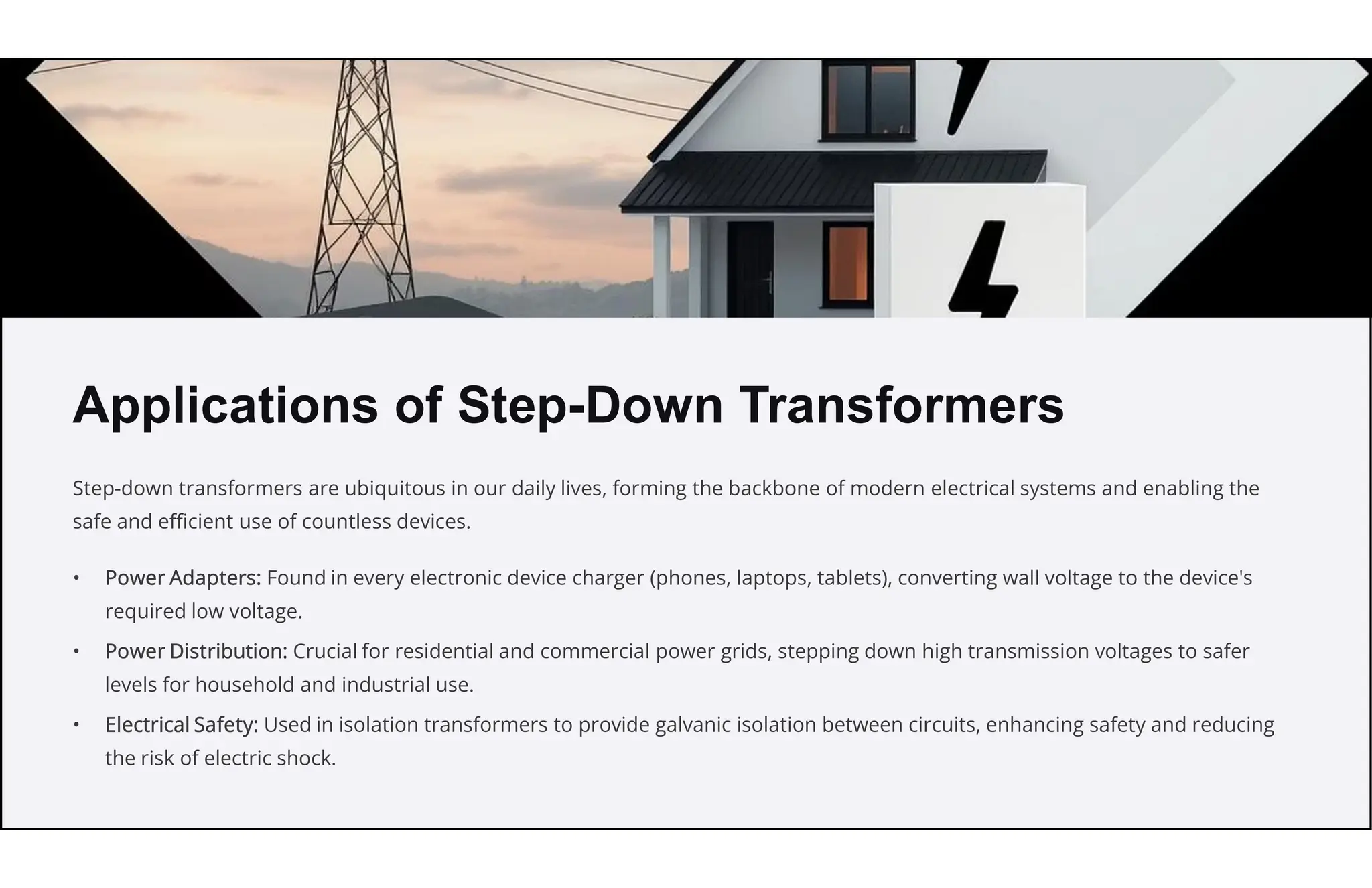
Applications of Step-DownTransformers
Step-down transformers are ubiquitous in our daily lives, forming the backbone of modern electrical systems and enabling the
safe and efficient use of countless devices.
• Power Adapters: Found in every electronic device charger (phones, laptops, tablets), converting wall voltage to the device's
required low voltage.
• Power Distribution: Crucial for residential and commercial power grids, stepping down high transmission voltages to safer
levels for household and industrial use.
• Electrical Safety: Used in isolation transformers to provide galvanic isolation between circuits, enhancing safety and reducing
the risk of electric shock.
10.
Conclusion & LearningOutcomes
Voltage Regulation
Step-down transformers are
fundamental for safe and efficient
voltage regulation in diverse
applications.
Core Principles
Mastery of turns ratio, mutual
induction, and electromagnetic
principles is key to understanding
transformer operation.
Practical Skills
The project hones practical skills,
from coil winding to voltage
measurement and efficiency analysis.
Energy Transfer
Encourages deeper exploration into
the fascinating world of electrical
energy transfer and its underlying
physics.
This project serves as a comprehensive journey, transforming theoretical knowledge into tangible understanding and practical
expertise, preparing you for future scientific endeavors.