Unit 5, Chapter 13 CPO Science Foundations of Physics
Unit 5: Waves and Sound 13.1 Harmonic Motion 13.2 Why Things Oscillate 13.3 Resonance and Energy Chapter 13 Harmonic Motion
Chapter 13 Objectives Identify characteristics of harmonic motion, such as cycles, frequency, and amplitude. Determine period, frequency, and amplitude from a graph of harmonic motion. Use the concept of phase to compare the motion of two oscillators. Describe the characteristics of a system that lead to harmonic motion. Describe the meaning of natural frequency. Identify ways to change the natural frequency of a system. Explain harmonic motion in terms of potential and kinetic energy. Describe the meaning of periodic force. Explain the concept of resonance and give examples of resonance.
Chapter 13 Vocabulary Terms harmonic motion  cycle  period  frequency  amplitude hertz (Hz)  damping  periodic motion  periodic force  resonance phase  phase difference  equilibrium  restoring force  stable equilibrium unstable equilibrium  oscillator  natural frequency  steady state  piezoelectric effect
13.1 Harmonic motion Key Question: How do we describe the back and forth motion of a pendulum? *Students read Section 13.1  AFTER Investigation 13.1
13.1 Cycles, systems, and oscillators A  cycle  is  a unit of motion that repeats.
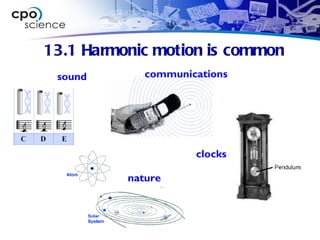
13.1 Harmonic motion is common sound communications clocks nature
 
13.1 Amplitude Amplitude  describes the size of a cycle.
13.1 Amplitude The energy of an  oscillator  is proportional to the amplitude of the motion. Friction drains energy away from motion and slows the pendulum down.  Damping  is the term used to describe this loss.
13.1 Linear Motion vs. Harmonic Motion Graphs
 
13.1 Circles and the phase  of harmonic motion Circular motion  is very similar to  harmonic motion .  Rotation is a cycle, just like harmonic motion.  One key difference is that cycles of circular motion  always  have a length of 360 degrees.
13.1 Circles and the phase  of harmonic motion The word “ phase”  means where the oscillator is in the cycle. The concept of phase is important when comparing one oscillator with another.
13.2 Why Things Oscillate Key Question: What kinds of systems oscillate? *Students read Section 13.2  AFTER Investigation 13.2
13.2 Why Things Oscillate Systems that have harmonic motion move back and forth around a central or  equilibrium  position. Equilibrium is maintained by  restoring forces .  A restoring force is any force that always acts to pull the system back toward equilibrium.
13.2 Inertia Newton’s first law explains why harmonic motion happens for moving objects. According to the first law, an object in motion stays in motion unless acted upon by a force.
13.2 Stable and unstable systems Not all systems in equilibrium show harmonic motion when disturbed. In  unstable  systems there are forces that act to pull the system  away  from equilibrium when disturbed.  Unstable systems do not usually result in harmonic motion (don't have restoring forces).
13.2 The natural frequency The  natural frequency  is the frequency at which systems tend to oscillate when disturbed.  Everything that can oscillate has a natural frequency, and most systems have more than one. Adding a steel nut greatly increases the inertia of a stretched rubber band, so the natural frequency decreases.
13.2 Changing the natural frequency The natural frequency is proportional to the acceleration of a system. Newton’s second law can be applied to see the relationship between acceleration and natural frequency.
13.3 Resonance and Energy Key Question: What is resonance and why is it important? *Students read Section 13.3  AFTER Investigation 13.3
13.3 Resonance and Energy Harmonic motion involves both  potential energy  and  kinetic energy . Oscillators like a pendulum, or a mass on a spring, continually exchange energy back and forth between potential and kinetic.
13.3 Resonance A good way to understand resonance is to think about three distinct parts of any interaction between a  system  and a  force.
13.3 Energy, resonance and damping Steady state  is a balance between damping from friction and the strength of the applied force.  Dribbling a basketball on a floor is a good example of resonance with steady state balance between energy loss from damping and energy input from your hand.
Application: Quartz Crystals

Physics chpt13

  • 1.
    Unit 5, Chapter13 CPO Science Foundations of Physics
  • 2.
    Unit 5: Wavesand Sound 13.1 Harmonic Motion 13.2 Why Things Oscillate 13.3 Resonance and Energy Chapter 13 Harmonic Motion
  • 3.
    Chapter 13 ObjectivesIdentify characteristics of harmonic motion, such as cycles, frequency, and amplitude. Determine period, frequency, and amplitude from a graph of harmonic motion. Use the concept of phase to compare the motion of two oscillators. Describe the characteristics of a system that lead to harmonic motion. Describe the meaning of natural frequency. Identify ways to change the natural frequency of a system. Explain harmonic motion in terms of potential and kinetic energy. Describe the meaning of periodic force. Explain the concept of resonance and give examples of resonance.
  • 4.
    Chapter 13 VocabularyTerms harmonic motion cycle period frequency amplitude hertz (Hz) damping periodic motion periodic force resonance phase phase difference equilibrium restoring force stable equilibrium unstable equilibrium oscillator natural frequency steady state piezoelectric effect
  • 5.
    13.1 Harmonic motionKey Question: How do we describe the back and forth motion of a pendulum? *Students read Section 13.1 AFTER Investigation 13.1
  • 6.
    13.1 Cycles, systems,and oscillators A cycle is a unit of motion that repeats.
  • 7.
    13.1 Harmonic motionis common sound communications clocks nature
  • 8.
  • 9.
    13.1 Amplitude Amplitude describes the size of a cycle.
  • 10.
    13.1 Amplitude Theenergy of an oscillator is proportional to the amplitude of the motion. Friction drains energy away from motion and slows the pendulum down. Damping is the term used to describe this loss.
  • 11.
    13.1 Linear Motionvs. Harmonic Motion Graphs
  • 12.
  • 13.
    13.1 Circles andthe phase of harmonic motion Circular motion is very similar to harmonic motion . Rotation is a cycle, just like harmonic motion. One key difference is that cycles of circular motion always have a length of 360 degrees.
  • 14.
    13.1 Circles andthe phase of harmonic motion The word “ phase” means where the oscillator is in the cycle. The concept of phase is important when comparing one oscillator with another.
  • 15.
    13.2 Why ThingsOscillate Key Question: What kinds of systems oscillate? *Students read Section 13.2 AFTER Investigation 13.2
  • 16.
    13.2 Why ThingsOscillate Systems that have harmonic motion move back and forth around a central or equilibrium position. Equilibrium is maintained by restoring forces . A restoring force is any force that always acts to pull the system back toward equilibrium.
  • 17.
    13.2 Inertia Newton’sfirst law explains why harmonic motion happens for moving objects. According to the first law, an object in motion stays in motion unless acted upon by a force.
  • 18.
    13.2 Stable andunstable systems Not all systems in equilibrium show harmonic motion when disturbed. In unstable systems there are forces that act to pull the system away from equilibrium when disturbed. Unstable systems do not usually result in harmonic motion (don't have restoring forces).
  • 19.
    13.2 The naturalfrequency The natural frequency is the frequency at which systems tend to oscillate when disturbed. Everything that can oscillate has a natural frequency, and most systems have more than one. Adding a steel nut greatly increases the inertia of a stretched rubber band, so the natural frequency decreases.
  • 20.
    13.2 Changing thenatural frequency The natural frequency is proportional to the acceleration of a system. Newton’s second law can be applied to see the relationship between acceleration and natural frequency.
  • 21.
    13.3 Resonance andEnergy Key Question: What is resonance and why is it important? *Students read Section 13.3 AFTER Investigation 13.3
  • 22.
    13.3 Resonance andEnergy Harmonic motion involves both potential energy and kinetic energy . Oscillators like a pendulum, or a mass on a spring, continually exchange energy back and forth between potential and kinetic.
  • 23.
    13.3 Resonance Agood way to understand resonance is to think about three distinct parts of any interaction between a system and a force.
  • 24.
    13.3 Energy, resonanceand damping Steady state is a balance between damping from friction and the strength of the applied force. Dribbling a basketball on a floor is a good example of resonance with steady state balance between energy loss from damping and energy input from your hand.
  • 25.

Editor's Notes

  • #22 1. The restoring force pulls the pendulum toward the center (equilibrium). 2. The pendulum overshoots the center because of its inertia. 3. The restoring force pulls back toward the center, slowing and reversing the pendulum’s direction. 4. The pendulum overshoots the center again, because of inertia. 5. The cycle repeats, creating harmonic motion.