Quarter 1 –Module 4:
Polarity of Molecules and Its Properties
Lesson 1: Properties of Molecules
based on its Polarity
2.
A. Polarity, Solubility,and Miscibility
One of the practical applications of polarity of molecule in real-
life scenario is manifested on the solubility and miscibility of
substances to form solution.
• Solubility is defined as the ability of a solid substance to be
dissolved in a given amount of solvent.
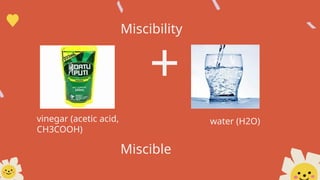
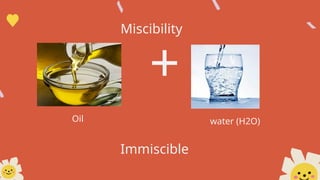
• Miscibility is the ability of the two liquids to combine or mix
in all proportions, creating a homogenous mixture.
The general rule to remember about the solubility and
miscibility of molecular compounds can be summarized in a
phrase,“like dissolves like” or “like mixes with like”.
• Solubility isdefined as the ability of a solid substance to be
dissolved in a given amount of solvent.
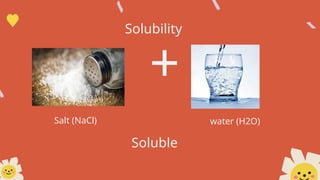
1. Soluble - A substance is considered soluble if it can
dissolve in a particular solvent to form a homogeneous
solution.
example: salt is soluble in water.
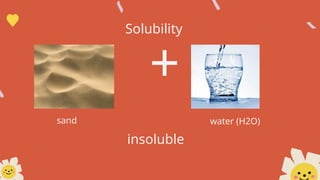
2. Insoluble - A substance is considered insoluble if it does
not dissolve appreciably in a particular solvent under
specified conditions.
example: sand is insoluble in water.
• Miscibility isthe ability of the two liquids to combine or mix
in all proportions, creating a homogenous mixture.
1. Miscible - Two or more substances are considered miscible if
they can mix together in all proportions to form a
homogeneous solution. Example: vinegar and water are
miscible.
2. Immiscible - Two or more substances are considered
immiscible if they cannot mix together to form a
homogeneous solution and instead form separate layers.
Example: oil and water are immiscible.
9.
B. Bond Strengthand Physical Properties of Covalent Compounds
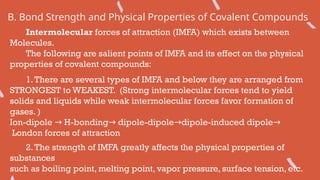
Intermolecular forces of attraction (IMFA) which exists between
Molecules.
The following are salient points of IMFA and its effect on the physical
properties of covalent compounds:
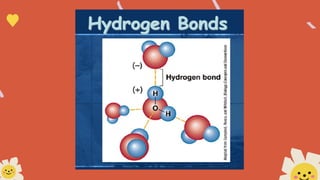
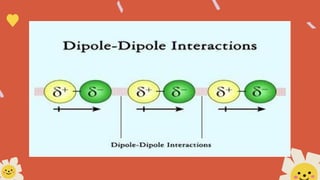
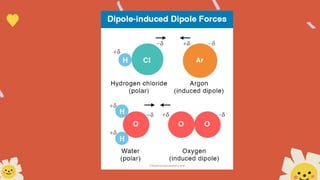
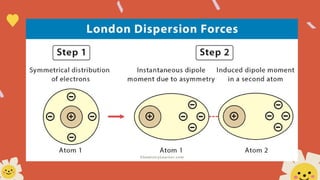
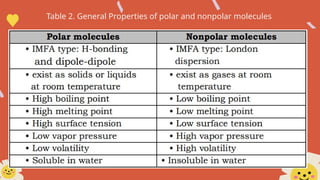
1.There are several types of IMFA and below they are arranged from
STRONGEST to WEAKEST. (Strong intermolecular forces tend to yield
solids and liquids while weak intermolecular forces favor formation of
gases. )
Ion-dipole H-bonding dipole-dipole dipole-induced dipole
→ → → →
London forces of attraction
2.The strength of IMFA greatly affects the physical properties of
substances
such as boiling point, melting point, vapor pressure, surface tension, etc.
10.
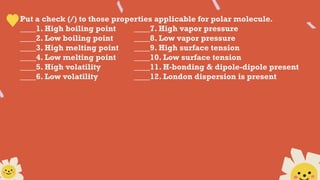
Put a check(/) to those properties applicable for polar molecule.
____1. High boiling point ____7. High vapor pressure
____2. Low boiling point ____8. Low vapor pressure
____3. High melting point ____9. High surface tension
____4. Low melting point ____10. Low surface tension
____5. High volatility ____11. H-bonding & dipole-dipole present
____6. Low volatility ____12. London dispersion is present
11.
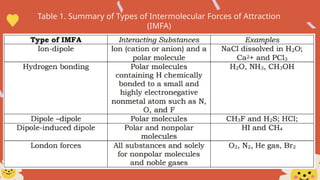
Table 1. Summaryof Types of Intermolecular Forces of Attraction
(IMFA)
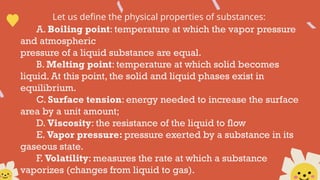
Let us definethe physical properties of substances:
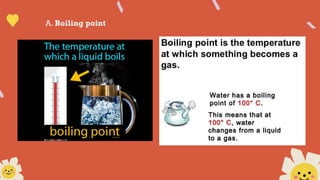
A. Boiling point: temperature at which the vapor pressure
and atmospheric
pressure of a liquid substance are equal.
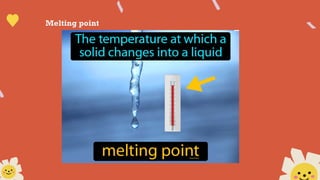
B. Melting point: temperature at which solid becomes
liquid. At this point, the solid and liquid phases exist in
equilibrium.
C. Surface tension: energy needed to increase the surface
area by a unit amount;
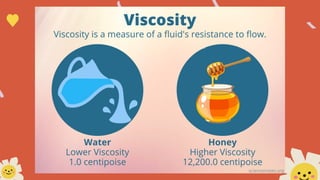
D. Viscosity: the resistance of the liquid to flow
E. Vapor pressure: pressure exerted by a substance in its
gaseous state.
F. Volatility: measures the rate at which a substance
vaporizes (changes from liquid to gas).
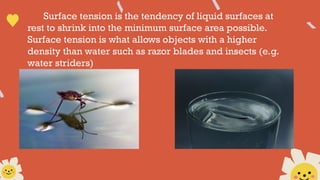
Surface tension isthe tendency of liquid surfaces at
rest to shrink into the minimum surface area possible.
Surface tension is what allows objects with a higher
density than water such as razor blades and insects (e.g.
water striders)
22.
Vapor pressure, alsoknown as vapor equilibrium pressure, can
be defined as the pressure exerted (in a system featuring
thermodynamic equilibrium) by a vapor with its condensed
phases (solid or liquid) in a closed system at a given temperature.
24.
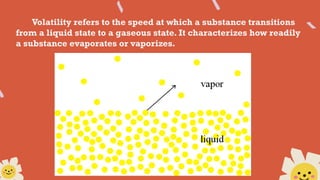
Volatility refers tothe speed at which a substance transitions
from a liquid state to a gaseous state. It characterizes how readily
a substance evaporates or vaporizes.