



PHOTOGRAPHY
1.- BRIEF HISTORY
2.- PHOTOGRAPHY AND HUMAN VISION
3.- TAKING PICTURES
1.- BRIEF HISTORY
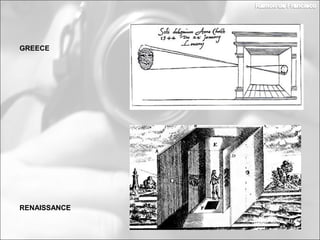
GREECE
RENAISSANCE
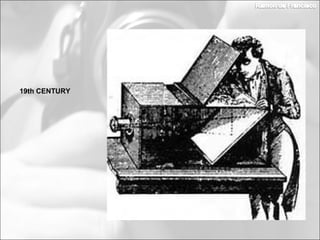
19th CENTURY
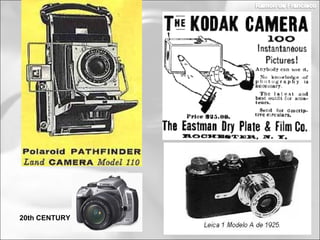
20th CENTURY
2.- PHOTOGRAPHY & HUMAN
VISION
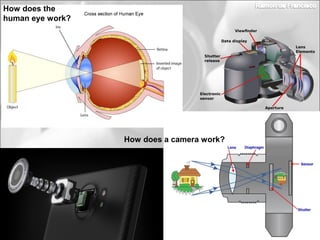
How does the
human eye work?
How does a camera work?
3.- TAKING PICTURES
3.1.- FORMAT
3.2.- FIELD SIZE
3.3.- POINTS OF VIEW
3.4.- COMPOSITION RULES
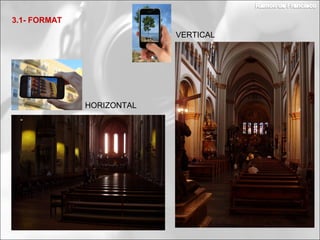
3.1- FORMAT
HORIZONTAL
VERTICAL
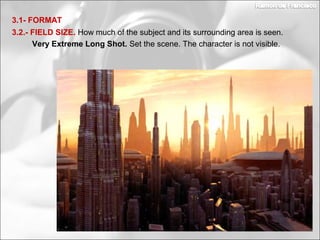
3.2.- FIELD SIZE. How much of the subject and its surrounding area is seen.
Very Extreme Long Shot. Set the scene. The character is not visible.
3.1- FORMAT
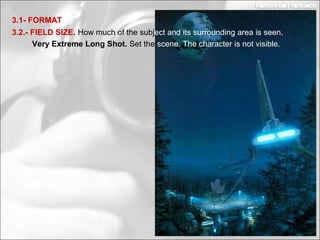
3.2.- FIELD SIZE. How much of the subject and its surrounding area is seen.
Very Extreme Long Shot. Set the scene. The character is not visible.
3.1- FORMAT
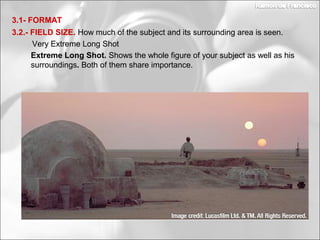
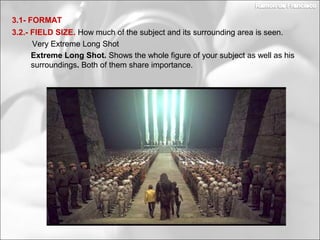
Extreme Long Shot. Shows the whole figure of your subject as well as his
surroundings. Both of them share importance.
3.2.- FIELD SIZE. How much of the subject and its surrounding area is seen.
3.1- FORMAT
Very Extreme Long Shot
3.2.- FIELD SIZE. How much of the subject and its surrounding area is seen.
3.1- FORMAT
Extreme Long Shot. Shows the whole figure of your subject as well as his
surroundings. Both of them share importance.
Very Extreme Long Shot
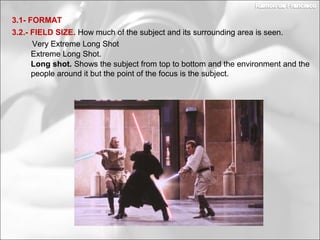
Long shot. Shows the subject from top to bottom and the environment and the
people around it but the point of the focus is the subject.
3.2.- FIELD SIZE. How much of the subject and its surrounding area is seen.
3.1- FORMAT
Extreme Long Shot.
Very Extreme Long Shot
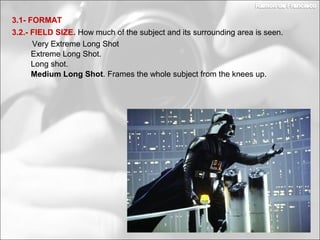
Medium Long Shot. Frames the whole subject from the knees up.
Long shot.
3.2.- FIELD SIZE. How much of the subject and its surrounding area is seen.
3.1- FORMAT
Extreme Long Shot.
Very Extreme Long Shot
Medium Long Shot.
Long shot.
3.2.- FIELD SIZE. How much of the subject and its surrounding area is seen.
3.1- FORMAT
Extreme Long Shot.
Very Extreme Long Shot
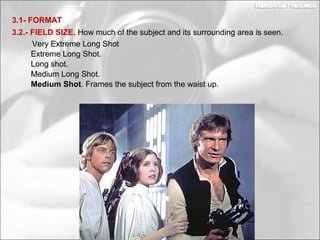
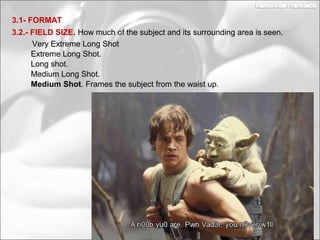
Medium Shot. Frames the subject from the waist up.
Medium Long Shot.
Long shot.
3.2.- FIELD SIZE. How much of the subject and its surrounding area is seen.
3.1- FORMAT
Extreme Long Shot.
Very Extreme Long Shot
Medium Shot. Frames the subject from the waist up.
Medium Long Shot.
Long shot.
3.2.- FIELD SIZE. How much of the subject and its surrounding area is seen.
3.1- FORMAT
Extreme Long Shot.
Very Extreme Long Shot
Medium Shot.
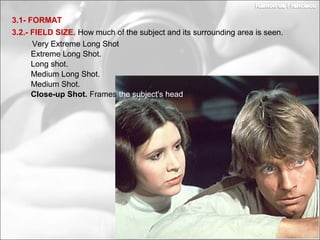
Close-up Shot. Frames the subject's head
Medium Long Shot.
Long shot.
3.2.- FIELD SIZE. How much of the subject and its surrounding area is seen.
3.1- FORMAT
Extreme Long Shot.
Very Extreme Long Shot
Medium Shot.
Close-up Shot.
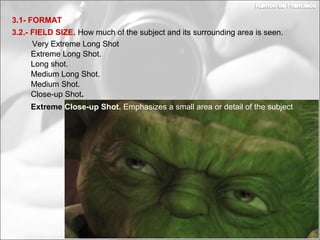
Extreme Close-up Shot. Emphasizes a small area or detail of the subject
3.2.- FIELD SIZE.
3.1- FORMAT
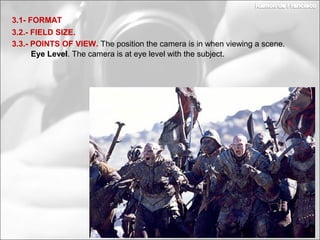
3.3.- POINTS OF VIEW. The position the camera is in when viewing a scene.
Eye Level. The camera is at eye level with the subject.
3.2.- FIELD SIZE.
3.1- FORMAT
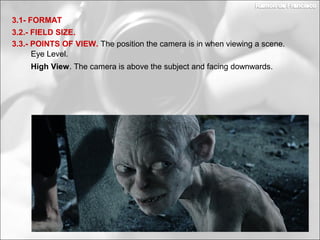
3.3.- POINTS OF VIEW. The position the camera is in when viewing a scene.
Eye Level.
High View. The camera is above the subject and facing downwards.
3.2.- FIELD SIZE.
3.1- FORMAT
3.3.- POINTS OF VIEW.
Eye Level.
High View.
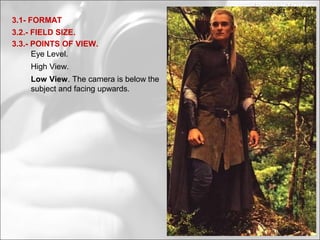
Low View. The camera is below the
subject and facing upwards.
3.2.- FIELD SIZE.
3.1- FORMAT
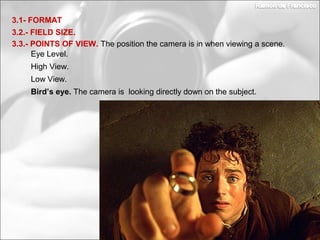
3.3.- POINTS OF VIEW. The position the camera is in when viewing a scene.
Eye Level.
High View.
Low View.
Bird’s eye. The camera is looking directly down on the subject.
3.2.- FIELD SIZE.
3.1- FORMAT
3.3.- POINTS OF VIEW. The position the camera is in when viewing a scene.
Bird’s eye.
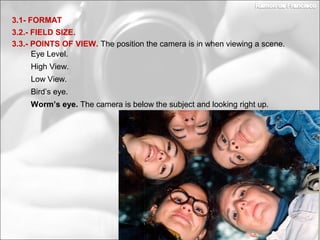
Worm’s eye. The camera is below the subject and looking right up.
Eye Level.
High View.
Low View.
3.2.- FIELD SIZE.
3.1- FORMAT
3.3.- POINTS OF VIEW. The position the camera is in when viewing a scene.
Worm’s eye.
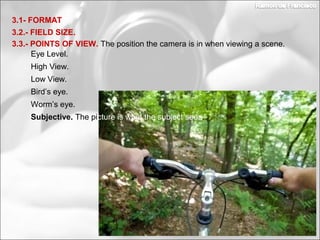
Subjective. The picture is what the subject sees.
Bird’s eye.
Eye Level.
High View.
Low View.
3.2.- FIELD SIZE.
3.1- FORMAT
3.3.- POINTS OF VIEW. The position the camera is in when viewing a scene.
3.4.- COMPOSITION RULES.
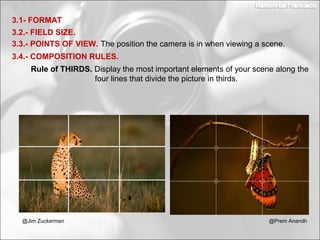
Rule of THIRDS. Display the most important elements of your scene along the
four lines that divide the picture in thirds.
@Prem Anandh@Jim Zuckerman
3.2.- FIELD SIZE.
3.1- FORMAT
3.3.- POINTS OF VIEW. The position the camera is in when viewing a scene.
3.4.- COMPOSITION RULES.
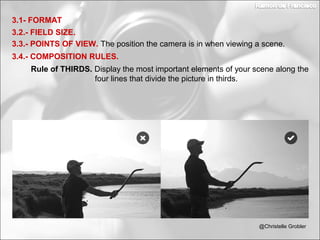
Rule of THIRDS. Display the most important elements of your scene along the
four lines that divide the picture in thirds.
@Christelle Grobler
3.2.- FIELD SIZE.
3.1- FORMAT
3.3.- POINTS OF VIEW. The position the camera is in when viewing a scene.
3.4.- COMPOSITION RULES.
Rule of THIRDS.
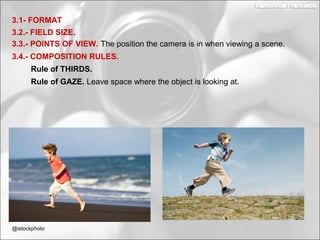
Rule of GAZE. Leave space where the object is looking at.
@istockphoto
3.2.- FIELD SIZE.
3.1- FORMAT
3.3.- POINTS OF VIEW. The position the camera is in when viewing a scene.
3.4.- COMPOSITION RULES.
Rule of THIRDS.
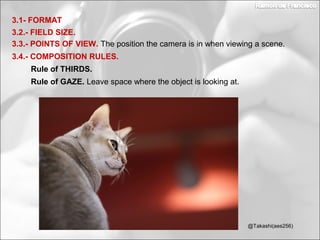
Rule of GAZE. Leave space where the object is looking at.
@Takashi(aes256)

Photography 1 eso

  • 1.
  • 2.
    1.- BRIEF HISTORY 2.-PHOTOGRAPHY AND HUMAN VISION 3.- TAKING PICTURES
  • 3.
  • 4.
  • 5.
  • 6.
  • 7.
    2.- PHOTOGRAPHY &HUMAN VISION
  • 8.
    How does the humaneye work? How does a camera work?
  • 9.
    3.- TAKING PICTURES 3.1.-FORMAT 3.2.- FIELD SIZE 3.3.- POINTS OF VIEW 3.4.- COMPOSITION RULES
  • 10.
  • 11.
    3.2.- FIELD SIZE.How much of the subject and its surrounding area is seen. Very Extreme Long Shot. Set the scene. The character is not visible. 3.1- FORMAT
  • 12.
    3.2.- FIELD SIZE.How much of the subject and its surrounding area is seen. Very Extreme Long Shot. Set the scene. The character is not visible. 3.1- FORMAT
  • 13.
    Extreme Long Shot.Shows the whole figure of your subject as well as his surroundings. Both of them share importance. 3.2.- FIELD SIZE. How much of the subject and its surrounding area is seen. 3.1- FORMAT Very Extreme Long Shot
  • 14.
    3.2.- FIELD SIZE.How much of the subject and its surrounding area is seen. 3.1- FORMAT Extreme Long Shot. Shows the whole figure of your subject as well as his surroundings. Both of them share importance. Very Extreme Long Shot
  • 15.
    Long shot. Showsthe subject from top to bottom and the environment and the people around it but the point of the focus is the subject. 3.2.- FIELD SIZE. How much of the subject and its surrounding area is seen. 3.1- FORMAT Extreme Long Shot. Very Extreme Long Shot
  • 16.
    Medium Long Shot.Frames the whole subject from the knees up. Long shot. 3.2.- FIELD SIZE. How much of the subject and its surrounding area is seen. 3.1- FORMAT Extreme Long Shot. Very Extreme Long Shot
  • 17.
    Medium Long Shot. Longshot. 3.2.- FIELD SIZE. How much of the subject and its surrounding area is seen. 3.1- FORMAT Extreme Long Shot. Very Extreme Long Shot Medium Shot. Frames the subject from the waist up.
  • 18.
    Medium Long Shot. Longshot. 3.2.- FIELD SIZE. How much of the subject and its surrounding area is seen. 3.1- FORMAT Extreme Long Shot. Very Extreme Long Shot Medium Shot. Frames the subject from the waist up.
  • 19.
    Medium Long Shot. Longshot. 3.2.- FIELD SIZE. How much of the subject and its surrounding area is seen. 3.1- FORMAT Extreme Long Shot. Very Extreme Long Shot Medium Shot. Close-up Shot. Frames the subject's head
  • 20.
    Medium Long Shot. Longshot. 3.2.- FIELD SIZE. How much of the subject and its surrounding area is seen. 3.1- FORMAT Extreme Long Shot. Very Extreme Long Shot Medium Shot. Close-up Shot. Extreme Close-up Shot. Emphasizes a small area or detail of the subject
  • 21.
    3.2.- FIELD SIZE. 3.1-FORMAT 3.3.- POINTS OF VIEW. The position the camera is in when viewing a scene. Eye Level. The camera is at eye level with the subject.
  • 22.
    3.2.- FIELD SIZE. 3.1-FORMAT 3.3.- POINTS OF VIEW. The position the camera is in when viewing a scene. Eye Level. High View. The camera is above the subject and facing downwards.
  • 23.
    3.2.- FIELD SIZE. 3.1-FORMAT 3.3.- POINTS OF VIEW. Eye Level. High View. Low View. The camera is below the subject and facing upwards.
  • 24.
    3.2.- FIELD SIZE. 3.1-FORMAT 3.3.- POINTS OF VIEW. The position the camera is in when viewing a scene. Eye Level. High View. Low View. Bird’s eye. The camera is looking directly down on the subject.
  • 25.
    3.2.- FIELD SIZE. 3.1-FORMAT 3.3.- POINTS OF VIEW. The position the camera is in when viewing a scene. Bird’s eye. Worm’s eye. The camera is below the subject and looking right up. Eye Level. High View. Low View.
  • 26.
    3.2.- FIELD SIZE. 3.1-FORMAT 3.3.- POINTS OF VIEW. The position the camera is in when viewing a scene. Worm’s eye. Subjective. The picture is what the subject sees. Bird’s eye. Eye Level. High View. Low View.
  • 27.
    3.2.- FIELD SIZE. 3.1-FORMAT 3.3.- POINTS OF VIEW. The position the camera is in when viewing a scene. 3.4.- COMPOSITION RULES. Rule of THIRDS. Display the most important elements of your scene along the four lines that divide the picture in thirds. @Prem Anandh@Jim Zuckerman
  • 28.
    3.2.- FIELD SIZE. 3.1-FORMAT 3.3.- POINTS OF VIEW. The position the camera is in when viewing a scene. 3.4.- COMPOSITION RULES. Rule of THIRDS. Display the most important elements of your scene along the four lines that divide the picture in thirds. @Christelle Grobler
  • 29.
    3.2.- FIELD SIZE. 3.1-FORMAT 3.3.- POINTS OF VIEW. The position the camera is in when viewing a scene. 3.4.- COMPOSITION RULES. Rule of THIRDS. Rule of GAZE. Leave space where the object is looking at. @istockphoto
  • 30.
    3.2.- FIELD SIZE. 3.1-FORMAT 3.3.- POINTS OF VIEW. The position the camera is in when viewing a scene. 3.4.- COMPOSITION RULES. Rule of THIRDS. Rule of GAZE. Leave space where the object is looking at. @Takashi(aes256)