AAI:  Appraiser & Lender Perspectives Mitch Kreeger, MAI, SRA Chief Appraiser, Affinity Bank [email_address]
Introduction Regulatory Compliance:  USPAP Methodology (FIRREA, Appraisal Institute) Affinity Bank Loan Policy Survey of Lender Policies
USPAP Advisory Opinion 9 – “Appraisal of Real Property That May Be Impacted by Environmental Contamination” Competency & Requisite Knowledge Have it, Get it, or Rely on outside experts (Extraordinary Assumption) Relevant Property Characteristics – usually obtained from 3rd party experts (EPs)
Terms  (USPAP AO-9) -- Property Value Diminution -- Environmental Contamination -- Environmental Risk -- Environmental Stigma -- Impaired Value:  “as-is” value of a contaminated property. -- Remediation Cost -- Remediation Lifecycle:  3 stages of cleanup…before, during and after remediation.
Terms, cont.  (AO-9) -- Source, Non-source, Adjacent and Proximate Sites: Source sites are the sites on which contamination is, or has been, generated. Non-source sites are sites onto which contamination, generated from a source site, has migrated. Adjacent site is not contaminated, but shares a common property line with a source site. Proximate sites are not contaminated and not adjacent, but are in close proximity to the source site. -- Unimpaired Value:  Market value under hypothetical condition (not contaminated).
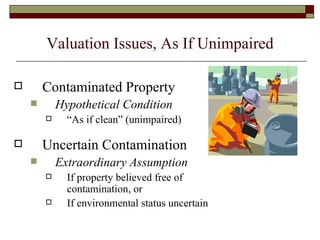
Valuation Issues, As If Unimpaired Contaminated Property Hypothetical Condition “As if clean” (unimpaired) Uncertain Contamination Extraordinary Assumption If property believed free of contamination, or If environmental status uncertain
Valuation Issues, As Impaired (Brownfields) Highest & Best Use issues: As If Unimpaired  -  no limitations  from contamination As Impaired  -  considers limitations  due to environmental contamination and legal use restrictions associated with cleanup, and how it may affect: Feasibility of site development or redevelopment, Use during and after remediation, and Marketability Will excessive environmental risk and/or stigma deter site development or redevelopment until acceptable risk levels?
Satisfying USPAP SR 1-4 (Scope of Work) Impaired value  may   not  equal unimpaired value less costs of remediation & compliance Cost, Use & Risk Effects  – potential value impact Cost:   deductions for remediation costs Use:   impacts on utility of the site due to contamination Risk:   derived from market’s perception (Environmental Stigma) of increased environmental risk or uncertainty, based on actual market data
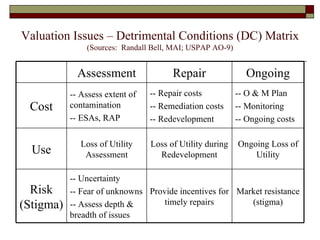
Valuation Issues – Detrimental Conditions (DC) Matrix (Sources:  Randall Bell, MAI; USPAP AO-9) Market resistance (stigma) Provide incentives for timely repairs -- Uncertainty -- Fear of unknowns -- Assess depth & breadth of issues Risk (Stigma) Ongoing Loss of Utility Loss of Utility during Redevelopment Loss of Utility Assessment Use -- O & M Plan -- Monitoring -- Ongoing costs -- Repair costs -- Remediation costs -- Redevelopment -- Assess extent of contamination -- ESAs, RAP Cost Ongoing Repair Assessment
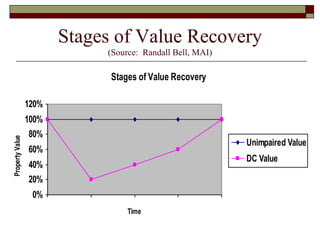
Stages of Value Recovery (Source:  Randall Bell, MAI)
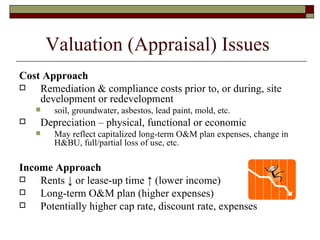
Valuation (Appraisal) Issues  Cost Approach Remediation & compliance costs prior to, or during, site development or redevelopment soil, groundwater, asbestos, lead paint, mold, etc. Depreciation – physical, functional or economic May reflect capitalized long-term O&M plan expenses, change in H&BU, full/partial loss of use, etc. Income Approach Rents  ↓  or lease-up time  ↑  (lower income) Long-term O&M plan (higher expenses) Potentially higher cap rate, discount rate, expenses
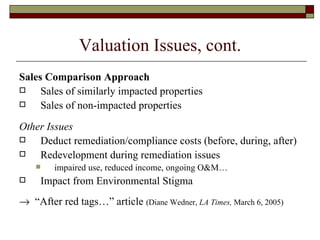
Valuation Issues, cont. Sales Comparison Approach Sales of similarly impacted properties Sales of non-impacted properties Other Issues Deduct remediation/compliance costs (before, during, after) Redevelopment during remediation issues impaired use, reduced income, ongoing O&M… Impact from Environmental Stigma    “ After red tags…” article  (Diane Wedner,  LA Times,  March 6, 2005)
Lender Point of View: Affinity Bank
Lender Point of View - Affinity Bank Low risk lender $1B assets Privately owned FDIC Bulletin FIL-14-93 “Guidelines for an Environmental Risk Program” Property Inspection – Site Visits Regional loan manager Credit risk officer Appraiser
Lender Point of View - Affinity Bank Initial Due Diligence Environmental Risk Questionnaire  (applicant) Transaction Screen  (bank ordered) ESA:  Phase I and/or Phase II  (borrower) Secured Creditor Impaired Property Policy  (SCIPP) Potential environmental risk mitigation Coverage must begin  upon default , not foreclosure
Lender Point of View - Affinity Bank  Ongoing Due Diligence Training -- credit & lending personnel Vendors/Consultants -- licensed + approved by Bank AAI -- “Wait-and-See” until finalized, implemented Environmental Insurance (SCIPP) -- monitor carriers, terms: Zurich – lesser of cleanup  or  outstanding loan balance  upon default AIG – lesser of cleanup  or  outstanding loan balance  after foreclosure Chubb – coverage is  not transferable  (secondary market) Kemper – essentially out of business Others – only carry property owner policies
Lender Point of View: Lender Survey
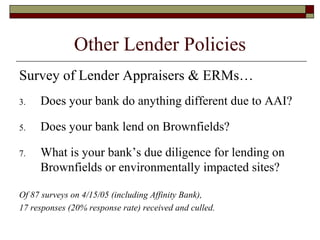
Other Lender Policies Survey of Lender Appraisers & ERMs… Does your bank do anything different due to AAI? Does your bank lend on Brownfields? What is your bank’s due diligence for lending on Brownfields or environmentally impacted sites? Of 87 surveys on 4/15/05 (including Affinity Bank), 17 responses (20% response rate) received and culled.
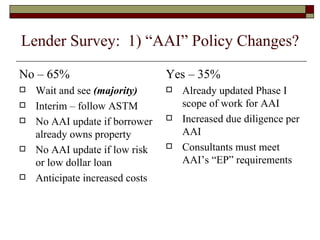
Lender Survey:  1) “AAI” Policy Changes? No – 65% Wait and see  (majority) Interim – follow ASTM No AAI update if borrower already owns property No AAI update if low risk or low dollar loan Anticipate increased costs Yes – 35% Already updated Phase I scope of work for AAI Increased due diligence per AAI Consultants must meet AAI’s “EP” requirements
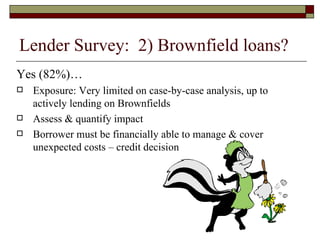
Yes (82%)… Exposure: Very limited on case-by-case analysis, up to actively lending on Brownfields Assess & quantify impact Borrower must be financially able to manage & cover unexpected costs – credit decision Lender Survey:  2) Brownfield loans?
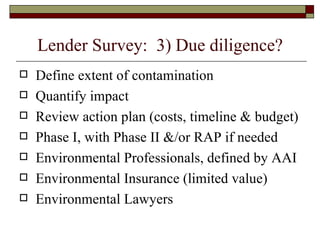
Lender Survey:  3) Due diligence? Define extent of contamination Quantify impact Review action plan (costs, timeline & budget) Phase I, with Phase II &/or RAP if needed Environmental Professionals, defined by AAI Environmental Insurance (limited value) Environmental Lawyers
Lender Survey:  3) Due diligence? Do NOT depend on liability risks, BFPP or other defenses Underwrite to the risks US EPA definition of AAI may not be supported by State authority over cleanup Establish financial mitigation (escrow acct) ASTM may be key to defining due diligence
Questions?
Sources & Links: Appraisal Institute ( www.appraisalinstitute.org ) Environmental Bankers Association ( www.envirobank.org ) Risk Management Association ( www.rmahq.org ) Affinity Bank ( www.AffinityBank.com ) Thanks to my survey respondents!

Phoenix Brownfields University 2005

  • 1.
    AAI: Appraiser& Lender Perspectives Mitch Kreeger, MAI, SRA Chief Appraiser, Affinity Bank [email_address]
  • 2.
    Introduction Regulatory Compliance: USPAP Methodology (FIRREA, Appraisal Institute) Affinity Bank Loan Policy Survey of Lender Policies
  • 3.
    USPAP Advisory Opinion9 – “Appraisal of Real Property That May Be Impacted by Environmental Contamination” Competency & Requisite Knowledge Have it, Get it, or Rely on outside experts (Extraordinary Assumption) Relevant Property Characteristics – usually obtained from 3rd party experts (EPs)
  • 4.
    Terms (USPAPAO-9) -- Property Value Diminution -- Environmental Contamination -- Environmental Risk -- Environmental Stigma -- Impaired Value: “as-is” value of a contaminated property. -- Remediation Cost -- Remediation Lifecycle: 3 stages of cleanup…before, during and after remediation.
  • 5.
    Terms, cont. (AO-9) -- Source, Non-source, Adjacent and Proximate Sites: Source sites are the sites on which contamination is, or has been, generated. Non-source sites are sites onto which contamination, generated from a source site, has migrated. Adjacent site is not contaminated, but shares a common property line with a source site. Proximate sites are not contaminated and not adjacent, but are in close proximity to the source site. -- Unimpaired Value: Market value under hypothetical condition (not contaminated).
  • 6.
    Valuation Issues, AsIf Unimpaired Contaminated Property Hypothetical Condition “As if clean” (unimpaired) Uncertain Contamination Extraordinary Assumption If property believed free of contamination, or If environmental status uncertain
  • 7.
    Valuation Issues, AsImpaired (Brownfields) Highest & Best Use issues: As If Unimpaired - no limitations from contamination As Impaired - considers limitations due to environmental contamination and legal use restrictions associated with cleanup, and how it may affect: Feasibility of site development or redevelopment, Use during and after remediation, and Marketability Will excessive environmental risk and/or stigma deter site development or redevelopment until acceptable risk levels?
  • 8.
    Satisfying USPAP SR1-4 (Scope of Work) Impaired value may not equal unimpaired value less costs of remediation & compliance Cost, Use & Risk Effects – potential value impact Cost: deductions for remediation costs Use: impacts on utility of the site due to contamination Risk: derived from market’s perception (Environmental Stigma) of increased environmental risk or uncertainty, based on actual market data
  • 9.
    Valuation Issues –Detrimental Conditions (DC) Matrix (Sources: Randall Bell, MAI; USPAP AO-9) Market resistance (stigma) Provide incentives for timely repairs -- Uncertainty -- Fear of unknowns -- Assess depth & breadth of issues Risk (Stigma) Ongoing Loss of Utility Loss of Utility during Redevelopment Loss of Utility Assessment Use -- O & M Plan -- Monitoring -- Ongoing costs -- Repair costs -- Remediation costs -- Redevelopment -- Assess extent of contamination -- ESAs, RAP Cost Ongoing Repair Assessment
  • 10.
    Stages of ValueRecovery (Source: Randall Bell, MAI)
  • 11.
    Valuation (Appraisal) Issues Cost Approach Remediation & compliance costs prior to, or during, site development or redevelopment soil, groundwater, asbestos, lead paint, mold, etc. Depreciation – physical, functional or economic May reflect capitalized long-term O&M plan expenses, change in H&BU, full/partial loss of use, etc. Income Approach Rents ↓ or lease-up time ↑ (lower income) Long-term O&M plan (higher expenses) Potentially higher cap rate, discount rate, expenses
  • 12.
    Valuation Issues, cont.Sales Comparison Approach Sales of similarly impacted properties Sales of non-impacted properties Other Issues Deduct remediation/compliance costs (before, during, after) Redevelopment during remediation issues impaired use, reduced income, ongoing O&M… Impact from Environmental Stigma  “ After red tags…” article (Diane Wedner, LA Times, March 6, 2005)
  • 13.
    Lender Point ofView: Affinity Bank
  • 14.
    Lender Point ofView - Affinity Bank Low risk lender $1B assets Privately owned FDIC Bulletin FIL-14-93 “Guidelines for an Environmental Risk Program” Property Inspection – Site Visits Regional loan manager Credit risk officer Appraiser
  • 15.
    Lender Point ofView - Affinity Bank Initial Due Diligence Environmental Risk Questionnaire (applicant) Transaction Screen (bank ordered) ESA: Phase I and/or Phase II (borrower) Secured Creditor Impaired Property Policy (SCIPP) Potential environmental risk mitigation Coverage must begin upon default , not foreclosure
  • 16.
    Lender Point ofView - Affinity Bank Ongoing Due Diligence Training -- credit & lending personnel Vendors/Consultants -- licensed + approved by Bank AAI -- “Wait-and-See” until finalized, implemented Environmental Insurance (SCIPP) -- monitor carriers, terms: Zurich – lesser of cleanup or outstanding loan balance upon default AIG – lesser of cleanup or outstanding loan balance after foreclosure Chubb – coverage is not transferable (secondary market) Kemper – essentially out of business Others – only carry property owner policies
  • 17.
    Lender Point ofView: Lender Survey
  • 18.
    Other Lender PoliciesSurvey of Lender Appraisers & ERMs… Does your bank do anything different due to AAI? Does your bank lend on Brownfields? What is your bank’s due diligence for lending on Brownfields or environmentally impacted sites? Of 87 surveys on 4/15/05 (including Affinity Bank), 17 responses (20% response rate) received and culled.
  • 19.
    Lender Survey: 1) “AAI” Policy Changes? No – 65% Wait and see (majority) Interim – follow ASTM No AAI update if borrower already owns property No AAI update if low risk or low dollar loan Anticipate increased costs Yes – 35% Already updated Phase I scope of work for AAI Increased due diligence per AAI Consultants must meet AAI’s “EP” requirements
  • 20.
    Yes (82%)… Exposure:Very limited on case-by-case analysis, up to actively lending on Brownfields Assess & quantify impact Borrower must be financially able to manage & cover unexpected costs – credit decision Lender Survey: 2) Brownfield loans?
  • 21.
    Lender Survey: 3) Due diligence? Define extent of contamination Quantify impact Review action plan (costs, timeline & budget) Phase I, with Phase II &/or RAP if needed Environmental Professionals, defined by AAI Environmental Insurance (limited value) Environmental Lawyers
  • 22.
    Lender Survey: 3) Due diligence? Do NOT depend on liability risks, BFPP or other defenses Underwrite to the risks US EPA definition of AAI may not be supported by State authority over cleanup Establish financial mitigation (escrow acct) ASTM may be key to defining due diligence
  • 23.
  • 24.
    Sources & Links:Appraisal Institute ( www.appraisalinstitute.org ) Environmental Bankers Association ( www.envirobank.org ) Risk Management Association ( www.rmahq.org ) Affinity Bank ( www.AffinityBank.com ) Thanks to my survey respondents!