Plymouth eBook Project
Phil Gee
the idea
• customer is the school, not its
students (core texts).
key benefits
• teach knowing ALL students can access
reading (anywhere)
• level playing field
• note sharing (for starters ... nexus for
educational tech)
• frees up library resources.
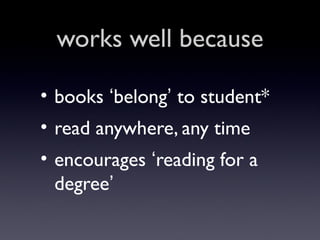
works well because
• books ‘belong’ to student*
• read anywhere, any time
• encourages ‘reading for a
degree’
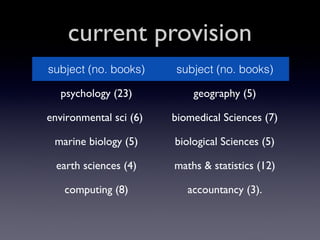
current provision
subject (no. books)

subject (no. books)

psychology (23)

geography (5)

environmental sci (6)

biomedical Sciences (7)

marine biology (5)

biological Sciences (5)

earth sciences (4)

maths & statistics (12)

computing (8)

accountancy (3).
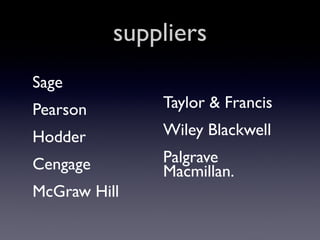
suppliers
Sage
Pearson

Taylor & Francis

Hodder

Wiley Blackwell

Cengage

Palgrave
Macmillan.

McGraw Hill
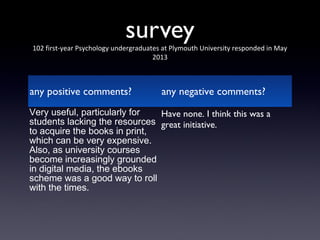
survey

102 first-year Psychology undergraduates at Plymouth University responded in May
2013

any positive comments?

any negative comments?

Very useful, particularly for
Have none. I think this was a
students lacking the resources great initiative.
to acquire the books in print,
which can be very expensive.
Also, as university courses
become increasingly grounded
in digital media, the ebooks
scheme was a good way to roll
with the times.
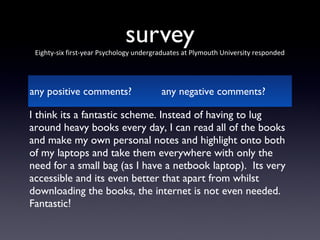
survey

Eighty-six first-year Psychology undergraduates at Plymouth University responded

any positive comments?

any negative comments?

I think its a fantastic scheme. Instead of having to lug
around heavy books every day, I can read all of the books
and make my own personal notes and highlight onto both
of my laptops and take them everywhere with only the
need for a small bag (as I have a netbook laptop). Its very
accessible and its even better that apart from whilst
downloading the books, the internet is not even needed.
Fantastic!
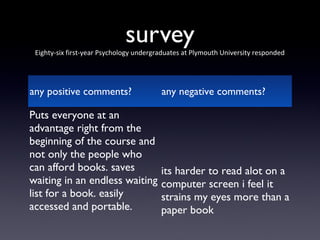
survey

Eighty-six first-year Psychology undergraduates at Plymouth University responded

any positive comments?

any negative comments?

Puts everyone at an
advantage right from the
beginning of the course and
not only the people who
can afford books. saves
waiting in an endless waiting
list for a book. easily
accessed and portable.

its harder to read alot on a
computer screen i feel it
strains my eyes more than a
paper book
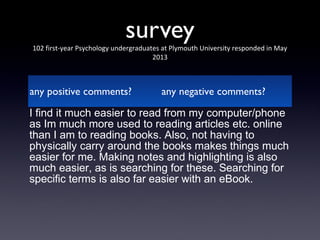
survey

102 first-year Psychology undergraduates at Plymouth University responded in May
2013

any positive comments?

any negative comments?

I find it much easier to read from my computer/phone
as Im much more used to reading articles etc. online
than I am to reading books. Also, not having to
physically carry around the books makes things much
easier for me. Making notes and highlighting is also
much easier, as is searching for these. Searching for
specific terms is also far easier with an eBook.
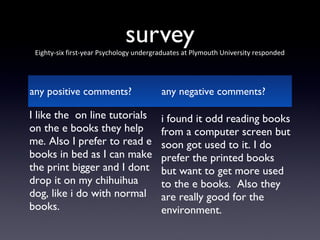
survey

Eighty-six first-year Psychology undergraduates at Plymouth University responded

any positive comments?

any negative comments?

I like the on line tutorials
on the e books they help
me. Also I prefer to read e
books in bed as I can make
the print bigger and I dont
drop it on my chihuihua
dog, like i do with normal
books.

i found it odd reading books
from a computer screen but
soon got used to it. I do
prefer the printed books
but want to get more used
to the e books. Also they
are really good for the
environment.
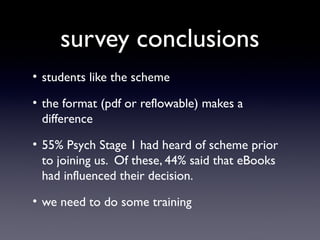
survey conclusions
• students like the scheme
• the format (pdf or reflowable) makes a
difference
• 55% Psych Stage 1 had heard of scheme prior
to joining us. Of these, 44% said that eBooks
had influenced their decision.
• we need to do some training
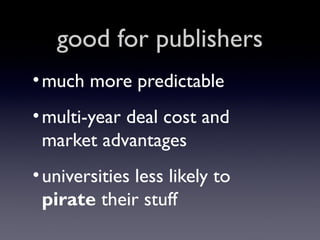
good for publishers
• much more predictable
• multi-year deal cost and
market advantages
• universities less likely to
pirate their stuff
good for us
• we do our job more
effectively
• we have happy students
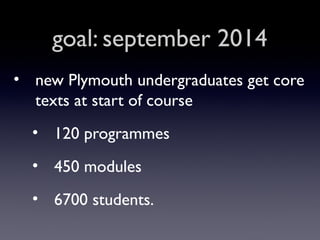
goal: september 2014
• new Plymouth undergraduates get core
texts at start of course
• 120 programmes
• 450 modules
• 6700 students.
challenge: working with
academics
• herding cats would be easier
• decision: which available texts suitable?
• commit to several years?
• email isn’t enough
• a new cost.
challenge: working with
publishers
• like herding partially-trained cats
• variation in digital & institutional
strategies
• variation in pricing policy
• RRP RIP?.
challenge: working
together
• find ways to collect & share data
• focus on service not products
• clear and realistic pricing
final thoughts
• really exciting time in academic publishing
• opportunity to put quality (& enhanced?)
texts in to back pockets
• chance to develop new partnerships &
ways of thinking about content.
pgee@plymouth.ac.uk

Phil gee

  • 1.
  • 2.
    the idea • customeris the school, not its students (core texts).
  • 3.
    key benefits • teachknowing ALL students can access reading (anywhere) • level playing field • note sharing (for starters ... nexus for educational tech) • frees up library resources.
  • 4.
    works well because •books ‘belong’ to student* • read anywhere, any time • encourages ‘reading for a degree’
  • 5.
    current provision subject (no.books) subject (no. books) psychology (23) geography (5) environmental sci (6) biomedical Sciences (7) marine biology (5) biological Sciences (5) earth sciences (4) maths & statistics (12) computing (8) accountancy (3).
  • 6.
    suppliers Sage Pearson Taylor & Francis Hodder WileyBlackwell Cengage Palgrave Macmillan. McGraw Hill
  • 7.
    survey 102 first-year Psychologyundergraduates at Plymouth University responded in May 2013 any positive comments? any negative comments? Very useful, particularly for Have none. I think this was a students lacking the resources great initiative. to acquire the books in print, which can be very expensive. Also, as university courses become increasingly grounded in digital media, the ebooks scheme was a good way to roll with the times.
  • 8.
    survey Eighty-six first-year Psychologyundergraduates at Plymouth University responded any positive comments? any negative comments? I think its a fantastic scheme. Instead of having to lug around heavy books every day, I can read all of the books and make my own personal notes and highlight onto both of my laptops and take them everywhere with only the need for a small bag (as I have a netbook laptop). Its very accessible and its even better that apart from whilst downloading the books, the internet is not even needed. Fantastic!
  • 9.
    survey Eighty-six first-year Psychologyundergraduates at Plymouth University responded any positive comments? any negative comments? Puts everyone at an advantage right from the beginning of the course and not only the people who can afford books. saves waiting in an endless waiting list for a book. easily accessed and portable. its harder to read alot on a computer screen i feel it strains my eyes more than a paper book
  • 10.
    survey 102 first-year Psychologyundergraduates at Plymouth University responded in May 2013 any positive comments? any negative comments? I find it much easier to read from my computer/phone as Im much more used to reading articles etc. online than I am to reading books. Also, not having to physically carry around the books makes things much easier for me. Making notes and highlighting is also much easier, as is searching for these. Searching for specific terms is also far easier with an eBook.
  • 11.
    survey Eighty-six first-year Psychologyundergraduates at Plymouth University responded any positive comments? any negative comments? I like the on line tutorials on the e books they help me. Also I prefer to read e books in bed as I can make the print bigger and I dont drop it on my chihuihua dog, like i do with normal books. i found it odd reading books from a computer screen but soon got used to it. I do prefer the printed books but want to get more used to the e books. Also they are really good for the environment.
  • 12.
    survey conclusions • studentslike the scheme • the format (pdf or reflowable) makes a difference • 55% Psych Stage 1 had heard of scheme prior to joining us. Of these, 44% said that eBooks had influenced their decision. • we need to do some training
  • 13.
    good for publishers •much more predictable • multi-year deal cost and market advantages • universities less likely to pirate their stuff
  • 14.
    good for us •we do our job more effectively • we have happy students
  • 15.
    goal: september 2014 •new Plymouth undergraduates get core texts at start of course • 120 programmes • 450 modules • 6700 students.
  • 16.
    challenge: working with academics •herding cats would be easier • decision: which available texts suitable? • commit to several years? • email isn’t enough • a new cost.
  • 17.
    challenge: working with publishers •like herding partially-trained cats • variation in digital & institutional strategies • variation in pricing policy • RRP RIP?.
  • 18.
    challenge: working together • findways to collect & share data • focus on service not products • clear and realistic pricing
  • 19.
    final thoughts • reallyexciting time in academic publishing • opportunity to put quality (& enhanced?) texts in to back pockets • chance to develop new partnerships & ways of thinking about content.
  • 20.

Editor's Notes

  • #2 Background less on pricing benefits to students challenges in setting up vision for future 30 mins plus Q&A