 Presented to:
Madam Amna Shahid
 Presented by:
Ammara Ahsan
Ayesha Amjad
Najia Majid
Rashda Meraj
by
Ammara Ahsan
Ayesha Amjad
Najia Majid
Rashda Meraj
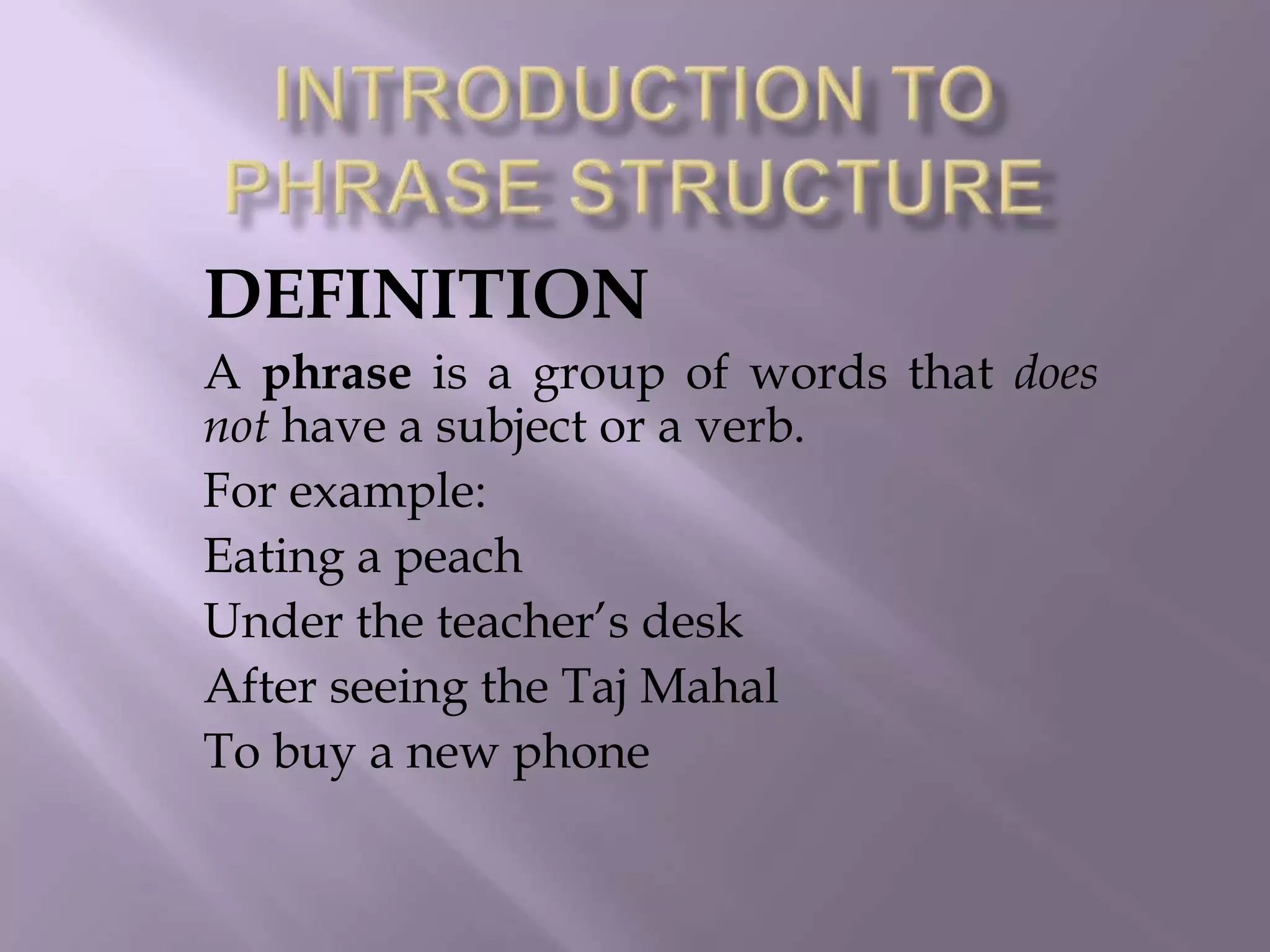
DEFINITION
A phrase is a group of words that does
not have a subject or a verb.
For example:
Eating a peach
Under the teacher‟s desk
After seeing the Taj Mahal
To buy a new phone
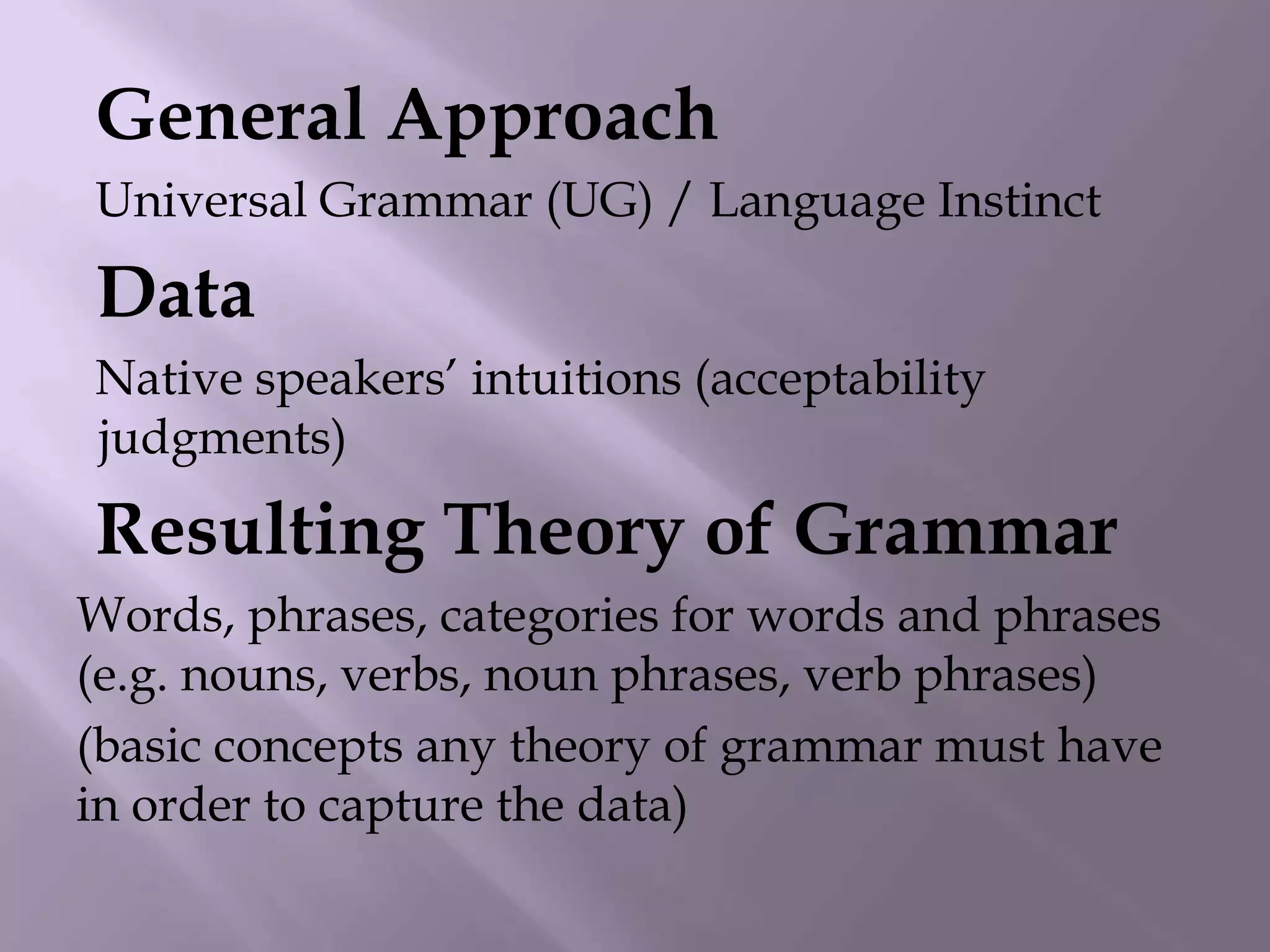
General Approach
Universal Grammar (UG) / Language Instinct
Data
Native speakers‟ intuitions (acceptability
judgments)
Resulting Theory of Grammar
Words, phrases, categories for words and phrases
(e.g. nouns, verbs, noun phrases, verb phrases)
(basic concepts any theory of grammar must have
in order to capture the data)
1) Every word belongs to a lexical category
2) Lexical categories forms heads of phrases
3) How phrases are formed is governed by rules
(= „phrase structure rules‟)
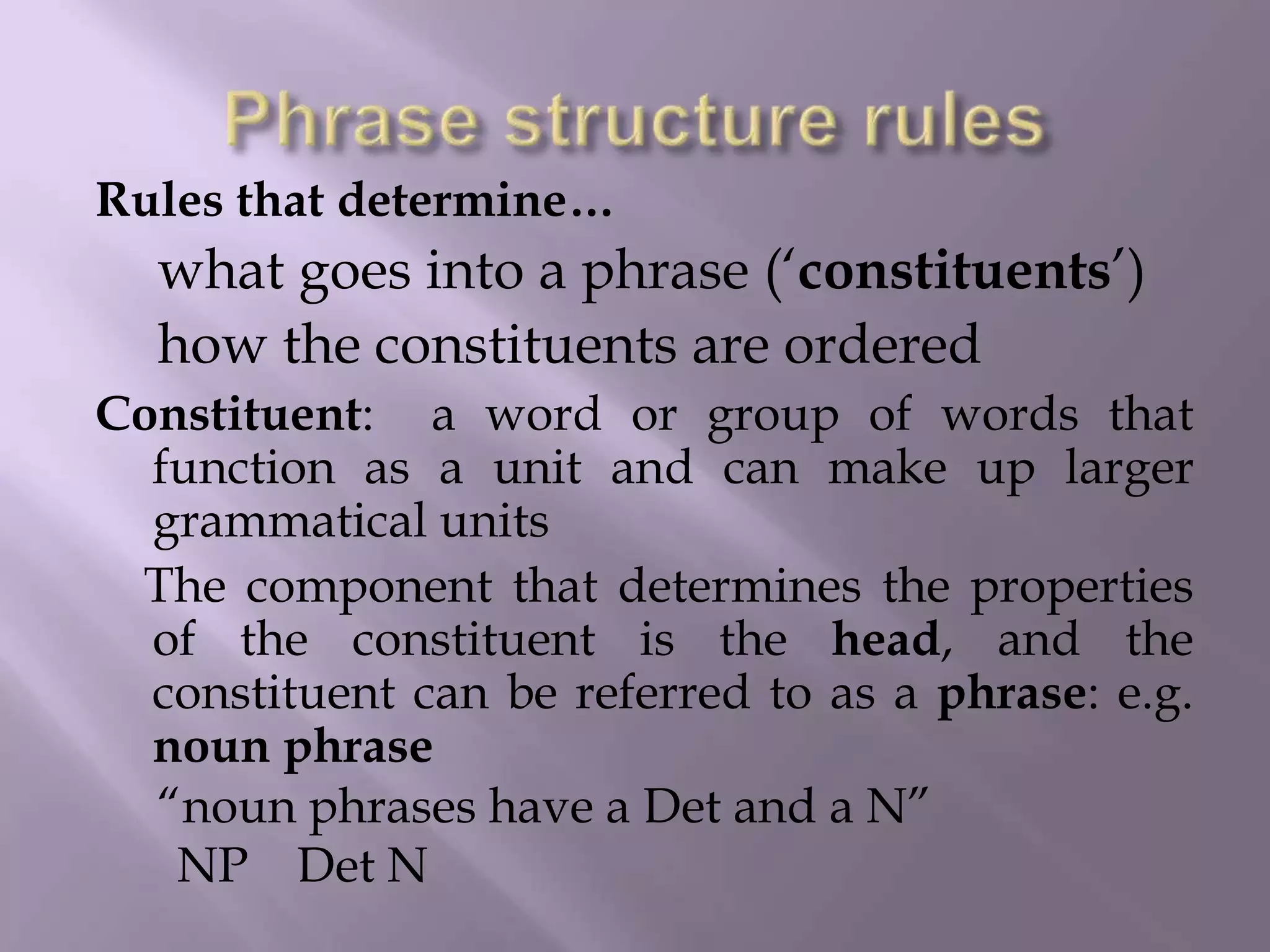
Rules that determine…
what goes into a phrase („constituents‟)
how the constituents are ordered
Constituent: a word or group of words that
function as a unit and can make up larger
grammatical units
The component that determines the properties
of the constituent is the head, and the
constituent can be referred to as a phrase: e.g.
noun phrase
“noun phrases have a Det and a N”
NP Det N
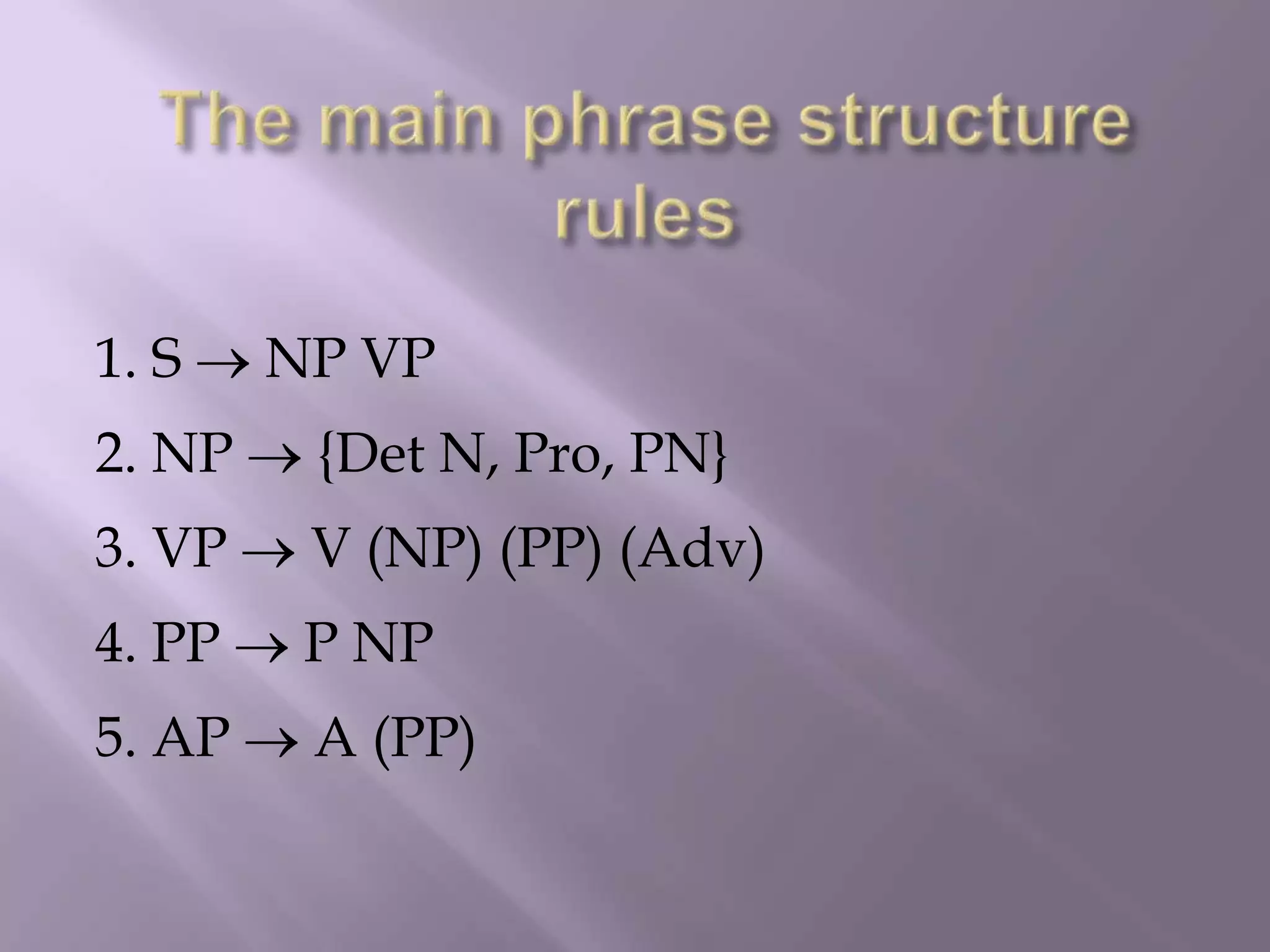
1. S NP VP
2. NP {Det N, Pro, PN}
3. VP V (NP) (PP) (Adv)
4. PP P NP
5. AP A (PP)
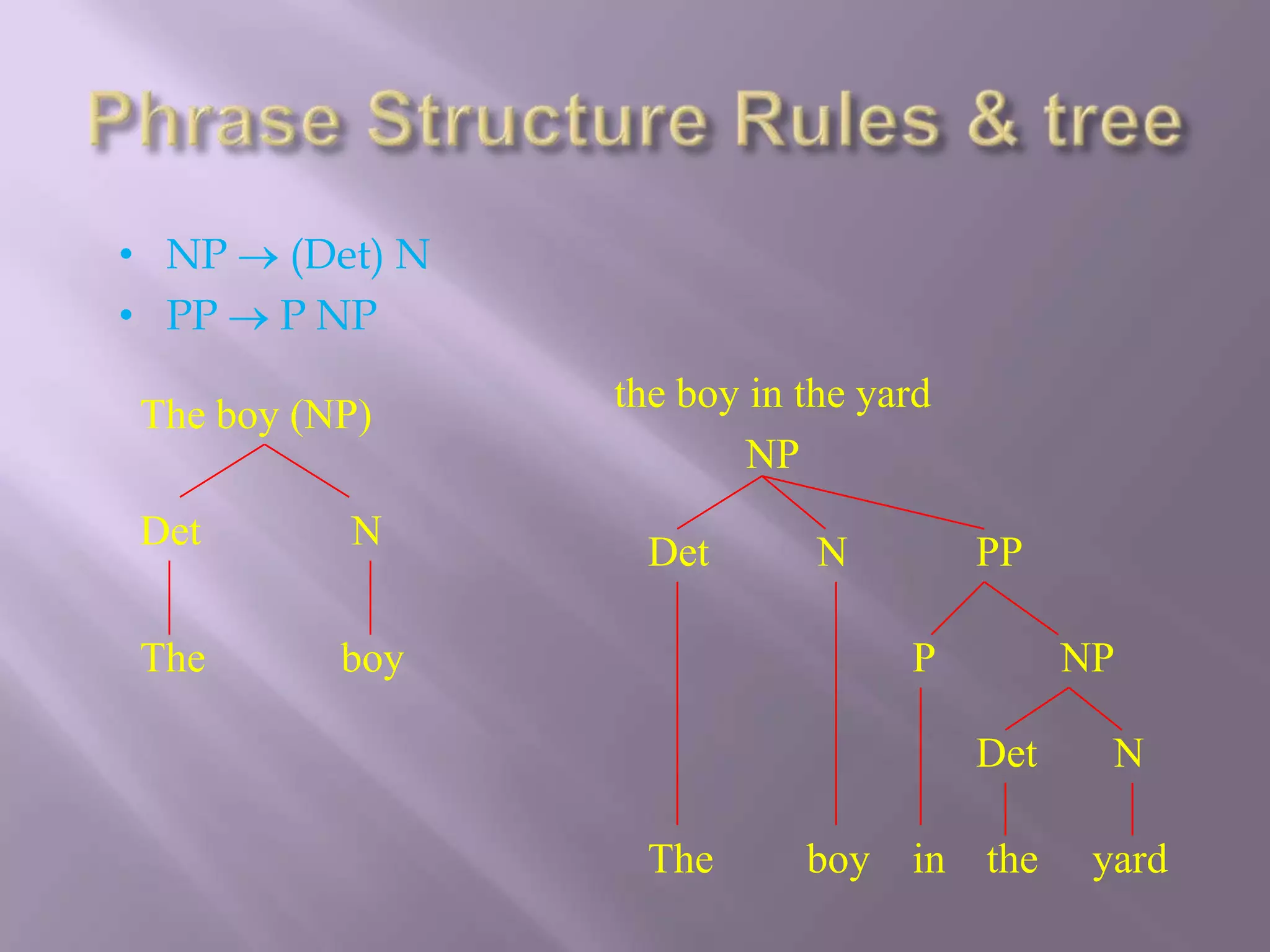
• NP (Det) N
• PP P NP
The boy (NP)
The
NDet
boy
the boy in the yard
NP
The
NDet
boy
PP
in
NPP
the
Det N
yard
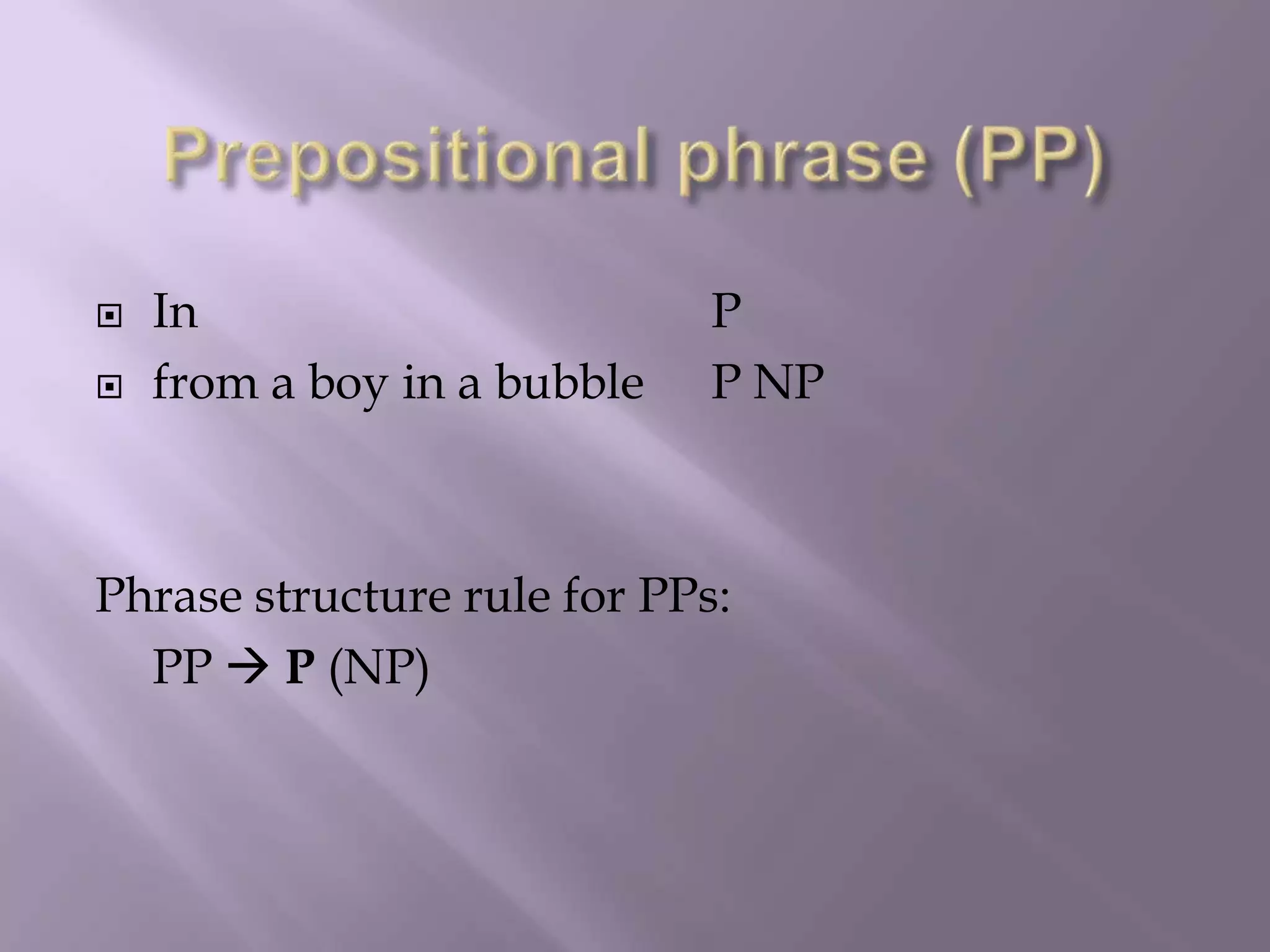
 In P
 from a boy in a bubble P NP
Phrase structure rule for PPs:
PP  P (NP)
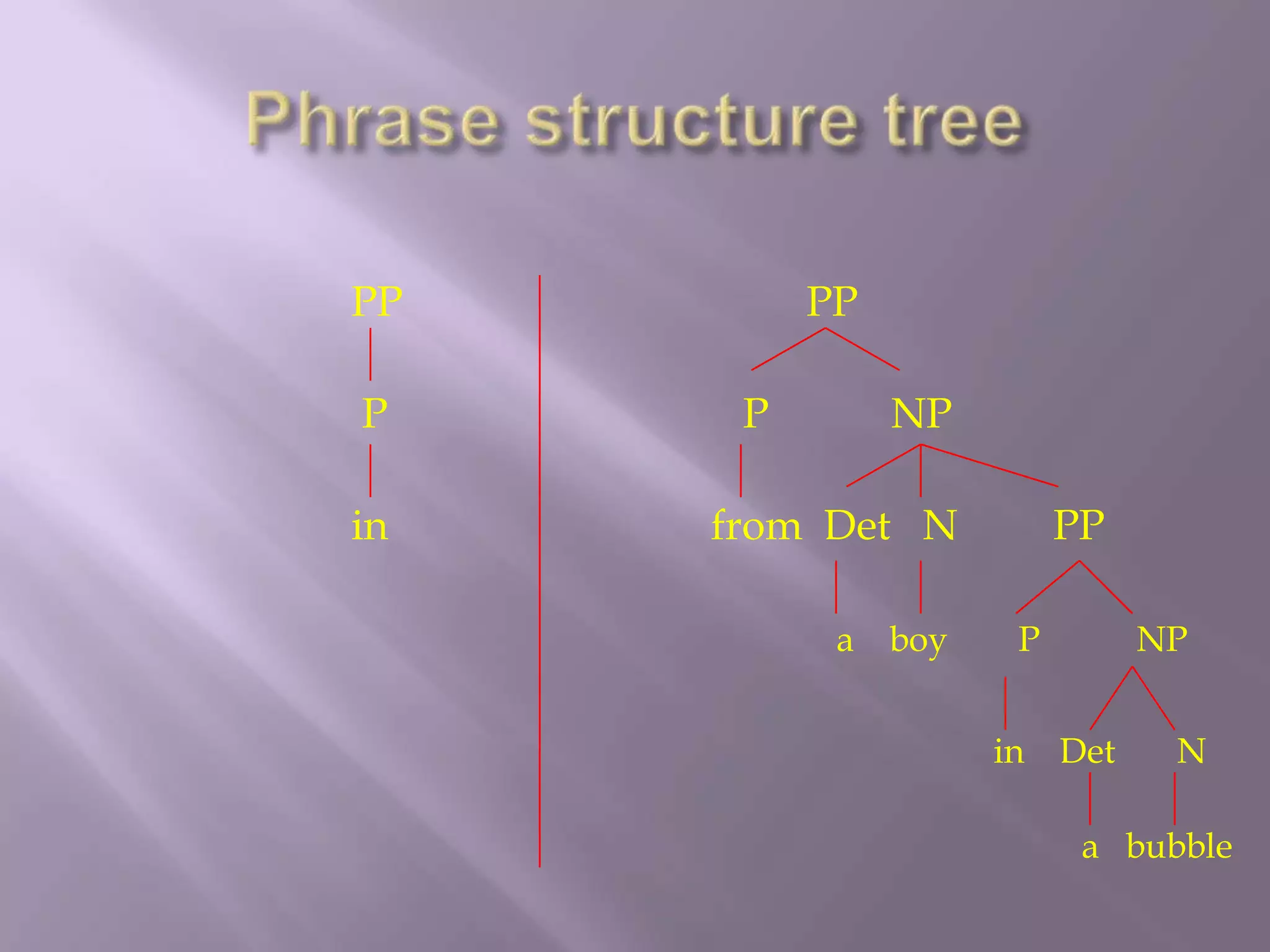
PP PP
P P NP
in from Det N PP
a boy P NP
in Det N
a bubble
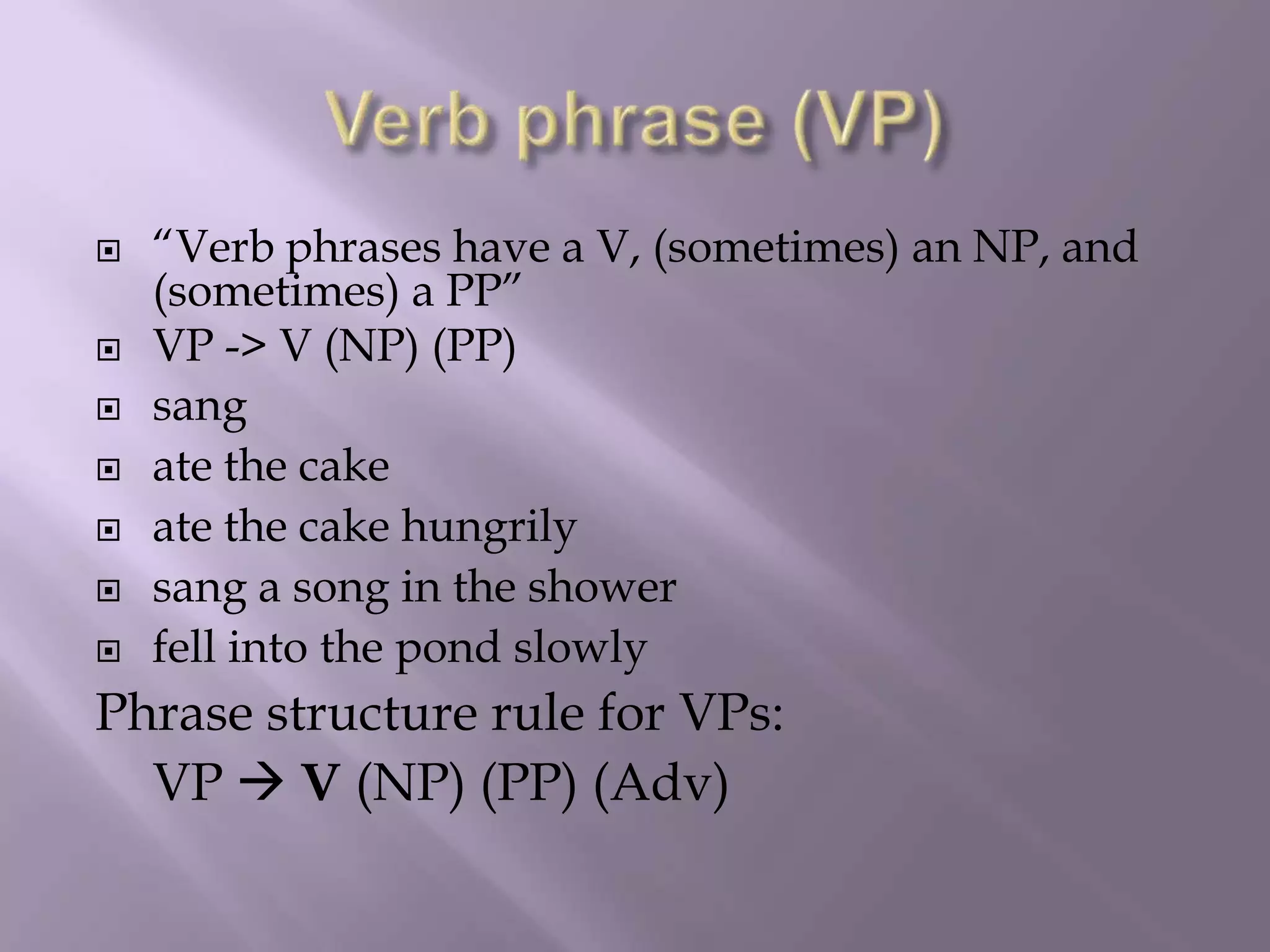
 “Verb phrases have a V, (sometimes) an NP, and
(sometimes) a PP”
 VP -> V (NP) (PP)
 sang
 ate the cake
 ate the cake hungrily
 sang a song in the shower
 fell into the pond slowly
Phrase structure rule for VPs:
VP  V (NP) (PP) (Adv)
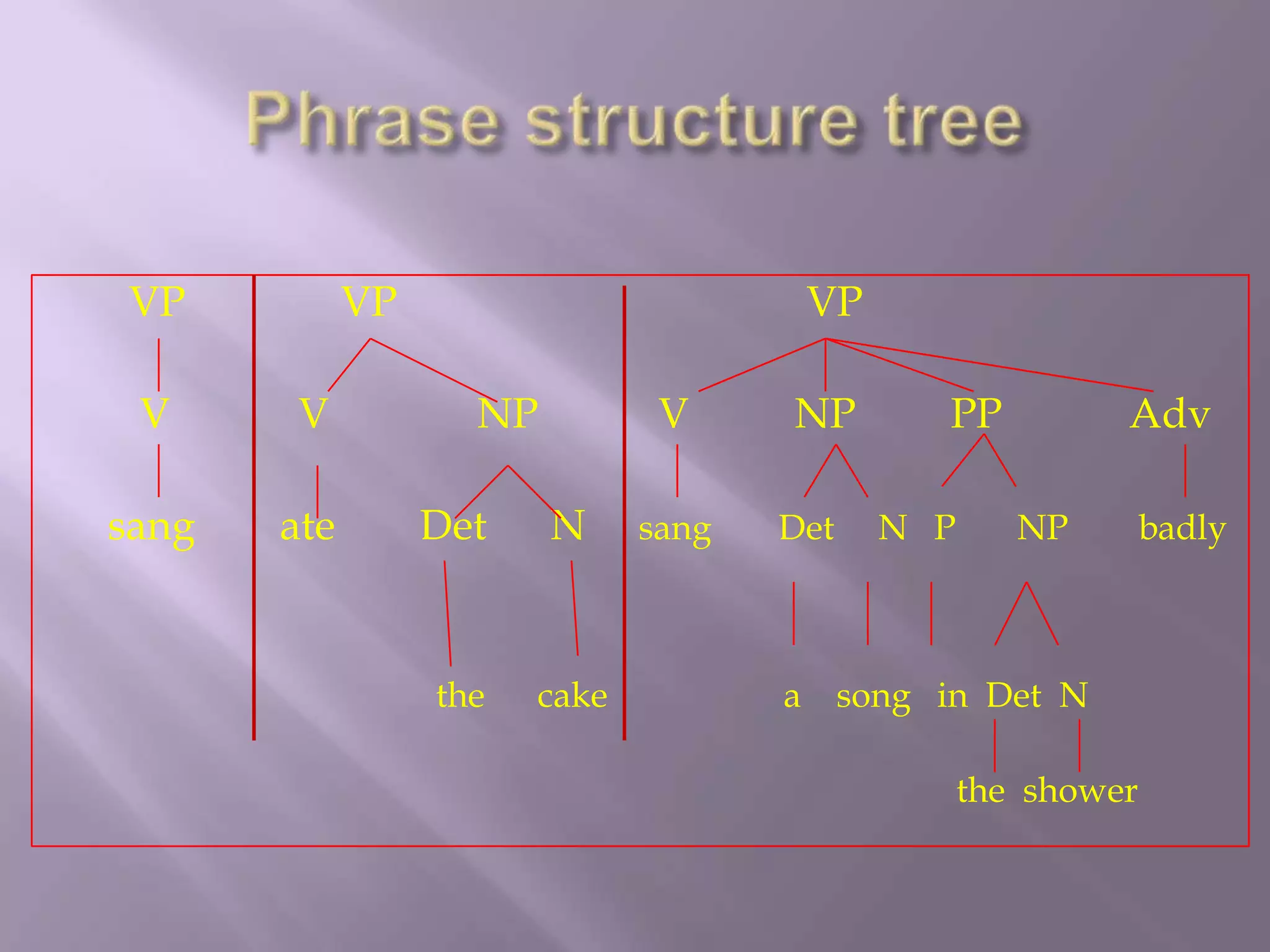
VP VP VP
V V NP V NP PP Adv
sang ate Det N sang Det N P NP badly
the cake a song in Det N
the shower
Thank You

Phase structure

  • 2.
     Presented to: MadamAmna Shahid  Presented by: Ammara Ahsan Ayesha Amjad Najia Majid Rashda Meraj
  • 3.
  • 4.
    DEFINITION A phrase isa group of words that does not have a subject or a verb. For example: Eating a peach Under the teacher‟s desk After seeing the Taj Mahal To buy a new phone
  • 5.
    General Approach Universal Grammar(UG) / Language Instinct Data Native speakers‟ intuitions (acceptability judgments) Resulting Theory of Grammar Words, phrases, categories for words and phrases (e.g. nouns, verbs, noun phrases, verb phrases) (basic concepts any theory of grammar must have in order to capture the data)
  • 6.
    1) Every wordbelongs to a lexical category 2) Lexical categories forms heads of phrases 3) How phrases are formed is governed by rules (= „phrase structure rules‟)
  • 7.
    Rules that determine… whatgoes into a phrase („constituents‟) how the constituents are ordered Constituent: a word or group of words that function as a unit and can make up larger grammatical units The component that determines the properties of the constituent is the head, and the constituent can be referred to as a phrase: e.g. noun phrase “noun phrases have a Det and a N” NP Det N
  • 8.
    1. S NPVP 2. NP {Det N, Pro, PN} 3. VP V (NP) (PP) (Adv) 4. PP P NP 5. AP A (PP)
  • 9.
    • NP (Det)N • PP P NP The boy (NP) The NDet boy the boy in the yard NP The NDet boy PP in NPP the Det N yard
  • 10.
     In P from a boy in a bubble P NP Phrase structure rule for PPs: PP  P (NP)
  • 11.
    PP PP P PNP in from Det N PP a boy P NP in Det N a bubble
  • 12.
     “Verb phraseshave a V, (sometimes) an NP, and (sometimes) a PP”  VP -> V (NP) (PP)  sang  ate the cake  ate the cake hungrily  sang a song in the shower  fell into the pond slowly Phrase structure rule for VPs: VP  V (NP) (PP) (Adv)
  • 13.
    VP VP VP VV NP V NP PP Adv sang ate Det N sang Det N P NP badly the cake a song in Det N the shower
  • 14.