The Pharmacy Act
-
CONTENTS
 INTRODUCTION
 HISTORYOFTHEACT
 PHARMACYCOUNCILOFINDIA
 STATEPHARMACYCOUNCIL
 SPECIALPROVISIONSOFTHEACT
 OFFENCESANDPENALTIES
 CONCLUSION
 REFERENCES
INTRODUCTION
 “AnAct to regulate the Profession of Pharmacy.”
 TheAct waspromulgated in the Year1948.
 ThePharmacy Bill, 1947, having been passedby the
Legislature received its assent on 4th March, 1948. It came
on the Statute Book asTHEPHARMACY ACT,1948 (8 of
1948).
 Definitions –
 CentralCouncil
 StateCouncil
 CentralRegister
 MedicalPractitioner
 RegisteredPharmacist
HISTORY OF THE PHARMACYACT
Greatharm
to the
Health of
the People
Early twentieth
century – No
restriction to the
practice of
Pharmacy.
Poor quality of
service.
Absence of
recognized
curriculum
 Thefollowing statement of objects and reasons of the
Pharmacy Bill waspublished in the Gazette of India,1947,
Part V,Page469:
“It is desirable that, asin most other countries, only persons who
have attained aminimum standard of professional educationshould
be permitted to practise the profession of Pharmacy. It is
accordingly proposed to establish aCentral Council, which will
prescribe the minimum standards of education and approved
coursesof study and examination for Pharmacists, and Provincial
Pharmacy Councils, which will be responsible for the maintenance
of provincial registers of Qualified Pharmacists. It is further
proposed to empower Provincial Governments to prohibit the
dispensing of medicines on the prescription pf amedical
practitioner otherwise than by,or under the direct and personal
supervision of, aRegistered Pharmacist.”
OBJECTIVES
Regulating and Raisingthe Status of theProfession
of Pharmacy in India.
Providing uniform education and training tothe
persons willing to enter the profession of
Pharmacy.
Maintaining control over the persons enteringthe
profession of Pharmacy.
PHARMACY COUNCIL OF INDIA
ThePCIwasfirst constituted in the year1949.
Reconstituted every 5years.
Composition:
Elected members
Nominated members
Ex-officio members
www.ngsmips.nitte.edu.in
 Elected members –
 Sixmembers – Elected by UGCfrom Teachingprofession.
 Onemember – Elected by MCI
 Onemember – Elected by State Pharmacy Council.
 Nominated members –
 Sixmembers – Nominated by Central Govt.
 Onerepresentative each– UGCandAICTE
 OneRegisteredPharmacist – EachState/ Union Territory
 Ex– Officio members–
 TheDirector General of HealthServices
 TheDirector of Central DrugsLaboratory.
 TheDrugsController of India.
EXECUTIVECOMMITTEE–
ThePresident of the Council.
TheVice President of the Council.
Fiveother members elected by the Central Councilfrom
amongst its members.
Apart from this, the council also appoints–
ARegistrar
Other officers and servants for carrying out its statutory
functions.
Toframe an educational structure for the would be pharmacist and tokeep
it tuned to the changing needs with passageof time .
Education Regulations
Recognisethe qualification granted outside the territory to whichthe
PharmacyAct extends.
Maintain the Central Register for Pharmacists.
Other functions for the furtherance of the Act.
FUNCTIONSOFTHEPCI–
 APPROVAL– Procedure to be followed for approval for an
institution providing course of study inPharmacy:
 Application by institution toPCI
 Inspection
 Approval
 Declaration
 WITHDRAWAL–
Non compliance with EducationRegulations
Notice issued to the Institution by the PCI.
3 month window for the Institute to make its representation.
Final Decision rests with thePCI.
APPROVAL/WITHDRAWAL OF
INSTITUTIONS
APPROVAL OF QUALIFICATION GRANTED
OUTSIDE INDIA
 Qualification in Pharmacy granted outside India
canbe recognised by the PCI.This is applicable to
Indian Citizens.
 Citizensof Foreign nationality canbe eligible for
registration when an Indian national holding the
samequalification is allowed to enter anpractice
in that country.
MAINTENANCE OF CENTRAL
REGISTER
Under the provisions of the Pharmacy Act
(Amendment), 1976, the PCIis required to
maintain aCentral Register.
TheRegister has to:
Maintained by the Registrar of theCouncil.
Hasto be revised suitably from time totime.
Published in the Gazette of India.
STATEPHARMACY COUNCIL
 Constitution of aState Pharmacy Council in eachstate.
 Composition –
Elected members-
Sixmembers – Elected from amongst themselves by registered
pharmacist of thestate.
Onemember elected by the Medical Council ofState.
Nominated members–
Fivemembers – nominated by the StateGovt.
Ex-Officio members–
ChiefAdministrative Medical Officer
Officer in-charge of DrugsControlAdministration ofState.
GovernmentAnalyst.
JOINT STATE PHARMACY
COUNCIL
 Twoor more states enter into an agreement to form a Joint
State PharmacyCouncil.
 Elected Members –
 Registeredpharmacist – 3 to 5 from each state instead of 6 ina
SingleState Council.
 Medical Council – one from eachState.
 Nominated Members–
Government Nominees – 2 to 4 from each State instead of 5.
 Ex-Officio Members –
 ChiefAdministrative Medical
 Officer in-charge of DrugsControlAdministration
 GovernmentAnalyst
 ThePresident and Vice-President are elected by
the members from amongstthemselves.
 Period of 5years.
 CasualVacancyis filled by nomination or election.
 Members are eligible for re-election.
 Possessesan Executive Committee similar to the
Central Government.
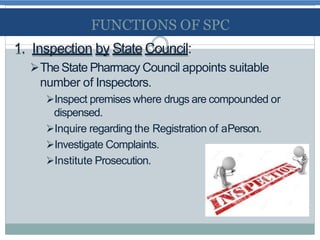
FUNCTIONS OF SPC
1. Inspection by State Council:
TheState Pharmacy Council appoints suitable
number of Inspectors.
Inspect premises where drugs are compounded or
dispensed.
Inquire regarding the Registration of aPerson.
Investigate Complaints.
Institute Prosecution.
2. Maintenance of Registers –
Thefirst and subsequent Registers of Pharmacists in aState–
Prepared and maintained by the StateGovernment.
TheState Councils, before the end of Juneeach year, are
required to pay to the PCI,asum equivalent to one-fourth of
the fessrealised by them during the period of 12 months ,
ending March 31st in thatyear.
Register of PharmacistsParticulars.
3. ENTRYANDREMOVALOFNAMES:
 Entry –
 All applications for registration should be addressed to
the Registrar of the State PharmacyCouncil.
 Ifthe applicant hasthe requisite qualifications for
registration, he shall direct his or her name to be entered in
the register.
 Upon entry, aCertificate of Registration isissued.
 Personwhose name hasbeen removed from the Register of
any State shall not be entitled to registration unless the State
Council gives its consent.
 Renewal Rules.
Removal –
Thename of apharmacist may be removed fromthe
register on followingcounts-
If his name hasbeen entered in register byerror.
If he hasbeen convicted of an offence inany professional
respect.
If aperson employed by him is convicted of an offense or is
guilty of infamousconduct.
30 day period forAppealing.
Surrender of the Certificate of Registration and Published in
the Official Gazette.
4. Printing of Registers-
Printing of the Registers– carried out on the first day of
April following the beginning of the Pharmacy
(Amendment)Act, 1959.
Thereafter, eachyear after the first of April, the
Registrar willarrange for the reprinting, showing
supplements to theRegisters.
TheseRegistersand supplements are deemed to be
proof that the persons, whose name are contained
therein, are registeredpharmacist.
SPECIAL PROVISIONS OF THE
ACT
PharmacyAct, 1959 (Amendment) –
Pertaining to Pharmacists affected by the Partitionof
1947.
Also, the Reorganisation of States in1956.
Provisions remained in effect for aperiod of 2years.
State Governments were empowered to extendthe
period of operation up toanother 2 years.
PharmacyAct, 1976 (Amendment) –
Provided for Registration of Pharmacists bySPC’swho:
Were eligible for Registration between the closing of the First
register and the coming into effect of the Educational
Regulations.
Approved Qualified Persons,before 31st December1969,
under the Drugsand CosmeticsAct, 1940 andRules.
Displaced persons from Bangladesh,after 14th April, 1957but
before 25th March,1971.
Repatriates from Burma, SriLanka,Ugandaor anyother
country.
OFFENCES PENALTIES
1. FalselyClaimsto be aRegistered
Pharmacist
 Fine up to Rs500.00 onfirst
conviction.
 Fine up to Rs1000.00 and/or 6
months imprisonment of any
subsequent conviction.
2. Dispensing by an Unregistered
Person(Exception – Medical
Practitioner)
 6 months of imprisonment or afineof
up to Rs1000 or both.
3. Failure to Surrender theCertificate
of Registration
 Fine of Rs50.
4. Obstruction of StatePharmacy
CouncilInspectors
 Imprisonment of up to 6 months or a
fine of up to Rs1000 orboth.

Pharmacyact

  • 1.
  • 2.
    CONTENTS  INTRODUCTION  HISTORYOFTHEACT PHARMACYCOUNCILOFINDIA  STATEPHARMACYCOUNCIL  SPECIALPROVISIONSOFTHEACT  OFFENCESANDPENALTIES  CONCLUSION  REFERENCES
  • 3.
    INTRODUCTION  “AnAct toregulate the Profession of Pharmacy.”  TheAct waspromulgated in the Year1948.  ThePharmacy Bill, 1947, having been passedby the Legislature received its assent on 4th March, 1948. It came on the Statute Book asTHEPHARMACY ACT,1948 (8 of 1948).  Definitions –  CentralCouncil  StateCouncil  CentralRegister  MedicalPractitioner  RegisteredPharmacist
  • 4.
    HISTORY OF THEPHARMACYACT Greatharm to the Health of the People Early twentieth century – No restriction to the practice of Pharmacy. Poor quality of service. Absence of recognized curriculum
  • 5.
     Thefollowing statementof objects and reasons of the Pharmacy Bill waspublished in the Gazette of India,1947, Part V,Page469: “It is desirable that, asin most other countries, only persons who have attained aminimum standard of professional educationshould be permitted to practise the profession of Pharmacy. It is accordingly proposed to establish aCentral Council, which will prescribe the minimum standards of education and approved coursesof study and examination for Pharmacists, and Provincial Pharmacy Councils, which will be responsible for the maintenance of provincial registers of Qualified Pharmacists. It is further proposed to empower Provincial Governments to prohibit the dispensing of medicines on the prescription pf amedical practitioner otherwise than by,or under the direct and personal supervision of, aRegistered Pharmacist.”
  • 6.
    OBJECTIVES Regulating and RaisingtheStatus of theProfession of Pharmacy in India. Providing uniform education and training tothe persons willing to enter the profession of Pharmacy. Maintaining control over the persons enteringthe profession of Pharmacy.
  • 7.
    PHARMACY COUNCIL OFINDIA ThePCIwasfirst constituted in the year1949. Reconstituted every 5years. Composition: Elected members Nominated members Ex-officio members www.ngsmips.nitte.edu.in
  • 8.
     Elected members–  Sixmembers – Elected by UGCfrom Teachingprofession.  Onemember – Elected by MCI  Onemember – Elected by State Pharmacy Council.  Nominated members –  Sixmembers – Nominated by Central Govt.  Onerepresentative each– UGCandAICTE  OneRegisteredPharmacist – EachState/ Union Territory  Ex– Officio members–  TheDirector General of HealthServices  TheDirector of Central DrugsLaboratory.  TheDrugsController of India.
  • 9.
    EXECUTIVECOMMITTEE– ThePresident of theCouncil. TheVice President of the Council. Fiveother members elected by the Central Councilfrom amongst its members. Apart from this, the council also appoints– ARegistrar Other officers and servants for carrying out its statutory functions.
  • 10.
    Toframe an educationalstructure for the would be pharmacist and tokeep it tuned to the changing needs with passageof time . Education Regulations Recognisethe qualification granted outside the territory to whichthe PharmacyAct extends. Maintain the Central Register for Pharmacists. Other functions for the furtherance of the Act. FUNCTIONSOFTHEPCI–
  • 11.
     APPROVAL– Procedureto be followed for approval for an institution providing course of study inPharmacy:  Application by institution toPCI  Inspection  Approval  Declaration  WITHDRAWAL– Non compliance with EducationRegulations Notice issued to the Institution by the PCI. 3 month window for the Institute to make its representation. Final Decision rests with thePCI. APPROVAL/WITHDRAWAL OF INSTITUTIONS
  • 12.
    APPROVAL OF QUALIFICATIONGRANTED OUTSIDE INDIA  Qualification in Pharmacy granted outside India canbe recognised by the PCI.This is applicable to Indian Citizens.  Citizensof Foreign nationality canbe eligible for registration when an Indian national holding the samequalification is allowed to enter anpractice in that country.
  • 13.
    MAINTENANCE OF CENTRAL REGISTER Underthe provisions of the Pharmacy Act (Amendment), 1976, the PCIis required to maintain aCentral Register. TheRegister has to: Maintained by the Registrar of theCouncil. Hasto be revised suitably from time totime. Published in the Gazette of India.
  • 14.
    STATEPHARMACY COUNCIL  Constitutionof aState Pharmacy Council in eachstate.  Composition – Elected members- Sixmembers – Elected from amongst themselves by registered pharmacist of thestate. Onemember elected by the Medical Council ofState. Nominated members– Fivemembers – nominated by the StateGovt. Ex-Officio members– ChiefAdministrative Medical Officer Officer in-charge of DrugsControlAdministration ofState. GovernmentAnalyst.
  • 15.
    JOINT STATE PHARMACY COUNCIL Twoor more states enter into an agreement to form a Joint State PharmacyCouncil.  Elected Members –  Registeredpharmacist – 3 to 5 from each state instead of 6 ina SingleState Council.  Medical Council – one from eachState.  Nominated Members– Government Nominees – 2 to 4 from each State instead of 5.  Ex-Officio Members –  ChiefAdministrative Medical  Officer in-charge of DrugsControlAdministration  GovernmentAnalyst
  • 16.
     ThePresident andVice-President are elected by the members from amongstthemselves.  Period of 5years.  CasualVacancyis filled by nomination or election.  Members are eligible for re-election.  Possessesan Executive Committee similar to the Central Government.
  • 17.
    FUNCTIONS OF SPC 1.Inspection by State Council: TheState Pharmacy Council appoints suitable number of Inspectors. Inspect premises where drugs are compounded or dispensed. Inquire regarding the Registration of aPerson. Investigate Complaints. Institute Prosecution.
  • 18.
    2. Maintenance ofRegisters – Thefirst and subsequent Registers of Pharmacists in aState– Prepared and maintained by the StateGovernment. TheState Councils, before the end of Juneeach year, are required to pay to the PCI,asum equivalent to one-fourth of the fessrealised by them during the period of 12 months , ending March 31st in thatyear. Register of PharmacistsParticulars.
  • 19.
    3. ENTRYANDREMOVALOFNAMES:  Entry–  All applications for registration should be addressed to the Registrar of the State PharmacyCouncil.  Ifthe applicant hasthe requisite qualifications for registration, he shall direct his or her name to be entered in the register.  Upon entry, aCertificate of Registration isissued.  Personwhose name hasbeen removed from the Register of any State shall not be entitled to registration unless the State Council gives its consent.  Renewal Rules.
  • 20.
    Removal – Thename ofapharmacist may be removed fromthe register on followingcounts- If his name hasbeen entered in register byerror. If he hasbeen convicted of an offence inany professional respect. If aperson employed by him is convicted of an offense or is guilty of infamousconduct. 30 day period forAppealing. Surrender of the Certificate of Registration and Published in the Official Gazette.
  • 21.
    4. Printing ofRegisters- Printing of the Registers– carried out on the first day of April following the beginning of the Pharmacy (Amendment)Act, 1959. Thereafter, eachyear after the first of April, the Registrar willarrange for the reprinting, showing supplements to theRegisters. TheseRegistersand supplements are deemed to be proof that the persons, whose name are contained therein, are registeredpharmacist.
  • 22.
    SPECIAL PROVISIONS OFTHE ACT PharmacyAct, 1959 (Amendment) – Pertaining to Pharmacists affected by the Partitionof 1947. Also, the Reorganisation of States in1956. Provisions remained in effect for aperiod of 2years. State Governments were empowered to extendthe period of operation up toanother 2 years.
  • 23.
    PharmacyAct, 1976 (Amendment)– Provided for Registration of Pharmacists bySPC’swho: Were eligible for Registration between the closing of the First register and the coming into effect of the Educational Regulations. Approved Qualified Persons,before 31st December1969, under the Drugsand CosmeticsAct, 1940 andRules. Displaced persons from Bangladesh,after 14th April, 1957but before 25th March,1971. Repatriates from Burma, SriLanka,Ugandaor anyother country.
  • 24.
    OFFENCES PENALTIES 1. FalselyClaimstobe aRegistered Pharmacist  Fine up to Rs500.00 onfirst conviction.  Fine up to Rs1000.00 and/or 6 months imprisonment of any subsequent conviction. 2. Dispensing by an Unregistered Person(Exception – Medical Practitioner)  6 months of imprisonment or afineof up to Rs1000 or both. 3. Failure to Surrender theCertificate of Registration  Fine of Rs50. 4. Obstruction of StatePharmacy CouncilInspectors  Imprisonment of up to 6 months or a fine of up to Rs1000 orboth.