PHARMACY ACT-1948
Pharmaceutical Jurisprudence
BALVINDRA SAHANI
ASSIGNMENT- 2
CONTENT
1. History of Pharmacy Act
2. Objective
3. Definition
4. Pharmacy council of india
5. Constitution and function of PCI
6. Education Regulation
7. State Pharmacy Council
8. Joint state Pharmacy council .
History of Pharmacy Act
● In India there was no restriction to practise the
profession of Pharmacy.
● One could practise this profession as any other
profession .
● Person, having no knowledge and having no education
in pharmacy or pharmaceutical chemisrty or
pharmacology, engaged in this profession.
History of Pharmacy Act
● Hundreds of cases were found by Government where in
the compounding , mixing or dispensing of medicines
was being done by person who were not adequately
educated in this line.
● These causing great harm to the health of people.
● It was found necessary to enact a law for the regulation
of the profession and practice of pharmacy.
Objective
● To restore the Pharmacy profession in its due place in the health
services.
● Raising the status of the profession of Pharmacy in India.
● To regulate the practice of Pharmacy in India.
● To provide uniform education and training through out India.
● To maintain control over persons entering the profession of
pharmacy.
● To Protect the Public Health
● — Medical Use of Drugs
● — Drug Abuse
DEFINITIONS
● "Pharmacy Act" : An Act to regulate the profession of
pharmacy.
● "Medical practitioner "
● A person,
➢ (i) Holding a qualification granted by an authority notified
under section 3 of the Indian Medical Degrees Act, 1916 or
specified in the schedules to the Indian Medical Council Act
1956.
(ii) Registered or eligible for registration in a Medical register
of a State, meant for the registration of persons practicing
the Modern scientific system of medicine; OR
(iii) Registered in a medical register of a State, who, although
not falling within above first and second clause , but is
declared by a general or special order made by the State
Government; OR
"Registered Pharmacist"
A person whose name is for the time being entered in the
register of the State in which he or she is for the time being
residing or carrying on his profession or business of
pharmacy.
PHARMACY COUNCIL OF INDIA
● The PCI was first constituted in the year 1949.
● Reconstituted every 5 years.
● Composition:
● Elected members
● Nominated members
● Ex-officio members
❖ Elected members —
❖ Six members — Elected by UGC from Teaching profession. ).
❖ One member — Elected by MCI .
❖ One member — Elected by State Pharmacy Council.
❖ Nominated members-
❖ Six members — Nominated by Central Govt.
❖ One representative each — UGC and AICTE .
❖ One Registered Pharmacist — Each State/ Union Territory
❖ Ex — Officio members -
❖ The Director General of Health Services .
❖ The Director of Central Drugs Laboratory.
❖ The Drugs Controller of India.
❖ EXECUTIVE COMMITTEE —
❖ The President of the Council.
❖ The Vice President of the Council.
❖ Five other members elected by the Central Council from
amongst its members.
❖ Apart from this, the council also appoints —
❖ A Registrar
❖ Other officers and servants for carrying out its statutory
functions.
FUNCTIONS OF P.C.I.
A) Education Regulations (E.R.)
-Minimum standard of education laid down by P.C.I. are known as the
"Education Regulation".
• They include,
i. Minimum qualification for registration as a Pharmacist.
ii. Minimum qualification for admission Diploma in Pharmacy.
iii. Duration of training and course of study to be covered.
iv. Condition to be fulfilled by the academic Institution and by the Examining
Authority.
v. Nature and period of practical training .
vi. The subjects of examination and minimum standard of passing.
vii. Condition to be fulfilled by the institution to be recognized for giving practical
training.
viii. Practical training contract form for Pharmacists.
B) To regulate the Education Regulation in the states.
C) Approval of the Institutions providing course and examination for the
pharmacists.
• Procedure:
i) Institution has to apply to P.C.I/A.I.C.T.E.
ii) P.C.UA.I.C.T.E. deputes its inspector to visit the institution.
iii) Inspector then reports to council on which if council is satisfied , it approves
the course of examination.
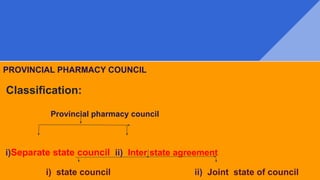
PROVINCIAL PHARMACY COUNCIL
Classification:
Provincial pharmacy council
i)Separate state council ii) Inter state agreement
i) state council ii) Joint state of council
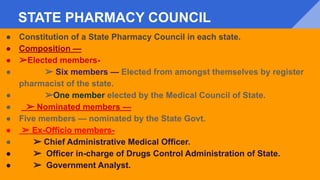
STATE PHARMACY COUNCIL
● Constitution of a State Pharmacy Council in each state.
● Composition —
● ➢Elected members-
● ➢ Six members — Elected from amongst themselves by register
pharmacist of the state.
● ➢One member elected by the Medical Council of State.
● ➢ Nominated members —
● Five members — nominated by the State Govt.
● ➢ Ex-Officio members-
● ➢ Chief Administrative Medical Officer.
● ➢ Officer in-charge of Drugs Control Administration of State.
● ➢ Government Analyst.
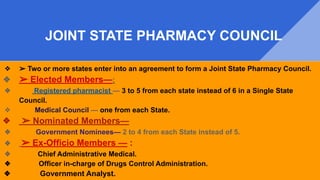
JOINT STATE PHARMACY COUNCIL
❖ ➢ Two or more states enter into an agreement to form a Joint State Pharmacy Council.
❖ ➢ Elected Members—:
❖ Registered pharmacist — 3 to 5 from each state instead of 6 in a Single State
Council.
❖ Medical Council — one from each State.
❖ ➢ Nominated Members—
❖ Government Nominees— 2 to 4 from each State instead of 5.
❖ ➢ Ex-Officio Members — :
❖ Chief Administrative Medical.
❖ Officer in-charge of Drugs Control Administration.
❖ Government Analyst.
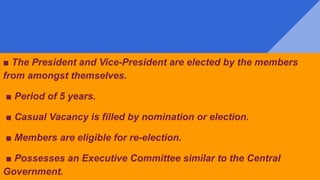
■ The President and Vice-President are elected by the members
from amongst themselves.
■ Period of 5 years.
■ Casual Vacancy is filled by nomination or election.
■ Members are eligible for re-election.
■ Possesses an Executive Committee similar to the Central
Government.
Pharmacy Act 1948

Pharmacy Act 1948

  • 1.
  • 2.
    CONTENT 1. History ofPharmacy Act 2. Objective 3. Definition 4. Pharmacy council of india 5. Constitution and function of PCI 6. Education Regulation 7. State Pharmacy Council 8. Joint state Pharmacy council .
  • 3.
    History of PharmacyAct ● In India there was no restriction to practise the profession of Pharmacy. ● One could practise this profession as any other profession . ● Person, having no knowledge and having no education in pharmacy or pharmaceutical chemisrty or pharmacology, engaged in this profession.
  • 4.
    History of PharmacyAct ● Hundreds of cases were found by Government where in the compounding , mixing or dispensing of medicines was being done by person who were not adequately educated in this line. ● These causing great harm to the health of people. ● It was found necessary to enact a law for the regulation of the profession and practice of pharmacy.
  • 5.
    Objective ● To restorethe Pharmacy profession in its due place in the health services. ● Raising the status of the profession of Pharmacy in India. ● To regulate the practice of Pharmacy in India.
  • 6.
    ● To provideuniform education and training through out India. ● To maintain control over persons entering the profession of pharmacy. ● To Protect the Public Health ● — Medical Use of Drugs ● — Drug Abuse
  • 7.
    DEFINITIONS ● "Pharmacy Act": An Act to regulate the profession of pharmacy. ● "Medical practitioner " ● A person, ➢ (i) Holding a qualification granted by an authority notified under section 3 of the Indian Medical Degrees Act, 1916 or specified in the schedules to the Indian Medical Council Act 1956.
  • 8.
    (ii) Registered oreligible for registration in a Medical register of a State, meant for the registration of persons practicing the Modern scientific system of medicine; OR (iii) Registered in a medical register of a State, who, although not falling within above first and second clause , but is declared by a general or special order made by the State Government; OR
  • 9.
    "Registered Pharmacist" A personwhose name is for the time being entered in the register of the State in which he or she is for the time being residing or carrying on his profession or business of pharmacy.
  • 10.
    PHARMACY COUNCIL OFINDIA ● The PCI was first constituted in the year 1949. ● Reconstituted every 5 years. ● Composition: ● Elected members ● Nominated members ● Ex-officio members
  • 11.
    ❖ Elected members— ❖ Six members — Elected by UGC from Teaching profession. ). ❖ One member — Elected by MCI . ❖ One member — Elected by State Pharmacy Council. ❖ Nominated members- ❖ Six members — Nominated by Central Govt. ❖ One representative each — UGC and AICTE . ❖ One Registered Pharmacist — Each State/ Union Territory ❖ Ex — Officio members - ❖ The Director General of Health Services . ❖ The Director of Central Drugs Laboratory. ❖ The Drugs Controller of India.
  • 12.
    ❖ EXECUTIVE COMMITTEE— ❖ The President of the Council. ❖ The Vice President of the Council. ❖ Five other members elected by the Central Council from amongst its members. ❖ Apart from this, the council also appoints — ❖ A Registrar ❖ Other officers and servants for carrying out its statutory functions.
  • 13.
    FUNCTIONS OF P.C.I. A)Education Regulations (E.R.) -Minimum standard of education laid down by P.C.I. are known as the "Education Regulation". • They include, i. Minimum qualification for registration as a Pharmacist. ii. Minimum qualification for admission Diploma in Pharmacy.
  • 14.
    iii. Duration oftraining and course of study to be covered. iv. Condition to be fulfilled by the academic Institution and by the Examining Authority. v. Nature and period of practical training . vi. The subjects of examination and minimum standard of passing. vii. Condition to be fulfilled by the institution to be recognized for giving practical training. viii. Practical training contract form for Pharmacists.
  • 15.
    B) To regulatethe Education Regulation in the states. C) Approval of the Institutions providing course and examination for the pharmacists. • Procedure: i) Institution has to apply to P.C.I/A.I.C.T.E. ii) P.C.UA.I.C.T.E. deputes its inspector to visit the institution. iii) Inspector then reports to council on which if council is satisfied , it approves the course of examination.
  • 16.
    PROVINCIAL PHARMACY COUNCIL Classification: Provincialpharmacy council i)Separate state council ii) Inter state agreement i) state council ii) Joint state of council
  • 17.
    STATE PHARMACY COUNCIL ●Constitution of a State Pharmacy Council in each state. ● Composition — ● ➢Elected members- ● ➢ Six members — Elected from amongst themselves by register pharmacist of the state. ● ➢One member elected by the Medical Council of State. ● ➢ Nominated members — ● Five members — nominated by the State Govt. ● ➢ Ex-Officio members- ● ➢ Chief Administrative Medical Officer. ● ➢ Officer in-charge of Drugs Control Administration of State. ● ➢ Government Analyst.
  • 18.
    JOINT STATE PHARMACYCOUNCIL ❖ ➢ Two or more states enter into an agreement to form a Joint State Pharmacy Council. ❖ ➢ Elected Members—: ❖ Registered pharmacist — 3 to 5 from each state instead of 6 in a Single State Council. ❖ Medical Council — one from each State. ❖ ➢ Nominated Members— ❖ Government Nominees— 2 to 4 from each State instead of 5. ❖ ➢ Ex-Officio Members — : ❖ Chief Administrative Medical. ❖ Officer in-charge of Drugs Control Administration. ❖ Government Analyst.
  • 19.
    ■ The Presidentand Vice-President are elected by the members from amongst themselves. ■ Period of 5 years. ■ Casual Vacancy is filled by nomination or election. ■ Members are eligible for re-election. ■ Possesses an Executive Committee similar to the Central Government.