Rational Use of
Medication
And
Patient Compliance
Presented by
Dr. Wadha AlFarwan
RATIONAL means “prescribing
right drug, in adequate dose for the
sufficient duration & appropriate to the
clinical needs of the patient at lowest
cost”
The rational use of drugs requires that patients
receive medications appropriate to their
clinical needs, in doses that meet their own
individual requirements for an adequate period
of time, and at the lowest cost to them and
their community.
WHO conference of experts Nairobi 1985
Criteria for Using Medicines:
 Appropriate indication.
 Appropriate drug considering efficacy, safety,
suitability for the patient, and cost .
 Appropriate dosage, administration, duration
 Affordable
 Appropriate patient
 Appropriate patient information
Objectives
• To Understand:
- Concept of rational use of medicines
- Factors influencing the irrational use of medicines
- Adverse impact of irrational use of medicines
- Role of doctors and pharmacist in promoting the rational
use of medicines.
- Importance of patient education .
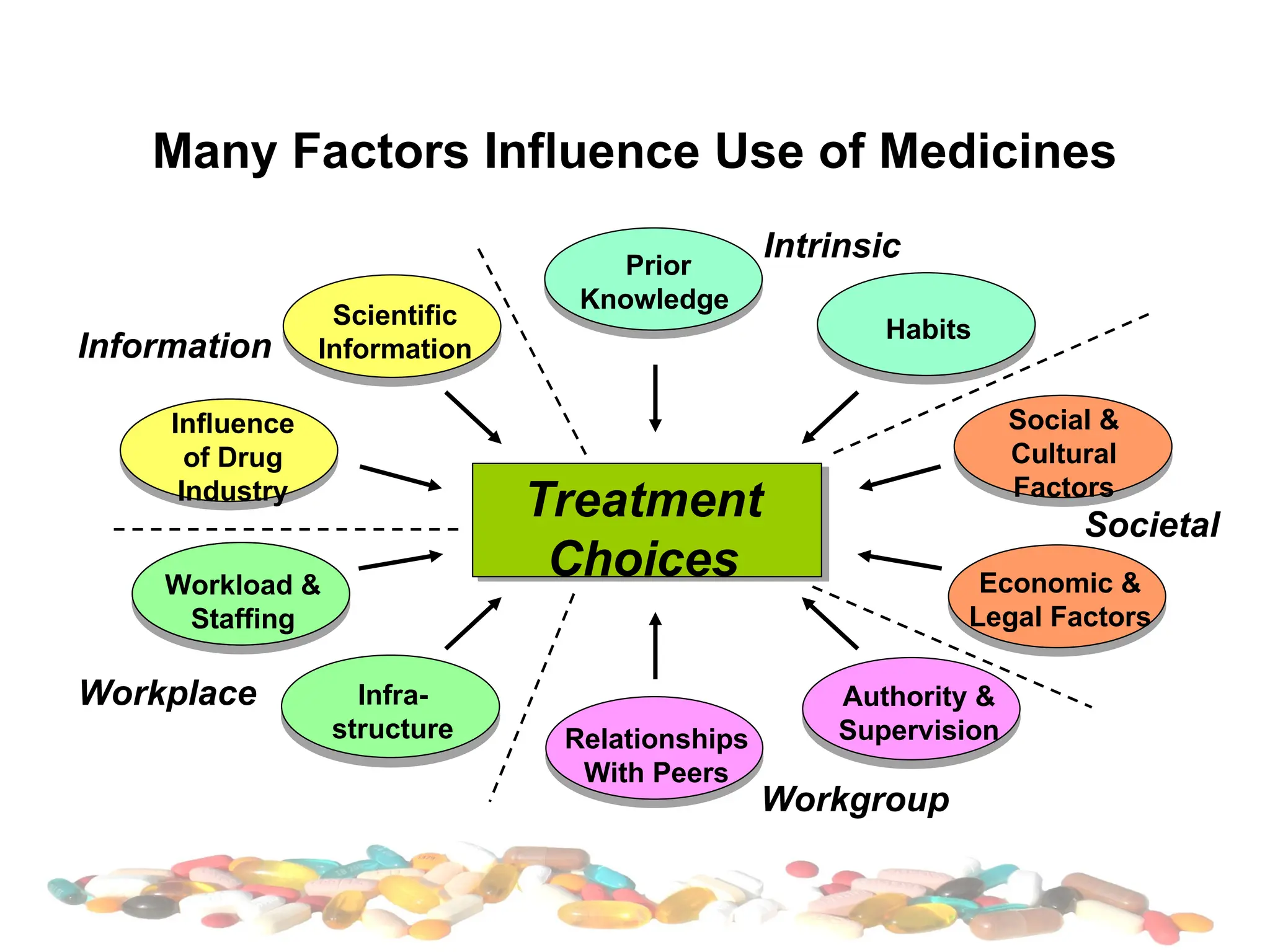
Many Factors Influence Use of Medicines
Treatment
Choices
Prior
Knowledge
Habits
Scientific
Information
Relationships
With Peers
Influence
of Drug
Industry
Workload &
Staffing
Infra-
structure
Authority &
Supervision
Societal
Information
Intrinsic
Workplace
Workgroup
Social &
Cultural
Factors
Economic &
Legal Factors
 Drug explosion: Increase in the number of drugs available
has incredibly complicated the choice of appropriate drug
 Efforts to prevent the development of resistance
 Growing awareness: Today, the information about drug
development
 Increased cost of the treatment
 Consumer protection Act. (CPA):- Extension of CPA in
medical profession may restrict the irrational use of drugs.
Reason for Irrational Use
 Lack of information
 Role model – Teachers or seniors
 Poor communication between health professional &
patient
 Lack of diagnostic facilities/Uncertainty of diagnosis
 Demand from the patient
 Defective drug supply system & ineffective drug
regulation
 Promotional activities of pharmaceutical industries
Common patterns of irrational prescribing :
The use of drugs when no drug therapy is indicated,
e.g. antibiotics for viral upper respiratory infections.
The use of the wrong drug for a specific condition
requiring drug therapy, e.g. tetracycline in childhood
diarrhea requiring ORS.
The use of drugs with doubtful or unproven efficacy,
e.g. the use of antimotility agents in acute diarrhea
cont.
 Failure to provide available, safe and effective drugs, e.g.
failure to vaccinate for measles or tetanus, or failure to
prescribe ORS for acute diarrhea.
 The use of correct drugs with incorrect administration,
dosage and duration, e.g. using intravenous route where
oral or suppository routes would be appropriate.
 The use of unnecessarily expensive drugs, e.g. the use of a
third generation, broad-spectrum antimicrobial when a first
line, narrow spectrum agent is indicated.
 Antibiotics misuse
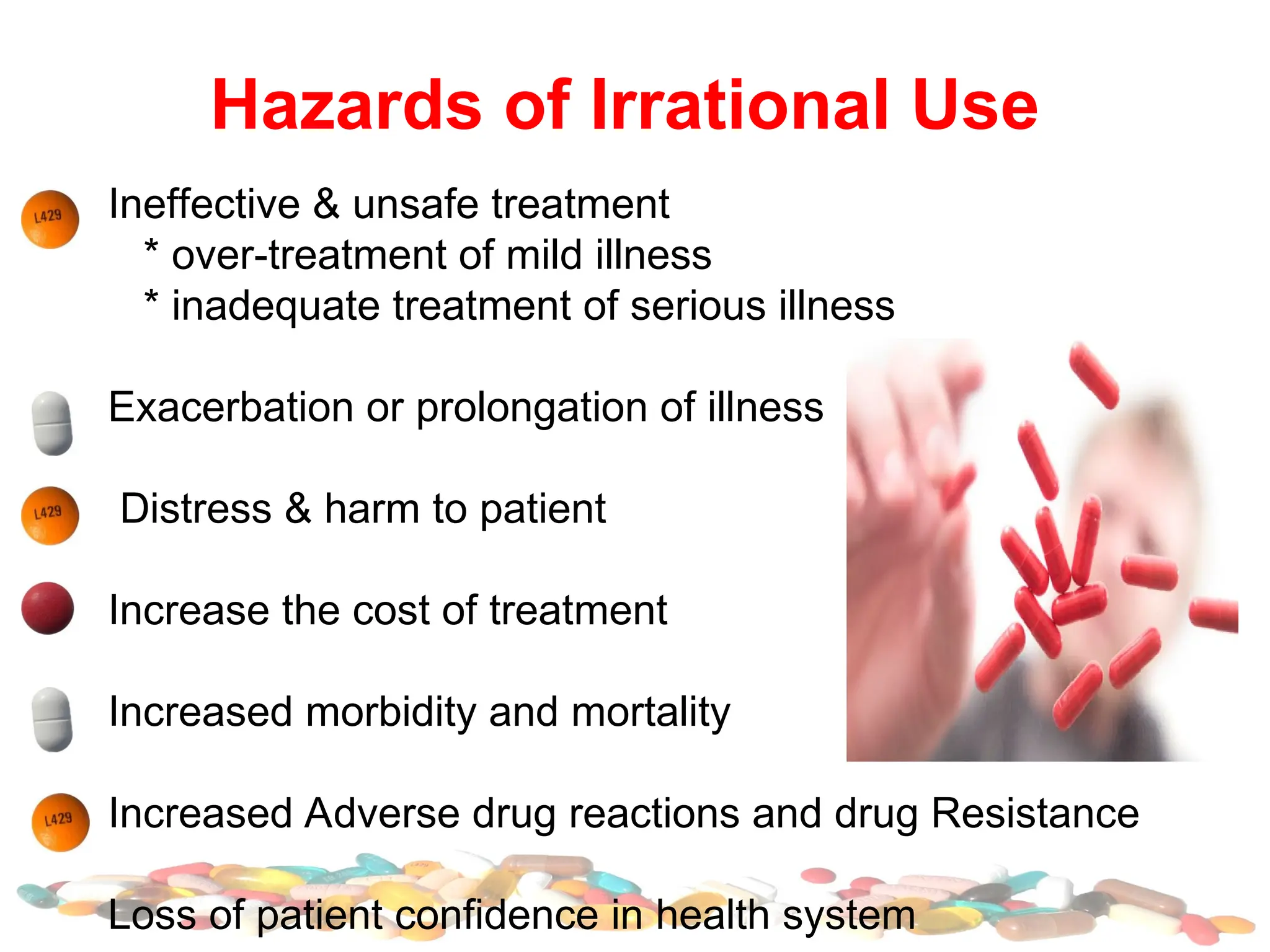
Hazards of Irrational Use
Ineffective & unsafe treatment
* over-treatment of mild illness
* inadequate treatment of serious illness
Exacerbation or prolongation of illness
Distress & harm to patient
Increase the cost of treatment
Increased morbidity and mortality
Increased Adverse drug reactions and drug Resistance
Loss of patient confidence in health system
o Lack of objective information & of continuing education &
training programs.
o Lack of well organized drug regulatory authority & supply
of drugs.
o Presence of large number of drugs in the market & the
lucrative methods of promotion of drugs employed by
pharmaceutical industries.
o The prevalent belief that “every ill has a pill.”
Steps To Improve Rational Drug Prescribing :
 Make a specific diagnosis
 Consider the pathophysiology of diagnosis
selected : If the disorder is well understood the
prescriber is in a better position to select effective
therapy.
 Select a specific therapeutic objective or goal and
medications should be selected based on it.
 Select a drug of choice .
 Determine the appropriate dosing regimen to
obtain desired therapeutic levels and the drug
must be inexpensive, easily available and should
be prescribed in generic name.
 Drug interaction and adverse effects must be
taken into account before initiating combination
of drugs.
 Device a plan for monitoring the drugs action and
determine an end point for the therapy.
 Plan a program for patient education.
Economic:
 Offer incentives
– Institutions
– Providers and patients
Managerial:
 Guide clinical practice
– Information systems/STGs
– Drug supply / lab capacity
Regulatory:
 Restrict choices
– Market or practice
controls
– Enforcement
Educational:
 Inform or persuade
– Health providers
– Consumers
Use of
Medicines
Strategies to Improve Use of Drugs
Educational Strategies
• Training for Providers
– Undergraduate education
– Continuing in-service medical education (seminars,
workshops)
– Face-to-face persuasive outreach e.g. academic
detailing
– Clinical supervision or consultation
• Printed Materials
– Clinical literature and newsletters
– Formularies or therapeutics manuals
– Persuasive print materials
• Media-Based Approaches
– Posters
– Audio tapes, plays
– Radio, television
Managerial strategies
• Changes in selection, procurement, distribution
to ensure availability of essential drugs
– Essential Drug Lists, morbidity-based quantification, kit
systems
• Strategies aimed at prescribers
– targeted face-to-face supervision with audit, peer group
monitoring, structured order forms, evidence-based standard
treatment guidelines
• Dispensing strategies
– course of treatment packaging, labelling, generic substitution
Economic strategies:
• Avoid perverse financial incentives
– prescribers’ salaries from drug sales
– insurance policies that reimburse non-
essential drugs or incorrect doses
– flat prescription fees that encourage
polypharmacy by charging the same
amount irrespective of number of drug
items or quantity of each item
Regulatory strategies
• Drug registration
• Banning unsafe drugs - but beware unexpected results
– substitution of a second inappropriate drug after banning a
first inappropriate or unsafe drug
• Regulating the use of different drugs to different
levels of the health sector e.g.
– licensing prescribers and drug outlets
– scheduling drugs into prescription-only & over-the-counter
• Regulating pharmaceutical promotional activities
Role of Doctors and Pharmacist
 They can establish a common approach to the rational use
of drugs by giving advice and information to patient
regarding the proper use of drugs.
 They have more opportunity to interact closely with the
prescriber and therefore, to promote the rational prescribing
and use of drugs.
 By having access to medical records, they are in a
position to influence the selection of drugs, dosage
regimens, to monitor patient compliance and
therapeutics, response to drugs and to recognize and
report adverse drug reactions.
 They can control hospital manufacture and
procurement of drugs to ensure the supply of high
quality products.
Conclusion :
 The demands of rational drug use are:
• Availability of essential & life saving drugs and
unbiased drug information with generic name.
• Adequate quality control & drug control.
• Withdrawal of hazardous & irrational drugs.
• Drug legislation reform.
 Irrational use of medicines is a very serious global public
health problem.
 Much is known about how to improve rational use of
medicines but much more needs to be done
- Policy implementation at the national level
- implementation and evaluation of more interventions, particularly
managerial, economic and regulatory interventions
 Rational use of medicines could be greatly improved if a
fraction of the resources spent on medicines were spent on
improving use.
Definition of compliance
Compliance, simply defined as “agreement.” With
regard to medicine, compliance means agreeing to
take medicine(s) as directed, and then following
through with that agreement…..accepting the
responsibility of taking medicine(s) as agreed8
Definition of Adherence
Adherence is defined as the extent to which a
patient’s health behavior coincides with their
physician’s recommendations, whether taking
medications or following advice for some type of
behavioral change.
Adherence vs. Compliance
Adherence is a more accurate term than
compliance.
Compliance suggests a process in which dutiful
patients passively follow the advice of their
physicians
Adherence, in contrast, better fits how most
patients actively participate in their care and
decide for themselves when and whether to
follow their doctor’s advice.
Non compliance can be caused by:
Failure to understand instructions
Non comprehension
Volitional non compliance
How big a problem is medication non
compliance?
Up to 60% of all medication prescribed is taken
incorrectly or not taken at all!
Medication noncompliance includes:
Not filling a prescription
Over medication
Taking wrong medication
Taking right medication in a wrong time
Forgetting to take medication
Deliberately under dosing or not taking
medication
90% of elderly patients make some medication
errors.
35% of elderly patients make potentially serious
errors.
50% of all long term medications are abandoned in
the first year.
75% of chronic care patients prescribed drugs either
stop taking their medication at some point or don’t
take them as directed.
Only 75% of patients who understand and agree
with treatment are compliant.
Overall Rates Of Noncompliance
Noncompliance causes admission of 380,000
patients to nursing homes (23% of all
admissions) and is the key factors in
admissions.
Noncompliance in medication taking can be
classified as:
Errors of omission
Errors of commission
Dosage errors
Scheduling errors
Patient’s noncompliance is important
from at least 4 perceptions:
Individual patient care.
Public health efforts.
Interpretation of the medical literature.
Economic consequences.
Health Effects:
Increase morbidity
Treatment failure
Exacerbation of disease
Increases frequent physician visits
Increases hospitalization
Death
Economic Effects
Increases absenteeism
Lost productivity at work
Lost revenues to pharmacies
Lost revenues to pharmaceutical
manufacturers
Measurements of Compliance
 Approaches to assessing compliance
behavior in patients by
Asking
Medication counting
Assay
Supervision
 Often necessary to use more than one method to
arrive at a reasonably valid estimate of compliance
in the individual patient.
Ability to predict compliance
Sometimes no better than would be expected by chance
Methods of measurement:
1. Asking:
Simplest and most practical method of assessing
compliance behavior.
Self-reports of noncompliance are valid, but often result
in underestimation of the degree of noncompliance.
Only 40%-80% of patients admit their noncompliance .
Self-reported compliance over estimate true compliance
rates.
Manner of asking influences the accuracy of patient
response.
2. Medication Counting :
More objective but it has problems:
 Overestimation
 Underestimation
3. Assays :
Limitations:
 Assays can be expensive.
 Multiple measurements are required over
extended period of time.
 Patient may take medicine immediately before
the collection of specimen but not at other time.
Differences in drug absorption, distribution,
metabolism, excretion.(whether a low level
represents noncompliance or inadequate
dosage in patient???).
Collection of specimens has to be timed
correctly, at appropriate times, absence of
any drugs in the specimen suggests
noncompliance.
Assays are not available for many
medications.
Patient Considerations
Factors believed to affect compliance:
 Patient knowledge.
 Prior compliance behavior
 Ability to integrate into daily life / Complexity of the
particular drug regimen.
 Health beliefs and perceptions of possible benefits
of treatment (self efficiency)
 Social support (including practitioner relationships)
Factors which NOT believed to be
associated with compliance:
 Age, race, gender, income or education.
 Patient intelligence.
 Actual seriousness of the disease or the
efficiency of the treatment.
Patients in Higher Risk:
Asymptomatic conditions
 Hypertension.
Chronic conditions
 Hypertension, arthritis, diabetes.
Cognitive impairment
 Dementia, Alzheimer.
Complex regimens
 Poly pharmacy.
5. Multiple daily dosing
6. Patient perceptions
 Effectiveness, side effects, cost.
7. Poor communication
 Patient practitioner rapport
8. Psychiatric illness
 Less likely to comply.
Any Questions?
Thank You

Rational use of medicines and patient compliance

  • 1.
    Rational Use of Medication And PatientCompliance Presented by Dr. Wadha AlFarwan
  • 2.
    RATIONAL means “prescribing rightdrug, in adequate dose for the sufficient duration & appropriate to the clinical needs of the patient at lowest cost”
  • 3.
    The rational useof drugs requires that patients receive medications appropriate to their clinical needs, in doses that meet their own individual requirements for an adequate period of time, and at the lowest cost to them and their community. WHO conference of experts Nairobi 1985
  • 4.
    Criteria for UsingMedicines:  Appropriate indication.  Appropriate drug considering efficacy, safety, suitability for the patient, and cost .  Appropriate dosage, administration, duration  Affordable  Appropriate patient  Appropriate patient information
  • 5.
    Objectives • To Understand: -Concept of rational use of medicines - Factors influencing the irrational use of medicines - Adverse impact of irrational use of medicines - Role of doctors and pharmacist in promoting the rational use of medicines. - Importance of patient education .
  • 6.
    Many Factors InfluenceUse of Medicines Treatment Choices Prior Knowledge Habits Scientific Information Relationships With Peers Influence of Drug Industry Workload & Staffing Infra- structure Authority & Supervision Societal Information Intrinsic Workplace Workgroup Social & Cultural Factors Economic & Legal Factors
  • 7.
     Drug explosion:Increase in the number of drugs available has incredibly complicated the choice of appropriate drug  Efforts to prevent the development of resistance  Growing awareness: Today, the information about drug development  Increased cost of the treatment  Consumer protection Act. (CPA):- Extension of CPA in medical profession may restrict the irrational use of drugs.
  • 8.
    Reason for IrrationalUse  Lack of information  Role model – Teachers or seniors  Poor communication between health professional & patient  Lack of diagnostic facilities/Uncertainty of diagnosis  Demand from the patient  Defective drug supply system & ineffective drug regulation  Promotional activities of pharmaceutical industries
  • 9.
    Common patterns ofirrational prescribing : The use of drugs when no drug therapy is indicated, e.g. antibiotics for viral upper respiratory infections. The use of the wrong drug for a specific condition requiring drug therapy, e.g. tetracycline in childhood diarrhea requiring ORS. The use of drugs with doubtful or unproven efficacy, e.g. the use of antimotility agents in acute diarrhea
  • 10.
    cont.  Failure toprovide available, safe and effective drugs, e.g. failure to vaccinate for measles or tetanus, or failure to prescribe ORS for acute diarrhea.  The use of correct drugs with incorrect administration, dosage and duration, e.g. using intravenous route where oral or suppository routes would be appropriate.  The use of unnecessarily expensive drugs, e.g. the use of a third generation, broad-spectrum antimicrobial when a first line, narrow spectrum agent is indicated.  Antibiotics misuse
  • 11.
    Hazards of IrrationalUse Ineffective & unsafe treatment * over-treatment of mild illness * inadequate treatment of serious illness Exacerbation or prolongation of illness Distress & harm to patient Increase the cost of treatment Increased morbidity and mortality Increased Adverse drug reactions and drug Resistance Loss of patient confidence in health system
  • 12.
    o Lack ofobjective information & of continuing education & training programs. o Lack of well organized drug regulatory authority & supply of drugs. o Presence of large number of drugs in the market & the lucrative methods of promotion of drugs employed by pharmaceutical industries. o The prevalent belief that “every ill has a pill.”
  • 13.
    Steps To ImproveRational Drug Prescribing :  Make a specific diagnosis  Consider the pathophysiology of diagnosis selected : If the disorder is well understood the prescriber is in a better position to select effective therapy.  Select a specific therapeutic objective or goal and medications should be selected based on it.  Select a drug of choice .
  • 14.
     Determine theappropriate dosing regimen to obtain desired therapeutic levels and the drug must be inexpensive, easily available and should be prescribed in generic name.  Drug interaction and adverse effects must be taken into account before initiating combination of drugs.  Device a plan for monitoring the drugs action and determine an end point for the therapy.  Plan a program for patient education.
  • 15.
    Economic:  Offer incentives –Institutions – Providers and patients Managerial:  Guide clinical practice – Information systems/STGs – Drug supply / lab capacity Regulatory:  Restrict choices – Market or practice controls – Enforcement Educational:  Inform or persuade – Health providers – Consumers Use of Medicines Strategies to Improve Use of Drugs
  • 16.
    Educational Strategies • Trainingfor Providers – Undergraduate education – Continuing in-service medical education (seminars, workshops) – Face-to-face persuasive outreach e.g. academic detailing – Clinical supervision or consultation • Printed Materials – Clinical literature and newsletters – Formularies or therapeutics manuals – Persuasive print materials • Media-Based Approaches – Posters – Audio tapes, plays – Radio, television
  • 17.
    Managerial strategies • Changesin selection, procurement, distribution to ensure availability of essential drugs – Essential Drug Lists, morbidity-based quantification, kit systems • Strategies aimed at prescribers – targeted face-to-face supervision with audit, peer group monitoring, structured order forms, evidence-based standard treatment guidelines • Dispensing strategies – course of treatment packaging, labelling, generic substitution
  • 18.
    Economic strategies: • Avoidperverse financial incentives – prescribers’ salaries from drug sales – insurance policies that reimburse non- essential drugs or incorrect doses – flat prescription fees that encourage polypharmacy by charging the same amount irrespective of number of drug items or quantity of each item
  • 19.
    Regulatory strategies • Drugregistration • Banning unsafe drugs - but beware unexpected results – substitution of a second inappropriate drug after banning a first inappropriate or unsafe drug • Regulating the use of different drugs to different levels of the health sector e.g. – licensing prescribers and drug outlets – scheduling drugs into prescription-only & over-the-counter • Regulating pharmaceutical promotional activities
  • 20.
    Role of Doctorsand Pharmacist  They can establish a common approach to the rational use of drugs by giving advice and information to patient regarding the proper use of drugs.  They have more opportunity to interact closely with the prescriber and therefore, to promote the rational prescribing and use of drugs.
  • 21.
     By havingaccess to medical records, they are in a position to influence the selection of drugs, dosage regimens, to monitor patient compliance and therapeutics, response to drugs and to recognize and report adverse drug reactions.  They can control hospital manufacture and procurement of drugs to ensure the supply of high quality products.
  • 22.
    Conclusion :  Thedemands of rational drug use are: • Availability of essential & life saving drugs and unbiased drug information with generic name. • Adequate quality control & drug control. • Withdrawal of hazardous & irrational drugs. • Drug legislation reform.
  • 23.
     Irrational useof medicines is a very serious global public health problem.  Much is known about how to improve rational use of medicines but much more needs to be done - Policy implementation at the national level - implementation and evaluation of more interventions, particularly managerial, economic and regulatory interventions  Rational use of medicines could be greatly improved if a fraction of the resources spent on medicines were spent on improving use.
  • 24.
    Definition of compliance Compliance,simply defined as “agreement.” With regard to medicine, compliance means agreeing to take medicine(s) as directed, and then following through with that agreement…..accepting the responsibility of taking medicine(s) as agreed8
  • 25.
    Definition of Adherence Adherenceis defined as the extent to which a patient’s health behavior coincides with their physician’s recommendations, whether taking medications or following advice for some type of behavioral change.
  • 26.
    Adherence vs. Compliance Adherenceis a more accurate term than compliance. Compliance suggests a process in which dutiful patients passively follow the advice of their physicians Adherence, in contrast, better fits how most patients actively participate in their care and decide for themselves when and whether to follow their doctor’s advice.
  • 27.
    Non compliance canbe caused by: Failure to understand instructions Non comprehension Volitional non compliance How big a problem is medication non compliance? Up to 60% of all medication prescribed is taken incorrectly or not taken at all!
  • 28.
    Medication noncompliance includes: Notfilling a prescription Over medication Taking wrong medication Taking right medication in a wrong time Forgetting to take medication Deliberately under dosing or not taking medication
  • 29.
    90% of elderlypatients make some medication errors. 35% of elderly patients make potentially serious errors. 50% of all long term medications are abandoned in the first year. 75% of chronic care patients prescribed drugs either stop taking their medication at some point or don’t take them as directed. Only 75% of patients who understand and agree with treatment are compliant. Overall Rates Of Noncompliance
  • 30.
    Noncompliance causes admissionof 380,000 patients to nursing homes (23% of all admissions) and is the key factors in admissions. Noncompliance in medication taking can be classified as: Errors of omission Errors of commission Dosage errors Scheduling errors
  • 31.
    Patient’s noncompliance isimportant from at least 4 perceptions: Individual patient care. Public health efforts. Interpretation of the medical literature. Economic consequences.
  • 32.
    Health Effects: Increase morbidity Treatmentfailure Exacerbation of disease Increases frequent physician visits Increases hospitalization Death
  • 33.
    Economic Effects Increases absenteeism Lostproductivity at work Lost revenues to pharmacies Lost revenues to pharmaceutical manufacturers
  • 34.
    Measurements of Compliance Approaches to assessing compliance behavior in patients by Asking Medication counting Assay Supervision  Often necessary to use more than one method to arrive at a reasonably valid estimate of compliance in the individual patient.
  • 35.
    Ability to predictcompliance Sometimes no better than would be expected by chance Methods of measurement: 1. Asking: Simplest and most practical method of assessing compliance behavior. Self-reports of noncompliance are valid, but often result in underestimation of the degree of noncompliance. Only 40%-80% of patients admit their noncompliance . Self-reported compliance over estimate true compliance rates. Manner of asking influences the accuracy of patient response.
  • 36.
    2. Medication Counting: More objective but it has problems:  Overestimation  Underestimation 3. Assays : Limitations:  Assays can be expensive.  Multiple measurements are required over extended period of time.  Patient may take medicine immediately before the collection of specimen but not at other time.
  • 37.
    Differences in drugabsorption, distribution, metabolism, excretion.(whether a low level represents noncompliance or inadequate dosage in patient???). Collection of specimens has to be timed correctly, at appropriate times, absence of any drugs in the specimen suggests noncompliance. Assays are not available for many medications.
  • 38.
    Patient Considerations Factors believedto affect compliance:  Patient knowledge.  Prior compliance behavior  Ability to integrate into daily life / Complexity of the particular drug regimen.  Health beliefs and perceptions of possible benefits of treatment (self efficiency)  Social support (including practitioner relationships)
  • 39.
    Factors which NOTbelieved to be associated with compliance:  Age, race, gender, income or education.  Patient intelligence.  Actual seriousness of the disease or the efficiency of the treatment.
  • 40.
    Patients in HigherRisk: Asymptomatic conditions  Hypertension. Chronic conditions  Hypertension, arthritis, diabetes. Cognitive impairment  Dementia, Alzheimer. Complex regimens  Poly pharmacy.
  • 41.
    5. Multiple dailydosing 6. Patient perceptions  Effectiveness, side effects, cost. 7. Poor communication  Patient practitioner rapport 8. Psychiatric illness  Less likely to comply.
  • 42.
  • 43.