1
PHARMACOLOGY OF BRADYKININ
Presented by
Shivanshu Mishra
MS(Pharm)/2024-26/PT/03
Dept. of Pharmacology &
Toxicology
2
 Table of contents
• Introduction
• Generation & metabolism
• Bradykinin receptor
• Physiological roles
• References
3
Introduction
• Greek word Brady means slow & kinin refers to its
function to causing movement
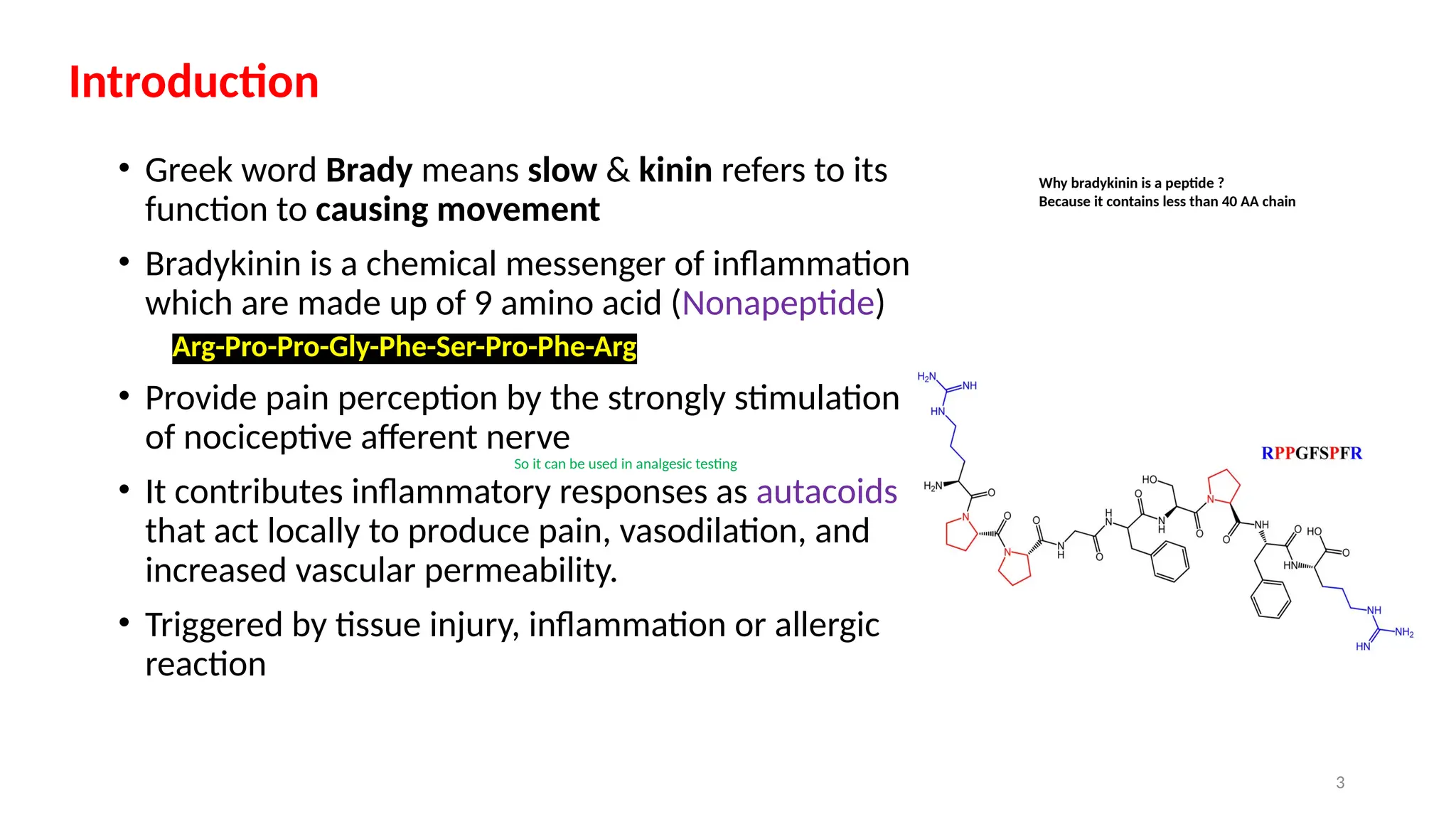
• Bradykinin is a chemical messenger of inflammation
which are made up of 9 amino acid (Nonapeptide)
Arg-Pro-Pro-Gly-Phe-Ser-Pro-Phe-Arg
• Provide pain perception by the strongly stimulation
of nociceptive afferent nerve
• It contributes inflammatory responses as autacoids
that act locally to produce pain, vasodilation, and
increased vascular permeability.
• Triggered by tissue injury, inflammation or allergic
reaction
Why bradykinin is a peptide ?
Because it contains less than 40 AA chain
So it can be used in analgesic testing
4
Bradykinin (BK) is generated by the action of plasma kallikrein on high-molecular-
weight (HMW) kininogen, tissue kallikrein on low molecular weight (LMW)
kininogen
• Activation of PreKallikrein into kallikrein is induced by Hageman factor (XII)
which itself is activated by tissue injury and contact with surfaces having
negative charge e.g. Collagen, basement membrane etc
• Plasmin facilitates contact activation of Hageman factor
• After activation of plasma kallikrein (synthesized in liver circulated in blood)
they convert the high molecular weight kininogen(HMWK) to bradykinin
Generation & Metabolism
5
6
• Tissue kallikrein found in glandular secretions particularly in pancreas, kidney,
salivary glands convert the LMW kininogen to kallidin
• Kallidin is a decapeptide whose sequence is H-Lys-Arg-Pro-Pro-Gly-Phe-Ser-
Pro-Phe-Arg-OH. It can be converted to bradykinin by the aminopeptidase
enzyme
LMWK Kallidin (Lys-Bradykinin)
Aminopeptidase
Bradykinin (Nonapeptide)
Tissue kallikrein
7
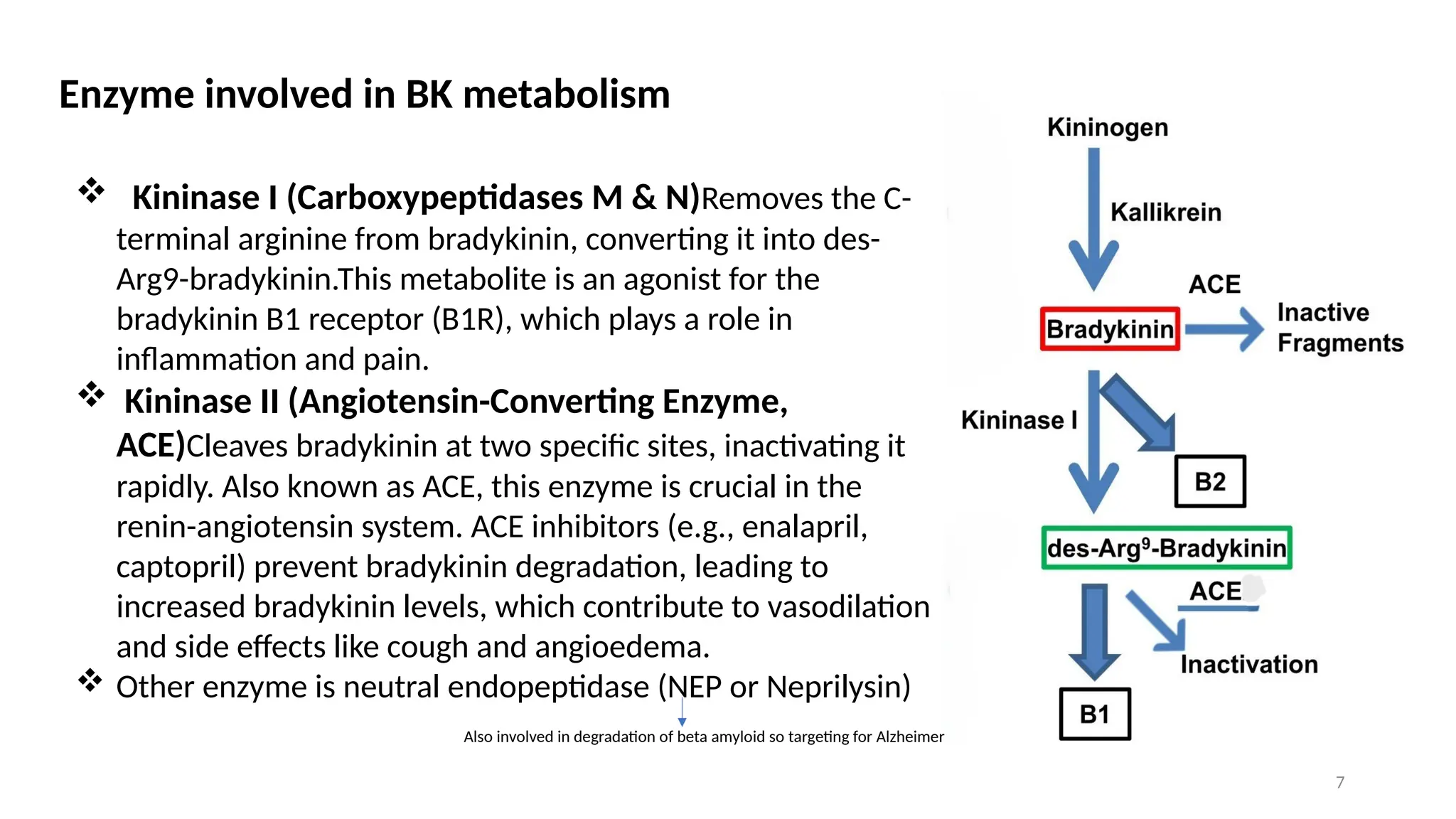
 Kininase I (Carboxypeptidases M & N)Removes the C-
terminal arginine from bradykinin, converting it into des-
Arg9-bradykinin.This metabolite is an agonist for the
bradykinin B1 receptor (B1R), which plays a role in
inflammation and pain.
 Kininase II (Angiotensin-Converting Enzyme,
ACE)Cleaves bradykinin at two specific sites, inactivating it
rapidly. Also known as ACE, this enzyme is crucial in the
renin-angiotensin system. ACE inhibitors (e.g., enalapril,
captopril) prevent bradykinin degradation, leading to
increased bradykinin levels, which contribute to vasodilation
and side effects like cough and angioedema.
 Other enzyme is neutral endopeptidase (NEP or Neprilysin)
Enzyme involved in BK metabolism
Also involved in degradation of beta amyloid so targeting for Alzheimer
8
Bradykinin receptor
B1 Receptor
• Induction: The B1 receptor is induced in response to tissue injury,
inflammation, or other pathophysiological conditions
• Expression: It is not constitutively expressed in healthy tissues but it is
synthesized de novo following tissue injury
• Mechanism: The B1 receptor is a G-protein-coupled receptor (GPCR)
that, upon binding bradykinin, leads to an increase in intracellular
calcium ion concentration This results in chronic and acute
inflammatory responses
• Function: It plays a significant role in mediating inflammatory
responses and pain
9
B2 Receptor
• Expression: The B2 receptor is constitutively expressed in most
normal tissues
• Mechanism: The B2 receptor is also a GPCR, coupled to Gq proteins,
Gq stimulates phospholipase C, leading to an increase in intracellular
free calcium
• Function: The B2 receptor mediates most of the acute effects of
bradykinin, including vasodilation, increased vascular permeability,
and pain sensitization
Kallidin, decapeptide &
convert into BK by
aminopeptidase
10
11
Physiological roles
 Cardioprotective
Bradykinin, through its B2 receptor, stimulates endothelial release of a number of
vasodilators, such as nitric oxide, prostacyclin, or PG
Angiotensin-converting enzyme (ACE) inhibitors enhance the effects of local bradykinin
by decreasing its degradation and by increasing B2 receptor sensitivity
Blockade of the B2 receptor reduce the antihypertensive, antihypertrophic, and
antiatherosclerosis effects of ACE inhibitors
ACE inhibitor like captopril,lisinopril
causes bronchoconstriction or
coughing by inhibiting the
degradation of BK so avoid in
asthma
12
Hereditary angioedema (HAE) Most
commonly occurs as a result of
insufficient levels or function of a
protein called C1 esterase inhibitor
(C1-INH), a naturally occurring
inhibitor of the plasma kallikrein
enzyme
C1-INH deficiency results in
uncontrolled plasma kallikrein
activity which leads to elevated
levels of bradykinin and painful
swelling affecting different body
areas
Caused by mutation in the SERPING1 or F12 genes
13
 Bronchoconstriction and coughing
Bradykinin acts on B2 receptors (B2R) on
second order neurons to stimulate the
release of COX and 12-LOX metabolites
which in turn activate TRPV1 and TRPA1
channels on the second order neurons
resulting in an enhanced cough response
TRPV1 & TRPA1 generally found in the upper airway after
activation causes nociception (pain), inflammation, burning
sensation or cough hypersensitivity
14
References
• Sugawara A., Shimada, H., Otsubo, Y., Kouketsu, T., Suzuki, Kaplan, A. P., Joseph,
K., & Silverberg, M. (2002). Pathways for bradykinin formation and inflammatory
disease. Journal of Allergy and Clinical Immunology, 109(2), 195–209.
https://doi.org/10.1067/mai.2002.121316
• S. Akira, & Yokoyama A. (2021). The usefulness of angiotensin-(1-7) and des-Arg9-
bradykinin as novel biomarkers for metabolic syndrome. Hypertension Research,
44(8), 1034–1036. https://doi.org/10.1038/s41440-021-00671-9
• Graeff, F. G., Joca, S., & Zangrossi, H. (2024). Bradykinin actions in the central
nervous system: historical overview and psychiatric implications. Acta
Neuropsychiatrica, 36(3), 129–138. https://doi.org/10.1017/neu.2023.57
• Murphey, L. (2003). Contribution of bradykinin to the cardioprotective effects of
ACE inhibitors. European Heart Journal Supplements, 5, A37–A41.
https://doi.org/10.1016/s1520-765x(03)90062-9
15
Thank you

Pharmacology of bradykinin ppt.

  • 1.
    1 PHARMACOLOGY OF BRADYKININ Presentedby Shivanshu Mishra MS(Pharm)/2024-26/PT/03 Dept. of Pharmacology & Toxicology
  • 2.
    2  Table ofcontents • Introduction • Generation & metabolism • Bradykinin receptor • Physiological roles • References
  • 3.
    3 Introduction • Greek wordBrady means slow & kinin refers to its function to causing movement • Bradykinin is a chemical messenger of inflammation which are made up of 9 amino acid (Nonapeptide) Arg-Pro-Pro-Gly-Phe-Ser-Pro-Phe-Arg • Provide pain perception by the strongly stimulation of nociceptive afferent nerve • It contributes inflammatory responses as autacoids that act locally to produce pain, vasodilation, and increased vascular permeability. • Triggered by tissue injury, inflammation or allergic reaction Why bradykinin is a peptide ? Because it contains less than 40 AA chain So it can be used in analgesic testing
  • 4.
    4 Bradykinin (BK) isgenerated by the action of plasma kallikrein on high-molecular- weight (HMW) kininogen, tissue kallikrein on low molecular weight (LMW) kininogen • Activation of PreKallikrein into kallikrein is induced by Hageman factor (XII) which itself is activated by tissue injury and contact with surfaces having negative charge e.g. Collagen, basement membrane etc • Plasmin facilitates contact activation of Hageman factor • After activation of plasma kallikrein (synthesized in liver circulated in blood) they convert the high molecular weight kininogen(HMWK) to bradykinin Generation & Metabolism
  • 5.
  • 6.
    6 • Tissue kallikreinfound in glandular secretions particularly in pancreas, kidney, salivary glands convert the LMW kininogen to kallidin • Kallidin is a decapeptide whose sequence is H-Lys-Arg-Pro-Pro-Gly-Phe-Ser- Pro-Phe-Arg-OH. It can be converted to bradykinin by the aminopeptidase enzyme LMWK Kallidin (Lys-Bradykinin) Aminopeptidase Bradykinin (Nonapeptide) Tissue kallikrein
  • 7.
    7  Kininase I(Carboxypeptidases M & N)Removes the C- terminal arginine from bradykinin, converting it into des- Arg9-bradykinin.This metabolite is an agonist for the bradykinin B1 receptor (B1R), which plays a role in inflammation and pain.  Kininase II (Angiotensin-Converting Enzyme, ACE)Cleaves bradykinin at two specific sites, inactivating it rapidly. Also known as ACE, this enzyme is crucial in the renin-angiotensin system. ACE inhibitors (e.g., enalapril, captopril) prevent bradykinin degradation, leading to increased bradykinin levels, which contribute to vasodilation and side effects like cough and angioedema.  Other enzyme is neutral endopeptidase (NEP or Neprilysin) Enzyme involved in BK metabolism Also involved in degradation of beta amyloid so targeting for Alzheimer
  • 8.
    8 Bradykinin receptor B1 Receptor •Induction: The B1 receptor is induced in response to tissue injury, inflammation, or other pathophysiological conditions • Expression: It is not constitutively expressed in healthy tissues but it is synthesized de novo following tissue injury • Mechanism: The B1 receptor is a G-protein-coupled receptor (GPCR) that, upon binding bradykinin, leads to an increase in intracellular calcium ion concentration This results in chronic and acute inflammatory responses • Function: It plays a significant role in mediating inflammatory responses and pain
  • 9.
    9 B2 Receptor • Expression:The B2 receptor is constitutively expressed in most normal tissues • Mechanism: The B2 receptor is also a GPCR, coupled to Gq proteins, Gq stimulates phospholipase C, leading to an increase in intracellular free calcium • Function: The B2 receptor mediates most of the acute effects of bradykinin, including vasodilation, increased vascular permeability, and pain sensitization Kallidin, decapeptide & convert into BK by aminopeptidase
  • 10.
  • 11.
    11 Physiological roles  Cardioprotective Bradykinin,through its B2 receptor, stimulates endothelial release of a number of vasodilators, such as nitric oxide, prostacyclin, or PG Angiotensin-converting enzyme (ACE) inhibitors enhance the effects of local bradykinin by decreasing its degradation and by increasing B2 receptor sensitivity Blockade of the B2 receptor reduce the antihypertensive, antihypertrophic, and antiatherosclerosis effects of ACE inhibitors ACE inhibitor like captopril,lisinopril causes bronchoconstriction or coughing by inhibiting the degradation of BK so avoid in asthma
  • 12.
    12 Hereditary angioedema (HAE)Most commonly occurs as a result of insufficient levels or function of a protein called C1 esterase inhibitor (C1-INH), a naturally occurring inhibitor of the plasma kallikrein enzyme C1-INH deficiency results in uncontrolled plasma kallikrein activity which leads to elevated levels of bradykinin and painful swelling affecting different body areas Caused by mutation in the SERPING1 or F12 genes
  • 13.
    13  Bronchoconstriction andcoughing Bradykinin acts on B2 receptors (B2R) on second order neurons to stimulate the release of COX and 12-LOX metabolites which in turn activate TRPV1 and TRPA1 channels on the second order neurons resulting in an enhanced cough response TRPV1 & TRPA1 generally found in the upper airway after activation causes nociception (pain), inflammation, burning sensation or cough hypersensitivity
  • 14.
    14 References • Sugawara A.,Shimada, H., Otsubo, Y., Kouketsu, T., Suzuki, Kaplan, A. P., Joseph, K., & Silverberg, M. (2002). Pathways for bradykinin formation and inflammatory disease. Journal of Allergy and Clinical Immunology, 109(2), 195–209. https://doi.org/10.1067/mai.2002.121316 • S. Akira, & Yokoyama A. (2021). The usefulness of angiotensin-(1-7) and des-Arg9- bradykinin as novel biomarkers for metabolic syndrome. Hypertension Research, 44(8), 1034–1036. https://doi.org/10.1038/s41440-021-00671-9 • Graeff, F. G., Joca, S., & Zangrossi, H. (2024). Bradykinin actions in the central nervous system: historical overview and psychiatric implications. Acta Neuropsychiatrica, 36(3), 129–138. https://doi.org/10.1017/neu.2023.57 • Murphey, L. (2003). Contribution of bradykinin to the cardioprotective effects of ACE inhibitors. European Heart Journal Supplements, 5, A37–A41. https://doi.org/10.1016/s1520-765x(03)90062-9
  • 15.