Introduction
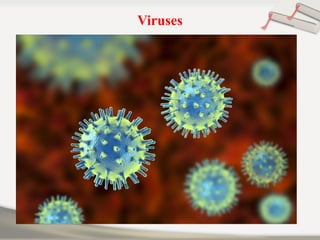
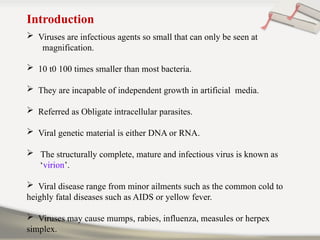
Viruses areinfectious agents so small that can only be seen at
magnification.
10 t0 100 times smaller than most bacteria.
They are incapable of independent growth in artificial media.
Referred as Obligate intracellular parasites.
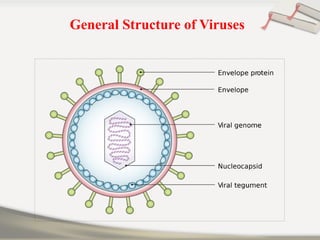
Viral genetic material is either DNA or RNA.
The structurally complete, mature and infectious virus is known as
‘virion’.
Viral disease range from minor ailments such as the common cold to
heighly fatal diseases such as AIDS or yellow fever.
Viruses may cause mumps, rabies, influenza, measules or herpex
simplex.
4.
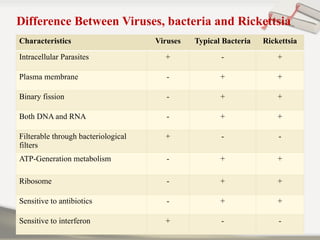
Difference Between Viruses,bacteria and Rickettsia
Characteristics Viruses Typical Bacteria Rickettsia
Intracellular Parasites + - +
Plasma membrane - + +
Binary fission - + +
Both DNA and RNA - + +
Filterable through bacteriological
filters
+ - -
ATP-Generation metabolism - + +
Ribosome - + +
Sensitive to antibiotics - + +
Sensitive to interferon + - -
5.
Classification
• Based uponmultiplication in cells of different
species:
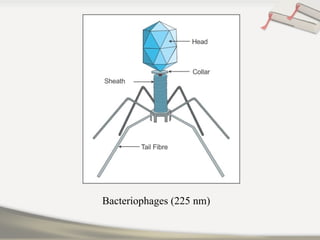
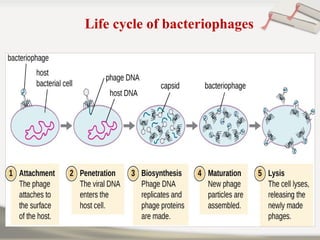
1. Bacterial viruses (phagineae)-They have DNA.
2. Plant viruses (phytophagineae)-They have RNA and
infect potato, sugarcane, tobacco, cucurbits etc.
3. Animal viruses (zoophagineae)-Have DNA or some
also have RNA and infect man, pigeon, parrot, dog,
cow etc.
6.
Classification
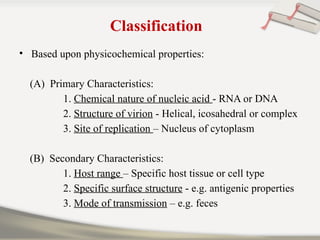
• Based uponphysicochemical properties:
(A) Primary Characteristics:
1. Chemical nature of nucleic acid - RNA or DNA
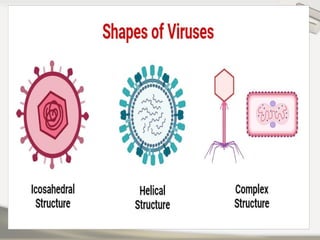
2. Structure of virion - Helical, icosahedral or complex
3. Site of replication – Nucleus of cytoplasm
(B) Secondary Characteristics:
1. Host range – Specific host tissue or cell type
2. Specific surface structure - e.g. antigenic properties
3. Mode of transmission – e.g. feces
7.
Classification
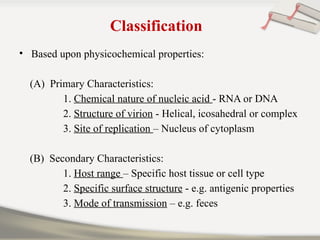
• Based uponphysicochemical properties:
(A) Primary Characteristics:
1. Chemical nature of nucleic acid - RNA or DNA
2. Structure of virion - Helical, icosahedral or complex
3. Site of replication – Nucleus of cytoplasm
(B) Secondary Characteristics:
1. Host range – Specific host tissue or cell type
2. Specific surface structure - e.g. antigenic properties
3. Mode of transmission – e.g. feces
8.
Classification
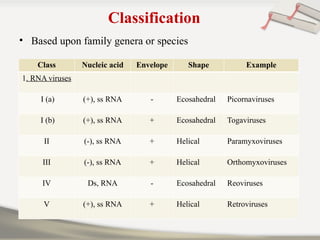
• Based uponfamily genera or species
Class Nucleic acid Envelope Shape Example
1. RNA viruses
I (a) (+), ss RNA - Ecosahedral Picornaviruses
I (b) (+), ss RNA + Ecosahedral Togaviruses
II (-), ss RNA + Helical Paramyxoviruses
III (-), ss RNA + Helical Orthomyxoviruses
IV Ds, RNA - Ecosahedral Reoviruses
V (+), ss RNA + Helical Retroviruses
9.
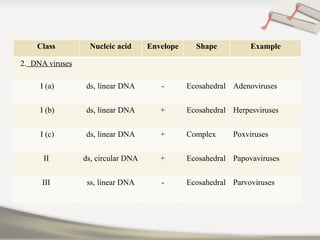
Class Nucleic acidEnvelope Shape Example
2. DNA viruses
I (a) ds, linear DNA - Ecosahedral Adenoviruses
I (b) ds, linear DNA + Ecosahedral Herpesviruses
I (c) ds, linear DNA + Complex Poxviruses
II ds, circular DNA + Ecosahedral Papovaviruses
III ss, linear DNA - Ecosahedral Parvoviruses
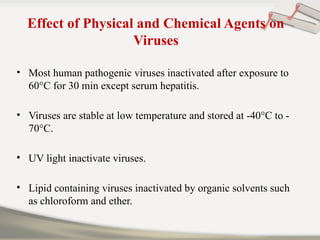
Effect of Physicaland Chemical Agents on
Viruses
• Most human pathogenic viruses inactivated after exposure to
60°C for 30 min except serum hepatitis.
• Viruses are stable at low temperature and stored at -40°C to -
70°C.
• UV light inactivate viruses.
• Lipid containing viruses inactivated by organic solvents such
as chloroform and ether.
Cultivation of Viruses
Laboratory
Animals
•Oldest method
• Reed and Colleagues
in 1900 on human
volunteer for study
of yellow fever.
• Lansteiner and
Popper in 1909 on
monkeys.
• Other animal like
rabbits, mice, guinea
pigs are also used.
• Viruses can be
inoculated by
intraperitoneal or
subcutaneous route.
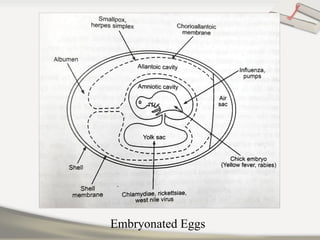
Embryonated
Eggs
• Hen’s egg was first
time used by
Goodpasture in
1931.
• Fertile chicken eggs
incubated for 5 to 12
days.
• Yellow fever and
rabies vaccine are
produced from the
chick embryo.
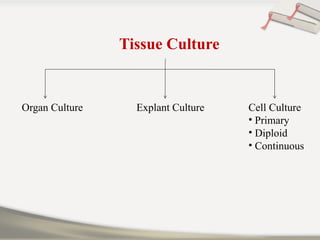
Tissue Culture
• 1st
application of
tissue culture in
virology was by
Steinhardt in 1913
who maintained the
vaccinea virus in
fragment of rabbit
cornea.
• Enders, Wellers and
Robbins in 1949 was
demonstrates the
poliovirus.




![1. introduction to_virology[1]](https://cdn.slidesharecdn.com/ss_thumbnails/1-210814125616-thumbnail.jpg?width=640&height=640&fit=bounds)


