| |JULY 2014
1CIOReview
CIOReview
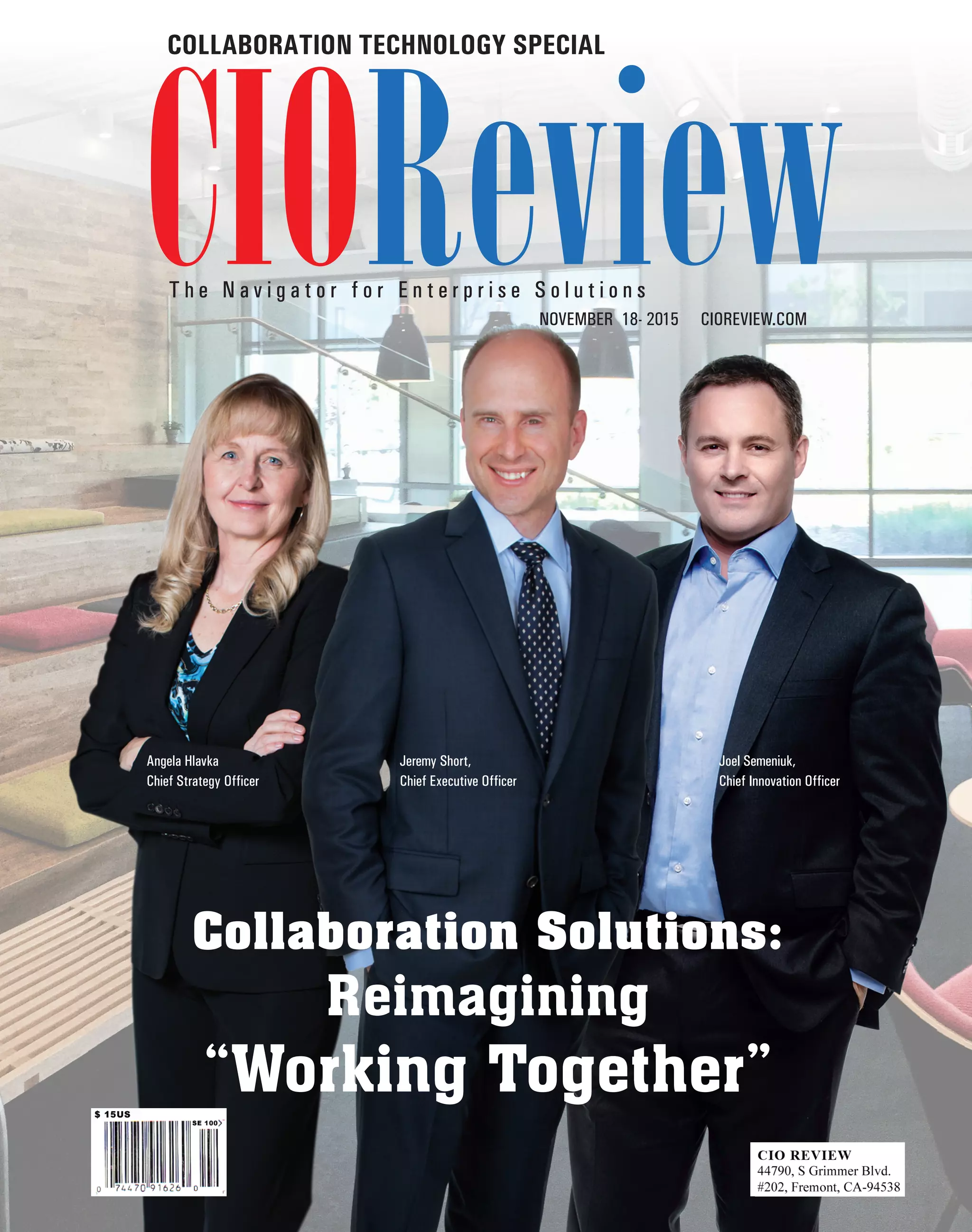
COLLABORATION TECHNOLOGY SPECIAL
T h e N a v i g a t o r f o r E n t e r p r i s e S o l u t i o n s
NOVEMBER 18- 2015 CIOREVIEW.COM
Joel Semeniuk,
Chief Innovation Officer
Angela Hlavka
Chief Strategy Officer
Jeremy Short,
Chief Executive Officer
Collaboration Solutions:
Reimagining
“Working Together”
| |JULY 2014
32CIOReview
UC&C Solutions Bridge LOB
andWork style Divides
By Georgia Jarrard, Global Collaboration Solutions/Acquisition, PGi
T
he interplay of different departments within an
enterprise is extremely important for business
efficiency. Companies are increasingly data-driven,
and the speed at which information is created and
exchanged today means that staying on the same page is harder
than it's ever been.
Luckily, evolving right alongside this deluge of
information are the tools that businesses use to stay connected,
communicative and collaborative: unified communications
and collaboration tools. There's a reason why Transparency
Market Research has the UCaaS market exploding over the
next 5 years, approaching nearly $40B by 2020.
Businesses have to collaborate —plain and simple. And
UC&C is increasingly how they're doing it.
Driving meaningful results
One of the reasons why I'm so passionate about collaboration
is that I've seen firsthand how it impacts and affects every
single department within an enterprise. From sales to IT, from
marketing to operations and everything in between, every
department across an enterprise has to collaborate effectively
to be successful.
And this would be true even if we weren't in the middle of
a flexible working revolution, where it's increasingly common
for our closest colleagues to have the freedom to work from
anywhere at any time. Technology and evolving workstyles are
converging in a way that's made effective virtual collaboration
an absolute business imperative rather than merely another
available tool in the toolbox.
It might sound like ‘sales speak,’ but unified
communications and collaboration solutions really and truly
provide tangible benefits for every line of business within an
organization. And while it's one thing to claim across-the-board
improvements, it's another thing entirely to back them up,
which is what research from Aberdeen has done. According to
Aberdeen Research, companies that leverage next-generation
communications technologies (integrated voice, mobile, video
chat, etc.) saw-
• 128 percent increase in customer retention.
• 650 percent increase in employee productivity.
• 125 percent increase in operational efficiency.
• 140 percent increase in sales cycle reduction.
These are numbers any management
team would kill for, and companies are
achieving these results by providing
their employees with technologies
they actually need.
Collaboration isn't a ‘nice-to-
have’ conversation; with trends
like globalization, remote work
and always-on connectivity
all firmly entrenched in the
enterprise, UC&C technologies
are mission-critical tools for
enabling effective communication
both inside and outside
of your organization.
E m p o w e r i n g
flexibility
However, tradi-
tionally communi-
cations tools have
been some
Georgia Jarrard
CIO INSIGHTCXO INSIGHT
| |JULY 2014
33CIOReview
what stodgy in the flexibility they provide each employee. In
other words, there's only one option provided through which
you can collaborate with your coworkers. If it doesn't work for
you or their workstyles, tough luck.
Fortunately, UC&C tools have evolved to create
opportunities for each department across an organization to
define their own workstyles and collaborate in ways that are
meaningful and effective for them. Differences in process
and priority, or even just geographic location, can necessitate
different means of communication, and UC&C addresses this
head-on by combining so many different options together.
The key trend that's again emerging here is one of flexibility.
As our workstyles themselves become more flexible, so too are
the tools we use to stay connected and collaborative with our
colleagues. By merging real-time, synchronous collaboration
(like video and audio conferencing)with near-time,
asynchronous collaboration (like instant messaging and online
workspaces), companies create a better virtual environment in
which each department not only succeeds but also thrives.
Improving interdepartmental communication
You'd be hard-pressed to name a process or function across
your organization that doesn't, at some stage or another,
require collaboration in order to be successful. Sales, for
example, while stereotypically viewed as something of a
lone-wolf sport, increasingly relies upon marketing for leads
and product collateral, engineers for technical assistance and
support, implementation specialists to guide their accounts
through deployments, customer care to ensure support needs
are met on their accounts, etc. And without an effective way
to communicate and collaborate with all of these constituents,
suddenly ‘herding the cats’ becomes your full-time job rather
than focusing on your specific area of responsibility.
It’s very important to weave collaboration into the processes
and protocols that keep your business running. And like most
business processes today, technology is the key to unlocking the
efficiency and productivity your teams need to be successful.
Any ineffectiveness in the way your departments are equipped
to communicate and collaborate will ultimately reveal itself in
your bottom line, whether you're aware of it or not.
There's a reason why, according to an IBM study of global
CEOs, that 63 percent of CEOs surveyed cited "creating a
collaborative environment" as a top factor in drawing the
most out of their employees. There's a reason why UC is top-
of-mind for CTOs and CIOs at every organization across the
globe. Collaborative companies are more effective, are growing
faster and are creating more productive employees. And unified
communications and collaboration is the technology bridge that
can get you there.
It is very important to
weave collaboration
into the processes and
protocols that keep your
business running

PGi_CIO Review_JARRARD Article

  • 1.
    | |JULY 2014 1CIOReview CIOReview COLLABORATIONTECHNOLOGY SPECIAL T h e N a v i g a t o r f o r E n t e r p r i s e S o l u t i o n s NOVEMBER 18- 2015 CIOREVIEW.COM Joel Semeniuk, Chief Innovation Officer Angela Hlavka Chief Strategy Officer Jeremy Short, Chief Executive Officer Collaboration Solutions: Reimagining “Working Together”
  • 2.
    | |JULY 2014 32CIOReview UC&CSolutions Bridge LOB andWork style Divides By Georgia Jarrard, Global Collaboration Solutions/Acquisition, PGi T he interplay of different departments within an enterprise is extremely important for business efficiency. Companies are increasingly data-driven, and the speed at which information is created and exchanged today means that staying on the same page is harder than it's ever been. Luckily, evolving right alongside this deluge of information are the tools that businesses use to stay connected, communicative and collaborative: unified communications and collaboration tools. There's a reason why Transparency Market Research has the UCaaS market exploding over the next 5 years, approaching nearly $40B by 2020. Businesses have to collaborate —plain and simple. And UC&C is increasingly how they're doing it. Driving meaningful results One of the reasons why I'm so passionate about collaboration is that I've seen firsthand how it impacts and affects every single department within an enterprise. From sales to IT, from marketing to operations and everything in between, every department across an enterprise has to collaborate effectively to be successful. And this would be true even if we weren't in the middle of a flexible working revolution, where it's increasingly common for our closest colleagues to have the freedom to work from anywhere at any time. Technology and evolving workstyles are converging in a way that's made effective virtual collaboration an absolute business imperative rather than merely another available tool in the toolbox. It might sound like ‘sales speak,’ but unified communications and collaboration solutions really and truly provide tangible benefits for every line of business within an organization. And while it's one thing to claim across-the-board improvements, it's another thing entirely to back them up, which is what research from Aberdeen has done. According to Aberdeen Research, companies that leverage next-generation communications technologies (integrated voice, mobile, video chat, etc.) saw- • 128 percent increase in customer retention. • 650 percent increase in employee productivity. • 125 percent increase in operational efficiency. • 140 percent increase in sales cycle reduction. These are numbers any management team would kill for, and companies are achieving these results by providing their employees with technologies they actually need. Collaboration isn't a ‘nice-to- have’ conversation; with trends like globalization, remote work and always-on connectivity all firmly entrenched in the enterprise, UC&C technologies are mission-critical tools for enabling effective communication both inside and outside of your organization. E m p o w e r i n g flexibility However, tradi- tionally communi- cations tools have been some Georgia Jarrard CIO INSIGHTCXO INSIGHT
  • 3.
    | |JULY 2014 33CIOReview whatstodgy in the flexibility they provide each employee. In other words, there's only one option provided through which you can collaborate with your coworkers. If it doesn't work for you or their workstyles, tough luck. Fortunately, UC&C tools have evolved to create opportunities for each department across an organization to define their own workstyles and collaborate in ways that are meaningful and effective for them. Differences in process and priority, or even just geographic location, can necessitate different means of communication, and UC&C addresses this head-on by combining so many different options together. The key trend that's again emerging here is one of flexibility. As our workstyles themselves become more flexible, so too are the tools we use to stay connected and collaborative with our colleagues. By merging real-time, synchronous collaboration (like video and audio conferencing)with near-time, asynchronous collaboration (like instant messaging and online workspaces), companies create a better virtual environment in which each department not only succeeds but also thrives. Improving interdepartmental communication You'd be hard-pressed to name a process or function across your organization that doesn't, at some stage or another, require collaboration in order to be successful. Sales, for example, while stereotypically viewed as something of a lone-wolf sport, increasingly relies upon marketing for leads and product collateral, engineers for technical assistance and support, implementation specialists to guide their accounts through deployments, customer care to ensure support needs are met on their accounts, etc. And without an effective way to communicate and collaborate with all of these constituents, suddenly ‘herding the cats’ becomes your full-time job rather than focusing on your specific area of responsibility. It’s very important to weave collaboration into the processes and protocols that keep your business running. And like most business processes today, technology is the key to unlocking the efficiency and productivity your teams need to be successful. Any ineffectiveness in the way your departments are equipped to communicate and collaborate will ultimately reveal itself in your bottom line, whether you're aware of it or not. There's a reason why, according to an IBM study of global CEOs, that 63 percent of CEOs surveyed cited "creating a collaborative environment" as a top factor in drawing the most out of their employees. There's a reason why UC is top- of-mind for CTOs and CIOs at every organization across the globe. Collaborative companies are more effective, are growing faster and are creating more productive employees. And unified communications and collaboration is the technology bridge that can get you there. It is very important to weave collaboration into the processes and protocols that keep your business running