ROLE OF PHARMACISTS IN
PAIN MANAGEMENT
SEE JIAN MING
PHARMACIST, HOSPITAL PORT DICKSON
• Pain Free Program
• Multidisciplinary Healthcare Team
• Roles of pharmacists in pain management
• Pain Medication Therapy Management (MTM) Services
• Training programme for pharmacist in pain management
• Pain Medication Therapy Management (MTM) Guideline for
Pharmacy
• Reporting Of Pain MTM Services
2
Overview
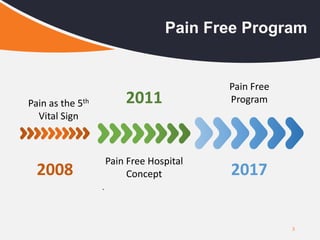
3
Pain Free Program
2011
Pain as the 5th
Vital Sign
Pain Free
Program
Pain Free Hospital
Concept
.
2008 2017
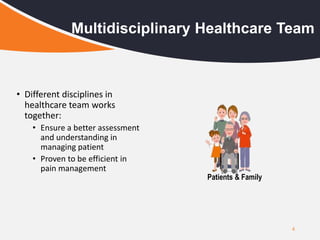
• Different disciplines in
healthcare team works
together:
• Ensure a better assessment
and understanding in
managing patient
• Proven to be efficient in
pain management
4
Multidisciplinary Healthcare Team
Patients & Family
• Pharmacist expertise  understanding in pharmacology,
pharmacokinetics, and therapeutic efficacy of medications.
• Therefore pharmacist play an essential role to safeguard
cost effectiveness and safe practice of pain medications
while improving quality of life for patients.
5
Multidisciplinary Healthcare Team
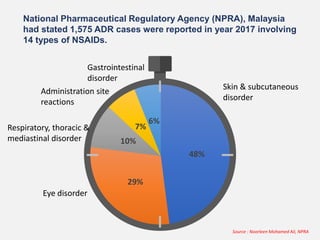
48%
29%
10%
7%
6%
National Pharmaceutical Regulatory Agency (NPRA), Malaysia
had stated 1,575 ADR cases were reported in year 2017 involving
14 types of NSAIDs.
Source : Noorleen Mohamed Ali, NPRA
Eye disorder
Respiratory, thoracic &
mediastinal disorder
Administration site
reactions
Gastrointestinal
disorder
Skin & subcutaneous
disorder
7
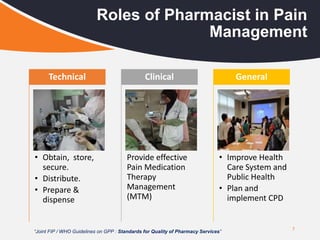
Roles of Pharmacist in Pain
Management
• Obtain, store,
secure.
• Distribute.
• Prepare &
dispense
Technical
Provide effective
Pain Medication
Therapy
Management
(MTM)
Clinical
• Improve Health
Care System and
Public Health
• Plan and
implement CPD
General
“Joint FIP / WHO Guidelines on GPP : Standards for Quality of Pharmacy Services”
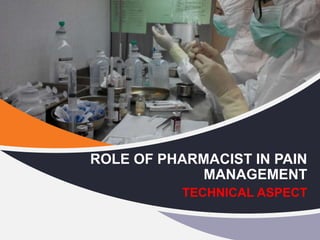
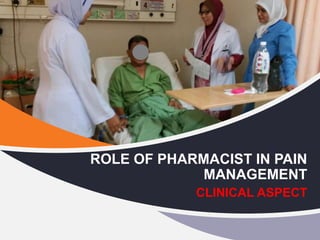
ROLE OF PHARMACIST IN PAIN
MANAGEMENT
TECHNICAL ASPECT
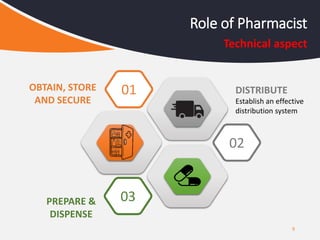
9
Role of Pharmacist
Technical aspect
OBTAIN, STORE
AND SECURE
PREPARE &
DISPENSE
DISTRIBUTE
Establish an effective
distribution system
02
03
01
10
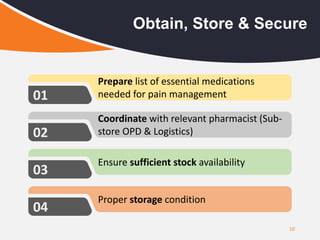
Obtain, Store & Secure
Prepare list of essential medications
needed for pain management
01
Coordinate with relevant pharmacist (Sub-
store OPD & Logistics)
02
Ensure sufficient stock availability
03
Proper storage condition
04
11
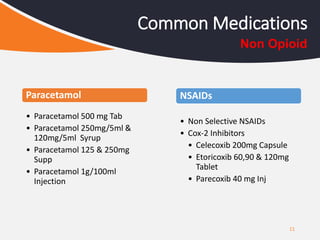
Common Medications
Non Opioid
Paracetamol
• Paracetamol 500 mg Tab
• Paracetamol 250mg/5ml &
120mg/5ml Syrup
• Paracetamol 125 & 250mg
Supp
• Paracetamol 1g/100ml
Injection
NSAIDs
• Non Selective NSAIDs
• Cox-2 Inhibitors
• Celecoxib 200mg Capsule
• Etoricoxib 60,90 & 120mg
Tablet
• Parecoxib 40 mg Inj
12
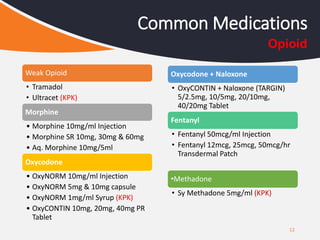
Common Medications
Opioid
Weak Opioid
• Tramadol
• Ultracet (KPK)
Morphine
• Morphine 10mg/ml Injection
• Morphine SR 10mg, 30mg & 60mg
• Aq. Morphine 10mg/5ml
Oxycodone
• OxyNORM 10mg/ml Injection
• OxyNORM 5mg & 10mg capsule
• OxyNORM 1mg/ml Syrup (KPK)
• OxyCONTIN 10mg, 20mg, 40mg PR
Tablet
Oxycodone + Naloxone
• OxyCONTIN + Naloxone (TARGIN)
5/2.5mg, 10/5mg, 20/10mg,
40/20mg Tablet
Fentanyl
• Fentanyl 50mcg/ml Injection
• Fentanyl 12mcg, 25mcg, 50mcg/hr
Transdermal Patch
•Methadone
• Sy Methadone 5mg/ml (KPK)
13
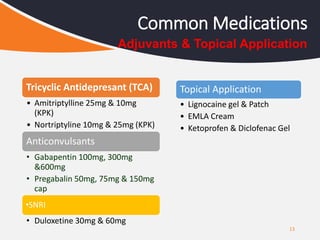
Common Medications
Adjuvants & Topical Application
Tricyclic Antidepresant (TCA)
• Amitriptylline 25mg & 10mg
(KPK)
• Nortriptyline 10mg & 25mg (KPK)
Anticonvulsants
• Gabapentin 100mg, 300mg
&600mg
• Pregabalin 50mg, 75mg & 150mg
cap
•SNRI
• Duloxetine 30mg & 60mg
Topical Application
• Lignocaine gel & Patch
• EMLA Cream
• Ketoprofen & Diclofenac Gel
• Conducted in appropriate technique especially sterile to
ensure efficacy & safety of products [IV admixture for
PCA & epidural cocktail]
• Extemporaneous should be done according to
formulation MOH Extemporaneous Formulary & proper
reference [Syrup Morphine]
14
Preparation
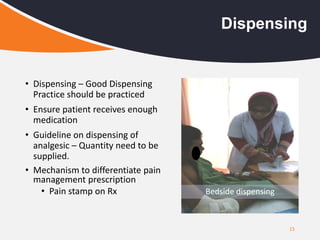
• Dispensing – Good Dispensing
Practice should be practiced
• Ensure patient receives enough
medication
• Guideline on dispensing of
analgesic – Quantity need to be
supplied.
• Mechanism to differentiate pain
management prescription
• Pain stamp on Rx
15
Dispensing
Bedside dispensing
ROLE OF PHARMACIST IN PAIN
MANAGEMENT
CLINICAL ASPECT
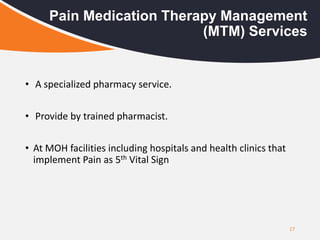
• A specialized pharmacy service.
• Provide by trained pharmacist.
• At MOH facilities including hospitals and health clinics that
implement Pain as 5th Vital Sign
17
Pain Medication Therapy Management
(MTM) Services
18
Pain Medication Therapy Management
(MTM) Services
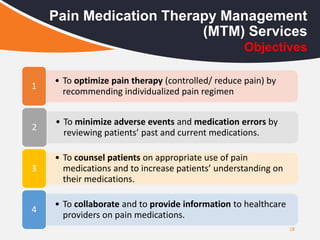
• To optimize pain therapy (controlled/ reduce pain) by
recommending individualized pain regimen
1
• To minimize adverse events and medication errors by
reviewing patients’ past and current medications.
2
• To counsel patients on appropriate use of pain
medications and to increase patients’ understanding on
their medications.
3
• To collaborate and to provide information to healthcare
providers on pain medications.
4
Objectives
Provision Of Pain MTM Service
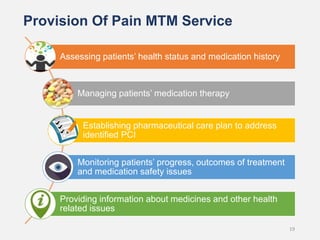
Assessing patients’ health status and medication history
Managing patients’ medication therapy
Establishing pharmaceutical care plan to address
identified PCI
Monitoring patients’ progress, outcomes of treatment
and medication safety issues
Providing information about medicines and other health
related issues
19
20
Pain MTM Service in Ambulatory &
Inpatient setting
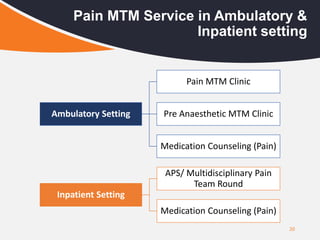
Ambulatory Setting
Pain MTM Clinic
Pre Anaesthetic MTM Clinic
Medication Counseling (Pain)
Inpatient Setting
APS/ Multidisciplinary Pain
Team Round
Medication Counseling (Pain)
21
Pain Medication Therapy Management
(MTM) Clinic
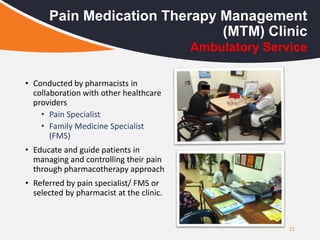
• Conducted by pharmacists in
collaboration with other healthcare
providers
• Pain Specialist
• Family Medicine Specialist
(FMS)
• Educate and guide patients in
managing and controlling their pain
through pharmacotherapy approach
• Referred by pain specialist/ FMS or
selected by pharmacist at the clinic.
Ambulatory Service
22
Pain Medication Therapy Management
(MTM) Clinic
Patient Selection
• Newly started on analgesics & adjuvants (first time seen by pain
specialist)
• Therapeutic goals not achieved with current pain medication regimen
• Chronic pain requiring long term use of pain medication and regular
monitoring
• Patient referred to Pain MTM Clinic
• Changes in pain medication regimen
• Experiencing side effects or complications due to their pain medications.
• On strong opioids therapy.
• Poor understanding on pain medication regimen.
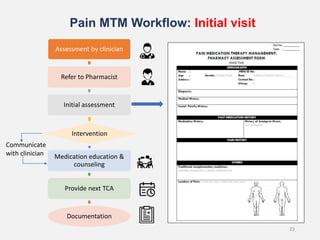
Pain MTM Workflow: Initial visit
23
Assessment by clinician
Refer to Pharmacist
Initial assessment
Intervention
Medication education &
counseling
Provide next TCA
Documentation
Communicate
with clinician
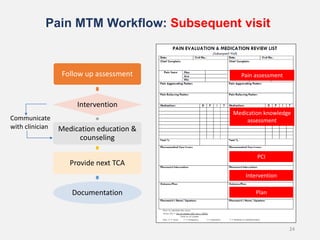
Pain MTM Workflow: Subsequent visit
24
Follow up assessment
Intervention
Medication education &
counseling
Provide next TCA
Documentation
Pain assessment
Medication knowledge
assessment
PCI
Intervention
Plan
Communicate
with clinician
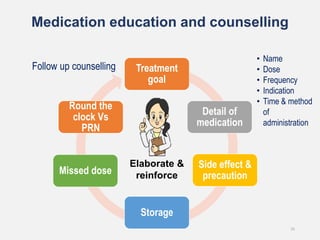
Medication education and counselling
Treatment
goal
Detail of
medication
Side effect &
precaution
Storage
Missed dose
Round the
clock Vs
PRN
25
Elaborate &
reinforce
Follow up counselling
• Name
• Dose
• Frequency
• Indication
• Time & method
of
administration
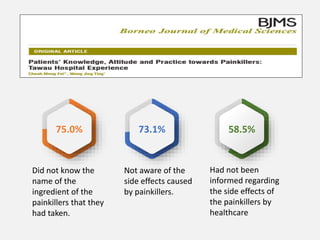
75.0% 73.1%
Not aware of the
side effects caused
by painkillers.
Had not been
informed regarding
the side effects of
the painkillers by
healthcare
Did not know the
name of the
ingredient of the
painkillers that they
had taken.
58.5%
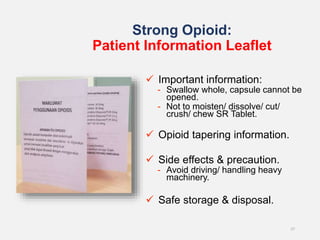
Strong Opioid:
Patient Information Leaflet
27
 Important information:
- Swallow whole, capsule cannot be
opened.
- Not to moisten/ dissolve/ cut/
crush/ chew SR Tablet.
 Opioid tapering information.
 Side effects & precaution.
- Avoid driving/ handling heavy
machinery.
 Safe storage & disposal.
28
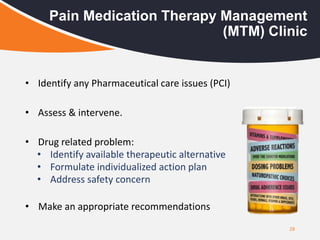
Pain Medication Therapy Management
(MTM) Clinic
• Identify any Pharmaceutical care issues (PCI)
• Assess & intervene.
• Drug related problem:
• Identify available therapeutic alternative
• Formulate individualized action plan
• Address safety concern
• Make an appropriate recommendations
29
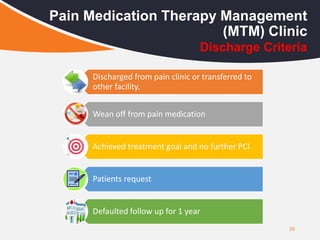
Pain Medication Therapy Management
(MTM) Clinic
Discharge Criteria
Discharged from pain clinic or transferred to
other facility.
Wean off from pain medication
Achieved treatment goal and no further PCI
Patients request
Defaulted follow up for 1 year
30
Pre Anaesthetic MTM Clinic
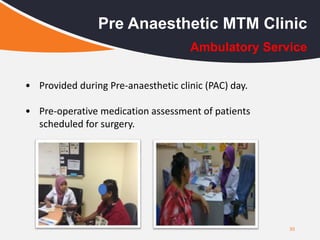
• Provided during Pre-anaesthetic clinic (PAC) day.
• Pre-operative medication assessment of patients
scheduled for surgery.
Ambulatory Service
31
Pre Anaesthetic MTM Clinic
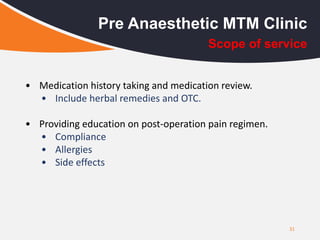
• Medication history taking and medication review.
• Include herbal remedies and OTC.
• Providing education on post-operation pain regimen.
• Compliance
• Allergies
• Side effects
Scope of service
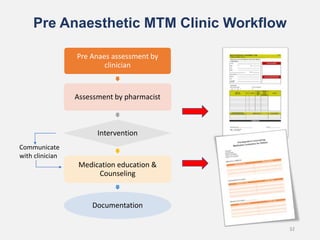
Pre Anaesthetic MTM Clinic Workflow
32
Pre Anaes assessment by
clinician
Assessment by pharmacist
Intervention
Medication education &
Counseling
Documentation
Communicate
with clinician
33
Acute Pain Service (APS)/
Multidisciplinary Pain Team Round
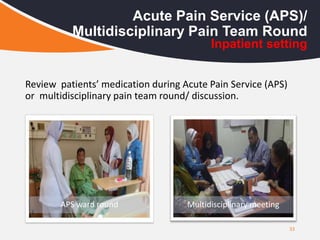
Review patients’ medication during Acute Pain Service (APS)
or multidisciplinary pain team round/ discussion.
Inpatient setting
APS ward round Multidisciplinary meeting
Acute Pain Service (APS)/ Multidisciplinary
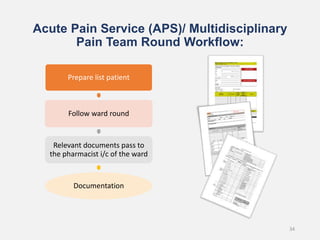
Pain Team Round Workflow:
34
Prepare list patient
Follow ward round
Relevant documents pass to
the pharmacist i/c of the ward
Documentation
35
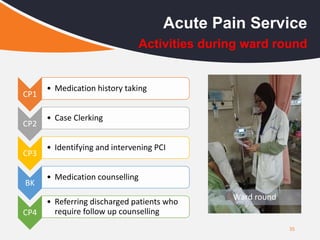
Acute Pain Service
Activities during ward round
CP1
• Medication history taking
CP2
• Case Clerking
CP3
• Identifying and intervening PCI
BK
• Medication counselling
CP4
• Referring discharged patients who
require follow up counselling
Ward round
36
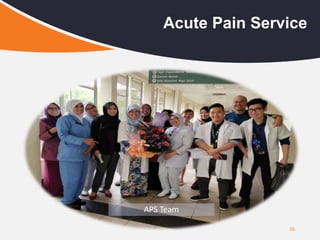
Acute Pain Service
APS Team
37
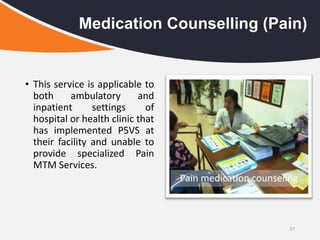
Medication Counselling (Pain)
• This service is applicable to
both ambulatory and
inpatient settings of
hospital or health clinic that
has implemented P5VS at
their facility and unable to
provide specialized Pain
MTM Services.
Pain medication counseling
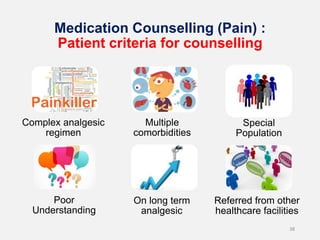
Medication Counselling (Pain) :
Patient criteria for counselling
Complex analgesic
regimen
Multiple
comorbidities
Special
Population
Poor
Understanding
On long term
analgesic
Referred from other
healthcare facilities
38
39
Home Medication Review
• Palliative care population - one of the groups who are at
the highest risk of medication misadventure and adverse
events, and consequently hospital admissions
• Involvement of pharmacist –
• Ensure better therapeutic outcomes in the overall
management of the patient
40
Home Medication Review
ROLE OF PHARMACIST IN PAIN
MANAGEMENT
GENERAL ROLE
42
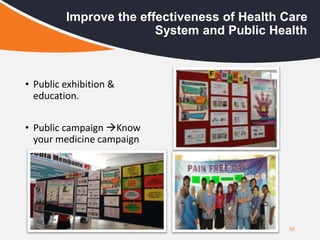
Improve the effectiveness of Health Care
System and Public Health
• Public exhibition &
education.
• Public campaign Know
your medicine campaign
43
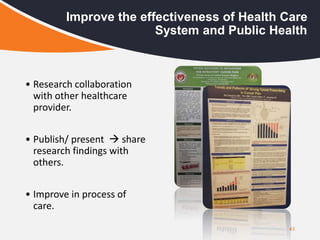
Improve the effectiveness of Health Care
System and Public Health
• Research collaboration
with other healthcare
provider.
• Publish/ present  share
research findings with
others.
• Improve in process of
care.
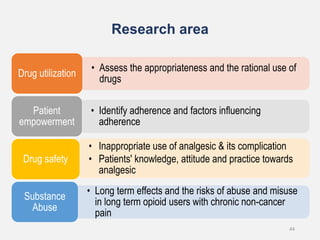
Research area
• Assess the appropriateness and the rational use of
drugs
Drug utilization
• Identify adherence and factors influencing
adherence
Patient
empowerment
• Inappropriate use of analgesic & its complication
• Patients' knowledge, attitude and practice towards
analgesic
Drug safety
• Long term effects and the risks of abuse and misuse
in long term opioid users with chronic non-cancer
pain
Substance
Abuse
44
45
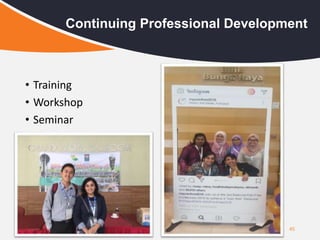
Continuing Professional Development
• Training
• Workshop
• Seminar
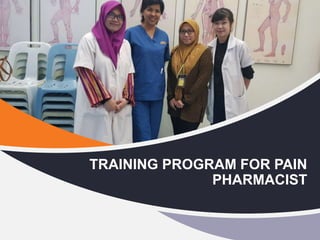
TRAINING PROGRAM FOR PAIN
PHARMACIST
47
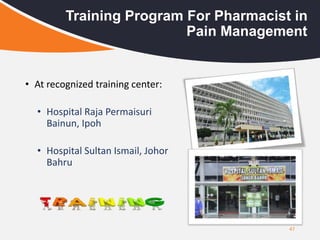
Training Program For Pharmacist in
Pain Management
• At recognized training center:
• Hospital Raja Permaisuri
Bainun, Ipoh
• Hospital Sultan Ismail, Johor
Bahru
48
Training Program For Pharmacist in
Pain Management
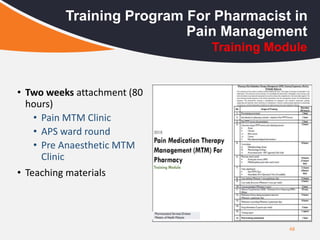
• Two weeks attachment (80
hours)
• Pain MTM Clinic
• APS ward round
• Pre Anaesthetic MTM
Clinic
• Teaching materials
Training Module
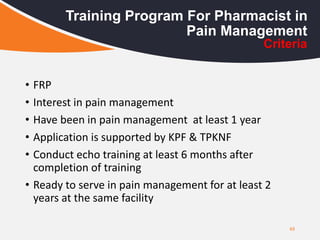
• FRP
• Interest in pain management
• Have been in pain management at least 1 year
• Application is supported by KPF & TPKNF
• Conduct echo training at least 6 months after
completion of training
• Ready to serve in pain management for at least 2
years at the same facility
49
Training Program For Pharmacist in
Pain Management
Criteria
50
51
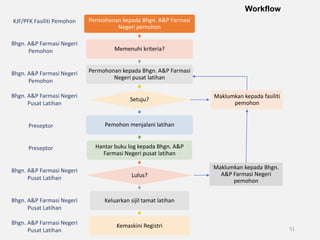
Permohonan kepada Bhgn. A&P Farmasi
Negeri pemohon
Memenuhi kriteria?
Permohonan kepada Bhgn. A&P Farmasi
Negeri pusat latihan
Setuju?
Pemohon menjalani latihan
Hantar buku log kepada Bhgn. A&P
Farmasi Negeri pusat latihan
Lulus?
Keluarkan sijil tamat latihan
Kemaskini Registri
Maklumkan kepada fasiliti
pemohon
Maklumkan kepada Bhgn.
A&P Farmasi Negeri
pemohon
KJF/PFK Fasiliti Pemohon
Bhgn. A&P Farmasi Negeri
Pemohon
Bhgn. A&P Farmasi Negeri
Pemohon
Bhgn. A&P Farmasi Negeri
Pusat Latihan
Preseptor
Preseptor
Bhgn. A&P Farmasi Negeri
Pusat Latihan
Bhgn. A&P Farmasi Negeri
Pusat Latihan
Bhgn. A&P Farmasi Negeri
Pusat Latihan
Workflow
52
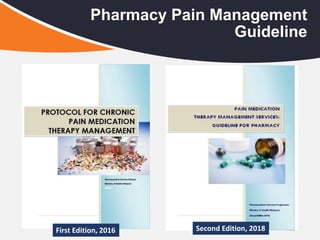
Pharmacy Pain Management
Guideline
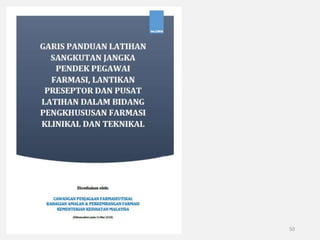
• Published by Pharmaceutical Services Programme, MOH
• 1st edition - 2016
• 2nd edition – 2018
• Content : Pharmacy Pain Management Services in MOH
facilities
• Accessible at website:
www. pharmacy.gov.my – Publications
www. moh.gov.my – Publications
53
Pharmacy Pain Management
Guideline
First Edition, 2016 Second Edition, 2018
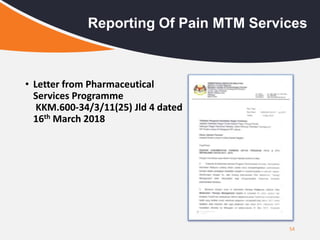
• Letter from Pharmaceutical
Services Programme
KKM.600-34/3/11(25) Jld 4 dated
16th March 2018
54
Reporting Of Pain MTM Services
• Data collection form for Pain Medication Therapy
Management (MTM) services carried out by the pharmacist
at a Pain Free Hospital (starting 2018)
• The statistical report will be sent by the Head of pharmacy
department (KPF)/ appointed Pharmacist (PF YM) to
Bahagian Amalan & Perkembangan Farmasi, KKM via
Timbalan Pengarah Kesihatan Negeri (Farmasi) in each state
55
Reporting Of Pain MTM Services
56
Pain MTM
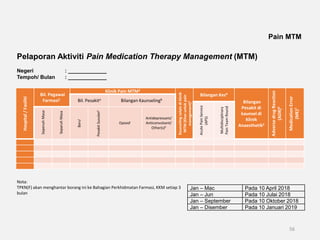
Pelaporan Aktiviti Pain Medication Therapy Management (MTM)
Negeri : _____________
Tempoh/ Bulan : _____________
Hospital
/
Fasiliti
Bil. Pegawai
Farmasi1
Klinik Pain MTM2
Kaunseling
selain
di
klinik
MTM
(Khas
untuk
pain
management)
3
Bilangan Kes4
Bilangan
Pesakit di
kaunsel di
Klinik
Anaesthetik5
Adverse
drug
Reaction
(ADR)
6
Medication
Error
(ME)
7
Bil. Pesakita Bilangan Kaunselingb
Acute
Pain
Service
(APS)
Multidisciplinary
Pain
Team
Round
Sepenuh
Masa
Separuh
Masa
Baru
i
Pesakit
Susulan
ii
Opioidi
Antidepressant/
Anticonvulsant/
Other(s)ii
Jan – Mac Pada 10 April 2018
Jan – Jun Pada 10 Julai 2018
Jan – September Pada 10 Oktober 2018
Jan – Disember Pada 10 Januari 2019
Nota:
TPKN(F) akan menghantar borang ini ke Bahagian Perkhidmatan Farmasi, KKM setiap 3
bulan
57
Summary
• Pharmacists play an important role in facilitating seamless
care to promote better pain management and overall
health outcomes.
• Pharmacists can play an active part in management of
both acute and chronic pain;
• Ensuring safe and appropriate use of medications.
• Counseling and educating patients, caregivers and
other health care team about medication therapy.
THANK YOU
This is an initiative by the Pain
Pharmacy Committee of
Pharmaceutical Services
Programme, Ministry of Health
Malaysia. Would like to express our
heartfelt gratitude the committee
members of the reviewers,
contributors and all those involved
for their valuable and constructive59
Acknowledgement

PFP The Pharmacist Role.pptx

  • 1.
    ROLE OF PHARMACISTSIN PAIN MANAGEMENT SEE JIAN MING PHARMACIST, HOSPITAL PORT DICKSON
  • 2.
    • Pain FreeProgram • Multidisciplinary Healthcare Team • Roles of pharmacists in pain management • Pain Medication Therapy Management (MTM) Services • Training programme for pharmacist in pain management • Pain Medication Therapy Management (MTM) Guideline for Pharmacy • Reporting Of Pain MTM Services 2 Overview
  • 3.
    3 Pain Free Program 2011 Painas the 5th Vital Sign Pain Free Program Pain Free Hospital Concept . 2008 2017
  • 4.
    • Different disciplinesin healthcare team works together: • Ensure a better assessment and understanding in managing patient • Proven to be efficient in pain management 4 Multidisciplinary Healthcare Team Patients & Family
  • 5.
    • Pharmacist expertise understanding in pharmacology, pharmacokinetics, and therapeutic efficacy of medications. • Therefore pharmacist play an essential role to safeguard cost effectiveness and safe practice of pain medications while improving quality of life for patients. 5 Multidisciplinary Healthcare Team
  • 6.
    48% 29% 10% 7% 6% National Pharmaceutical RegulatoryAgency (NPRA), Malaysia had stated 1,575 ADR cases were reported in year 2017 involving 14 types of NSAIDs. Source : Noorleen Mohamed Ali, NPRA Eye disorder Respiratory, thoracic & mediastinal disorder Administration site reactions Gastrointestinal disorder Skin & subcutaneous disorder
  • 7.
    7 Roles of Pharmacistin Pain Management • Obtain, store, secure. • Distribute. • Prepare & dispense Technical Provide effective Pain Medication Therapy Management (MTM) Clinical • Improve Health Care System and Public Health • Plan and implement CPD General “Joint FIP / WHO Guidelines on GPP : Standards for Quality of Pharmacy Services”
  • 8.
    ROLE OF PHARMACISTIN PAIN MANAGEMENT TECHNICAL ASPECT
  • 9.
    9 Role of Pharmacist Technicalaspect OBTAIN, STORE AND SECURE PREPARE & DISPENSE DISTRIBUTE Establish an effective distribution system 02 03 01
  • 10.
    10 Obtain, Store &Secure Prepare list of essential medications needed for pain management 01 Coordinate with relevant pharmacist (Sub- store OPD & Logistics) 02 Ensure sufficient stock availability 03 Proper storage condition 04
  • 11.
    11 Common Medications Non Opioid Paracetamol •Paracetamol 500 mg Tab • Paracetamol 250mg/5ml & 120mg/5ml Syrup • Paracetamol 125 & 250mg Supp • Paracetamol 1g/100ml Injection NSAIDs • Non Selective NSAIDs • Cox-2 Inhibitors • Celecoxib 200mg Capsule • Etoricoxib 60,90 & 120mg Tablet • Parecoxib 40 mg Inj
  • 12.
    12 Common Medications Opioid Weak Opioid •Tramadol • Ultracet (KPK) Morphine • Morphine 10mg/ml Injection • Morphine SR 10mg, 30mg & 60mg • Aq. Morphine 10mg/5ml Oxycodone • OxyNORM 10mg/ml Injection • OxyNORM 5mg & 10mg capsule • OxyNORM 1mg/ml Syrup (KPK) • OxyCONTIN 10mg, 20mg, 40mg PR Tablet Oxycodone + Naloxone • OxyCONTIN + Naloxone (TARGIN) 5/2.5mg, 10/5mg, 20/10mg, 40/20mg Tablet Fentanyl • Fentanyl 50mcg/ml Injection • Fentanyl 12mcg, 25mcg, 50mcg/hr Transdermal Patch •Methadone • Sy Methadone 5mg/ml (KPK)
  • 13.
    13 Common Medications Adjuvants &Topical Application Tricyclic Antidepresant (TCA) • Amitriptylline 25mg & 10mg (KPK) • Nortriptyline 10mg & 25mg (KPK) Anticonvulsants • Gabapentin 100mg, 300mg &600mg • Pregabalin 50mg, 75mg & 150mg cap •SNRI • Duloxetine 30mg & 60mg Topical Application • Lignocaine gel & Patch • EMLA Cream • Ketoprofen & Diclofenac Gel
  • 14.
    • Conducted inappropriate technique especially sterile to ensure efficacy & safety of products [IV admixture for PCA & epidural cocktail] • Extemporaneous should be done according to formulation MOH Extemporaneous Formulary & proper reference [Syrup Morphine] 14 Preparation
  • 15.
    • Dispensing –Good Dispensing Practice should be practiced • Ensure patient receives enough medication • Guideline on dispensing of analgesic – Quantity need to be supplied. • Mechanism to differentiate pain management prescription • Pain stamp on Rx 15 Dispensing Bedside dispensing
  • 16.
    ROLE OF PHARMACISTIN PAIN MANAGEMENT CLINICAL ASPECT
  • 17.
    • A specializedpharmacy service. • Provide by trained pharmacist. • At MOH facilities including hospitals and health clinics that implement Pain as 5th Vital Sign 17 Pain Medication Therapy Management (MTM) Services
  • 18.
    18 Pain Medication TherapyManagement (MTM) Services • To optimize pain therapy (controlled/ reduce pain) by recommending individualized pain regimen 1 • To minimize adverse events and medication errors by reviewing patients’ past and current medications. 2 • To counsel patients on appropriate use of pain medications and to increase patients’ understanding on their medications. 3 • To collaborate and to provide information to healthcare providers on pain medications. 4 Objectives
  • 19.
    Provision Of PainMTM Service Assessing patients’ health status and medication history Managing patients’ medication therapy Establishing pharmaceutical care plan to address identified PCI Monitoring patients’ progress, outcomes of treatment and medication safety issues Providing information about medicines and other health related issues 19
  • 20.
    20 Pain MTM Servicein Ambulatory & Inpatient setting Ambulatory Setting Pain MTM Clinic Pre Anaesthetic MTM Clinic Medication Counseling (Pain) Inpatient Setting APS/ Multidisciplinary Pain Team Round Medication Counseling (Pain)
  • 21.
    21 Pain Medication TherapyManagement (MTM) Clinic • Conducted by pharmacists in collaboration with other healthcare providers • Pain Specialist • Family Medicine Specialist (FMS) • Educate and guide patients in managing and controlling their pain through pharmacotherapy approach • Referred by pain specialist/ FMS or selected by pharmacist at the clinic. Ambulatory Service
  • 22.
    22 Pain Medication TherapyManagement (MTM) Clinic Patient Selection • Newly started on analgesics & adjuvants (first time seen by pain specialist) • Therapeutic goals not achieved with current pain medication regimen • Chronic pain requiring long term use of pain medication and regular monitoring • Patient referred to Pain MTM Clinic • Changes in pain medication regimen • Experiencing side effects or complications due to their pain medications. • On strong opioids therapy. • Poor understanding on pain medication regimen.
  • 23.
    Pain MTM Workflow:Initial visit 23 Assessment by clinician Refer to Pharmacist Initial assessment Intervention Medication education & counseling Provide next TCA Documentation Communicate with clinician
  • 24.
    Pain MTM Workflow:Subsequent visit 24 Follow up assessment Intervention Medication education & counseling Provide next TCA Documentation Pain assessment Medication knowledge assessment PCI Intervention Plan Communicate with clinician
  • 25.
    Medication education andcounselling Treatment goal Detail of medication Side effect & precaution Storage Missed dose Round the clock Vs PRN 25 Elaborate & reinforce Follow up counselling • Name • Dose • Frequency • Indication • Time & method of administration
  • 26.
    75.0% 73.1% Not awareof the side effects caused by painkillers. Had not been informed regarding the side effects of the painkillers by healthcare Did not know the name of the ingredient of the painkillers that they had taken. 58.5%
  • 27.
    Strong Opioid: Patient InformationLeaflet 27  Important information: - Swallow whole, capsule cannot be opened. - Not to moisten/ dissolve/ cut/ crush/ chew SR Tablet.  Opioid tapering information.  Side effects & precaution. - Avoid driving/ handling heavy machinery.  Safe storage & disposal.
  • 28.
    28 Pain Medication TherapyManagement (MTM) Clinic • Identify any Pharmaceutical care issues (PCI) • Assess & intervene. • Drug related problem: • Identify available therapeutic alternative • Formulate individualized action plan • Address safety concern • Make an appropriate recommendations
  • 29.
    29 Pain Medication TherapyManagement (MTM) Clinic Discharge Criteria Discharged from pain clinic or transferred to other facility. Wean off from pain medication Achieved treatment goal and no further PCI Patients request Defaulted follow up for 1 year
  • 30.
    30 Pre Anaesthetic MTMClinic • Provided during Pre-anaesthetic clinic (PAC) day. • Pre-operative medication assessment of patients scheduled for surgery. Ambulatory Service
  • 31.
    31 Pre Anaesthetic MTMClinic • Medication history taking and medication review. • Include herbal remedies and OTC. • Providing education on post-operation pain regimen. • Compliance • Allergies • Side effects Scope of service
  • 32.
    Pre Anaesthetic MTMClinic Workflow 32 Pre Anaes assessment by clinician Assessment by pharmacist Intervention Medication education & Counseling Documentation Communicate with clinician
  • 33.
    33 Acute Pain Service(APS)/ Multidisciplinary Pain Team Round Review patients’ medication during Acute Pain Service (APS) or multidisciplinary pain team round/ discussion. Inpatient setting APS ward round Multidisciplinary meeting
  • 34.
    Acute Pain Service(APS)/ Multidisciplinary Pain Team Round Workflow: 34 Prepare list patient Follow ward round Relevant documents pass to the pharmacist i/c of the ward Documentation
  • 35.
    35 Acute Pain Service Activitiesduring ward round CP1 • Medication history taking CP2 • Case Clerking CP3 • Identifying and intervening PCI BK • Medication counselling CP4 • Referring discharged patients who require follow up counselling Ward round
  • 36.
  • 37.
    37 Medication Counselling (Pain) •This service is applicable to both ambulatory and inpatient settings of hospital or health clinic that has implemented P5VS at their facility and unable to provide specialized Pain MTM Services. Pain medication counseling
  • 38.
    Medication Counselling (Pain): Patient criteria for counselling Complex analgesic regimen Multiple comorbidities Special Population Poor Understanding On long term analgesic Referred from other healthcare facilities 38
  • 39.
    39 Home Medication Review •Palliative care population - one of the groups who are at the highest risk of medication misadventure and adverse events, and consequently hospital admissions • Involvement of pharmacist – • Ensure better therapeutic outcomes in the overall management of the patient
  • 40.
  • 41.
    ROLE OF PHARMACISTIN PAIN MANAGEMENT GENERAL ROLE
  • 42.
    42 Improve the effectivenessof Health Care System and Public Health • Public exhibition & education. • Public campaign Know your medicine campaign
  • 43.
    43 Improve the effectivenessof Health Care System and Public Health • Research collaboration with other healthcare provider. • Publish/ present  share research findings with others. • Improve in process of care.
  • 44.
    Research area • Assessthe appropriateness and the rational use of drugs Drug utilization • Identify adherence and factors influencing adherence Patient empowerment • Inappropriate use of analgesic & its complication • Patients' knowledge, attitude and practice towards analgesic Drug safety • Long term effects and the risks of abuse and misuse in long term opioid users with chronic non-cancer pain Substance Abuse 44
  • 45.
    45 Continuing Professional Development •Training • Workshop • Seminar
  • 46.
    TRAINING PROGRAM FORPAIN PHARMACIST
  • 47.
    47 Training Program ForPharmacist in Pain Management • At recognized training center: • Hospital Raja Permaisuri Bainun, Ipoh • Hospital Sultan Ismail, Johor Bahru
  • 48.
    48 Training Program ForPharmacist in Pain Management • Two weeks attachment (80 hours) • Pain MTM Clinic • APS ward round • Pre Anaesthetic MTM Clinic • Teaching materials Training Module
  • 49.
    • FRP • Interestin pain management • Have been in pain management at least 1 year • Application is supported by KPF & TPKNF • Conduct echo training at least 6 months after completion of training • Ready to serve in pain management for at least 2 years at the same facility 49 Training Program For Pharmacist in Pain Management Criteria
  • 50.
  • 51.
    51 Permohonan kepada Bhgn.A&P Farmasi Negeri pemohon Memenuhi kriteria? Permohonan kepada Bhgn. A&P Farmasi Negeri pusat latihan Setuju? Pemohon menjalani latihan Hantar buku log kepada Bhgn. A&P Farmasi Negeri pusat latihan Lulus? Keluarkan sijil tamat latihan Kemaskini Registri Maklumkan kepada fasiliti pemohon Maklumkan kepada Bhgn. A&P Farmasi Negeri pemohon KJF/PFK Fasiliti Pemohon Bhgn. A&P Farmasi Negeri Pemohon Bhgn. A&P Farmasi Negeri Pemohon Bhgn. A&P Farmasi Negeri Pusat Latihan Preseptor Preseptor Bhgn. A&P Farmasi Negeri Pusat Latihan Bhgn. A&P Farmasi Negeri Pusat Latihan Bhgn. A&P Farmasi Negeri Pusat Latihan Workflow
  • 52.
    52 Pharmacy Pain Management Guideline •Published by Pharmaceutical Services Programme, MOH • 1st edition - 2016 • 2nd edition – 2018 • Content : Pharmacy Pain Management Services in MOH facilities • Accessible at website: www. pharmacy.gov.my – Publications www. moh.gov.my – Publications
  • 53.
    53 Pharmacy Pain Management Guideline FirstEdition, 2016 Second Edition, 2018
  • 54.
    • Letter fromPharmaceutical Services Programme KKM.600-34/3/11(25) Jld 4 dated 16th March 2018 54 Reporting Of Pain MTM Services
  • 55.
    • Data collectionform for Pain Medication Therapy Management (MTM) services carried out by the pharmacist at a Pain Free Hospital (starting 2018) • The statistical report will be sent by the Head of pharmacy department (KPF)/ appointed Pharmacist (PF YM) to Bahagian Amalan & Perkembangan Farmasi, KKM via Timbalan Pengarah Kesihatan Negeri (Farmasi) in each state 55 Reporting Of Pain MTM Services
  • 56.
    56 Pain MTM Pelaporan AktivitiPain Medication Therapy Management (MTM) Negeri : _____________ Tempoh/ Bulan : _____________ Hospital / Fasiliti Bil. Pegawai Farmasi1 Klinik Pain MTM2 Kaunseling selain di klinik MTM (Khas untuk pain management) 3 Bilangan Kes4 Bilangan Pesakit di kaunsel di Klinik Anaesthetik5 Adverse drug Reaction (ADR) 6 Medication Error (ME) 7 Bil. Pesakita Bilangan Kaunselingb Acute Pain Service (APS) Multidisciplinary Pain Team Round Sepenuh Masa Separuh Masa Baru i Pesakit Susulan ii Opioidi Antidepressant/ Anticonvulsant/ Other(s)ii Jan – Mac Pada 10 April 2018 Jan – Jun Pada 10 Julai 2018 Jan – September Pada 10 Oktober 2018 Jan – Disember Pada 10 Januari 2019 Nota: TPKN(F) akan menghantar borang ini ke Bahagian Perkhidmatan Farmasi, KKM setiap 3 bulan
  • 57.
    57 Summary • Pharmacists playan important role in facilitating seamless care to promote better pain management and overall health outcomes. • Pharmacists can play an active part in management of both acute and chronic pain; • Ensuring safe and appropriate use of medications. • Counseling and educating patients, caregivers and other health care team about medication therapy.
  • 58.
  • 59.
    This is aninitiative by the Pain Pharmacy Committee of Pharmaceutical Services Programme, Ministry of Health Malaysia. Would like to express our heartfelt gratitude the committee members of the reviewers, contributors and all those involved for their valuable and constructive59 Acknowledgement

Editor's Notes

  • #44 © Copyright PresentationGo.com – The free PowerPoint template library
  • #58 © Copyright PresentationGo.com – The free PowerPoint template library
  • #59 © Copyright PresentationGo.com – The free PowerPoint template library