Dr. Kumbhare Manoj Ramesh
Professor
S.M.B.T. College of Pharmacy
Nashik-422403
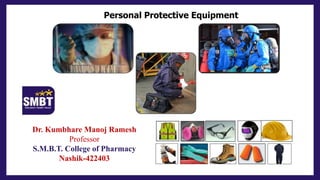
Personal Protective Equipment
COLLEGE OF PHARMACY
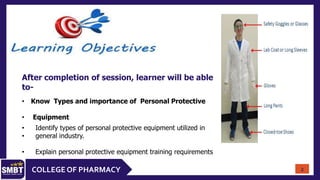
After completion of session, learner will be able
to-
• Know Types and importance of Personal Protective
• Equipment
• Identify types of personal protective equipment utilized in
• general industry.
• Explain personal protective equipment training requirements
2
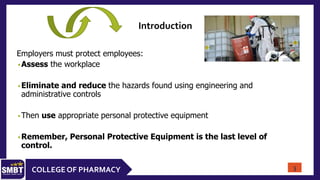
Employers must protect employees:
•Assess the workplace
•Eliminate and reduce the hazards found using engineering and
administrative controls
•Then use appropriate personal protective equipment
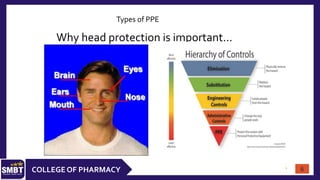
•Remember, Personal Protective Equipment is the last level of
control.
3
Introduction
COLLEGE OF PHARMACY 3
COLLEGE OF PHARMACY 4
PPE controls:
Requires worker to wear something
Examples
4
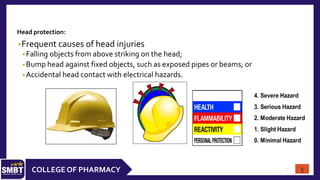
Head protection:
•Frequent causes of head injuries
•Falling objects from above striking on the head;
•Bump head against fixed objects, such as exposed pipes or beams; or
•Accidental head contact with electrical hazards.
5
COLLEGE OF PHARMACY 5
6
COLLEGE OF PHARMACY
Types of PPE
Why head protection is important…
6
COLLEGE OF PHARMACY
Types of PPE
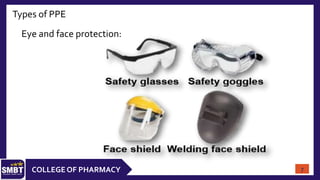
Eye and face protection:
7
8
COLLEGE OF PHARMACY
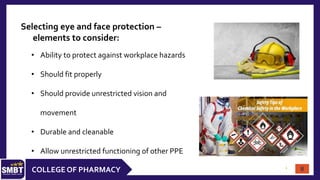
Selecting eye and face protection –
elements to consider:
• Ability to protect against workplace hazards
• Should fit properly
• Should provide unrestricted vision and
movement
• Durable and cleanable
• Allow unrestricted functioning of other PPE
8
9
COLLEGE OF PHARMACY
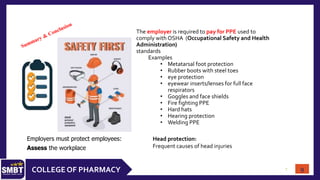
The employer is required to pay for PPE used to
comply with OSHA (Occupational Safety and Health
Administration)
standards
Examples
• Metatarsal foot protection
• Rubber boots with steel toes
• eye protection
• eyewear inserts/lenses for full face
respirators
• Goggles and face shields
• Fire fighting PPE
• Hard hats
• Hearing protection
• Welding PPE
Employers must protect employees:
Assess the workplace
Head protection:
Frequent causes of head injuries
9
10
1. Common causes of foot injuries include: crushing, penetration, molten metal,
chemicals, slippery surfaces, and sharp objects.
a.True
b. False
2. Who is responsible for providing PPE needed to comply with OSHA standards?
a. The employee
b. OSHA
c. The Employer
d. Workers’ Compensation
Q. Explain personal protective equipment training requirements 5 marks
10
COLLEGE OF PHARMACY
1.Personal Protective Equipment". Citation PLC. Archived from the original on 2012-10-14. Retrieved 2012-10-31. Personal
Protective Equipment
2. Funderburk, Greg; McGowan, Dennis; Stumph, Charles (2015). Weapons of Mass Destruction. LawTech Publishing
Group. ISBN 978-1-56325-283-9.
3. Lynteris, Christos (18 August 2018). "Plague Masks: The Visual Emergence of Anti-Epidemic Personal Protection
Equipment". Medical Anthropology. 37 (6): 442–457. doi:10.1080/01459740.2017.1423072. hdl:10023/16472. ISSN 0145-
9740. PMID 30427733.
4.Tikka, Christina; Verbeek, Jos H; Kateman, Erik; Morata, Thais C; Dreschler, Wouter A; Ferrite, Silvia (2017-07-07). "Interventions
to prevent occupational noise-induced hearing loss". The Cochrane Database of Systematic Reviews. 2017 (7):
CD006396. doi:10.1002/14651858.CD006396.pub4. ISSN 1469-493X. PMC 6353150. PMID 28685503.
11
12

Personal Protective Equipment requirements

  • 1.
    Dr. Kumbhare ManojRamesh Professor S.M.B.T. College of Pharmacy Nashik-422403 Personal Protective Equipment
  • 2.
    COLLEGE OF PHARMACY Aftercompletion of session, learner will be able to- • Know Types and importance of Personal Protective • Equipment • Identify types of personal protective equipment utilized in • general industry. • Explain personal protective equipment training requirements 2
  • 3.
    Employers must protectemployees: •Assess the workplace •Eliminate and reduce the hazards found using engineering and administrative controls •Then use appropriate personal protective equipment •Remember, Personal Protective Equipment is the last level of control. 3 Introduction COLLEGE OF PHARMACY 3
  • 4.
    COLLEGE OF PHARMACY4 PPE controls: Requires worker to wear something Examples 4
  • 5.
    Head protection: •Frequent causesof head injuries •Falling objects from above striking on the head; •Bump head against fixed objects, such as exposed pipes or beams; or •Accidental head contact with electrical hazards. 5 COLLEGE OF PHARMACY 5
  • 6.
    6 COLLEGE OF PHARMACY Typesof PPE Why head protection is important… 6
  • 7.
    COLLEGE OF PHARMACY Typesof PPE Eye and face protection: 7
  • 8.
    8 COLLEGE OF PHARMACY Selectingeye and face protection – elements to consider: • Ability to protect against workplace hazards • Should fit properly • Should provide unrestricted vision and movement • Durable and cleanable • Allow unrestricted functioning of other PPE 8
  • 9.
    9 COLLEGE OF PHARMACY Theemployer is required to pay for PPE used to comply with OSHA (Occupational Safety and Health Administration) standards Examples • Metatarsal foot protection • Rubber boots with steel toes • eye protection • eyewear inserts/lenses for full face respirators • Goggles and face shields • Fire fighting PPE • Hard hats • Hearing protection • Welding PPE Employers must protect employees: Assess the workplace Head protection: Frequent causes of head injuries 9
  • 10.
    10 1. Common causesof foot injuries include: crushing, penetration, molten metal, chemicals, slippery surfaces, and sharp objects. a.True b. False 2. Who is responsible for providing PPE needed to comply with OSHA standards? a. The employee b. OSHA c. The Employer d. Workers’ Compensation Q. Explain personal protective equipment training requirements 5 marks 10
  • 11.
    COLLEGE OF PHARMACY 1.PersonalProtective Equipment". Citation PLC. Archived from the original on 2012-10-14. Retrieved 2012-10-31. Personal Protective Equipment 2. Funderburk, Greg; McGowan, Dennis; Stumph, Charles (2015). Weapons of Mass Destruction. LawTech Publishing Group. ISBN 978-1-56325-283-9. 3. Lynteris, Christos (18 August 2018). "Plague Masks: The Visual Emergence of Anti-Epidemic Personal Protection Equipment". Medical Anthropology. 37 (6): 442–457. doi:10.1080/01459740.2017.1423072. hdl:10023/16472. ISSN 0145- 9740. PMID 30427733. 4.Tikka, Christina; Verbeek, Jos H; Kateman, Erik; Morata, Thais C; Dreschler, Wouter A; Ferrite, Silvia (2017-07-07). "Interventions to prevent occupational noise-induced hearing loss". The Cochrane Database of Systematic Reviews. 2017 (7): CD006396. doi:10.1002/14651858.CD006396.pub4. ISSN 1469-493X. PMC 6353150. PMID 28685503. 11
  • 12.