1
Safety Equipment
2
Safety Equipment Maintenance
As part of the incident prevention, all safety and lifesaving equipment
must always in good condition and ready for use, therefore, a well
planned maintenance should be applied.
These equipment include :
 Large dry chemical (LDC).
 Portable fire extinguishers.
 Life rafts.
 Lifebuoy.
 Lifeboats.
 Safety equipment audit.
 Carley Float.
 Work vest.
 Swing ropes.
 Dry powder (Ansul) hose reel.
 Water hose reel.
 Fire sprinkler system.
 Breathing Apparatus.
3
Large Dry Chemical (LDC)
Large Dry Chemical (LDC) System
• This large Dry Chemical (ANSUL) is the main fire extinguisher on the
platform. On production platform, the system is usually designed to
extinguish should any fire occurs at wellhead and production header
area, test separator area and at slop area. The planned maintenance
of this safety equipment is scheduled one month, 6 month and yearly.
Practical Tip
• Although the job lists has been established, the next most importance
step for supervisor is to ensure that the jobs are done correctly and
the procedures are precisely followed as written in the job list.
4
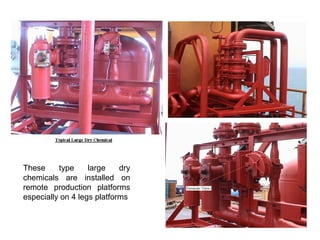
These type large dry
chemicals are installed on
remote production platforms
especially on 4 legs platforms
5
Portable Fire Extinguisher (PFE)
6
Portable Fire Extinguisher (PFE)
Portable Fire Extinguisher.
• Considering that economics become an important factor in the
larger capacity fire extinguishers; consequently portable fire
extinguisher becomes a favorite choice. It is very popular and
widely used in the world from large industries to household. The
units are designed for personal use. Dry chemical cartridge
operated hand portable fire extinguishers are available in size
ranging from 5 - 30 pounds. The units are classified in to class A, B
and C depending on the agent used. Specialized units are also
available for class D fires.
• Maintenance of portable fire extinguisher is scheduled monthly and
yearly. Detail work scopes are described in the SAP.
7
Portable Fire Extinguisher (PFE)
There are two main types of portable fire extinguishers :
a. Stored pressure, where the expellant is stored in the same
chamber as the firefighting agent itself. Depending on the
agent used, different propellants are used. With dry
chemical extinguishers, nitrogen is typically used; water
and foam extinguishers typically use air. Stored pressure
fire extinguishers are the most common type
b. Cartridge-operated, where the expellant gas in a separate
cartridge that is punctured prior to discharge, exposing the
propellant to the extinguishing agent. This type has the
advantage of simple and prompt recharge, allowing an
operator to discharge the extinguisher, recharge it, and
return to the fire in a reasonable amount of time. Unlike
stored pressure types, these extinguishers utilize
compressed carbon dioxide instead of nitrogen.
8
Portable Fire Extinguisher (PFE)
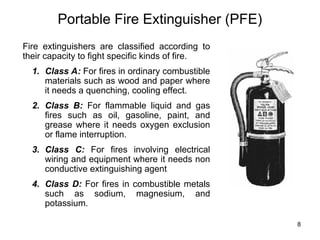
Fire extinguishers are classified according to
their capacity to fight specific kinds of fire.
1. Class A: For fires in ordinary combustible
materials such as wood and paper where
it needs a quenching, cooling effect.
2. Class B: For flammable liquid and gas
fires such as oil, gasoline, paint, and
grease where it needs oxygen exclusion
or flame interruption.
3. Class C: For fires involving electrical
wiring and equipment where it needs non
conductive extinguishing agent
4. Class D: For fires in combustible metals
such as sodium, magnesium, and
potassium.
9
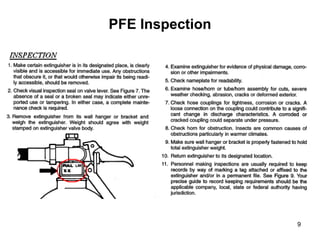
PFE Inspection
10
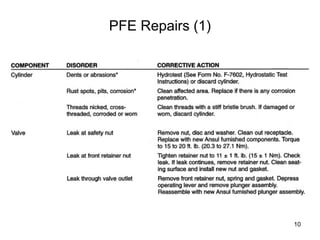
PFE Repairs (1)
11
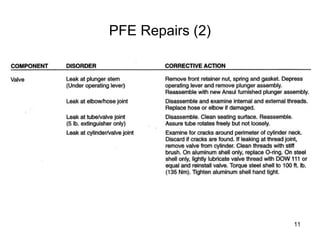
PFE Repairs (2)
12
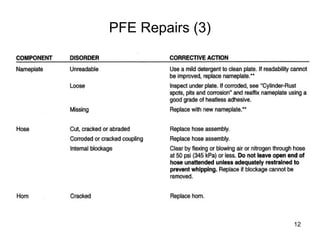
PFE Repairs (3)
13
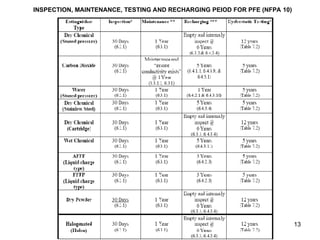
INSPECTION, MAINTENANCE, TESTING AND RECHARGING PEIOD FOR PFE (NFPA 10)
14
LIFERAFT
• Inflatable life rafts come in various sizes from six to forty persons.
They may be round or oval in shape. It is made from rubberized
fabric which must meet tear and abrasion standards.
• Double tube rafts have two tubes one above the other, so the lower
tube carries the weight while the top tube provides freeboard which
makes for a drier more comfortable raft.
• All approved SOLAS life rafts have canopies to protect the
occupants from exposure which automatically set in place when the
life rafts is launched and waterborne.
• Every life raft shall be so constructed that when it is dropped in to
the water from height of 18 meters above the water line in the
lightest seagoing condition will remain in satisfactory condition;
therefore, the life rafts must have been drop tested at least that
height prior to leaving the manufacturer for selling.
15
LIFERAFT MAINTENANCE
SCOPE OF WORK FOR LIFE RAFTS SERVICE & RECERTIFICATION
1. All inspection jobs, repairs, spare part replacement, life preservation renewal
shall be done in accordance with manufacturer recommendation and shall
meet SOLAS standard application.
2. Any spare part replacement, life preservation / food ration renewal and
emergency survival kit replacement shall be clearly mentioned and quoted
per item.
3. Inspect shell for damaged or deterioration, replace if necessary.
4. Inspect all accessories for damaged / missing, and replace / complete as
necessary.
5. Inspect all emergency survival kit for damaged / missing, and replace /
complete as necessary.
6. Perform floor seam test, working pressure test, gas inflation test of the
inflatable component, check for damaged, leak and any anomaly condition.
7. Replace all life preservation in accordance with manufacturer
recommendation and shall meet SOLAS standard application.
8. Check / replace the Nitrogen Cylinder for life raft inflation with proper
capacity in accordance with manufacturer recommendation and shall meet
SOLAS standard application.
9. Repack, close and seal the life raft properly in accordance with manufacturer
recommendation and shall meet SOLAS standard application.
10. The life raft shall be certified to Dir. Jen. of HUBLA (or ABS) approval
certificate.
16
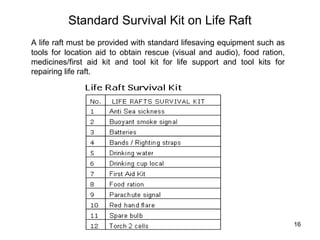
Standard Survival Kit on Life Raft
A life raft must be provided with standard lifesaving equipment such as
tools for location aid to obtain rescue (visual and audio), food ration,
medicines/first aid kit and tool kit for life support and tool kits for
repairing life raft.
17
Life Buoy
In offshore oil & gas operation, life buoys are provided and are
located usually on the main deck handrails. Each person
should learn the location a soon as possible after boarding the
platform/rig/barge. Lifebuoys are not lashed in position and are
always ready for use. In a man overboard situation, a life buoy
always be thrown near the individual so as to mark the location
in the event the man overboard can not reach the buoy.
Marking the approximate position of the man overboard greatly
assist rescue operation.
18
Life Buoy
Maintenance
In order to ensure the availability and reliability of the life buoys, a
preventive maintenance is implemented in three monthly schedules.
The PM covers checking and cleaning of the life buoys. Should any
part were found to be damaged or deteriorated must be replaced as
soon as possible
19
SWING ROPES
 Swing ropes are used to assist personnel to jump across from boat
to platform or FPSO or barge vice versa. Swing ropes are usually
attached on steel chain which installed at underneath of deck
 Planned maintenance routine for swing ropes is scheduled six
monthly. The objective of this maintenance strategy is to ensure
the swing ropes and its associated parts (shackles, chain and the
manila ropes) are in good and safe condition, however, cleaning
the ropes must also be done when it is found dirty or oily.
20
Swing Ropes Maintenance
1. Ensure the necessary precautions are taken for working at
height.
2. Check condition of swing rope and thimbles and replace if
necessary.
3. Clean the rope if necessary.
4. Check condition of shackle and ensure that pin is in a good
shape and well attached.
5. Check condition of chain, chip and repaint as necessary.
6. Carry out MPI of each supporting I-beam using a competent 3rd
Party.
21
LIFE BOAT
Life boat
• Life boat is one of the Totally Enclosed Motor Propelled Survival
Craft (TEMPSC), is a personnel escape device used in CNOOC
offshore operation. This life boat is used if evacuation of an
offshore installation is to be waterborne.
22
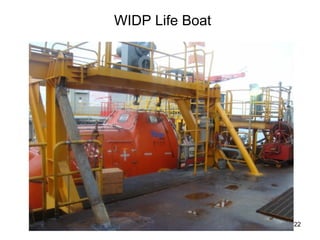
WIDP Life Boat
23
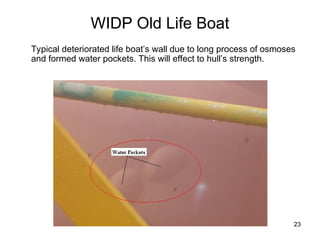
WIDP Old Life Boat
Typical deteriorated life boat’s wall due to long process of osmoses
and formed water pockets. This will effect to hull’s strength.
24
LIFE BOAT
 Under international convention, these crafts have to meet
certain requirements, and stringent testing is done to ensure
that this is the case.
 Main criteria that the crafts have to fulfill among others are:
1. The crafts have to be constructed with a rigid hull watertight
enclosure which completely encloses the craft and will protect
the occupant from heat and cold.
2. The materials used must withstand lateral impact at speed 6.8
knots, and drop from a height of at least 3 meters.
3. Materials used should fire retardant to an extent that the craft
when waterborne will protect occupant in an oil fire or otherwise
contaminated atmosphere, for minimum 8 (eight) minutes. In
addition, a water spray system is installed which utilized
seawater to spray externally allover the life boat to protect the
fabric of the craft.
25
LIFE BOAT
4. A self contained air support system must be installed. This
system must be capable of supporting the needs of occupants
and the engine for a period of at least 10 minutes during which
the air pressure inside the boat must never fall below the
atmospheric pressure.
5. The lifeboats must have inherent buoyancy or be fitted with
buoyancy materials such that the craft will remain afloat when
fully laden, flooded and open to the sea.
6. If there is no damage and hatches are fully closed with all
personnel secured in their seats, the craft should be totally self
righting.
7. The propulsion system in these crafts must be a compression
ignition engine which will deliver sufficient power to propel the
craft forward at speed of 6 knots when fully laden in calm
water, and sufficient fuel should be carried to enable the craft
to operate at this speed for 24 hours.
26
LIFE BOAT
The preventive maintenance for lifeboat is scheduled monthly,
three monthly, six monthly and yearly, and to be done in
conjunction with the manufacturers operations and maintenance
instructions.
If the life boat is powered by diesel engine, the maintenance
should refer to diesel engine maintenance strategy.
27
Firewater System
(Deluge and Sprinkler System)
On process platforms and on some production platforms are
provided with firewater system. A periodic inspection is carried out
on this firewater system. The general philosophy to be adopted in
the company for firewater system is that of periodic inspections with
testing, as required, to confirm continuing availability, reliability and
technical integrity of the systems provided for maximum personal
and facility protection in case of fire.
28
Firewater System
(Deluge and Sprinkler System)
Maintenance
• Maintenance of firewater system covers deluge and sprinkler
system. The controls, metering, regulating and other instrument
devices to be handled by instrument technician, whereas
mechanical portion related with deluge and sprinkler system to be
handled by maintenance safety.
• The planned maintenance practice refer to SAP, deluge system is
scheduled six monthly and yearly. The six monthly schedule is to
perform what so called dry deluge test. At this time all pilot valve
and other instrument controls are function tested. The yearly PM
schedule is to perform what so called wet deluge test where real
flooded on system is carried out. At this time all the instrument
controls plus the sprinklers are checked and ensured for correct
functioning.
29
Hose & Hose Reel
Water Hose Reel and Dry Chemical Hose Reel
• The water hose reel assembly and dry chemical hose reel assembly
are to be regularly maintained to ensure these equipment always be
in good ready and safe condition.
• The water hose reels are used more frequently as these are also
used for other purpose such as cleaning the deck, cleaning inside
vessels during tank cleaning, fire watch during hot works; on the
other hand, the dry chemical hose reels are hardly used.
• Maintenance for these hose reels are to ensure the reel assembly
for smooth spinning and leak free, whereas the hose are inspected
for expire, damaged/cracked or deterioration due to aging.
• Maintenance schedule for water hose is scheduled thee monthly
and yearly, whereas for dry chemical hose reel is scheduled
monthly and three monthly.
30
Typical Hose Reel Maintenance Job List
1. Unroll the hose, inspect for damage e.g. cuts, kinks and signs
of softening or separation of layers. Replace unserviceable
hoses
2. Check and grease reel drum bearings and reels rotate easily
3. Check that all branches are free and adjust easily
4. Check action and security of nozzle
5. Check clamp (hose to reel)
6. Clean any rust and protect with correct primer and gloss paint.
7. Weight the actuator cartridge and replace if under weight
8. Sign and date the record card on the hose reel
31
BREATHING APPARATUS
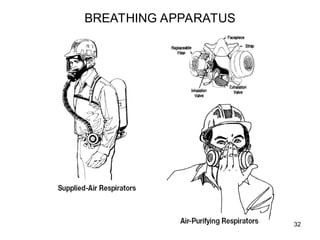
There are two basic type of respirators :
1. Air-Purifying Respirators - it is exactly what the name
implies. These apparatus purify and filter air before we
breathe it in. They do not supply air or oxygen, but they can
only purify air in the surrounding atmosphere. There are
different air-purifying filters for different hazards.
2. Supplied Air Respirators - it is exactly what the name
implies. It supply air, the air comes from a cylinder or
compressor. These respirator provide the best protection
against many hazards, but they have their limitations. With
self-contained breathing apparatus, there are problem with
weight, whereas with airline unit the hose can get tangled.
There are also concerned with the quality of air stored in
cylinder or supplied by compressor. It may not be breathable
air we need.
32
BREATHING APPARATUS
33
BREATHING APPARATUS
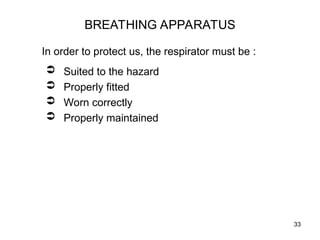
In order to protect us, the respirator must be :
 Suited to the hazard
 Properly fitted
 Worn correctly
 Properly maintained
34
BREATHING APPARATUS
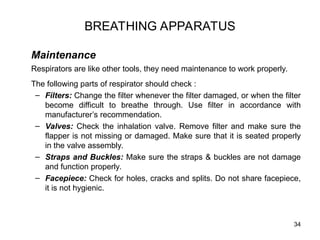
Maintenance
Respirators are like other tools, they need maintenance to work properly.
The following parts of respirator should check :
– Filters: Change the filter whenever the filter damaged, or when the filter
become difficult to breathe through. Use filter in accordance with
manufacturer’s recommendation.
– Valves: Check the inhalation valve. Remove filter and make sure the
flapper is not missing or damaged. Make sure that it is seated properly
in the valve assembly.
– Straps and Buckles: Make sure the straps & buckles are not damage
and function properly.
– Facepiece: Check for holes, cracks and splits. Do not share facepiece,
it is not hygienic.
35
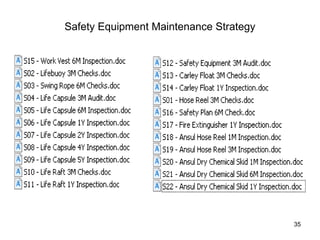
Safety Equipment Maintenance Strategy

2 - HSE Regulation Safety For Presentation.ppt

  • 1.
  • 2.
    2 Safety Equipment Maintenance Aspart of the incident prevention, all safety and lifesaving equipment must always in good condition and ready for use, therefore, a well planned maintenance should be applied. These equipment include :  Large dry chemical (LDC).  Portable fire extinguishers.  Life rafts.  Lifebuoy.  Lifeboats.  Safety equipment audit.  Carley Float.  Work vest.  Swing ropes.  Dry powder (Ansul) hose reel.  Water hose reel.  Fire sprinkler system.  Breathing Apparatus.
  • 3.
    3 Large Dry Chemical(LDC) Large Dry Chemical (LDC) System • This large Dry Chemical (ANSUL) is the main fire extinguisher on the platform. On production platform, the system is usually designed to extinguish should any fire occurs at wellhead and production header area, test separator area and at slop area. The planned maintenance of this safety equipment is scheduled one month, 6 month and yearly. Practical Tip • Although the job lists has been established, the next most importance step for supervisor is to ensure that the jobs are done correctly and the procedures are precisely followed as written in the job list.
  • 4.
    4 These type largedry chemicals are installed on remote production platforms especially on 4 legs platforms
  • 5.
  • 6.
    6 Portable Fire Extinguisher(PFE) Portable Fire Extinguisher. • Considering that economics become an important factor in the larger capacity fire extinguishers; consequently portable fire extinguisher becomes a favorite choice. It is very popular and widely used in the world from large industries to household. The units are designed for personal use. Dry chemical cartridge operated hand portable fire extinguishers are available in size ranging from 5 - 30 pounds. The units are classified in to class A, B and C depending on the agent used. Specialized units are also available for class D fires. • Maintenance of portable fire extinguisher is scheduled monthly and yearly. Detail work scopes are described in the SAP.
  • 7.
    7 Portable Fire Extinguisher(PFE) There are two main types of portable fire extinguishers : a. Stored pressure, where the expellant is stored in the same chamber as the firefighting agent itself. Depending on the agent used, different propellants are used. With dry chemical extinguishers, nitrogen is typically used; water and foam extinguishers typically use air. Stored pressure fire extinguishers are the most common type b. Cartridge-operated, where the expellant gas in a separate cartridge that is punctured prior to discharge, exposing the propellant to the extinguishing agent. This type has the advantage of simple and prompt recharge, allowing an operator to discharge the extinguisher, recharge it, and return to the fire in a reasonable amount of time. Unlike stored pressure types, these extinguishers utilize compressed carbon dioxide instead of nitrogen.
  • 8.
    8 Portable Fire Extinguisher(PFE) Fire extinguishers are classified according to their capacity to fight specific kinds of fire. 1. Class A: For fires in ordinary combustible materials such as wood and paper where it needs a quenching, cooling effect. 2. Class B: For flammable liquid and gas fires such as oil, gasoline, paint, and grease where it needs oxygen exclusion or flame interruption. 3. Class C: For fires involving electrical wiring and equipment where it needs non conductive extinguishing agent 4. Class D: For fires in combustible metals such as sodium, magnesium, and potassium.
  • 9.
  • 10.
  • 11.
  • 12.
  • 13.
    13 INSPECTION, MAINTENANCE, TESTINGAND RECHARGING PEIOD FOR PFE (NFPA 10)
  • 14.
    14 LIFERAFT • Inflatable liferafts come in various sizes from six to forty persons. They may be round or oval in shape. It is made from rubberized fabric which must meet tear and abrasion standards. • Double tube rafts have two tubes one above the other, so the lower tube carries the weight while the top tube provides freeboard which makes for a drier more comfortable raft. • All approved SOLAS life rafts have canopies to protect the occupants from exposure which automatically set in place when the life rafts is launched and waterborne. • Every life raft shall be so constructed that when it is dropped in to the water from height of 18 meters above the water line in the lightest seagoing condition will remain in satisfactory condition; therefore, the life rafts must have been drop tested at least that height prior to leaving the manufacturer for selling.
  • 15.
    15 LIFERAFT MAINTENANCE SCOPE OFWORK FOR LIFE RAFTS SERVICE & RECERTIFICATION 1. All inspection jobs, repairs, spare part replacement, life preservation renewal shall be done in accordance with manufacturer recommendation and shall meet SOLAS standard application. 2. Any spare part replacement, life preservation / food ration renewal and emergency survival kit replacement shall be clearly mentioned and quoted per item. 3. Inspect shell for damaged or deterioration, replace if necessary. 4. Inspect all accessories for damaged / missing, and replace / complete as necessary. 5. Inspect all emergency survival kit for damaged / missing, and replace / complete as necessary. 6. Perform floor seam test, working pressure test, gas inflation test of the inflatable component, check for damaged, leak and any anomaly condition. 7. Replace all life preservation in accordance with manufacturer recommendation and shall meet SOLAS standard application. 8. Check / replace the Nitrogen Cylinder for life raft inflation with proper capacity in accordance with manufacturer recommendation and shall meet SOLAS standard application. 9. Repack, close and seal the life raft properly in accordance with manufacturer recommendation and shall meet SOLAS standard application. 10. The life raft shall be certified to Dir. Jen. of HUBLA (or ABS) approval certificate.
  • 16.
    16 Standard Survival Kiton Life Raft A life raft must be provided with standard lifesaving equipment such as tools for location aid to obtain rescue (visual and audio), food ration, medicines/first aid kit and tool kit for life support and tool kits for repairing life raft.
  • 17.
    17 Life Buoy In offshoreoil & gas operation, life buoys are provided and are located usually on the main deck handrails. Each person should learn the location a soon as possible after boarding the platform/rig/barge. Lifebuoys are not lashed in position and are always ready for use. In a man overboard situation, a life buoy always be thrown near the individual so as to mark the location in the event the man overboard can not reach the buoy. Marking the approximate position of the man overboard greatly assist rescue operation.
  • 18.
    18 Life Buoy Maintenance In orderto ensure the availability and reliability of the life buoys, a preventive maintenance is implemented in three monthly schedules. The PM covers checking and cleaning of the life buoys. Should any part were found to be damaged or deteriorated must be replaced as soon as possible
  • 19.
    19 SWING ROPES  Swingropes are used to assist personnel to jump across from boat to platform or FPSO or barge vice versa. Swing ropes are usually attached on steel chain which installed at underneath of deck  Planned maintenance routine for swing ropes is scheduled six monthly. The objective of this maintenance strategy is to ensure the swing ropes and its associated parts (shackles, chain and the manila ropes) are in good and safe condition, however, cleaning the ropes must also be done when it is found dirty or oily.
  • 20.
    20 Swing Ropes Maintenance 1.Ensure the necessary precautions are taken for working at height. 2. Check condition of swing rope and thimbles and replace if necessary. 3. Clean the rope if necessary. 4. Check condition of shackle and ensure that pin is in a good shape and well attached. 5. Check condition of chain, chip and repaint as necessary. 6. Carry out MPI of each supporting I-beam using a competent 3rd Party.
  • 21.
    21 LIFE BOAT Life boat •Life boat is one of the Totally Enclosed Motor Propelled Survival Craft (TEMPSC), is a personnel escape device used in CNOOC offshore operation. This life boat is used if evacuation of an offshore installation is to be waterborne.
  • 22.
  • 23.
    23 WIDP Old LifeBoat Typical deteriorated life boat’s wall due to long process of osmoses and formed water pockets. This will effect to hull’s strength.
  • 24.
    24 LIFE BOAT  Underinternational convention, these crafts have to meet certain requirements, and stringent testing is done to ensure that this is the case.  Main criteria that the crafts have to fulfill among others are: 1. The crafts have to be constructed with a rigid hull watertight enclosure which completely encloses the craft and will protect the occupant from heat and cold. 2. The materials used must withstand lateral impact at speed 6.8 knots, and drop from a height of at least 3 meters. 3. Materials used should fire retardant to an extent that the craft when waterborne will protect occupant in an oil fire or otherwise contaminated atmosphere, for minimum 8 (eight) minutes. In addition, a water spray system is installed which utilized seawater to spray externally allover the life boat to protect the fabric of the craft.
  • 25.
    25 LIFE BOAT 4. Aself contained air support system must be installed. This system must be capable of supporting the needs of occupants and the engine for a period of at least 10 minutes during which the air pressure inside the boat must never fall below the atmospheric pressure. 5. The lifeboats must have inherent buoyancy or be fitted with buoyancy materials such that the craft will remain afloat when fully laden, flooded and open to the sea. 6. If there is no damage and hatches are fully closed with all personnel secured in their seats, the craft should be totally self righting. 7. The propulsion system in these crafts must be a compression ignition engine which will deliver sufficient power to propel the craft forward at speed of 6 knots when fully laden in calm water, and sufficient fuel should be carried to enable the craft to operate at this speed for 24 hours.
  • 26.
    26 LIFE BOAT The preventivemaintenance for lifeboat is scheduled monthly, three monthly, six monthly and yearly, and to be done in conjunction with the manufacturers operations and maintenance instructions. If the life boat is powered by diesel engine, the maintenance should refer to diesel engine maintenance strategy.
  • 27.
    27 Firewater System (Deluge andSprinkler System) On process platforms and on some production platforms are provided with firewater system. A periodic inspection is carried out on this firewater system. The general philosophy to be adopted in the company for firewater system is that of periodic inspections with testing, as required, to confirm continuing availability, reliability and technical integrity of the systems provided for maximum personal and facility protection in case of fire.
  • 28.
    28 Firewater System (Deluge andSprinkler System) Maintenance • Maintenance of firewater system covers deluge and sprinkler system. The controls, metering, regulating and other instrument devices to be handled by instrument technician, whereas mechanical portion related with deluge and sprinkler system to be handled by maintenance safety. • The planned maintenance practice refer to SAP, deluge system is scheduled six monthly and yearly. The six monthly schedule is to perform what so called dry deluge test. At this time all pilot valve and other instrument controls are function tested. The yearly PM schedule is to perform what so called wet deluge test where real flooded on system is carried out. At this time all the instrument controls plus the sprinklers are checked and ensured for correct functioning.
  • 29.
    29 Hose & HoseReel Water Hose Reel and Dry Chemical Hose Reel • The water hose reel assembly and dry chemical hose reel assembly are to be regularly maintained to ensure these equipment always be in good ready and safe condition. • The water hose reels are used more frequently as these are also used for other purpose such as cleaning the deck, cleaning inside vessels during tank cleaning, fire watch during hot works; on the other hand, the dry chemical hose reels are hardly used. • Maintenance for these hose reels are to ensure the reel assembly for smooth spinning and leak free, whereas the hose are inspected for expire, damaged/cracked or deterioration due to aging. • Maintenance schedule for water hose is scheduled thee monthly and yearly, whereas for dry chemical hose reel is scheduled monthly and three monthly.
  • 30.
    30 Typical Hose ReelMaintenance Job List 1. Unroll the hose, inspect for damage e.g. cuts, kinks and signs of softening or separation of layers. Replace unserviceable hoses 2. Check and grease reel drum bearings and reels rotate easily 3. Check that all branches are free and adjust easily 4. Check action and security of nozzle 5. Check clamp (hose to reel) 6. Clean any rust and protect with correct primer and gloss paint. 7. Weight the actuator cartridge and replace if under weight 8. Sign and date the record card on the hose reel
  • 31.
    31 BREATHING APPARATUS There aretwo basic type of respirators : 1. Air-Purifying Respirators - it is exactly what the name implies. These apparatus purify and filter air before we breathe it in. They do not supply air or oxygen, but they can only purify air in the surrounding atmosphere. There are different air-purifying filters for different hazards. 2. Supplied Air Respirators - it is exactly what the name implies. It supply air, the air comes from a cylinder or compressor. These respirator provide the best protection against many hazards, but they have their limitations. With self-contained breathing apparatus, there are problem with weight, whereas with airline unit the hose can get tangled. There are also concerned with the quality of air stored in cylinder or supplied by compressor. It may not be breathable air we need.
  • 32.
  • 33.
    33 BREATHING APPARATUS In orderto protect us, the respirator must be :  Suited to the hazard  Properly fitted  Worn correctly  Properly maintained
  • 34.
    34 BREATHING APPARATUS Maintenance Respirators arelike other tools, they need maintenance to work properly. The following parts of respirator should check : – Filters: Change the filter whenever the filter damaged, or when the filter become difficult to breathe through. Use filter in accordance with manufacturer’s recommendation. – Valves: Check the inhalation valve. Remove filter and make sure the flapper is not missing or damaged. Make sure that it is seated properly in the valve assembly. – Straps and Buckles: Make sure the straps & buckles are not damage and function properly. – Facepiece: Check for holes, cracks and splits. Do not share facepiece, it is not hygienic.
  • 35.