Permission using
modals
 A modal of permission is a type of auxiliary verb that is used to ask
for or give permission.
 Modals of permission are usually used in the present or future
tense and can be used to express both politeness and certainty.
They can also be used to express possibility and uncertainty.
 Modals of permission are used in English to ask for permission or to
express permission meaning.
 Modals of permission are used in English to ask for permission or to
express permission meaning.
 Examples of modals of permission include the following: can, could,
may, might, must, shall, should, and will.
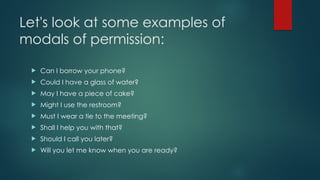
Let's look at some examples of
modals of permission:
 Can I borrow your phone?
 Could I have a glass of water?
 May I have a piece of cake?
 Might I use the restroom?
 Must I wear a tie to the meeting?
 Shall I help you with that?
 Should I call you later?
 Will you let me know when you are ready?
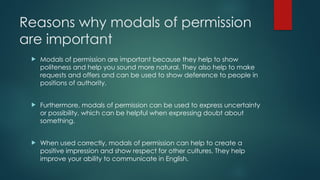
Reasons why modals of permission
are important
 Modals of permission are important because they help to show
politeness and help you sound more natural. They also help to make
requests and offers and can be used to show deference to people in
positions of authority.
 Furthermore, modals of permission can be used to express uncertainty
or possibility, which can be helpful when expressing doubt about
something.
 When used correctly, modals of permission can help to create a
positive impression and show respect for other cultures. They help
improve your ability to communicate in English.
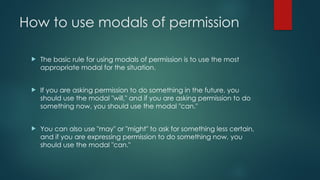
How to use modals of permission
 The basic rule for using modals of permission is to use the most
appropriate modal for the situation.
 If you are asking permission to do something in the future, you
should use the modal "will," and if you are asking permission to do
something now, you should use the modal "can."
 You can also use "may" or "might" to ask for something less certain,
and if you are expressing permission to do something now, you
should use the modal "can."
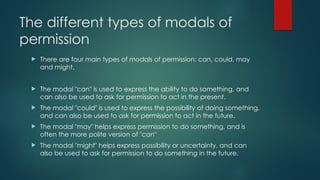
The different types of modals of
permission
 There are four main types of modals of permission: can, could, may
and might.
 The modal "can" is used to express the ability to do something, and
can also be used to ask for permission to act in the present.
 The modal "could" is used to express the possibility of doing something,
and can also be used to ask for permission to act in the future.
 The modal "may" helps express permission to do something, and is
often the more polite version of "can"
 The modal "might" helps express possibility or uncertainty, and can
also be used to ask for permission to do something in the future.
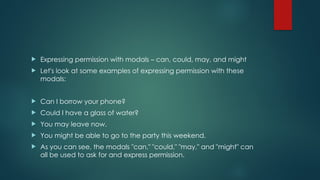
 Expressing permission with modals – can, could, may, and might
 Let's look at some examples of expressing permission with these
modals:
 Can I borrow your phone?
 Could I have a glass of water?
 You may leave now.
 You might be able to go to the party this weekend.
 As you can see, the modals "can," "could," "may," and "might" can
all be used to ask for and express permission.
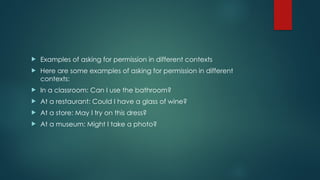
 Examples of asking for permission in different contexts
 Here are some examples of asking for permission in different
contexts:
 In a classroom: Can I use the bathroom?
 At a restaurant: Could I have a glass of wine?
 At a store: May I try on this dress?
 At a museum: Might I take a photo?
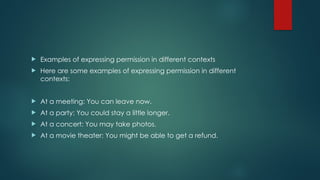
 Examples of expressing permission in different contexts
 Here are some examples of expressing permission in different
contexts:
 At a meeting: You can leave now.
 At a party: You could stay a little longer.
 At a concert: You may take photos.
 At a movie theater: You might be able to get a refund.
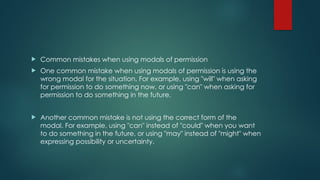
 Common mistakes when using modals of permission
 One common mistake when using modals of permission is using the
wrong modal for the situation. For example, using "will" when asking
for permission to do something now, or using "can" when asking for
permission to do something in the future.
 Another common mistake is not using the correct form of the
modal. For example, using "can" instead of "could" when you want
to do something in the future, or using "may" instead of "might" when
expressing possibility or uncertainty.
 Modals of permission are an important part of communication in
English. By using them correctly, you can create the right impression
and show respect for other cultures.
 Improve your English with their appropriate use to sound more
natural right away!

Permission using modals - English PowerPoint for 9th Grade

  • 1.
  • 2.
     A modalof permission is a type of auxiliary verb that is used to ask for or give permission.  Modals of permission are usually used in the present or future tense and can be used to express both politeness and certainty. They can also be used to express possibility and uncertainty.  Modals of permission are used in English to ask for permission or to express permission meaning.  Modals of permission are used in English to ask for permission or to express permission meaning.
  • 3.
     Examples ofmodals of permission include the following: can, could, may, might, must, shall, should, and will.
  • 4.
    Let's look atsome examples of modals of permission:  Can I borrow your phone?  Could I have a glass of water?  May I have a piece of cake?  Might I use the restroom?  Must I wear a tie to the meeting?  Shall I help you with that?  Should I call you later?  Will you let me know when you are ready?
  • 5.
    Reasons why modalsof permission are important  Modals of permission are important because they help to show politeness and help you sound more natural. They also help to make requests and offers and can be used to show deference to people in positions of authority.  Furthermore, modals of permission can be used to express uncertainty or possibility, which can be helpful when expressing doubt about something.  When used correctly, modals of permission can help to create a positive impression and show respect for other cultures. They help improve your ability to communicate in English.
  • 6.
    How to usemodals of permission  The basic rule for using modals of permission is to use the most appropriate modal for the situation.  If you are asking permission to do something in the future, you should use the modal "will," and if you are asking permission to do something now, you should use the modal "can."  You can also use "may" or "might" to ask for something less certain, and if you are expressing permission to do something now, you should use the modal "can."
  • 7.
    The different typesof modals of permission  There are four main types of modals of permission: can, could, may and might.  The modal "can" is used to express the ability to do something, and can also be used to ask for permission to act in the present.  The modal "could" is used to express the possibility of doing something, and can also be used to ask for permission to act in the future.  The modal "may" helps express permission to do something, and is often the more polite version of "can"  The modal "might" helps express possibility or uncertainty, and can also be used to ask for permission to do something in the future.
  • 8.
     Expressing permissionwith modals – can, could, may, and might  Let's look at some examples of expressing permission with these modals:  Can I borrow your phone?  Could I have a glass of water?  You may leave now.  You might be able to go to the party this weekend.  As you can see, the modals "can," "could," "may," and "might" can all be used to ask for and express permission.
  • 9.
     Examples ofasking for permission in different contexts  Here are some examples of asking for permission in different contexts:  In a classroom: Can I use the bathroom?  At a restaurant: Could I have a glass of wine?  At a store: May I try on this dress?  At a museum: Might I take a photo?
  • 10.
     Examples ofexpressing permission in different contexts  Here are some examples of expressing permission in different contexts:  At a meeting: You can leave now.  At a party: You could stay a little longer.  At a concert: You may take photos.  At a movie theater: You might be able to get a refund.
  • 11.
     Common mistakeswhen using modals of permission  One common mistake when using modals of permission is using the wrong modal for the situation. For example, using "will" when asking for permission to do something now, or using "can" when asking for permission to do something in the future.  Another common mistake is not using the correct form of the modal. For example, using "can" instead of "could" when you want to do something in the future, or using "may" instead of "might" when expressing possibility or uncertainty.
  • 12.
     Modals ofpermission are an important part of communication in English. By using them correctly, you can create the right impression and show respect for other cultures.  Improve your English with their appropriate use to sound more natural right away!