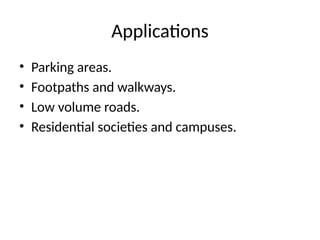
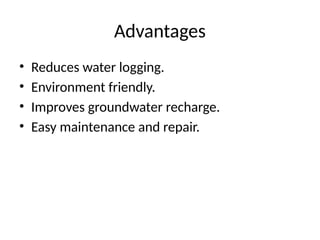
Introduction
• Permeable pavementis a sustainable
pavement solution.
• Allows rainwater to pass through pavement
layers.
• Reduces surface runoff and water logging.
• Improves groundwater recharge.
3.
Need of PermeablePavement
• Urban flooding and water logging issues.
• Increased impervious surfaces in cities.
• Environmental sustainability requirements.
• IRC recommendations for modern pavements.
4.
IRC Provisions
• IRCsupports use of permeable pavements in
low-volume roads.
• Recommended for parking areas, footpaths
and service roads.
• Design based on traffic load and drainage
capacity.
5.
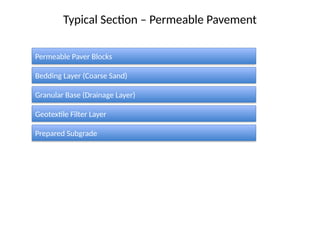
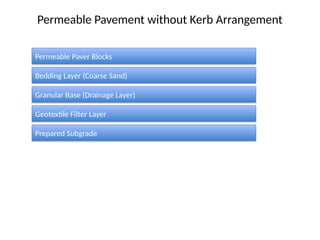
Typical Pavement Structure
•Permeable concrete or paver blocks on top.
• Bedding layer of coarse sand / grit.
• Granular base layer for storage.
• Filter layer / geotextile.
• Prepared subgrade soil.
6.
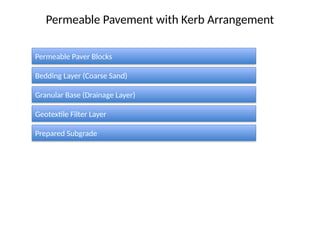
Permeable Pavement withKerb
• Kerb stones provided for edge confinement.
• Improves structural stability.
• Suitable for roads and organized parking
areas.
7.
Permeable Pavement withoutKerb
• Blocks interlocked without rigid edge.
• Used in footpaths and low traffic areas.
• Economical and easy to construct.
8.
Drainage Mechanism
• Rainwaterinfiltrates through joints.
• Stored temporarily in granular base.
• Excess water drained through subgrade or
drain pipe.
• Reduces load on stormwater drains.
IRC References
• IRC:SP:63– Guidelines for the Use of
Interlocking Concrete Block Pavement
• IRC:37 – Guidelines for the Design of Flexible
Pavements
• IRC:SP:50 – Guidelines on Urban Drainage
• IRC:SP:42 – Guidelines on Road Drainage
• IRC:SP:20 – Rural Roads Manual (low volume
roads)
15.
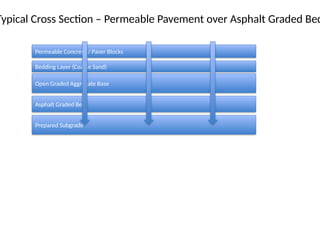
Typical Cross Section– Permeable Pavement over Asphalt Graded Bed
Permeable Concrete / Paver Blocks
Bedding Layer (Coarse Sand)
Open Graded Aggregate Base
Asphalt Graded Bed
Prepared Subgrade
16.
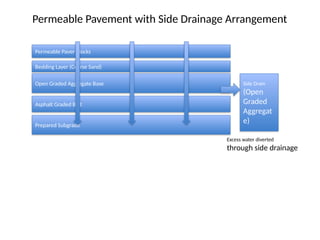
Permeable Pavement withSide Drainage Arrangement
Permeable Paver Blocks
Bedding Layer (Coarse Sand)
Open Graded Aggregate Base
Asphalt Graded Bed
Prepared Subgrade
Side Drain
(Open
Graded
Aggregat
e)
Excess water diverted
through side drainage
17.
Design Considerations (IRCBased)
• Traffic category: low to medium volume roads.
• Permeability requirement based on rainfall intensity.
• Structural capacity of base and subgrade.
• Provision of side drainage for excess runoff.
18.
Construction Methodology
• Preparationand compaction of subgrade.
• Laying of asphalt graded bed or granular layer.
• Placement of open graded aggregate base.
• Bedding layer and permeable paver block installation.
19.
Maintenance Aspects
• Regularcleaning of joints to avoid clogging.
• Inspection of side drainage system.
• Replacement of damaged paver blocks.
• Periodic performance evaluation.
20.
Conclusion
• Permeable pavementis an effective sustainable solution.
• Reduces water logging and urban flooding.
• Improves groundwater recharge.
• Highly suitable for Indian urban conditions as per IRC.
21.
Acknowledgement
• I expressmy sincere gratitude to my guide Mr. Ashis Mehta.
• Thanks to department faculty for guidance and support.
• Special thanks to external examiner for valuable time.
22.
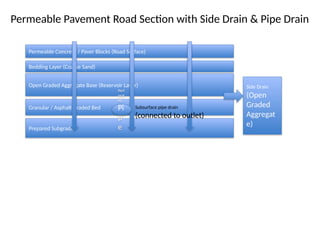
Permeable Pavement RoadSection with Side Drain & Pipe Drain
Permeable Concrete / Paver Blocks (Road Surface)
Bedding Layer (Coarse Sand)
Open Graded Aggregate Base (Reservoir Layer)
Granular / Asphalt Graded Bed
Prepared Subgrade
Side Drain
(Open
Graded
Aggregat
e)
Perf
orat
ed
Pi
p
e
Subsurface pipe drain
(connected to outlet)