Filter Press Applications 
Paul Nelsen 
Managing Director
Typical Filter Press Operational Sequence 
•Initially, the filter press is empty and the pump 
delivers high volumes at low discharge pressure 
As the press gradually fills then a back pressure builds 
up in the discharge line. This is normally monitored by 
a pressure switch on the filter press and as the back 
pressure increases, the speed of the pump is reduced 
to reduce the amount of product being fed to the press 
•When the filter press’s pressure reaches it’s maximum 
pressure then the pump stops and the rotor shoes act 
as a valve maintaining this pressure 
•The pressure will reduce as the material is filtered and 
at a pre-defined pressure the pump will restart and 
product will flow into the filter again
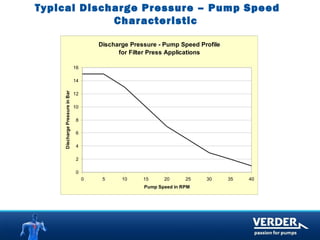
Typical Discharge Pressure – Pump Speed 
Characteristic 
Discharge Pressure - Pump Speed Profile 
for Filter Press Applications 
16 
14 
12 
10 
8 
6 
4 
2 
0 
0 5 10 15 20 25 30 35 40 
Pump Speed in RPM 
Discharge Pressure in Bar
Key Reasons to Use a Hose Pump 
• Leak-free design – no spillages costs 
• Can pump abrasive products 
• Gentle pumping action – low shear rate and 
minimal product damage 
• Rotor shoe seals the discharge line and can be 
used to maintain pressure to the filter 
• Pump has a linear Speed - Flow characteristic
Application Issues 
• Shim the pump to withstand the maximum 
pressure at low speed – this introduces and 
element of over-shimming when the pump is 
running at high speed 
• Fit a pulsation damper or air dome to reduce 
pulsation and act as a product accumulator 
• The filter press’s back pressure can be sufficient to 
drive the pump backwards – gearboxes fitted with 
drive brakes are recommended. This also 
eliminates product slip
Pumping Ceramic Slurry to a Filter Press 
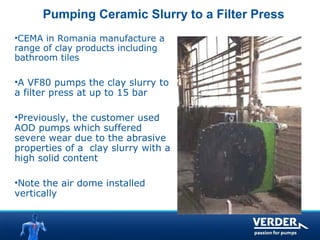
•CEMA in Romania manufacture a 
range of clay products including 
bathroom tiles 
•A VF80 pumps the clay slurry to 
a filter press at up to 15 bar 
•Previously, the customer used 
AOD pumps which suffered 
severe wear due to the abrasive 
properties of a clay slurry with a 
high solid content 
•Note the air dome installed 
vertically
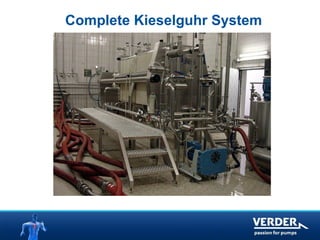
Kieselguhr Filter Press 
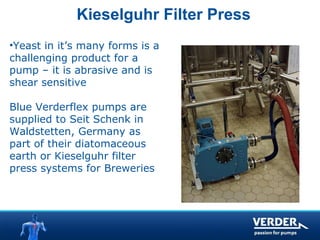
•Yeast in it’s many forms is a 
challenging product for a 
pump – it is abrasive and is 
shear sensitive 
Blue Verderflex pumps are 
supplied to Seit Schenk in 
Waldstetten, Germany as 
part of their diatomaceous 
earth or Kieselguhr filter 
press systems for Breweries
•The Verderflex Pumps 
replaced Screw fed 
Centrifugal pumps because 
of excessive wear and 
damage to the yeast 
An additional benefit is an 
EHEDG compliant design
Complete Kieselguhr System
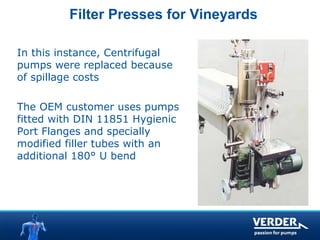
Filter Presses for Vineyards 
In this instance, Centrifugal 
pumps were replaced because 
of spillage costs 
The OEM customer uses pumps 
fitted with DIN 11851 Hygienic 
Port Flanges and specially 
modified filler tubes with an 
additional 180° U bend
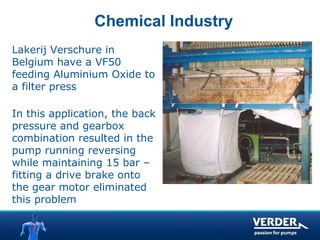
Chemical Industry 
Lakerij Verschure in 
Belgium have a VF50 
feeding Aluminium Oxide to 
a filter press 
In this application, the back 
pressure and gearbox 
combination resulted in the 
pump running reversing 
while maintaining 15 bar – 
fitting a drive brake onto 
the gear motor eliminated 
this problem
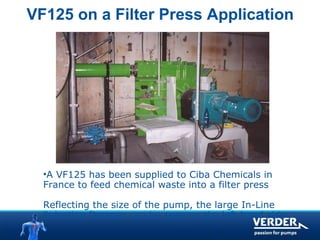
VF125 on a Filter Press Application 
•A VF125 has been supplied to Ciba Chemicals in 
France to feed chemical waste into a filter press 
Reflecting the size of the pump, the large In-Line 
Pulsation Damper can be seen on the left hand side
Summary 
• Successful filter press applications require 
consideration when specifying the gearbox 
and should be supplied with pulsation 
dampers 
• They represent a significant business 
opportunity as multiple ongoing pump 
sales can be achieved
For more information, 
please visit our website 
or call 1-855-535-4213 
www.verder-us.com

Peristaltic Pump Filter Press Applications

  • 1.
    Filter Press Applications Paul Nelsen Managing Director
  • 2.
    Typical Filter PressOperational Sequence •Initially, the filter press is empty and the pump delivers high volumes at low discharge pressure As the press gradually fills then a back pressure builds up in the discharge line. This is normally monitored by a pressure switch on the filter press and as the back pressure increases, the speed of the pump is reduced to reduce the amount of product being fed to the press •When the filter press’s pressure reaches it’s maximum pressure then the pump stops and the rotor shoes act as a valve maintaining this pressure •The pressure will reduce as the material is filtered and at a pre-defined pressure the pump will restart and product will flow into the filter again
  • 3.
    Typical Discharge Pressure– Pump Speed Characteristic Discharge Pressure - Pump Speed Profile for Filter Press Applications 16 14 12 10 8 6 4 2 0 0 5 10 15 20 25 30 35 40 Pump Speed in RPM Discharge Pressure in Bar
  • 4.
    Key Reasons toUse a Hose Pump • Leak-free design – no spillages costs • Can pump abrasive products • Gentle pumping action – low shear rate and minimal product damage • Rotor shoe seals the discharge line and can be used to maintain pressure to the filter • Pump has a linear Speed - Flow characteristic
  • 5.
    Application Issues •Shim the pump to withstand the maximum pressure at low speed – this introduces and element of over-shimming when the pump is running at high speed • Fit a pulsation damper or air dome to reduce pulsation and act as a product accumulator • The filter press’s back pressure can be sufficient to drive the pump backwards – gearboxes fitted with drive brakes are recommended. This also eliminates product slip
  • 6.
    Pumping Ceramic Slurryto a Filter Press •CEMA in Romania manufacture a range of clay products including bathroom tiles •A VF80 pumps the clay slurry to a filter press at up to 15 bar •Previously, the customer used AOD pumps which suffered severe wear due to the abrasive properties of a clay slurry with a high solid content •Note the air dome installed vertically
  • 7.
    Kieselguhr Filter Press •Yeast in it’s many forms is a challenging product for a pump – it is abrasive and is shear sensitive Blue Verderflex pumps are supplied to Seit Schenk in Waldstetten, Germany as part of their diatomaceous earth or Kieselguhr filter press systems for Breweries
  • 8.
    •The Verderflex Pumps replaced Screw fed Centrifugal pumps because of excessive wear and damage to the yeast An additional benefit is an EHEDG compliant design
  • 9.
  • 10.
    Filter Presses forVineyards In this instance, Centrifugal pumps were replaced because of spillage costs The OEM customer uses pumps fitted with DIN 11851 Hygienic Port Flanges and specially modified filler tubes with an additional 180° U bend
  • 11.
    Chemical Industry LakerijVerschure in Belgium have a VF50 feeding Aluminium Oxide to a filter press In this application, the back pressure and gearbox combination resulted in the pump running reversing while maintaining 15 bar – fitting a drive brake onto the gear motor eliminated this problem
  • 12.
    VF125 on aFilter Press Application •A VF125 has been supplied to Ciba Chemicals in France to feed chemical waste into a filter press Reflecting the size of the pump, the large In-Line Pulsation Damper can be seen on the left hand side
  • 13.
    Summary • Successfulfilter press applications require consideration when specifying the gearbox and should be supplied with pulsation dampers • They represent a significant business opportunity as multiple ongoing pump sales can be achieved
  • 14.
    For more information, please visit our website or call 1-855-535-4213 www.verder-us.com