



Neuropathy
Complication of Chemotherapy
in Womens’ Cancers
Dr Shirley Wong
Consultant Medical Oncologist
Breast Unit
Western Health
Chemotherapy- Induced Peripheral
Neuropathy (CIPN)
• Not all chemotherapy induced neuropathy
• Platinum compounds
• Taxanes
• Vinca Alkaloids
• Thalidomide and Lenalidomide
• Bortezomib
• Ixabepilone
Chemotherapy- Induced Peripheral
Neuropathy (CIPN)
• Overall incidence 38%
• Grading of severity
– Grade1 – reported symptoms
– Grade2 – interference with function
– Grade3 – interference with ADLs
– Grade4 – permanent and debilitating
• Observed in 60% of patients 1 month after
treatment and 30% of patients 6 months after
the treatment
MicroTubule-Stabilizing Agents –
Paclitaxel/Docetaxol
• “Unique” complication associated with microtubule-stabilizing drugs –
paclitaxel and docetaxol
• Uses commonly in breast/ovary/lung /Head & Neck cancers
• Reported to some degree in up to 70% of patients (Pachman 2011)
• Reported up to 30% of patients experience severe symptoms at high
cumulative doses (Carlson 2011)
• 3% patients discontinued drug
• Median days for improvement 22 days to 13 weeks
MicroTubule-Stabilizing Agents –
Paclitaxel/Docetaxol
• More frequent in paclitaxel- than docetaxol- based chemotherapy
• Therapeutic effect by binding to microtubules in dividing cells,
suppress dynamic instability, lead to arrest of mitosis and
ultimately apoptosis (Cell Death)
• Not cross blood-brain barrier so no effect on CNS
• Not affect autonomic nervous system
• Affects peripheral nervous system, predominatly sensory nerve
fibres (larger fibres than motor fibres)
MicroTubule-Stabilizing Agents –
Paclitaxel/Docetaxol
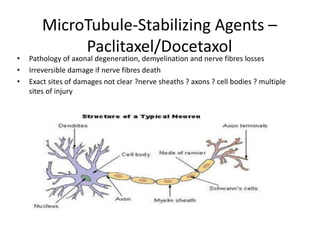
• Pathology of axonal degeneration, demyelination and nerve fibres losses
• Irreversible damage if nerve fibres death
• Exact sites of damages not clear ?nerve sheaths ? axons ? cell bodies ? multiple
sites of injury
MicroTubule-Stabilizing Agents –
Paclitaxel/Docetaxol
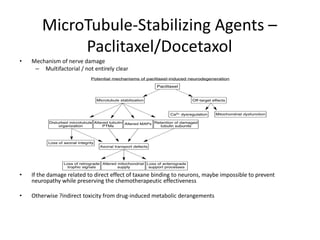
• Mechanism of nerve damage
– Multifactorial / not entirely clear
• If the damage related to direct effect of taxane binding to neurons, maybe impossible to prevent
neuropathy while preserving the chemotherapeutic effectiveness
• Otherwise ?indirect toxicity from drug-induced metabolic derangements
Paclitaxel-Acute Pain Syndrome
(P-APS)
• Paclitaxel –induced arthralgias and myalgias, described in up to almost
60% patients, develops within 1-3 days of drug administration largely
resolved within 1 week
• Related to sensitization of mechanical pain reception neurons, rather
from musculoskeletal or joint pathology
• Unpredictable with subsequent cycles
• Increased incidence of subsequent sensory neuropathy
• Not associated with rate of infusion and dose of paclitaxel
• ?gabapentin useful
Risk Factors
• Pre-existing neuropathy eg, diabetic
neuropathy, alcoholism
• Genetic makeup
• Dose and schedule of the chemotherapies
Natural History of CIPN
• May begin weeks to months after the initiation of
chemotherapy
• Often totally reversible sometimes only partially
reversible, can remained for years
• Dose limiting toxicity
• Potential confusion symptoms with met disease,
paraneoplastic symptoms or co-morbidity
Clinical Presentations
• Looks NORMAL
• sensory > motor neuropathy
• Sensory neuropathy
– tingling, numbness, paresthesias, hyperalgesia and pain in the feet and hands
– more on plantar surfaces
• Motor neuropathy
– proximal weakness like difficulty getting up from chair or climbing up stairs
– distal weakness like impaired fine motor skills
• Interference of daily activities
Clinical Presentations
• acute onset, tingling in fingertips and toes may be
within 24 hours after paclitaxel infusion
• late onset, pain involves muscles and joints of lower
limbs can occur up to 2-4 days after paclitaxel infusion
• most intermittently
• Loss of vibration and proprioception senses first
Prevention
• Amifostine
– IV binding agent to neurotoxic metabolites from
platinum compounds
– No consistent convincing supportive data
– Limited by nausea, vomiting and light-headedness
– Not available in PBS Australia
Prevention
• Anticonvulsants
– Small sized clinical trials in patients received
oxaliplatin based chemotherapy
– One study reported 58% reduction in CIPNs but
uncertain
– Not used as prevention in clinical practices
Prevention
• Serotonin-Norepinephrine reuptake Inhibitors (SSRIs)
– Analgesic effect
– Randomised-placebo-controlled trial of 54 cancer patients receiving
oxaliplatin based chemotherapy
– Venlafaxine (Effexor) 50mg 1 hr before chemo then extended release
Venlafaxine 37.5mg twice daily Day 2-11
– Significantly better in venlafaxine arm even 3 months after the end of
treatment
– Reported adverse events of nausea, vomiting and somnolence
–
– No reported influences of venlafaxine on the anticancer effect of oxaliplatin
Prevention
• Vitamin E
– Antioxidant effect
– Benefit not shown in phase III trial of >200 patients
• Calcium and Magnesium
– Increase extracellular Ca and hence reduce the hyperexcitability of
neurons
– In 2007, CONcePT trial of prevention of CIPN by FOLFOX, terminated
prematurely after 140 patients, related to unexpected low tumour
response rates in patients receiving IV Ca + Mg then those receiving
placebo
– ??use cautiously
Treatment
• Opioids not effective in treating pain by CIPN
• Adjuvant analgesics
– Topical agents
– Antidepressants
– Anticonvulsants
• Modification of chemotherapy
– Reducing the dose of chemotherapy
– Changing the chemotherapy
Treatment
• Topical Agents
– Localised anesthetic properties
– Lignocaine, NSAIDs, amitriptyline and ketamine in
various combinations and concentrations
– Short temporary relief
– Minimal systemic absorption
Treatment
• Tricyclic Antidepressant
– Few small studies not powerful enough to show
the benefit
– Intolerable side effects – dry mouth, drowsiness,
weight gain and hypotension
– Not much use in clinical settings
Treatment
• Duloxetine
– For treatment of depression PBS in Australia
– Daily dose of 30mg then escalated to 60mg daily after one week
– Moderate side effects with high 1% dropout rate
• Dzziness,nausea, somnolence, restlessness, insomnia, urinary
hesistancy
– Reported improvement in pain scores, improvement in daily
activities and QoL in numerous clinical trials (Yang 2012, Matsuoka
2012, Smith 2013 )
Treatment
• Anticonvulsants
– Gabapentin, Pregablin
• Numerious studies failed to show beneficial effects to
pain by CIPN
• Intolerable side effects – drowsiness, dizziness,
peripheral edema, weight gain, dry mouths
• Increasingly used
Association of CIPN with Clinical
Outcomes
• An analysis of 4500 women treated with taxanes in early stage
breast Ca
• Grade 2-4 peripheral neuropathy reported 13-20% of patients
• Matching all other factors including age, race, obesity, menopausal
status, tumour size, nodal status, treatment and hyperglycaemia
• No association between taxane-induced neuropathy and survival
(OS and DFS)
Conclusion
• Increasing complaints due to increased use of taxanes and platinum-
based chemotherapies in multiple cancers
• Spectrum of clinical severity
– Mild intermittent to debilitating in ADLs
• Fully reversible in most cases if reported early
• Treatment options improving
• Increasing focus on prevention options
• No proven association between CIPN and clinical outcome of cancer
treatment
Thank you!

Peripheral neuropathy - Dr Shirley Wong

  • 1.
    Neuropathy Complication of Chemotherapy inWomens’ Cancers Dr Shirley Wong Consultant Medical Oncologist Breast Unit Western Health
  • 2.
    Chemotherapy- Induced Peripheral Neuropathy(CIPN) • Not all chemotherapy induced neuropathy • Platinum compounds • Taxanes • Vinca Alkaloids • Thalidomide and Lenalidomide • Bortezomib • Ixabepilone
  • 3.
    Chemotherapy- Induced Peripheral Neuropathy(CIPN) • Overall incidence 38% • Grading of severity – Grade1 – reported symptoms – Grade2 – interference with function – Grade3 – interference with ADLs – Grade4 – permanent and debilitating • Observed in 60% of patients 1 month after treatment and 30% of patients 6 months after the treatment
  • 4.
    MicroTubule-Stabilizing Agents – Paclitaxel/Docetaxol •“Unique” complication associated with microtubule-stabilizing drugs – paclitaxel and docetaxol • Uses commonly in breast/ovary/lung /Head & Neck cancers • Reported to some degree in up to 70% of patients (Pachman 2011) • Reported up to 30% of patients experience severe symptoms at high cumulative doses (Carlson 2011) • 3% patients discontinued drug • Median days for improvement 22 days to 13 weeks
  • 5.
    MicroTubule-Stabilizing Agents – Paclitaxel/Docetaxol •More frequent in paclitaxel- than docetaxol- based chemotherapy • Therapeutic effect by binding to microtubules in dividing cells, suppress dynamic instability, lead to arrest of mitosis and ultimately apoptosis (Cell Death) • Not cross blood-brain barrier so no effect on CNS • Not affect autonomic nervous system • Affects peripheral nervous system, predominatly sensory nerve fibres (larger fibres than motor fibres)
  • 6.
    MicroTubule-Stabilizing Agents – Paclitaxel/Docetaxol •Pathology of axonal degeneration, demyelination and nerve fibres losses • Irreversible damage if nerve fibres death • Exact sites of damages not clear ?nerve sheaths ? axons ? cell bodies ? multiple sites of injury
  • 7.
    MicroTubule-Stabilizing Agents – Paclitaxel/Docetaxol •Mechanism of nerve damage – Multifactorial / not entirely clear • If the damage related to direct effect of taxane binding to neurons, maybe impossible to prevent neuropathy while preserving the chemotherapeutic effectiveness • Otherwise ?indirect toxicity from drug-induced metabolic derangements
  • 8.
    Paclitaxel-Acute Pain Syndrome (P-APS) •Paclitaxel –induced arthralgias and myalgias, described in up to almost 60% patients, develops within 1-3 days of drug administration largely resolved within 1 week • Related to sensitization of mechanical pain reception neurons, rather from musculoskeletal or joint pathology • Unpredictable with subsequent cycles • Increased incidence of subsequent sensory neuropathy • Not associated with rate of infusion and dose of paclitaxel • ?gabapentin useful
  • 9.
    Risk Factors • Pre-existingneuropathy eg, diabetic neuropathy, alcoholism • Genetic makeup • Dose and schedule of the chemotherapies
  • 10.
    Natural History ofCIPN • May begin weeks to months after the initiation of chemotherapy • Often totally reversible sometimes only partially reversible, can remained for years • Dose limiting toxicity • Potential confusion symptoms with met disease, paraneoplastic symptoms or co-morbidity
  • 11.
  • 12.
    Clinical Presentations • LooksNORMAL • sensory > motor neuropathy • Sensory neuropathy – tingling, numbness, paresthesias, hyperalgesia and pain in the feet and hands – more on plantar surfaces • Motor neuropathy – proximal weakness like difficulty getting up from chair or climbing up stairs – distal weakness like impaired fine motor skills • Interference of daily activities
  • 13.
    Clinical Presentations • acuteonset, tingling in fingertips and toes may be within 24 hours after paclitaxel infusion • late onset, pain involves muscles and joints of lower limbs can occur up to 2-4 days after paclitaxel infusion • most intermittently • Loss of vibration and proprioception senses first
  • 14.
    Prevention • Amifostine – IVbinding agent to neurotoxic metabolites from platinum compounds – No consistent convincing supportive data – Limited by nausea, vomiting and light-headedness – Not available in PBS Australia
  • 15.
    Prevention • Anticonvulsants – Smallsized clinical trials in patients received oxaliplatin based chemotherapy – One study reported 58% reduction in CIPNs but uncertain – Not used as prevention in clinical practices
  • 16.
    Prevention • Serotonin-Norepinephrine reuptakeInhibitors (SSRIs) – Analgesic effect – Randomised-placebo-controlled trial of 54 cancer patients receiving oxaliplatin based chemotherapy – Venlafaxine (Effexor) 50mg 1 hr before chemo then extended release Venlafaxine 37.5mg twice daily Day 2-11 – Significantly better in venlafaxine arm even 3 months after the end of treatment – Reported adverse events of nausea, vomiting and somnolence – – No reported influences of venlafaxine on the anticancer effect of oxaliplatin
  • 17.
    Prevention • Vitamin E –Antioxidant effect – Benefit not shown in phase III trial of >200 patients • Calcium and Magnesium – Increase extracellular Ca and hence reduce the hyperexcitability of neurons – In 2007, CONcePT trial of prevention of CIPN by FOLFOX, terminated prematurely after 140 patients, related to unexpected low tumour response rates in patients receiving IV Ca + Mg then those receiving placebo – ??use cautiously
  • 18.
    Treatment • Opioids noteffective in treating pain by CIPN • Adjuvant analgesics – Topical agents – Antidepressants – Anticonvulsants • Modification of chemotherapy – Reducing the dose of chemotherapy – Changing the chemotherapy
  • 19.
    Treatment • Topical Agents –Localised anesthetic properties – Lignocaine, NSAIDs, amitriptyline and ketamine in various combinations and concentrations – Short temporary relief – Minimal systemic absorption
  • 20.
    Treatment • Tricyclic Antidepressant –Few small studies not powerful enough to show the benefit – Intolerable side effects – dry mouth, drowsiness, weight gain and hypotension – Not much use in clinical settings
  • 21.
    Treatment • Duloxetine – Fortreatment of depression PBS in Australia – Daily dose of 30mg then escalated to 60mg daily after one week – Moderate side effects with high 1% dropout rate • Dzziness,nausea, somnolence, restlessness, insomnia, urinary hesistancy – Reported improvement in pain scores, improvement in daily activities and QoL in numerous clinical trials (Yang 2012, Matsuoka 2012, Smith 2013 )
  • 22.
    Treatment • Anticonvulsants – Gabapentin,Pregablin • Numerious studies failed to show beneficial effects to pain by CIPN • Intolerable side effects – drowsiness, dizziness, peripheral edema, weight gain, dry mouths • Increasingly used
  • 23.
    Association of CIPNwith Clinical Outcomes • An analysis of 4500 women treated with taxanes in early stage breast Ca • Grade 2-4 peripheral neuropathy reported 13-20% of patients • Matching all other factors including age, race, obesity, menopausal status, tumour size, nodal status, treatment and hyperglycaemia • No association between taxane-induced neuropathy and survival (OS and DFS)
  • 24.
    Conclusion • Increasing complaintsdue to increased use of taxanes and platinum- based chemotherapies in multiple cancers • Spectrum of clinical severity – Mild intermittent to debilitating in ADLs • Fully reversible in most cases if reported early • Treatment options improving • Increasing focus on prevention options • No proven association between CIPN and clinical outcome of cancer treatment
  • 25.