Download to read offline


![Bersot et al
10 Nepal Journal of Neuroscience, Volume 18, Number 2, 2021
Neurosurgical patient management is based on
maintaining homeostasis, focusing on haemodynamic
stability and cerebral perfusion. Normovolemia is crucial,
the expansion of intravascular volume will not have much
effect on cerebral oedema, as long as serum osmolarity
is maintained. Whether this is achieved with crystalloid
solutions or colloids seems to be of little relevance,
although other factors must be considered in this choice,
the osmolarity of the selected fluid, however, is crucial.
Physical and Physiological Aspects
Factors that influence brain water content
Knowledge of the forces involved and the
characteristics of fluid movement through brain capillaries
oftheblood-brainbarrier(BBB).Forcesandcharacteristics
are essential to avoid an increase in intracranial pressure.
BBB is impervious to small ions and proteins, but not
water. Therefore, for a rational choice of the type and
volume of the various hydration solutions available to
be used in the neurosurgical patient, an understanding of
the physical-chemical colligative properties involved in
the movement of brain water and the definition of certain
terms is essential.
Osmotic pressure
Osmotic pressure is the force with which water moves
through the semipermeable membrane from a solution
containing a low concentration of dissolved substances
(solutes) to another with a high concentration of solutes.
The water will pass, depending on the concentration
gradient (from a lower osmolarity solution to a higher
osmolarity). The driving force is proportional to the
water gradient across the membrane; if two solutions
with the same concentration are placed on either side of
a membrane, there will be no driving force. Likewise, if
the membrane is permeable to solutes, this will reduce the
gradient and therefore the osmotic forces.
Osmolarity
Osmolarityisdeterminedbythenumberofosmotically
active particles per litre of solution, the units in which
the osmolarity of a solution is expressed is milliosmoles
per litre of solution (mOsm /L), and is calculated by
adding the concentrations in milliequivalents of various
ions present in the solution. The osmotic activity of the
solution requires that the particles are independent, that
is, they dissociate and, thus, osmotically active particles
are created. Osmolarity is a determining factor for the
movement of fluids between compartments when different
osmolar solutions are separated by a membrane permeable
to water, but not to solutes.
Oncotic pressure
Oncotic pressure is the osmotic pressure generated
by proteins in blood plasma, especially albumin and
globulins. Since plasma proteins are generally unable to
pass through healthy blood capillary walls, they exert
significant osmotic pressure on the ions and water that
pass through the capillary walls into the blood, and
thus partially balance the amount of liquid leaving the
capillaries by hydrostatic pressure with which it returns.
It is represented by the Greek letter π (pi) in the Starling
Equation
Starling equation
The Starling equation illustrates the role of hydrostatic
and oncotic forces (also called Starling forces) in the flow
movement through capillary membranes.
MF= Kf S [(Pc-Pi) -σ (π c-π i)]
MFisfluidmovement;Kfisthecapillarywallfiltration
coefficient (its permeability); S is the surface area of the
capillary membrane; Pc is the hydrostatic pressure in the
capillary; Pi hydrostatic pressure in the interstitial space;
σ is the reflection coefficient, which varies from 0 (without
movement of solutes through the membrane) to up to 1
(the free diffusion of solutes through the membrane) and
will be different in the brain and in the periphery; and
πi and πc is the plasma colloid and interstitial pressure
respectively.4
Blood-brain barrier
The Starling equation describes the relationship
between the factors that determine the movement of fluids
betweentheintravascularandtheperipheralspace,however
unlike what happens in capillaries located in any other area
of
the body, the endothelial cells in the brain are connected
by a structure continuous semi-permeable unique in our
organism; the blood-brain barrier (BBB). BBB is formed
by the presence of endothelial junctions that control the
coordinated opening and closing of cell-cell junctions.5
These junctions are composed of different multi-protein
complexes, and are known as “tight junctions”, the main
regulators of cellular permeability.6
This high selectivity of
the BBB that separates blood circulation and extracellular
fluid from the central nervous system (CNS), is also due
to the presence of non-fenestrated membranes that have
trans-endothelial passageways with the effective pore size
of only 7-9 Å. Thus, the brain becomes the only structure
that is normally impervious to large molecules (plasma
proteins, synthetic colloids), but also relatively impervious
to many solutes (Na +, K +, Cl -
). The major implication
in neuro-anaesthesia is related to the passage of water
freely between the interstitial space of the brain and the
intravascular space. According to Tommasino, the brain
functions as a very sensitive “osmometer”, as the water
content can be altered by small changes in osmolarity.7](https://image.slidesharecdn.com/33373-articletext-107656-2-10-20210528-210716064117/75/Peri-operative-fluid-management-during-neurosurgical-procedures-3-2048.jpg)
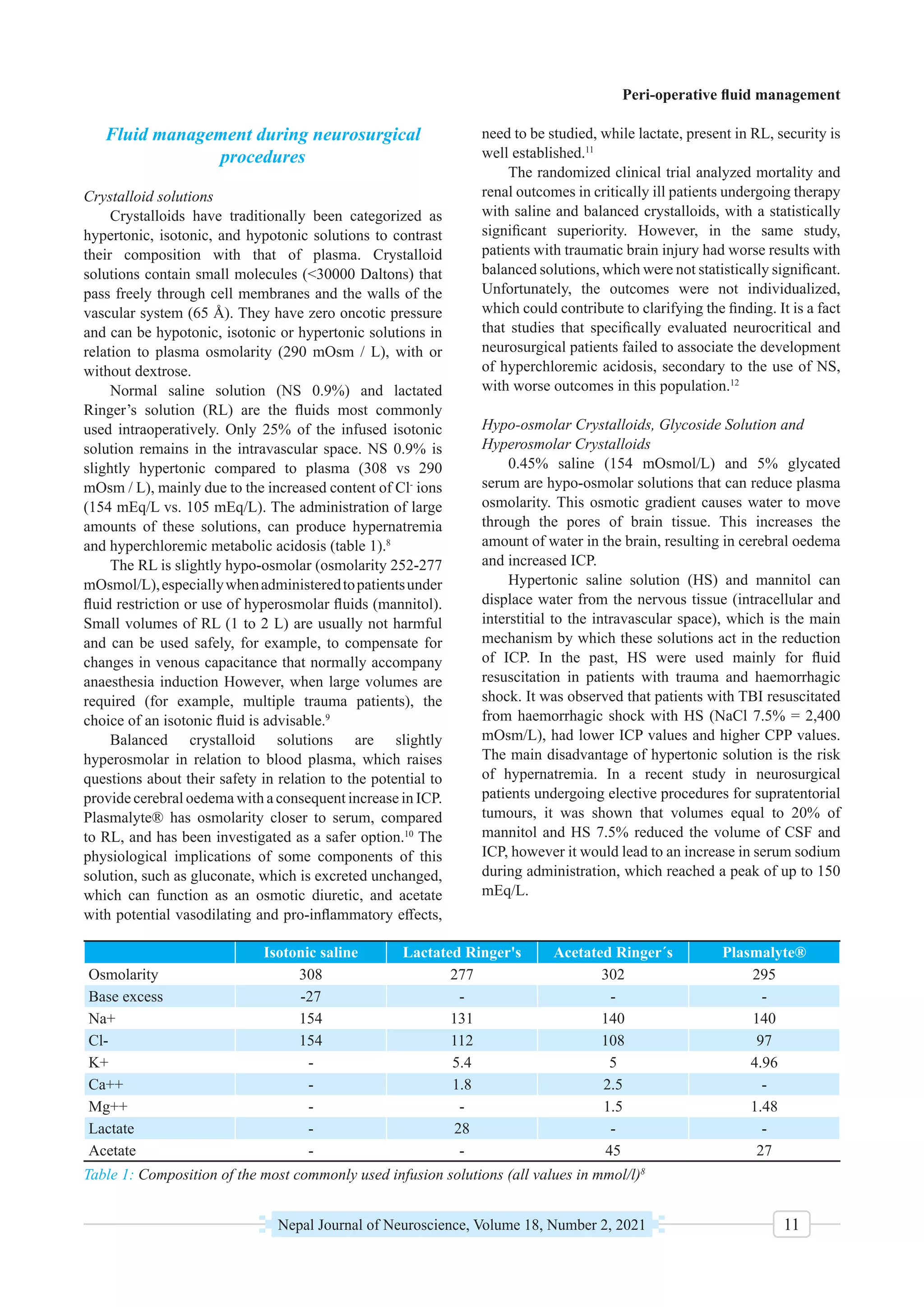


This document discusses peri-operative fluid management during neurosurgical procedures. It notes that fluid management aims to reduce cerebral edema and intracranial pressure while maintaining hemodynamic stability. Neurosurgical patients often receive diuretics which can cause complications like bleeding and diabetes insipidus, requiring large fluid volumes. Goal-directed therapy is recommended to maintain circulating volume and tolerate anesthesia-induced changes. The document then discusses factors influencing brain water content like osmolarity and the blood-brain barrier, which is semi-permeable and regulates fluid movement between blood and brain tissue.


![Management of Cerebral edema 1 [Autosaved].pptx](https://cdn.slidesharecdn.com/ss_thumbnails/managementofcerebraledema1autosaved-231006090123-7bf6a0fb-thumbnail.jpg?width=640&height=640&fit=bounds)


