Vapor Pressure
Define
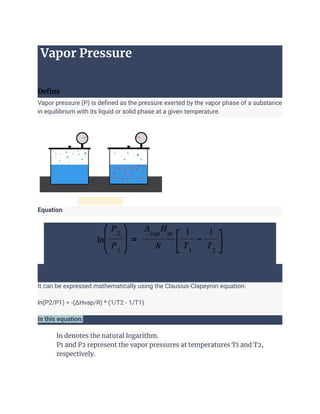
Vapor pressure (P) is defined as the pressure exerted by the vapor phase of a substance
in equilibrium with its liquid or solid phase at a given temperature.
general picture
Equation
It can be expressed mathematically using the Clausius-Clapeyron equation:
ln(P2/P1) = -(ΔHvap/R) * (1/T2 - 1/T1)
In this equation:
1. ln denotes the natural logarithm.
2. P1 and P2 represent the vapor pressures at temperatures T1 and T2,
respectively.
3. ΔHvap is the enthalpy of vaporization, which is the amount of heat
required to convert one mole of the substance from the liquid to the
vapor phase at a constant temperature.
4. R is the ideal gas constant (8.314 J/(mol·K)).
5. T1 and T2 are the temperatures in Kelvin at which the vapor pressures
are measured.
The Clausius-Clapeyron equation relates the vapor pressure of a substance at
different temperatures to the enthalpy of vaporization and the temperature. It
is derived from the principles of thermodynamics and assumes that the
substance behaves ideally as a gas
By rearranging the equation, you can solve for the vapor pressure (P2) at a given
temperature (T2) if the vapor pressure (P1) at a known temperature (T1) and the
enthalpy of vaporization (ΔHvap) are given.
It's important to note that the Clausius-Clapeyron equation is an approximation and may
not hold for substances with complex molecular interactions or at extreme
temperatures. Nevertheless, it provides a useful framework for understanding the
relationship between temperature and vapor pressure.
Explanation
Vapor pressure refers to the pressure exerted by the vapor phase of a substance when it
is in equilibrium with its liquid or solid phase at a given temperature. It is a measure of
the tendency of molecules to escape from the liquid or solid phase and enter the gas
phase.
When a substance is in its liquid or solid state, its
Read More Click on link
https://todaysciencewithchemistryandbiology.blogspot.com/2023/05/vapor-pressure.html

vapor pressure.pdf

  • 1.
    Vapor Pressure Define Vapor pressure(P) is defined as the pressure exerted by the vapor phase of a substance in equilibrium with its liquid or solid phase at a given temperature. general picture Equation It can be expressed mathematically using the Clausius-Clapeyron equation: ln(P2/P1) = -(ΔHvap/R) * (1/T2 - 1/T1) In this equation: 1. ln denotes the natural logarithm. 2. P1 and P2 represent the vapor pressures at temperatures T1 and T2, respectively.
  • 2.
    3. ΔHvap isthe enthalpy of vaporization, which is the amount of heat required to convert one mole of the substance from the liquid to the vapor phase at a constant temperature. 4. R is the ideal gas constant (8.314 J/(mol·K)). 5. T1 and T2 are the temperatures in Kelvin at which the vapor pressures are measured. The Clausius-Clapeyron equation relates the vapor pressure of a substance at different temperatures to the enthalpy of vaporization and the temperature. It is derived from the principles of thermodynamics and assumes that the substance behaves ideally as a gas By rearranging the equation, you can solve for the vapor pressure (P2) at a given temperature (T2) if the vapor pressure (P1) at a known temperature (T1) and the enthalpy of vaporization (ΔHvap) are given. It's important to note that the Clausius-Clapeyron equation is an approximation and may not hold for substances with complex molecular interactions or at extreme temperatures. Nevertheless, it provides a useful framework for understanding the relationship between temperature and vapor pressure. Explanation Vapor pressure refers to the pressure exerted by the vapor phase of a substance when it is in equilibrium with its liquid or solid phase at a given temperature. It is a measure of the tendency of molecules to escape from the liquid or solid phase and enter the gas phase. When a substance is in its liquid or solid state, its Read More Click on link
  • 3.