Introduction
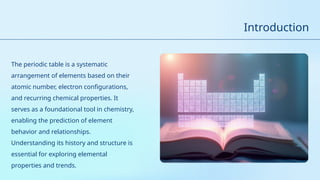
The periodic tableis a systematic
arrangement of elements based on their
atomic number, electron configurations,
and recurring chemical properties. It
serves as a foundational tool in chemistry,
enabling the prediction of element
behavior and relationships.
Understanding its history and structure is
essential for exploring elemental
properties and trends.
History and Development
Theperiodic table was first proposed by Dmitri Mendeleev in 1869, who arranged
elements by increasing atomic mass and predicted unknown elements. Its design
evolved with the discovery of atomic number and isotopes, leading to the modern
layout that reflects periodic trends accurately. This historical development is pivotal in
appreciating the table’s scientific significance.
5.
Structure and Organization
Elementsare arranged in rows called periods and columns known as groups, based
on their atomic number. Groups share similar chemical properties due to comparable
valence electron configurations. The table is divided into blocks (s, p, d, f) that indicate
electron subshells, providing a clear framework to understand element classification
and trends in properties.
6.
Classification of Elements
Elementsare grouped into metals,
nonmetals, and metalloids based on
shared characteristics. Metals are typically
conductive, malleable, and lustrous, while
nonmetals are more varied and often
insulators. Metalloids possess intermediate
properties. The periodic table also
segregates elements into blocks (s, p, d, f)
reflecting their electron configuration and
chemical behavior.
Physical Properties
Physical propertiesinclude atomic radius,
melting and boiling points, density, and
conductivity. These attributes vary
predictably across periods and groups,
with metals generally exhibiting high
conductivity and malleability, while
nonmetals tend to have lower density and
diverse states of matter at room
temperature.
9.
Chemical Properties
Chemical propertiesrelate to element reactivity, electronegativity, ionization energy,
and valence electrons. Reactivity trends are influenced by an elements position in the
periodic table, with alkali metals highly reactive and noble gases largely inert. These
properties guide understanding of chemical bonding and reactions.
10.
Trends in thePeriodic Table
Key trends in the periodic table include increasing atomic radius down groups,
decreasing ionic radius across periods, and variations in electronegativity and
ionization energy. These patterns reflect underlying atomic structure changes,
enabling predictions about element behavior in chemical processes.
11.
Conclusions
The periodic tableis a crucial scientific
tool that organizes elements by atomic
structure and properties. Understanding
classification, physical and chemical
properties, and observed trends allows
deeper insight into elemental behavior
and interactions, forming the foundation
of modern chemistry and related
sciences.
12.
CREDITS: This presentationtemplate was
created by Slidesgo, and includes icons,
infographics & images by Freepik
Thank you
Do you have any questions?
youremail@freepik.com
+00 000 000 000
yourwebsite.com
Please keep this slide for attribution



![THE PERIODIC TABLE [review]- Gr. 9.pptx](https://cdn.slidesharecdn.com/ss_thumbnails/theperiodictablereview-gr-220731030420-6f281019-thumbnail.jpg?width=640&height=640&fit=bounds)


