2
Performance Management System
Prepared By : Naveen Rao
3
AGENDA
1. Performance Management System
• Definition
• Objective
2. Philosophy
• Industry Practices
• Performance Management Philosophy of MS
3. Design
• Current Compensation Structure
• PMS Process
• Methodology
• Market Positioning
4. 3R’s (Review, Recognize, Reward)
• Review Concept
• Timing
• Evaluation
• Plan Rollout
• Payout
5. Pre and Post Documentation
6. Outcomes
4
Performance Management System
1
5
DEFINITION
Performance management is a goal-oriented system to ensure that organizational processes exist to
maximize the productivity of employees, teams and, ultimately, the organization.
A performance appraisal is a formal system of review and evaluation of individual or team performance.
Performance management is an ongoing organizational process that is conducted to maximize the
productivity of employees with the overall intention of improving the organization’s effectiveness.
It is strategic in nature and involves every person and all HR processes in the organization. All are directly
tied to achieving the organization’s goals.
The performance appraisal is a periodic event to reflect and evaluate past performance with the intent to
identify strengths and weaknesses of an employee’s performance and to identify developmental goals.
6
Objective work best when they are SMART
Specific and stretching
Measurable
Achievable and agreed
Relevant
Timed and trackable
7
OBJECTIVE
The objectives of performance management are discussed below:
 To enable the employees towards achievement of superior standards of work performance.
 To help the employees in identifying the knowledge and skills required for performing the job efficiently as
this would drive their focus towards performing the right task in the right way.
 Boosting the performance of the employees by encouraging employee empowerment, motivation and
implementation of an effective reward mechanism.
 Promoting a two way system of communication between the supervisors and the employees for clarifying
expectations about the roles and accountabilities, communicating the functional and organizational goals,
providing a regular and a transparent feedback for improving employee performance and continuous
coaching.
 Identifying the barriers to effective performance and resolving those barriers through constant monitoring,
coaching and development interventions.
 Creating a basis for several administrative decisions strategic planning, succession planning, promotions and
performance based payment.
 Promoting personal growth and advancement in the career of the employees by helping them in acquiring the
desired knowledge and skills
8
Philosophy
2
9
INDUSTRY PRACTICES
Most organizations in industry will follow:
 Keep attainable target and goals to
measure performance
 Measure and review performance on
targets achieved
 To adopt 5 rating tool / scale to judge
the measured performance
 To link compensation to the market
survey pool
 Determine the linked compensation
with performance matrix to the 5 rating
scale
 Use Individual and Organizational
performance for payouts
10
OUR PHILOSOPHY
Link and Communicate Vision, Business Strategy and Culture
Establish a shared understanding of performance targets, how is
to be achieved in defined timelines
To measure and motivate organization and individual
performance
Decide the reward philosophy to measure and pay
performance
Proactive approach on career progressions, retention and
performance competence.
Reward and retain the right potential – “Pay for Performance”
Train the talent to become future leaders
11
Design
3
12
CURRENT COMPENSATION STRUCTURE
Benefits
•Medical Insurance
•Airfare
•Leave
•Gratuity
1. Fixed Pay
•Basic @ 50%
•HRA @ 25%
•Other Allowance @ 15%
•Transport @ 10%
Others
•Camp Accommodation
•Transport
•Food
2. Variable
•Overtime
•Accommodation
Compensation
Structure
Concerns & Gaps
• To establish consistency in Pay across all tiers and functions
• To implement Variable / Performance Linked Pay
• To establish clear guidelines to map positions in a particular grades vs market data
• To develop process for evaluating individual performance
13
Set
Objectiv
es and
goals
Set
Individu
al
Objectiv
es
Mid
Term
Review
Annual
Review
Benchm
ark
Review
by HR
Reward
/
Promote
Feedbac
k to
stake
holders
Training
Need
Analysis
Docume
nt for
future
review
PMS PROCESS
14
METHODOLOGY
The performance evaluation process will be measured on “Forced Bell Curve”
Bell curve system of appraisal is a forced ranking system imposed on the employees by the
management.
Forced ranking has been defined as “a workforce management tool based on the premise that in order
to develop and thrive and rehabilitate and / or discard the latter”.
Bell curve system rates the entire workforce by comparing the performance of those engaged in similar
activity and ranking them on the basis of the performance. The entire workforce is segregated as the
top performers, medium performers and the poor performers.
15
METHODOLOGY (contd)
DEFINED KEY PARAMETERS UNDER FORCED BELL CURVE CONCEPT:
16
METHODOLOGY (contd)
DISTRUBUTION NORMALIZATION
15%
20%
40%
20%
5%
Recommended for MS
17
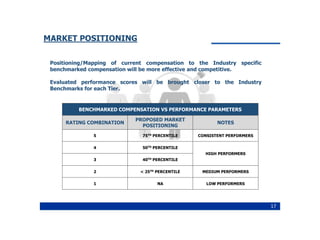
MARKET POSITIONING
Positioning/Mapping of current compensation to the Industry specific
benchmarked compensation will be more effective and competitive.
Evaluated performance scores will be brought closer to the Industry
Benchmarks for each Tier.
BENCHMARKED COMPENSATION VS PERFORMANCE PARAMETERS
RATING COMBINATION
PROPOSED MARKET
POSITIONING
NOTES
5 75TH PERCENTILE CONSISTENT PERFORMERS
4 50TH PERCENTILE
HIGH PERFORMERS
3 40TH PERCENTILE
2 < 25TH PERCENTILE MEDIUM PERFORMERS
1 NA LOW PERFORMERS
18
3R’S – REVIEW, RECOGNIZE, REWARD
4
19
REVIEW CONCEPT
L2
L1
The below pyramid will represent the review concept
20
TIMING
Note :
Performance Review Period : 01st Jan to 31st Dec Every Year
EVALUATION
• All employees who have completed six months of confirmed service with zzzzzzzzzzzzzz are eligible for
Performance Evaluation.
• KRA’s (Key Responsible Areas) for each individuals against their rob role to be identified
• All employees should be self assessed against KRA’s defined and to submit to their Immediate Reporting
Manager / Division Head – L1 for further review
• Initial assessment of the employee will be done by the Immediate Reporting Manager / Division Head – L1
• Once the Immediate Reporting Manager / Division Head – L1 has completed his evaluation, the same will
be discussed with his Reporting Manager – L2
• On completion of evaluation, the Reporting Manager – L2, submits the assessment form to HR for review
and feedback.
• The performance evaluation form duly filled should be returned to the HR before the prescribed timeline
• HR will review with his reporting manager and finalize the assessment ratings for Management Review
• The final rating of an employee will be decided by the HR ,CEO and the Chairman
• All evaluation form will need to be signed by both L1 and L2 post their consensus on the rating
• Any recommendations, feedback should be clearly justified by the L1 and L2 with necessary supportings.
21
PLAN ROLLOUT
22
Identify
the Cost
Impact
on Final
Rating
Review
Submit to
Board with
Total PMS
Cost Vs
Budgeted
Cost
On Approval
from Board –
Rollout the Plan
for Payout
PAYOUT
23
• On approval from the Board, HR will ensure the timely deliver of compensation
revision letters to all employees who are appraised/reviewed.
• Separate letters will be issued for each areas for employee like
• Performance Rating Letters
• Salary Revision Letters
• Promotion and Salary Revision Letters
• Salary Correction Letters
• HR to submit compensation revision sheet with all calculations to the
payroll/finance department for payouts
• All compensation revision letters will be personally handed over to the employee
and the copy of acceptance will be kept for future records
24
PRE & POST DOCUMENTATION
5
25
DOCUMENTATION
PMS
Process
1. Job Description
2. KPI’s – Division & Employee
3. KRA’s - Employee
4. Performance Review Form
5. PMS Guidelines
1. Filled and approved
Performance Review Form
2. Recommendations/
Justifications
3. Compensation Revision
Master
4. Presentation to Board &
Evaluation Managers
5. Salary Revision Letters
24
OUTCOMES
6
OUTCOMES
27
The results after Performance review may derive to plan for
 Succession Planning
 Long Term Career Progression
 Job Rotation
 De-Mobilization
 Retention of Critical Employees
 Performance Improvement Plan
28

Performance appraisal

  • 1.
  • 2.
    3 AGENDA 1. Performance ManagementSystem • Definition • Objective 2. Philosophy • Industry Practices • Performance Management Philosophy of MS 3. Design • Current Compensation Structure • PMS Process • Methodology • Market Positioning 4. 3R’s (Review, Recognize, Reward) • Review Concept • Timing • Evaluation • Plan Rollout • Payout 5. Pre and Post Documentation 6. Outcomes
  • 3.
  • 4.
    5 DEFINITION Performance management isa goal-oriented system to ensure that organizational processes exist to maximize the productivity of employees, teams and, ultimately, the organization. A performance appraisal is a formal system of review and evaluation of individual or team performance. Performance management is an ongoing organizational process that is conducted to maximize the productivity of employees with the overall intention of improving the organization’s effectiveness. It is strategic in nature and involves every person and all HR processes in the organization. All are directly tied to achieving the organization’s goals. The performance appraisal is a periodic event to reflect and evaluate past performance with the intent to identify strengths and weaknesses of an employee’s performance and to identify developmental goals.
  • 5.
    6 Objective work bestwhen they are SMART Specific and stretching Measurable Achievable and agreed Relevant Timed and trackable
  • 6.
    7 OBJECTIVE The objectives ofperformance management are discussed below:  To enable the employees towards achievement of superior standards of work performance.  To help the employees in identifying the knowledge and skills required for performing the job efficiently as this would drive their focus towards performing the right task in the right way.  Boosting the performance of the employees by encouraging employee empowerment, motivation and implementation of an effective reward mechanism.  Promoting a two way system of communication between the supervisors and the employees for clarifying expectations about the roles and accountabilities, communicating the functional and organizational goals, providing a regular and a transparent feedback for improving employee performance and continuous coaching.  Identifying the barriers to effective performance and resolving those barriers through constant monitoring, coaching and development interventions.  Creating a basis for several administrative decisions strategic planning, succession planning, promotions and performance based payment.  Promoting personal growth and advancement in the career of the employees by helping them in acquiring the desired knowledge and skills
  • 7.
  • 8.
    9 INDUSTRY PRACTICES Most organizationsin industry will follow:  Keep attainable target and goals to measure performance  Measure and review performance on targets achieved  To adopt 5 rating tool / scale to judge the measured performance  To link compensation to the market survey pool  Determine the linked compensation with performance matrix to the 5 rating scale  Use Individual and Organizational performance for payouts
  • 9.
    10 OUR PHILOSOPHY Link andCommunicate Vision, Business Strategy and Culture Establish a shared understanding of performance targets, how is to be achieved in defined timelines To measure and motivate organization and individual performance Decide the reward philosophy to measure and pay performance Proactive approach on career progressions, retention and performance competence. Reward and retain the right potential – “Pay for Performance” Train the talent to become future leaders
  • 10.
  • 11.
    12 CURRENT COMPENSATION STRUCTURE Benefits •MedicalInsurance •Airfare •Leave •Gratuity 1. Fixed Pay •Basic @ 50% •HRA @ 25% •Other Allowance @ 15% •Transport @ 10% Others •Camp Accommodation •Transport •Food 2. Variable •Overtime •Accommodation Compensation Structure Concerns & Gaps • To establish consistency in Pay across all tiers and functions • To implement Variable / Performance Linked Pay • To establish clear guidelines to map positions in a particular grades vs market data • To develop process for evaluating individual performance
  • 12.
  • 13.
    14 METHODOLOGY The performance evaluationprocess will be measured on “Forced Bell Curve” Bell curve system of appraisal is a forced ranking system imposed on the employees by the management. Forced ranking has been defined as “a workforce management tool based on the premise that in order to develop and thrive and rehabilitate and / or discard the latter”. Bell curve system rates the entire workforce by comparing the performance of those engaged in similar activity and ranking them on the basis of the performance. The entire workforce is segregated as the top performers, medium performers and the poor performers.
  • 14.
    15 METHODOLOGY (contd) DEFINED KEYPARAMETERS UNDER FORCED BELL CURVE CONCEPT:
  • 15.
  • 16.
    17 MARKET POSITIONING Positioning/Mapping ofcurrent compensation to the Industry specific benchmarked compensation will be more effective and competitive. Evaluated performance scores will be brought closer to the Industry Benchmarks for each Tier. BENCHMARKED COMPENSATION VS PERFORMANCE PARAMETERS RATING COMBINATION PROPOSED MARKET POSITIONING NOTES 5 75TH PERCENTILE CONSISTENT PERFORMERS 4 50TH PERCENTILE HIGH PERFORMERS 3 40TH PERCENTILE 2 < 25TH PERCENTILE MEDIUM PERFORMERS 1 NA LOW PERFORMERS
  • 17.
    18 3R’S – REVIEW,RECOGNIZE, REWARD 4
  • 18.
    19 REVIEW CONCEPT L2 L1 The belowpyramid will represent the review concept
  • 19.
    20 TIMING Note : Performance ReviewPeriod : 01st Jan to 31st Dec Every Year
  • 20.
    EVALUATION • All employeeswho have completed six months of confirmed service with zzzzzzzzzzzzzz are eligible for Performance Evaluation. • KRA’s (Key Responsible Areas) for each individuals against their rob role to be identified • All employees should be self assessed against KRA’s defined and to submit to their Immediate Reporting Manager / Division Head – L1 for further review • Initial assessment of the employee will be done by the Immediate Reporting Manager / Division Head – L1 • Once the Immediate Reporting Manager / Division Head – L1 has completed his evaluation, the same will be discussed with his Reporting Manager – L2 • On completion of evaluation, the Reporting Manager – L2, submits the assessment form to HR for review and feedback. • The performance evaluation form duly filled should be returned to the HR before the prescribed timeline • HR will review with his reporting manager and finalize the assessment ratings for Management Review • The final rating of an employee will be decided by the HR ,CEO and the Chairman • All evaluation form will need to be signed by both L1 and L2 post their consensus on the rating • Any recommendations, feedback should be clearly justified by the L1 and L2 with necessary supportings. 21
  • 21.
    PLAN ROLLOUT 22 Identify the Cost Impact onFinal Rating Review Submit to Board with Total PMS Cost Vs Budgeted Cost On Approval from Board – Rollout the Plan for Payout
  • 22.
    PAYOUT 23 • On approvalfrom the Board, HR will ensure the timely deliver of compensation revision letters to all employees who are appraised/reviewed. • Separate letters will be issued for each areas for employee like • Performance Rating Letters • Salary Revision Letters • Promotion and Salary Revision Letters • Salary Correction Letters • HR to submit compensation revision sheet with all calculations to the payroll/finance department for payouts • All compensation revision letters will be personally handed over to the employee and the copy of acceptance will be kept for future records
  • 23.
    24 PRE & POSTDOCUMENTATION 5
  • 24.
    25 DOCUMENTATION PMS Process 1. Job Description 2.KPI’s – Division & Employee 3. KRA’s - Employee 4. Performance Review Form 5. PMS Guidelines 1. Filled and approved Performance Review Form 2. Recommendations/ Justifications 3. Compensation Revision Master 4. Presentation to Board & Evaluation Managers 5. Salary Revision Letters
  • 25.
  • 26.
    OUTCOMES 27 The results afterPerformance review may derive to plan for  Succession Planning  Long Term Career Progression  Job Rotation  De-Mobilization  Retention of Critical Employees  Performance Improvement Plan
  • 27.