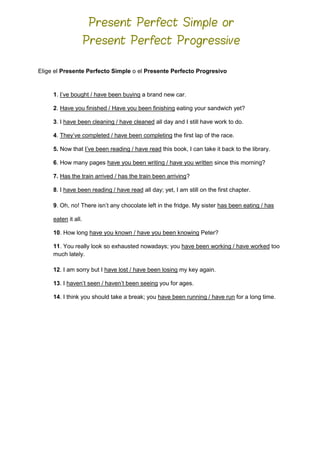
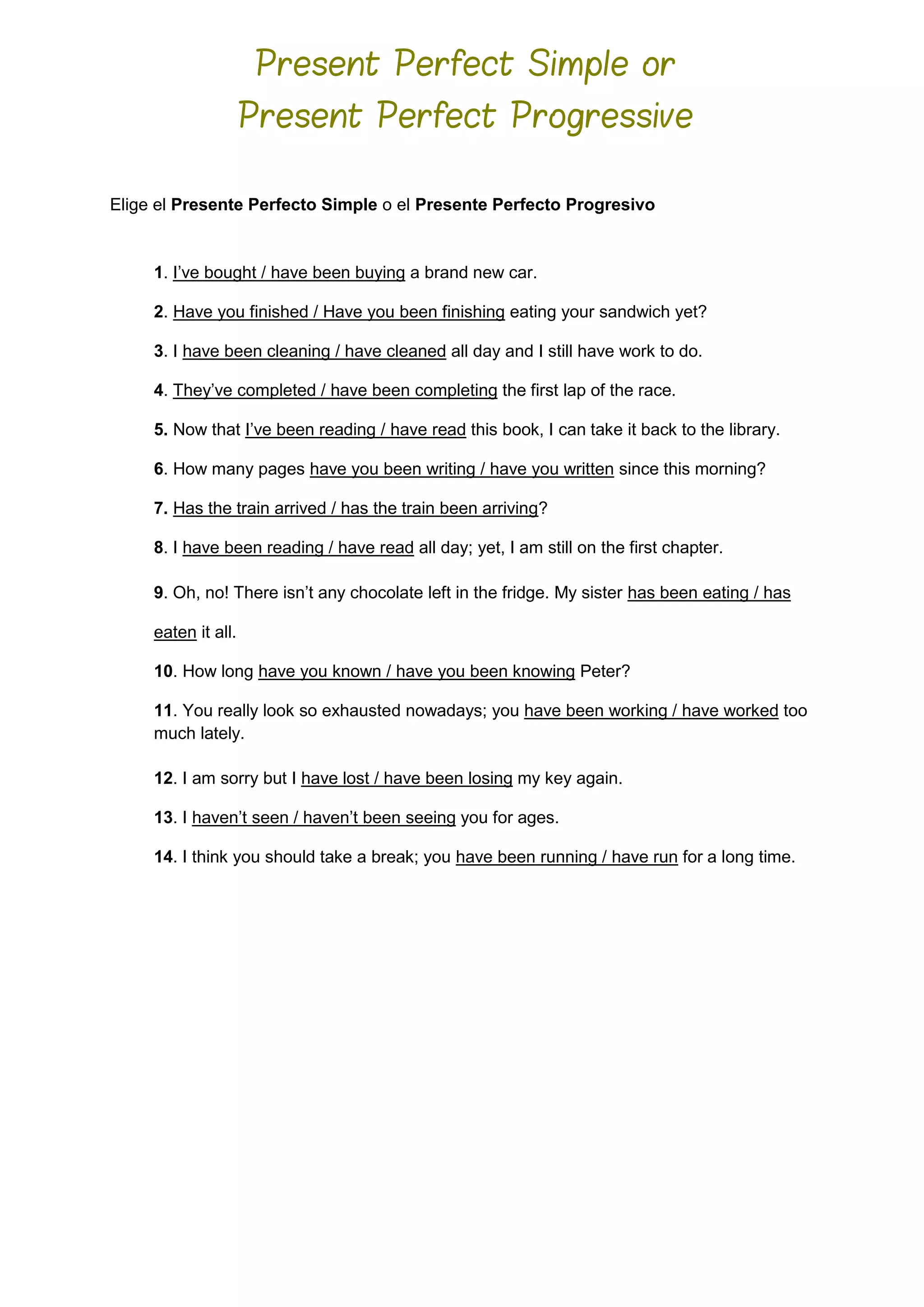
Present Perfect Simple or
Present Perfect Progressive
Elige el Presente Perfecto Simple o el Presente Perfecto Progresivo
1. I’ve bought / have been buying a brand new car.
2. Have you finished / Have you been finishing eating your sandwich yet?
3. I have been cleaning / have cleaned all day and I still have work to do.
4. They’ve completed / have been completing the first lap of the race.
5. Now that I’ve been reading / have read this book, I can take it back to the library.
6. How many pages have you been writing / have you written since this morning?
7. Has the train arrived / has the train been arriving?
8. I have been reading / have read all day; yet, I am still on the first chapter.
9. Oh, no! There isn’t any chocolate left in the fridge. My sister has been eating / has
eaten it all.
10. How long have you known / have you been knowing Peter?
11. You really look so exhausted nowadays; you have been working / have worked too
much lately.
12. I am sorry but I have lost / have been losing my key again.
13. I haven’t seen / haven’t been seeing you for ages.
14. I think you should take a break; you have been running / have run for a long time.
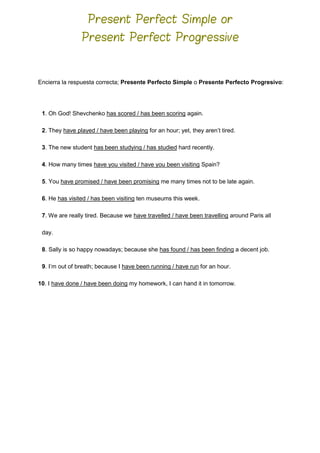
Encierra la respuesta correcta; Presente Perfecto Simple o Presente Perfecto Progresivo:
1. Oh God! Shevchenko has scored / has been scoring again.
2. They have played / have been playing for an hour; yet, they aren’t tired.
3. The new student has been studying / has studied hard recently.
4. How many times have you visited / have you been visiting Spain?
5. You have promised / have been promising me many times not to be late again.
6. He has visited / has been visiting ten museums this week.
7. We are really tired. Because we have travelled / have been travelling around Paris all
day.
8. Sally is so happy nowadays; because she has found / has been finding a decent job.
9. I’m out of breath; because I have been running / have run for an hour.
10. I have done / have been doing my homework, I can hand it in tomorrow.
Present Perfect Simple or
Present Perfect Progressive

Perfect -progressive

  • 1.
    Present Perfect Simpleor Present Perfect Progressive Elige el Presente Perfecto Simple o el Presente Perfecto Progresivo 1. I’ve bought / have been buying a brand new car. 2. Have you finished / Have you been finishing eating your sandwich yet? 3. I have been cleaning / have cleaned all day and I still have work to do. 4. They’ve completed / have been completing the first lap of the race. 5. Now that I’ve been reading / have read this book, I can take it back to the library. 6. How many pages have you been writing / have you written since this morning? 7. Has the train arrived / has the train been arriving? 8. I have been reading / have read all day; yet, I am still on the first chapter. 9. Oh, no! There isn’t any chocolate left in the fridge. My sister has been eating / has eaten it all. 10. How long have you known / have you been knowing Peter? 11. You really look so exhausted nowadays; you have been working / have worked too much lately. 12. I am sorry but I have lost / have been losing my key again. 13. I haven’t seen / haven’t been seeing you for ages. 14. I think you should take a break; you have been running / have run for a long time.
  • 2.
    Encierra la respuestacorrecta; Presente Perfecto Simple o Presente Perfecto Progresivo: 1. Oh God! Shevchenko has scored / has been scoring again. 2. They have played / have been playing for an hour; yet, they aren’t tired. 3. The new student has been studying / has studied hard recently. 4. How many times have you visited / have you been visiting Spain? 5. You have promised / have been promising me many times not to be late again. 6. He has visited / has been visiting ten museums this week. 7. We are really tired. Because we have travelled / have been travelling around Paris all day. 8. Sally is so happy nowadays; because she has found / has been finding a decent job. 9. I’m out of breath; because I have been running / have run for an hour. 10. I have done / have been doing my homework, I can hand it in tomorrow. Present Perfect Simple or Present Perfect Progressive