Retirement Prep
By, Sierra Timity
Facts








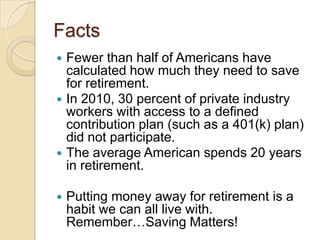
Fewer than half of Americans have
calculated how much they need to save
for retirement.
In 2010, 30 percent of private industry
workers with access to a defined
contribution plan (such as a 401(k) plan)
did not participate.
The average American spends 20 years
in retirement.

Putting money away for retirement is a
habit we can all live with.
Remember…Saving Matters!
Start saving, keep saving, and
stick to your goals




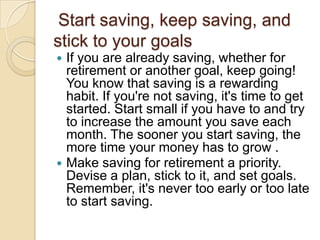
If you are already saving, whether for
retirement or another goal, keep going!
You know that saving is a rewarding
habit. If you're not saving, it's time to get
started. Start small if you have to and try
to increase the amount you save each
month. The sooner you start saving, the
more time your money has to grow .
Make saving for retirement a priority.
Devise a plan, stick to it, and set goals.
Remember, it's never too early or too late
to start saving.
KNOW YOUR
RETIREMENT
NEEDS
Retirement is expensive.
Experts estimate that you
will need about 70 percent
of your preretirement
income – lower earners,
90 percent or more – to
maintain your standard of
living when you stop
working. Take charge of
your financial future. The
key to a secure retirement
is to plan ahead.
Learn about your employer's
pension plan


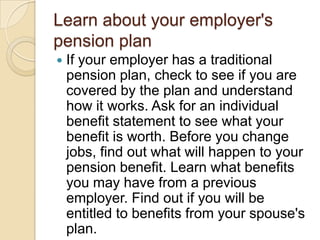
If your employer has a traditional
pension plan, check to see if you are
covered by the plan and understand
how it works. Ask for an individual
benefit statement to see what your
benefit is worth. Before you change
jobs, find out what will happen to your
pension benefit. Learn what benefits
you may have from a previous
employer. Find out if you will be
entitled to benefits from your spouse's
plan.
CONTRIBUTE TO
YOUR
EMPLOYER’S
RETIREMENT
SAVINGS PLAN
If your employer offers a
retirement savings plan,
such as a 401(k) plan, sign
up and contribute all you
can. Your taxes will be
lower, your company may
kick in more, and
automatic deductions
make it easy. Over time,
compound interest and tax
deferrals make a big
difference in the amount
you will accumulate. Find
out about your plan. For
example, how much would
you need to contribute to
get the full employer
contribution and how long
would you need to stay in
Consider basic investment
principles


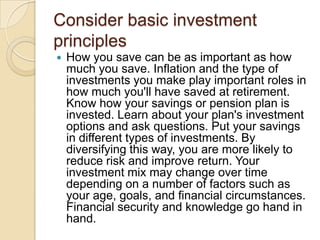
How you save can be as important as how
much you save. Inflation and the type of
investments you make play important roles in
how much you'll have saved at retirement.
Know how your savings or pension plan is
invested. Learn about your plan's investment
options and ask questions. Put your savings
in different types of investments. By
diversifying this way, you are more likely to
reduce risk and improve return. Your
investment mix may change over time
depending on a number of factors such as
your age, goals, and financial circumstances.
Financial security and knowledge go hand in
hand.
DON'T TOUCH YOUR
RETIREMENT SAVINGS
If you withdraw your
retirement savings now,
you'll lose principal and
interest and you may lose
tax benefits or have to pay
withdrawal penalties. If
you change jobs, leave
your savings invested in
your current retirement
plan, or roll them over to
an IRA or your new
employer's plan.
Ask your employer to start a plan
If your employer doesn't offer a
retirement plan, suggest that it start
one.
 There are a number of retirement
saving plan options available.

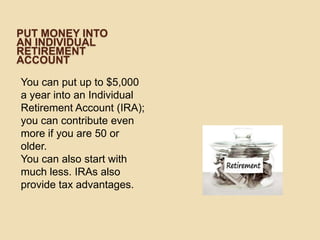
PUT MONEY INTO
AN INDIVIDUAL
RETIREMENT
ACCOUNT
You can put up to $5,000
a year into an Individual
Retirement Account (IRA);
you can contribute even
more if you are 50 or
older.
You can also start with
much less. IRAs also
provide tax advantages.
Find out about your Social
Security benefits
Social Security pays benefits that are
on average equal to about 40 percent
of what you earned before retirement.
 You may be able to estimate your
benefit by using the retirement
estimator on S. Security
Administration's website.

Ask Questions
Talk to your employer, your bank, your
union, or a financial adviser.
 Ask questions and make sure you
understand the answers.

LIGHT HUMOR
Q: How do you know your old
enough to retire?
A: Instead of lying about your
age you start bragging about it!
Q: Why do retirees count
pennies?
A: They are the only ones who
have the time.
Q: Why don't retirees mind
being called Seniors?
A: The term comes with a 10%
percent discount.

Retirement prep

  • 1.
  • 2.
    Facts     Fewer than halfof Americans have calculated how much they need to save for retirement. In 2010, 30 percent of private industry workers with access to a defined contribution plan (such as a 401(k) plan) did not participate. The average American spends 20 years in retirement. Putting money away for retirement is a habit we can all live with. Remember…Saving Matters!
  • 3.
    Start saving, keepsaving, and stick to your goals   If you are already saving, whether for retirement or another goal, keep going! You know that saving is a rewarding habit. If you're not saving, it's time to get started. Start small if you have to and try to increase the amount you save each month. The sooner you start saving, the more time your money has to grow . Make saving for retirement a priority. Devise a plan, stick to it, and set goals. Remember, it's never too early or too late to start saving.
  • 4.
    KNOW YOUR RETIREMENT NEEDS Retirement isexpensive. Experts estimate that you will need about 70 percent of your preretirement income – lower earners, 90 percent or more – to maintain your standard of living when you stop working. Take charge of your financial future. The key to a secure retirement is to plan ahead.
  • 5.
    Learn about youremployer's pension plan  If your employer has a traditional pension plan, check to see if you are covered by the plan and understand how it works. Ask for an individual benefit statement to see what your benefit is worth. Before you change jobs, find out what will happen to your pension benefit. Learn what benefits you may have from a previous employer. Find out if you will be entitled to benefits from your spouse's plan.
  • 6.
    CONTRIBUTE TO YOUR EMPLOYER’S RETIREMENT SAVINGS PLAN Ifyour employer offers a retirement savings plan, such as a 401(k) plan, sign up and contribute all you can. Your taxes will be lower, your company may kick in more, and automatic deductions make it easy. Over time, compound interest and tax deferrals make a big difference in the amount you will accumulate. Find out about your plan. For example, how much would you need to contribute to get the full employer contribution and how long would you need to stay in
  • 7.
    Consider basic investment principles  Howyou save can be as important as how much you save. Inflation and the type of investments you make play important roles in how much you'll have saved at retirement. Know how your savings or pension plan is invested. Learn about your plan's investment options and ask questions. Put your savings in different types of investments. By diversifying this way, you are more likely to reduce risk and improve return. Your investment mix may change over time depending on a number of factors such as your age, goals, and financial circumstances. Financial security and knowledge go hand in hand.
  • 8.
    DON'T TOUCH YOUR RETIREMENTSAVINGS If you withdraw your retirement savings now, you'll lose principal and interest and you may lose tax benefits or have to pay withdrawal penalties. If you change jobs, leave your savings invested in your current retirement plan, or roll them over to an IRA or your new employer's plan.
  • 9.
    Ask your employerto start a plan If your employer doesn't offer a retirement plan, suggest that it start one.  There are a number of retirement saving plan options available. 
  • 10.
    PUT MONEY INTO ANINDIVIDUAL RETIREMENT ACCOUNT You can put up to $5,000 a year into an Individual Retirement Account (IRA); you can contribute even more if you are 50 or older. You can also start with much less. IRAs also provide tax advantages.
  • 11.
    Find out aboutyour Social Security benefits Social Security pays benefits that are on average equal to about 40 percent of what you earned before retirement.  You may be able to estimate your benefit by using the retirement estimator on S. Security Administration's website. 
  • 12.
    Ask Questions Talk toyour employer, your bank, your union, or a financial adviser.  Ask questions and make sure you understand the answers. 
  • 13.
    LIGHT HUMOR Q: Howdo you know your old enough to retire? A: Instead of lying about your age you start bragging about it! Q: Why do retirees count pennies? A: They are the only ones who have the time. Q: Why don't retirees mind being called Seniors? A: The term comes with a 10% percent discount.