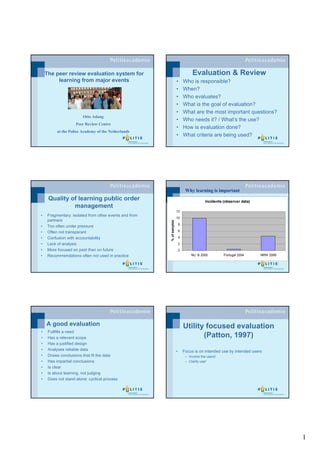
The peer review evaluation system for                                           Evaluation & Review
         learning from major events                                    •       Who is responsible?
                                                                       •       When?
                                                                       •       Who evaluates?
                                                                       •       What is the goal of evaluation?
                                                                       •       What are the most important questions?
                        Otto Adang
                                                                       •       Who needs it? / What’s the use?
                    Peer Review Centre
                                                                       •       How is evaluation done?
          at the Police Academy of the Netherlands
                                                                       •       What criteria are being used?


                                                                                Why learning is important
     Quality of learning public order                                                        Incidents (observer data)
              management
                                                                       12
•    Fragmentary: isolated from other events and from
                                                                       10
     partners
                                                        % of samples


                                                                           8
•    Too often under pressure
•    Often not transparant                                                 6

•    Confusion with accountability                                         4

•    Lack of analysis                                                      2
•    More focused on past than on future                                   0
•    Recommendations often not used in practice                                     NL/ B 2000         Portugal 2004     NRW 2006


    A good evaluation                                                          Utility focused evaluation
•    Fullfills a need
•    Has a relevant scope                                                             (Patton, 1997)
•    Has a justified design
•    Analyses reliable data                                            •       Focus is on intended use by intended users
•    Draws conclusions that fit the data                                        – Involve the users!
•    Has impartial conclusions                                                  – Clarify use!
•    Is clear
•    Is about learning, not judging
•    Does not stand alone: cyclical process


                                                                                                                                    1
Approach to evaluation of                                             The concept: peer review
              public order managament
                                                                           •   On a voluntary basis
•       Conduct intercollegiate reviews, focused on learning:
         – identification of good practices                                •   Involve experienced officers
         – exchange of experiences                                         •   From several forces/ countries
         – development of professional norms                               •   Based on an evaluation plan, developed in relation
•       Well-planned, in cooperation with local commander                      with inviting force, involving issues relevant to
•       Using a transparent methodology & criteria                             inviting force
•       Making use of international community of experienced               •   Observe in real time: focus not after-the-fact on
        practicioners, trained in evaluation                                   incidents, but on handling of events
•       Development: evaluation teams (Netherlands, Euro                   •   EU-handbook starting point
        2000, Euro 2004, pilot in EU)                                      •   Goal is continuous adaptation and learning, not
                                                                               judging: utilisation focused-evaluation


                            Advantages                                                     EU peer reviews
    •   Police concerned receive informed and constructive                 •   14 peer reviews in 10 different countries (UK, D, DK,
        feedback in a safe manner                                              E, CH, AU, NL, Cyprus, Romania, Bulgaria)
    •   Officers involved gain a lot of additional experience              •   15 experts from 13 different countries (Austria,
    •   Exchange of perspectives and findings deepens                          Belgium, Cyprus, Denmark, France, Germany, Italy,
        discussion, contributes to development of                              Netherlands, Portugal, Spain, Sweden, Switzerland
        professional norms and helps international                             and the United Kingdom) + support from 3 different
        understanding and cooperation                                          countries (NL, D, UK)
                                                                           •   4 Champions league matches, 4 national team
                                                                               matches, 5 local risk matches


                Use of the peer reviews
    •   For hosts AND reviewers: a win-win situation
    •   The peer review PROCESS itself was useful:                              For me it was a great experience and
        holding up a mirror, catalyst for change                                 it was very valuable for my work in
    •   Use of reports                                                              future in international football
          – the report was sent to and discussed with commanders/               matches. Thanks for the possibility to
            units involved in the operation                                             have joined this team.
          – the report was used for internal reflection within the force
          – the report was used in discussions with partners
    •   Examples: Romania, Cyprus, Denmark, Switzerland
        and Euro 2008


                                                                                                                                       2
Euro 2008 Switzerland                                          Points of attention
               Points of attention
                                                              •   Implementation of recommendations from EU handbook
•   Implementation of the 3D concept
                                                              •   Involvement of non-EU member states
•   Relation between risk assessment and tactical
    deployment                                                •   A failure of the operation/ officers to implement the
                                                                  chosen strategy
•   Cooperation between host cities and police forces
    providing support                                         •   A lack of balance between police officer uniform and
                                                                  behaviour on the one hand and actual risk on the other
•   Uniformity in approach between different host cities
                                                              •   A lack of interaction and communication between police
•   Role of and cooperation with stadium security                 officers and fans
•   Communication with fans                                   •   Imperfections in the cooperation between police and
                                                                  partners (either police or non-police partners such as
                                                                  transport police, club, stewards etc.)


                  Good practices                                               Good practices
•   careful and elaborate preparation of and planning         •   specific attention for crowd safety and for officer
    for the operation, good cooperation with agencies             safety, consistent use of well-structured briefings
    external to the police and effective management of            (with the use of visual aids), half-time briefings and
    media for benefit of police and local community. The          debriefings, positioning of officers in the operation
    teams also witnessed examples of use of dynamic               being determined by their experience rather than
    risk assessment, existence of a balance between               their rank, use of a GPS system to monitor the
    police profile and actual situational risk and tactical       movements of all units in the operation, and wearing
    deployments in line with a friendly and firm,                 of protective vests underneath rather than above
    community oriented policing approach, also in                 clothing.
    situations of increased risk


                                                                      Good practices: Dynamic risk
                  Good practices                                              assessment
•   positive facilitation of and communication with fans,     •   The clear distinction between different types of risks,
    including language courses for officers and                   and especially between spontaneous and planned
    conveyance of key information to fans via websites            disorder
    before arrival in a foreign city, police involvement in   •   The availability of different types of contingency
    preventive activities aimed at fans, formulation of a         scenarios related to risks (e.g. for evacuation, bomb
    clear behavioral profile that was clearly                     threat, flares, pitch invasion)
    communicated to officers                                  •   A clear identification of hot spots based on previous
                                                                  experiences and complaints by the public and flexible
                                                                  deployment in relation to these hot spots
                                                              •   The fact that intelligence officers had received
                                                                  dedicated training


                                                                                                                            3
Good practices: Tactical
                   deployment
                                                                          Critical succes factors
•   Rapid intervention and degrading when necessary          •   Peer aspect: Involvement of commanders
•   Use of the planning officer as a quality assurance       •   Open, informal and utilisation focused approach
    officer                                                  •   Learning from the bottom up, not an inspection
•   Use of dedicated tactical advisors                       •   Holding up a mirror
•   Use of a liaison officer working with units from         •   Also identifying good practice
    visiting/ neighbouring forces providing assistance       •   Mix between practice and theory
-   Explicit use of police officers with specific            •   focus on specific topics, tailored
    experience for specific functions or at specific posts
                                                             •   consistent systematic methodological approach


            Challenge for the future                                            Topics identified
•   Exchange and implement good practices identified,        •   Use of spotters (plainclothes/ uniform)
    including 3D/ low-profile strategies                     •   Task of spotters in relation to fans
•   Address points of attention with wider relevance:        •   Use of stewards from away teams
    especially dynamic risk assessment                       •   Division of tasks between police and stewards
•   Discuss/ resolve topics where there is a lot of          •   Segregation of fans
    variation between forces/ countries
                                                             •   Use of intelligence
                                                             •   Treatment of fans


                         Next steps                                   Suggestions for the future
•   EU training course with peer reviews as practical        •   implement peer reviews at a national level as well
    component                                                •   cascade information about peer reviews through NFIPs
                                                             •   involve commanders first as member of a peer review before
•   National peer reviews                                        asking them to be host
     –   Scotland                                            •   involve the peer review team in the host debriefing process
     –   Sweden                                              •   link up with other initiatives within Europe (including CEPOL)
     –   Metropolitan police (UK)                                so that experiences can be shared more fully in a more
                                                                 coordinated way
     –   Netherlands
                                                             •   encourage and facilitate peer reviews in countries that
     –   …                                                       organise championships
                                                             •   Involve partners
                                                             •   Apply to other (non-football) public order policing


                                                                                                                                  4

Peer Review Evaluation System

  • 1.
    The peer reviewevaluation system for Evaluation & Review learning from major events • Who is responsible? • When? • Who evaluates? • What is the goal of evaluation? • What are the most important questions? Otto Adang • Who needs it? / What’s the use? Peer Review Centre • How is evaluation done? at the Police Academy of the Netherlands • What criteria are being used? Why learning is important Quality of learning public order Incidents (observer data) management 12 • Fragmentary: isolated from other events and from 10 partners % of samples 8 • Too often under pressure • Often not transparant 6 • Confusion with accountability 4 • Lack of analysis 2 • More focused on past than on future 0 • Recommendations often not used in practice NL/ B 2000 Portugal 2004 NRW 2006 A good evaluation Utility focused evaluation • Fullfills a need • Has a relevant scope (Patton, 1997) • Has a justified design • Analyses reliable data • Focus is on intended use by intended users • Draws conclusions that fit the data – Involve the users! • Has impartial conclusions – Clarify use! • Is clear • Is about learning, not judging • Does not stand alone: cyclical process 1
  • 2.
    Approach to evaluationof The concept: peer review public order managament • On a voluntary basis • Conduct intercollegiate reviews, focused on learning: – identification of good practices • Involve experienced officers – exchange of experiences • From several forces/ countries – development of professional norms • Based on an evaluation plan, developed in relation • Well-planned, in cooperation with local commander with inviting force, involving issues relevant to • Using a transparent methodology & criteria inviting force • Making use of international community of experienced • Observe in real time: focus not after-the-fact on practicioners, trained in evaluation incidents, but on handling of events • Development: evaluation teams (Netherlands, Euro • EU-handbook starting point 2000, Euro 2004, pilot in EU) • Goal is continuous adaptation and learning, not judging: utilisation focused-evaluation Advantages EU peer reviews • Police concerned receive informed and constructive • 14 peer reviews in 10 different countries (UK, D, DK, feedback in a safe manner E, CH, AU, NL, Cyprus, Romania, Bulgaria) • Officers involved gain a lot of additional experience • 15 experts from 13 different countries (Austria, • Exchange of perspectives and findings deepens Belgium, Cyprus, Denmark, France, Germany, Italy, discussion, contributes to development of Netherlands, Portugal, Spain, Sweden, Switzerland professional norms and helps international and the United Kingdom) + support from 3 different understanding and cooperation countries (NL, D, UK) • 4 Champions league matches, 4 national team matches, 5 local risk matches Use of the peer reviews • For hosts AND reviewers: a win-win situation • The peer review PROCESS itself was useful: For me it was a great experience and holding up a mirror, catalyst for change it was very valuable for my work in • Use of reports future in international football – the report was sent to and discussed with commanders/ matches. Thanks for the possibility to units involved in the operation have joined this team. – the report was used for internal reflection within the force – the report was used in discussions with partners • Examples: Romania, Cyprus, Denmark, Switzerland and Euro 2008 2
  • 3.
    Euro 2008 Switzerland Points of attention Points of attention • Implementation of recommendations from EU handbook • Implementation of the 3D concept • Involvement of non-EU member states • Relation between risk assessment and tactical deployment • A failure of the operation/ officers to implement the chosen strategy • Cooperation between host cities and police forces providing support • A lack of balance between police officer uniform and behaviour on the one hand and actual risk on the other • Uniformity in approach between different host cities • A lack of interaction and communication between police • Role of and cooperation with stadium security officers and fans • Communication with fans • Imperfections in the cooperation between police and partners (either police or non-police partners such as transport police, club, stewards etc.) Good practices Good practices • careful and elaborate preparation of and planning • specific attention for crowd safety and for officer for the operation, good cooperation with agencies safety, consistent use of well-structured briefings external to the police and effective management of (with the use of visual aids), half-time briefings and media for benefit of police and local community. The debriefings, positioning of officers in the operation teams also witnessed examples of use of dynamic being determined by their experience rather than risk assessment, existence of a balance between their rank, use of a GPS system to monitor the police profile and actual situational risk and tactical movements of all units in the operation, and wearing deployments in line with a friendly and firm, of protective vests underneath rather than above community oriented policing approach, also in clothing. situations of increased risk Good practices: Dynamic risk Good practices assessment • positive facilitation of and communication with fans, • The clear distinction between different types of risks, including language courses for officers and and especially between spontaneous and planned conveyance of key information to fans via websites disorder before arrival in a foreign city, police involvement in • The availability of different types of contingency preventive activities aimed at fans, formulation of a scenarios related to risks (e.g. for evacuation, bomb clear behavioral profile that was clearly threat, flares, pitch invasion) communicated to officers • A clear identification of hot spots based on previous experiences and complaints by the public and flexible deployment in relation to these hot spots • The fact that intelligence officers had received dedicated training 3
  • 4.
    Good practices: Tactical deployment Critical succes factors • Rapid intervention and degrading when necessary • Peer aspect: Involvement of commanders • Use of the planning officer as a quality assurance • Open, informal and utilisation focused approach officer • Learning from the bottom up, not an inspection • Use of dedicated tactical advisors • Holding up a mirror • Use of a liaison officer working with units from • Also identifying good practice visiting/ neighbouring forces providing assistance • Mix between practice and theory - Explicit use of police officers with specific • focus on specific topics, tailored experience for specific functions or at specific posts • consistent systematic methodological approach Challenge for the future Topics identified • Exchange and implement good practices identified, • Use of spotters (plainclothes/ uniform) including 3D/ low-profile strategies • Task of spotters in relation to fans • Address points of attention with wider relevance: • Use of stewards from away teams especially dynamic risk assessment • Division of tasks between police and stewards • Discuss/ resolve topics where there is a lot of • Segregation of fans variation between forces/ countries • Use of intelligence • Treatment of fans Next steps Suggestions for the future • EU training course with peer reviews as practical • implement peer reviews at a national level as well component • cascade information about peer reviews through NFIPs • involve commanders first as member of a peer review before • National peer reviews asking them to be host – Scotland • involve the peer review team in the host debriefing process – Sweden • link up with other initiatives within Europe (including CEPOL) – Metropolitan police (UK) so that experiences can be shared more fully in a more coordinated way – Netherlands • encourage and facilitate peer reviews in countries that – … organise championships • Involve partners • Apply to other (non-football) public order policing 4