Writing in
adults
By
Juan Ramón Méndez
Agenda
• Presentation
• Warm up -Game wordy pop
• Writing skills
• Activity 1
• Activity 2
• Practice excersice
• Conclusion
• Attendance record
https://forms.gle/JmwfK4ozu2pinDmw7
Tips on How to Improve
English Writing Skills
1. Read as much as you can
This will help you improve your
vocabulary, grammar, sentence
structure, and show you there
are many different ways to
communicate ideas.
2. Keep an English dictionary
You’ll be able to look up words to clarify
their meaning and to learn antonyms
and synonyms so as not to repeat words
or phrases, which will better your
communication skills.
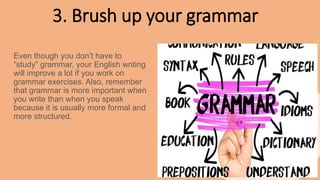
3. Brush up your grammar
Even though you don’t have to
“study” grammar, your English writing
will improve a lot if you work on
grammar exercises. Also, remember
that grammar is more important when
you write than when you speak
because it is usually more formal and
more structured.
4. Check your spelling before
and after writing
How do you feel when you read something full
of spelling mistakes in your own language?
Poor spelling can spoil an otherwise interesting
piece to read, and we generally write for other
people to read what we’ve written.
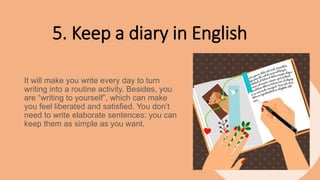
5. Keep a diary in English
It will make you write every day to turn
writing into a routine activity. Besides, you
are “writing to yourself”, which can make
you feel liberated and satisfied. You don’t
need to write elaborate sentences: you can
keep them as simple as you want.
6. Learn how to
expand your basic
sentences into
more elaborate
ones
7. Learn how to organize a
paragraph
An useful way to improve your English
writing skills is to start your paragraphs with
a topic sentence: i.e. a sentence that
explains what you are going to write about.
Continue with supporting sentences: i.e.
sentences that provide more information
about the topic. Finish with a conclusion:
i.e. it is generally a summary of the ideas
developed in the body of the paragraph.
8. Write an outline
Even in a very simple piece of English
writing you have to keep some kind of an
organization to convey the message you
want in a clear orderly way. There are
many different ways to write outlines and
these have much to do with the way you
organize things in your mind.
9. Try to get someone to read
what you’ve written
A teacher, a tutor, a native speaker:
whoever masters the language and can
help you understand and correct
whatever mistakes you may have made
both in grammar or spelling and in the
way your paragraph text has been
organized.
Types of writing activities
Controlled writing
Guided writing
Free writing
Activity 1 An opinion essay
Pre-Task
Activity 2
Check your writing: matching
https://es.liveworksheets.com/vb3033328fs
Conclusion
It is the teacher’s responsibility to develop writing
tasks for young learners that are enjoyable, full of
practice, meaningful, purposeful, social and
supported (Reid 1998). Challenging your learners
and exploiting collaborative opportunities all
combine to provide a learning environment where
writing is both valued and enjoyed. Instil the joy of
writing with your young learners and you could
inspire an important person in the world.
Pedagogical Session 4.pptx

Pedagogical Session 4.pptx

  • 1.
  • 2.
    Agenda • Presentation • Warmup -Game wordy pop • Writing skills • Activity 1 • Activity 2 • Practice excersice • Conclusion • Attendance record https://forms.gle/JmwfK4ozu2pinDmw7
  • 3.
    Tips on Howto Improve English Writing Skills 1. Read as much as you can This will help you improve your vocabulary, grammar, sentence structure, and show you there are many different ways to communicate ideas.
  • 4.
    2. Keep anEnglish dictionary You’ll be able to look up words to clarify their meaning and to learn antonyms and synonyms so as not to repeat words or phrases, which will better your communication skills.
  • 5.
    3. Brush upyour grammar Even though you don’t have to “study” grammar, your English writing will improve a lot if you work on grammar exercises. Also, remember that grammar is more important when you write than when you speak because it is usually more formal and more structured.
  • 6.
    4. Check yourspelling before and after writing How do you feel when you read something full of spelling mistakes in your own language? Poor spelling can spoil an otherwise interesting piece to read, and we generally write for other people to read what we’ve written.
  • 7.
    5. Keep adiary in English It will make you write every day to turn writing into a routine activity. Besides, you are “writing to yourself”, which can make you feel liberated and satisfied. You don’t need to write elaborate sentences: you can keep them as simple as you want.
  • 8.
    6. Learn howto expand your basic sentences into more elaborate ones
  • 9.
    7. Learn howto organize a paragraph An useful way to improve your English writing skills is to start your paragraphs with a topic sentence: i.e. a sentence that explains what you are going to write about. Continue with supporting sentences: i.e. sentences that provide more information about the topic. Finish with a conclusion: i.e. it is generally a summary of the ideas developed in the body of the paragraph.
  • 10.
    8. Write anoutline Even in a very simple piece of English writing you have to keep some kind of an organization to convey the message you want in a clear orderly way. There are many different ways to write outlines and these have much to do with the way you organize things in your mind.
  • 11.
    9. Try toget someone to read what you’ve written A teacher, a tutor, a native speaker: whoever masters the language and can help you understand and correct whatever mistakes you may have made both in grammar or spelling and in the way your paragraph text has been organized.
  • 12.
    Types of writingactivities Controlled writing Guided writing Free writing
  • 13.
    Activity 1 Anopinion essay Pre-Task
  • 14.
    Activity 2 Check yourwriting: matching https://es.liveworksheets.com/vb3033328fs
  • 15.
    Conclusion It is theteacher’s responsibility to develop writing tasks for young learners that are enjoyable, full of practice, meaningful, purposeful, social and supported (Reid 1998). Challenging your learners and exploiting collaborative opportunities all combine to provide a learning environment where writing is both valued and enjoyed. Instil the joy of writing with your young learners and you could inspire an important person in the world.