CURRICULUM
OF
AEROSPACE ENGINEERING
Bachelor of Engineering Program
(Revised 2019)
Pakistan Engineering Council
&
Higher Education Commission
Islamabad
ii
Contents
PREFACE ...............................................................................................................................iii
1. Engineering Curriculum Review & Development Committee (ECRDC)............... 1
2. ECRDC Agenda............................................................................................................ 1
3. OBE Based Curriculum Development Framework .................................................. 2
4. PDCA Approach to Curriculum Design and Development...................................... 3
5. ECRDC for Mechanical & Allied Engineering Disciplines ...................................... 4
6. Agenda of ECRDC for Mechanical and Allied Engineering Disciplines................. 7
7. Program Educational Objectvies (PEOs) and Learning Outcomes (PLOs)........... 9
7.1 Program Educational Objectives (PEOs)................................................................... 9
7.2 Program Learning Outcomes (PLOs) ........................................................................ 9
8. Program Salient Features .......................................................................................... 10
9. Framework for Bachelor of Aerospace Engineering .............................................. 15
10. Scheme of Studies for Bachelor of Aerospace Engineering.................................... 17
11. Program Specific Labs............................................................................................... 21
12. Course Details and Teaching-Assessment Approaches........................................... 21
12.1 Engineering Domain................................................................................................... 21
12.2 Non-Engineering Domain…………………………………………………………... 50
iii
PREFACE
The curriculum, with varying definitions, is said to be a roadmap or plan of teaching-learning
process that students of an academic programme are required to undergo. It includes objectives
and learning outcomes, course contents, scheme of studies, teaching approaches, and assessment
methodologies. Since knowledge in all fields and sectors is expanding at a faster pace and new
disciplines are also emerging; it is imperative that curricula should be dynamic having regular
review and updation.
The University Grants Commission (UGC) was designated as the competent authority to develop,
review, and revise curricula beyond Class-XII vide Section 3, Sub-Section 2 (ii), Act of Parliament
No. X of 1976 titled “Supervision of Curricula and Textbooks and Maintenance of Standard of
Education”. With the repeal of UGC Act, the same function was assigned to the Higher Education
Commission (HEC) under its Ordinance of 2002, Section 10, Sub-Section 1 (v). In compliance
with the above provisions, the HEC had been undertaking the development of curricula for new/
emerging fields and revision of curricula after regular intervals through respective National
Curriculum Revision Committees (NCRCs) until 2018.
As a policy change and expanding higher education base under HEC, the curriculum review and
development task has been shifted to the respective regulators and HEIs. PEC also having mandate
under its Act of Parliament and especially after attaining Washington Accord full signatory status
and IPEA licensing authority, took up the challenge to review and develop the curricula for
engineering programs based on Outcome-Based Education (OBE) System. PEC has therefore
constituted an Engineering Curriculum Review and Development Committee (ECRDC) and also
subject ECRDCs comprising of eminent engineers and professionals from academia and industry
to take up the task of curricula review and updation. Nevertheless, the basic templates developed
by HEC NCRCs have been followed as guidelines.
Under OBE based curriculum review and development framework, PEC held national and regional
level stakeholders and industrial consultation workshops engaging HEIs, industry, technical and
consulting organizations. The experts’ feedback and suggestions were translated into the
curriculum review process taking into consideration the dynamics of technological advancement,
industrial needs and management-cum-soft skills for engineering graduates.
This curriculum document would serve as a guideline whereas allowing HEIs to tame/ change
within the framework by introducing courses in support of local/ required industrial demand as
well as satisfying 12 GAs (Graduate Attributes) covering core and elective courses, considered as
hallmark of OBE system in the international environment. At the same time, this curriculum
framework would fulfill our national, social and economic needs leading towards attainment of
Sustainable Development Goals (SDGs-2030). It would also provide the level of competency
specified in Pakistan Qualification Framework to make it compatible with international
educational standards.
1
1. Engineering Curriculum Review & Development Committee (ECRDC)
1. Engr Prof Dr Fazal Ahmed Khalid,
Convener, Metallurgy, Materials, Mining Engg & Allied Disciplines
Convener
2.
3.
Engr Prof Dr Iftikhar Hussain
Convener Mechanical Engg & Allied Disciplines
Engr Prof Dr M. Younus Javed
Convener Electrical Engg & Allied Disciplines
Member
Member
4. Engr Malik Saleem Ullah Saeed,
Convener Chemical Engg & Allied Disciplines
Member
5. Engr Dr Wasim Khaliq,
Convener, Civil Engg & Allied Discipline
Member
6. Engr Dr Muhammad Ashraf,
Convener, Agricultural Engg & Allied Disciplines
Member
7. Engr Prof Dr Jameel Ahmed
Convener, Common to All (Non-Engg Component)
Member
8. Engr Muhammad Raza Chohan,
Director General, HEC
Member
9. Engr Dr Nasir Mahmood Khan,
Additional Registrar (Accreditation), PEC
Member
10. Engr Dr Ashfaq Ahmed Sheikh, Additional Registrar, CPD Secretary
2. ECRDC Agenda
• The ECRDC is responsible to oversee the overall working of curriculum review and
development for all engineering programs in terms of strategy, guidance and progress, and
thereby submission to the relevant forum for adoption/ notification.
• Each Member of ECRDC will also work in the capacity of Convener for respective
disciplines as mentioned against their names and as per their ToRs.
2
3. OBE Based Curriculum Development Framework
Outcome Based Education (OBE) is an approach of teaching and learning that focuses on what
students should be able to attain at the end of the educational program. OBE is a students centered
system which concerns what the students will know and be able to do as learning outcomes. The
curriculum development under OBE is therefore an integration of graduates attributes and
stakeholders’ feedback in cognizance with the institution's Vision and Mission.
Vision & Mission
of HEI
Stakeholders
Government
Industry/
Employer
Society/
Parents
Alumni
Program
Educational
Objectives (PEOs)
Curriculum
Design
(course contents,
duration, PLOs,
delivery &
assessment
mechanism, CQI
process)
Benchmarking
Facilities &
Infrastructure
Faculty &
Support Staff
Institutional &
Financial Support
Outcome-Based Education (OBE) - Curriculum
Development Framework
Student
centered
approach
HEIs
National Needs
(social, political,
technological,
developmental &
economic)
SDGs-2030
(based on pillars of
Sustainable Development
(Environment, Social &
Economic)
IT Tools, Artificial
Intelligence, Emerging
Technologies,
Soft & Life Skills,
Entrepreneurship
3
4. PDCA Approach to Curriculum Design and Development
The process of curriculum design and development constitutes various interconnected elements
with the objective of achieving the intended purpose of the program. The Plan-Do-Check-Act
approach (PDCA) as explained below has been followed in the curriculum development and
review process.
Plan. This stage begins with an analysis of the stakeholders' needs of faculty, current and past
students, employers and society in general. The stakeholders' needs are translated into human
resource terminology i.e. graduate competencies which in turn translated into educational
taxonomy and learning outcomes. Based on the learning outcomes, curriculum is designed
backward to meet PLOs.
Do. The plan stage is implemented where curriculum is delivered and learning outcomes are
assessed to gauge the achievement of PLOs.
Check. This stage involves the analysis of assessment results and feedback from students and
faculty. Areas for improvement are identified.
4
Act. When the learning outcomes are achieved, the curriculum, learning and teaching strategies
and assessment methods are standardized. Best practices are shared and improvement is made for
the next cycle of PDCA.
5. ECRDC for Mechanical & Allied Engineering Disciplines
The PEC Engineering Curriculum Review and Development Committee (ECRDC) of Mechanical
and Allied Engineering Disciplines took up the task to review and update the curriculum for the
BE Aerospace Engineering degree program. The subject Committee held meetings on 28-8-2019
and 22-1-2020 at PEC Headquarters Islamabad besides Sub-Group Aerospace Engg meeting on 7-
10-2019. The Committee consisted of following members:
1. Engr Prof Dr Iftikhar Hussain
Vice Chancellor
University of Engineering & Technology
Peshawar
Convener
2. Engr Prof Dr Muhammad Tufail
Pro Vice Chancellor
NED UET Karachi.
Member
3. Engr Prof Dr Syed Mushtaq Shah
Dean Faculty of Engg.
Baluchistan University of Engineering & Technology
Khuzdar, Balochistan
Member
4. Engr. Prof Dr Shahab Khushnood
Professor
Faculty of Mechanical & Aeronautical Engineering
UET Taxila
Member
5. Engr Prof Dr Javaid Iqbal
Dean College of EME
Peshawar Road
Rawalpindi
0300-5107045
Member
6. Engr Meer Abdul Qayyum Babar
Chief Engineer (Rtd)
WAPDA , Jhelum
Member
7. Engr Prof Dr Mohammad Pervez Mughal
Chairman
Department of Industrial & Manufacturing Engineering
University of Engineering & Technology
Lahore
Member
5
8. Engr Muhammad Shaukat
Deputy Manager
Mari Petroleum
Islamabad
Member
9. Engr Prof Dr Rizwan Mehmood Gul
Professor, Faculty of Mechanical Engineering
University of Engineering & Technology
Peshawar
Member
10. Engr Dr Alam Zeb
General Manager
Project Management Organization (PMO)
Rawalpindi
Member
11. Engr Dr Abdul Rahim Abbasi
Principal Engineer
Karachi Nuclear Power Plant (KANUPP)
Karachi
Member
12. Engr Dr Manzar
Air Commodore
Pakistan Aeronautical Complex
Kamra, Distt. Attock
Member
13. Engr Prof Dr Iqbal Hussain
Professor
UET, Lahore
Member
14. Dr Hamid Zaigham
Professor
Faculty of Materials Science and Engineering
Ghulam Ishaq Khan Institute of
Engineering Sciences and Technology
Swabi
Member
15. Engr. Dr. Khalid Rahman
Associate Professor
Faculty of Mechanical Engineering
Ghulam Ishaq Khan Institute of
Engineering Sciences and Technology
Swabi
Member
16. Engr Prof Dr M. A. Irfan Mufti
Dean Faculty of Mechanical, Chemical,
Industrial, Mechatronics & Energy Engineering
University of Engineering & Technology
Peshawar
Member
17. Engr Prof Dr Salim ur Rehman Member
6
Vice Chancellor
Sarhad University of Science & Information
Technology, Peshawar
18. Engr Dr Ajaz Bashir Janjua
Dy. General Manager
Heavy Mechanical Complex (HMC)
Rawalpindi
Member
19. Engr Prof Dr Muhammad Naeem
Professor
Institute of Space Technology
Islamabad
Member
20. Engr Dr Ashfaq Ahmed Sheikh
Additional Registrar-CPD
Pakistan Engineering Council
Islamabad
Secretary
21. Engr Muhammad Kashif Ali
Assistant Registrar-CPD
Pakistan Engineering Council
Islamabad
AR-CPD
5.1.Sub-Group, Aerospace Engineering
1. Engr Prof Dr Salim ur Rehman
Vice Chancellor
Sarhad University of Science & Information
Technology, Peshawar
Lead Sub-Group
2. Engr Prof Dr Muhammad Naeem
Professor
Institute of Space Technology
Islamabad
Member
3. Engr Meer Abdul Qayyum Babar
Chief Engineer (Rtd)
WAPDA , Jhelum
Member
4. Engr Dr Manzar
Air Commodore
Pakistan Aeronautical Complex
Kamra, Distt. Attock
Member
5. Engr Prof Dr Babar Saeed Expert
7
Professor
Air University, Islamabad
6. Engr Prof Dr Abdul Munem Khan
Professor
Institute of Space Technology
Islamabad
Expert
7. Engr Prof Dr Iqbal Rasool
Professor
Institute of Space Technology
Islamabad
Expert
8. Engr Prof Dr Ibrahim Haneef
Professor
Department of Mech and Aerospace Engineering
Air University, Islamabad
Expert
9. Engr Prof Dr Messam Abbas Naqvi
AVRID
Pakistan Aeronautical Complex,
Kamra
Expert
10. Engr Dr Ashfaq Ahmad Sheikh
Additional Registrar-CPD
Pakistan Engineering Council
Islamabad
Secretary
11. Engr Muhammad Kashif Ali
Assistant Registrar-CPD
Pakistan Engineering Council
Islamabad
AR-CPD
6. Agenda of ECRDC for Mechanical and Allied Engineering Disciplines
• The Subject ECRDC will work under the overall directions and supervision of main
ECRDC comprising all Conveners.
• The key driving lines for the development of engineering curriculum for each discipline
will be the overall policy of Pakistan Engineering Council in connection with international
commitments (Washington Accord, IPEA etc.) and Government policies/ HEC.
• Review of polices and stakeholders’ feedback for the sector(s) relevant to the respective
discipline
• Comparative study of the curricula being offered at various engineering
universities/institutions following the OBE-based system
8
• Development and finalization of complete scheme and curriculum for respective discipline
including all aspects.
Engr Prof Dr. Iftikhar Hussain, the Convener highlighted the important benchmarks and
international best practices to be considered for the revision of the curriculum while taking into
account the Outcome Based Education (OBE) system. He also suggested that the Committee
comprising professors and experts from academia, industry and R&D institutions has provided
useful inputs and suggestions covering new developments to be incorporated in the curriculum.
He also highlighted the importance of the field of Aerospace Engineering for a leadership role in
the defence related industry, space technology program, and the commercial airlines while
addressing socio-economic issues and challenges envisaged in SDGs-2030 as under and well-
mapped within curriculum;
 Goal-1: No Poverty
 Goal-2: Zero Hunger
 Goal-3: Good Health and Well-being
 Goal-4: Quality Education
 Goal-5: Gender Equality
 Goal-8: Decent Work and Economic Growth
 Goal-9: Industrial Innovation and Infrastructure
 Goal-12: Responsible Consumption and Production
The curriculum therefore has been designed based on above SDGs translating into program
objectives and mapped with the scheme of study.
9
7. Program Educational Objectives (PEOs) and Learning Outcomes (PLOs)
As guidance, the sample Program Educational Objectives (PEOs) and Program Learning
Outcomes (PLOs) are given below for a typical Aerospace Engineering Program. The HEIs should
have their own program objectives, PLOs and CLOs inline with the institution’s Vision and
Mission, in cognizance with industrial needs as well as national and international trends.
7.1 Program Educational Objectives (PEOs)
The program aims at imparting quality education to Aerospace Engineering graduates for
contributing to the society through modern technologies and practices inline with SDGs especially
Goal-1, Goal-2, Goal-3, Goal-4, Goal-5, Goal-8, Goal-9 and Goal-12.
The Aerospace Engineering graduates should:
i. Demonstrate the capacity to assume social, environmental and ethical responsibility in
the national and global perspective.
ii. Be effective team members and influential leaders in research, design, innovation,
implementation and operation of Aerospace related systems.
iii. Communicate effectively and possess an enduring desire for enhancing their
knowledge and skills.
iv. Be responsive and adaptive to an increasingly diverse and challenging global
environment.
7.2 Program Learning Outcomes (PLOs)
Program outcomes are the narrower statements that describe what students are expected to know
and be able to do by the time of graduation. These relate to the knowledge, skills and attitude that
the students acquire while progressing through the program. Specifically, it is to be demonstrated
that the students have acquired the following graduate attributes (GAs):
PLO1 Engineering Knowledge: An ability to apply knowledge of mathematics, science,
engineering fundamentals and an engineering specialization to the solution of complex engineering
problems.
PLO2 Problem Analysis: An ability to identify, formulate, research literature, and analyze
complex engineering problems reaching substantiated conclusions using first principles of
mathematics, natural sciences and engineering sciences.
PLO3 Design/Development of Solutions: An ability to design solutions for complex engineering
problems and design systems, components or processes that meet specified needs with appropriate
consideration for public health and safety, cultural, societal, and environmental considerations.
PLO4 Investigation: An ability to investigate complex engineering problems in a methodical way
including literature survey, design and conduct of experiments, analysis and interpretation of
experimental data, and synthesis of information to derive valid conclusions.
10
PLO5 Modern Tool Usage: An ability to create, select and apply appropriate techniques,
resources, and modern engineering and IT tools, including prediction and modeling, to complex
engineering activities, with an understanding of the limitations.
PLO6 The Engineer and Society: An ability to apply reasoning informed by contextual
knowledge to assess societal, health, safety, legal and cultural issues and the consequent
responsibilities relevant to professional engineering practice and solution to complex engineering
problems.
PLO7 Environment and Sustainability: An ability to understand the impact of professional
engineering solutions in societal and environmental contexts and demonstrate knowledge of and
need for sustainable development.
PLO8 Ethics: Apply ethical principles and commit to professional ethics and responsibilities and
norms of engineering practice.
PLO9 Individual and Team Work: An ability to work effectively, as an individual or in a team,
on multifaceted and/or multidisciplinary settings.
PLO10 Communication: An ability to communicate effectively, orally as well as in writing, on
complex engineering activities with the engineering community and with society at large, such as
being able to comprehend and write effective reports and design documentation, make effective
presentations, and give and receive clear instructions.
PLO11 Project Management: An ability to demonstrate management skills and apply
engineering principles to one’s own work, as a member and/or leader in a team, to manage projects
in a multidisciplinary environment.
PLO12 Lifelong Learning: An ability to recognize the importance of, and pursue lifelong
learning in the broader context of innovation and technological developments.
8. Program Salient Features
The undergraduate engineering program has been based on the following salient features:
● Duration: 4 years
● Number of Semesters: 8
● Total number of credit hours:130 - 136
o Engineering Domain: minimum 85 credit hours
o Non-Engineering Domain: minimum 30 credit Hours
(HIEs have flexibility of 15 - 21 Credit Hours to add courses either in Engineering, Non-
Engineering or both Domains to fulfill the program mission and objectives in line with the
overall Vision of the Institute concerned.)
● Number of weeks per semester: 15 - 18
● Number of credit hours per semester: 15 - 18
11
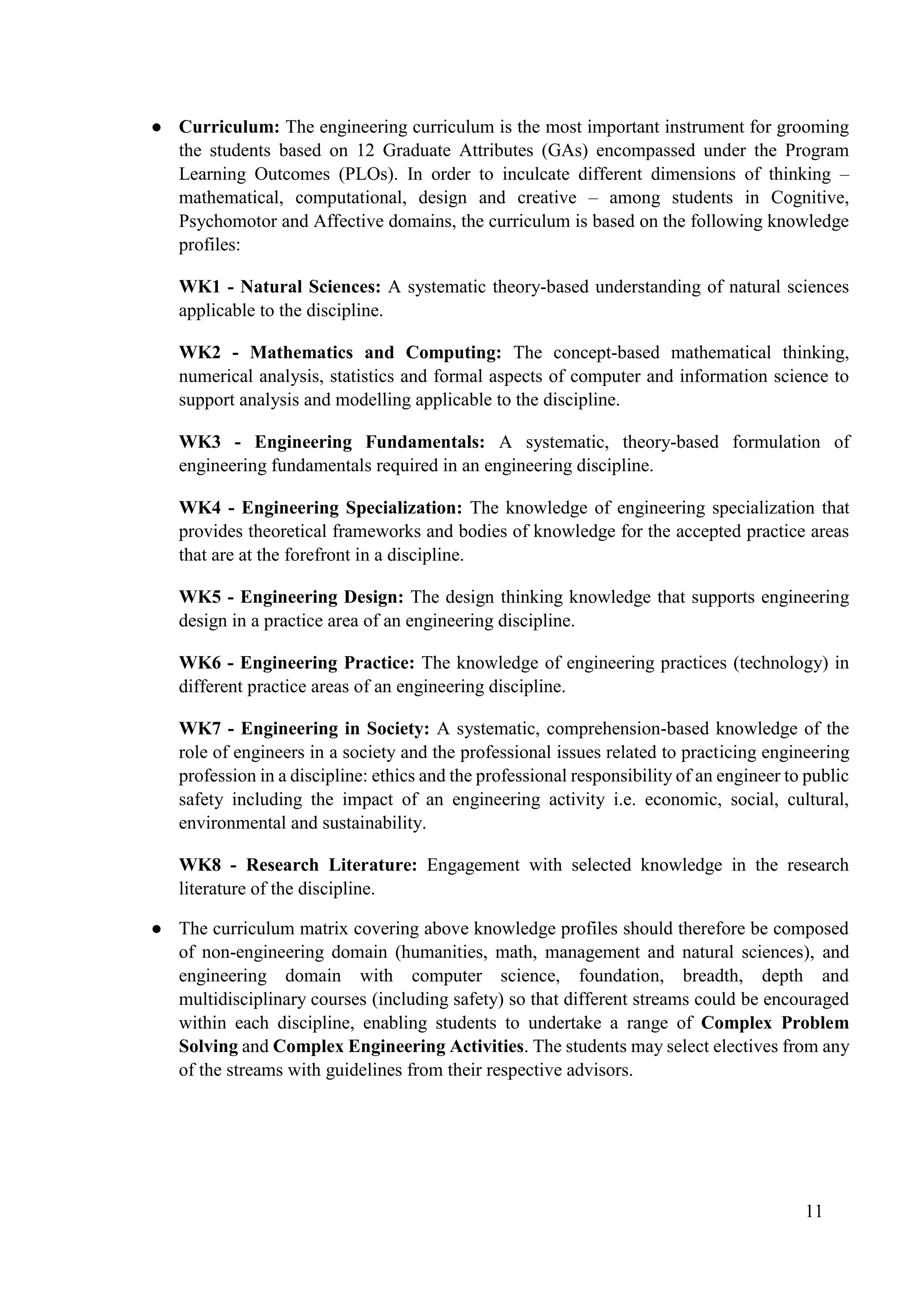
● Curriculum: The engineering curriculum is the most important instrument for grooming
the students based on 12 Graduate Attributes (GAs) encompassed under the Program
Learning Outcomes (PLOs). In order to inculcate different dimensions of thinking –
mathematical, computational, design and creative – among students in Cognitive,
Psychomotor and Affective domains, the curriculum is based on the following knowledge
profiles:
WK1 - Natural Sciences: A systematic theory-based understanding of natural sciences
applicable to the discipline.
WK2 - Mathematics and Computing: The concept-based mathematical thinking,
numerical analysis, statistics and formal aspects of computer and information science to
support analysis and modelling applicable to the discipline.
WK3 - Engineering Fundamentals: A systematic, theory-based formulation of
engineering fundamentals required in an engineering discipline.
WK4 - Engineering Specialization: The knowledge of engineering specialization that
provides theoretical frameworks and bodies of knowledge for the accepted practice areas
that are at the forefront in a discipline.
WK5 - Engineering Design: The design thinking knowledge that supports engineering
design in a practice area of an engineering discipline.
WK6 - Engineering Practice: The knowledge of engineering practices (technology) in
different practice areas of an engineering discipline.
WK7 - Engineering in Society: A systematic, comprehension-based knowledge of the
role of engineers in a society and the professional issues related to practicing engineering
profession in a discipline: ethics and the professional responsibility of an engineer to public
safety including the impact of an engineering activity i.e. economic, social, cultural,
environmental and sustainability.
WK8 - Research Literature: Engagement with selected knowledge in the research
literature of the discipline.
● The curriculum matrix covering above knowledge profiles should therefore be composed
of non-engineering domain (humanities, math, management and natural sciences), and
engineering domain with computer science, foundation, breadth, depth and
multidisciplinary courses (including safety) so that different streams could be encouraged
within each discipline, enabling students to undertake a range of Complex Problem
Solving and Complex Engineering Activities. The students may select electives from any
of the streams with guidelines from their respective advisors.
12
Knowledge
Profile
(WK-1 to
WK-8)*
Knowledge Area Sub-Area Courses Credit Hours
Non-Engineering Domain
WK-2 Natural Science Math As per program
requirements
12 - 15
WK-1 Physics Applied Physics 6 - 9
Chemistry Applied Chemistry
Natural
Science/
Math
Elective
As per program
requirements
WK-7 Humanities English Written, communication
and presentation skills
4 - 7
Culture Islamic Studies and
Ethics
2
Pakistan Studies and
Global Perspective
2
Social
Science
Social and soft skills
2 - 6
Management
Sciences
Professional
Practice
Professional and Project
Management
2 - 6
Total (Non-Engineering Domain) min 30
Knowledge
Profile*
Knowledge Area Sub-Area Courses Credit Hours
Engineering Domain
WK-2/ WK-4/
WK-5/ WK-6
Computer Science ICT/AI/ Data
Science/
Cyber
Security
6 - 9
WK-2/ WK-3 Foundation Engg
Courses
Specific to program
objectives and outcomes
22 - 24
13
WK-1/ WK-2/
WK-4
Core Breadth of
Engg discipline
Specific to program
objectives and outcomes
23 - 24
WK-5/ WK-6 Core Depth of
Engg Discipline
Specific to program
objectives and outcomes
22 - 24
WK-1/ WK-2/
WK-3/ WK-4
Multidisciplinary
Engg Courses
Specific to program
objectives and outcomes
6 - 12
Occupational Health and
Safety (mandatory – 01
Cr Hr)
WK-6/ WK-7/
WK-8
Final Year Design
Project (FYDP/
Capstone
Integration of innovative, creative,
technical, management and presentation
skills of a graduate towards final year.
6
WK-6/ WK-7 Industrial
Training
atleast 6 - 8 weeks mandatory internship Qualifying
WK-2/ WK-4/
WK-5/ WK-6/
WK-7/ WK-8
Innovative and Critical Thinking (under relevant courses):
- Complex Problem Solving
- Complex Engineering Activities
- Semester Project
- Case Studies
- Open Ended Labs
- Problem Based Learning (PBL)
Total (Engineering domain) min 85
Total (Credit Hours) 130 - 136
* As a specific or more than one knowledge profile to be covered.
 Industrial Training: Internship of atleast 6 - 8 weeks is mandatory part of degree
requirements towards 3rd
to 4th
year of program; must be supervised, monitored,
evaluated, and reflected in the transcripts under a prescribed mechanism and with defined
and mapped rubrics with program objectives;
o Selection of internship inline with elective subjects/ specific streams
o Qualifying percentage based on the following weightages: 70%
▪ Atleast 75% attendance is mandatory 10%
▪ Assessment report from the employer 50%
▪ Evaluation at relevant HEIs/ Deptt – presentation 40%
14
 Final Year Design Project (FYDP)/ Capstone: FYDP aims to challenge innovative,
creative, technical, management and presentation skills of a graduate to bring together
the learning over the degree programme.
o A final year design project (FYDP) is the confluence of an engineering program.
Undertaking a final year design project is a compulsory requirement. It should
mainly comprise literature search, individual analysis, modeling and simulation, AI
(Artificial Intelligence) and computational data analytics, design and putting
together various hardware, software, firmware and Algorithm Engineering /
Informatics related to the program to demonstrate a functional concept including
rapid prototyping, where applicable.
o The FYDP shall include complex engineering problems and design systems,
components or processes integrating core areas and meeting specific needs with
appropriate consideration for public health and safety, cultural, societal, and
environmental considerations.
o A project of this nature should invariably lead to an integration of the knowledge
and practical skills as mandated in the program outcomes. In this context, projects
of multidisciplinary nature should be encouraged.
o The FYDP should span over two consecutive semesters, i.e. semester 7 & 8, totaling
6-credit hours and should be fully supervised, assessed and reflected in the
transcripts under a prescribed mechanism so as to prepare for joining industry after
graduation.
 Faculty: The faculty must be trained for the Outcome-Based Education (OBE) system.
Their familiarity with the program objectives and outcomes, understanding of the
Outcome-Based Assessment (OBA) cycle, enthusiasm for developing an effective
program, and the ability to become an active player in this regard are the keys to ensure
the attainment of program objectives. The faculty is expected to have the ability to ensure
proper implementation of the program, and to develop processes for evaluation,
assessment and CQI. A formal training program to groom the faculty to become effective
instructors in applying pedagogical skills in all aspects of Teaching, Learning and
Assessment covering all domains of Knowledge, Skills and Attitude, should be instituted.
 Personal Grooming: Personal Grooming of young faculty members and students is very
important in order to develop and support their professional skills. Therefore, it is
required that HEIs should conduct/arrange sessions or counseling hours on regular basis
to provide guidance for personal grooming. Personal Grooming is important for positive
self-image and increasing the confidence level of the individuals. It would help in
enhancing students’ self-esteem and would go a long way in developing an attractive
personality by adopting habits like personal hygiene, clothing, appearance, interaction
and expressive skills, etc.
This curriculum has been designed to guide and facilitate the universities and departments to
formulate their own programs according to the industrial needs, emerging trends and recent
developments in the field of Aerospace Engineering. The HEIs have flexibility to incorporate
changes in the proposed curriculum within a given range of credit hours for engineering and non-
engineering domains.
15
9. Framework for Bachelor of Aerospace Engineering
Knowledge
Profile
(WK-1 to
WK-8)
Knowledge
Area
Sub Area Title of Course
Theory Lab Total
Credit Hours
Non-Engineering Domain
WK-7 Humanities
English
English-I (Functional English) 2 0 2
English-II (Communication Skills) 2 0 2
English-III (Technical Writing and
Presentation Skills)
2 1 3
Culture
Islamic Studies and Ethics 2 0 2
Pakistan Studies and Global Perspective 2 0 2
Social
Sciences
Elective-I (Sociology for Engineers/
Professional Ethics)
2 0 2
Elective-II (Engg. Economics) 2 0 2
Management
Sciences
Professional
Practice
Elective-I (Entrepreneurship &
Marketing)
2 0 2
Elective-II (Engineering Management/
Project Management)
3 0 3
WK-2
Natural
Sciences
Math
Calculus and Analytical Geometry 3 0 3
WK-1
Linear Algebra 3 0 3
Multivariate Calculus & Transforms 3 0 3
Differential Equations 3 0 3
Probability & Statistics 2 0 2
Physics Applied Physics 3 1 4
Chemistry Engineering Chemistry 2 1 3
Total (Non-Engineering Domain) 38 3 41
Knowledge
Profile
(WK-1 to
WK-8)
Knowledge
Area
Sub Area Title of Course Theory Lab Total
Engineering Domain
WK-2/ WK-
4/
WK-5/
WK-6
Computer
and
Information
Sciences
ICT/AI/
Data
Science/
Cyber
Security
Information and Communication
Technologies (ICT)
2 1 3
Artificial Intelligence 2 1 3
Numerical Methods 2 1 3
WK-2/ WK-
3
Engineering
Foundation
-- Engineering Mechanics – I (Statics) 3 0 3
Engineering Mechanics – II (Dynamics) 3 0 3
16
Materials Science and Engineering 3 0 3
Engineering Thermodynamics 3 0 3
Incompressible Aerodynamics 3 1 4
Mechanics of Materials 3 1 4
Introduction to Aerospace Engineering 2 0 2
Engineering Drawing 0 1 1
Computer Aided Drafting 0 1 1
Workshop Technology 1 1 2
WK-1/ WK-
2/ WK-4
Major Based
Core
(Breadth)
Compressible Aerodynamics 3 0 3
Heat and Mass Transfer 3 1 4
Aerospace Vehicle Performance 3 0 3
Stability and Control 3 0 3
Aerospace Structures-I 3 0 3
Aerospace Instrumentation 2 1 3
WK-5/ WK-
6
Major Based
Core
(Depth)
Aerospace Vehicle Design 2 2 4
Structural Dynamics & Aero-elasticity 3 0 3
Propulsion & Power Plants 3 1 4
Control Systems 2 1 3
Elective-I 2 1 3
Elective –II 3 0 3
Elective-III 3 0 3
Elective-IV 3 0 3
WK-1/ WK-
2/ WK-3/
WK-4
Multi-
Disciplinary
Engineering
Courses
MDEE-I 3 1 4
MDEE-II 3 0 3
Occupational Health and Safety* 1 0 1
WK-6/ WK-
7/ WK-8
Final Year
Design
Project
(FYDP)/
Capstone
Industrial/
Innovative/
Creative
Project
FYDP (Part-I) 0 3 3
FYDP (Part-II) 0 3 3
WK-6/ WK-
7
Industrial
Training
Atleast 6 – 8 weeks Mandatory Internship
0 0 0
WK-2/ WK-
4/ WK-5/
WK-6/ WK-
7/ WK-8
Innovative and Critical Thinking (under relevant courses):
- Complex Problem Solving
- Complex Engineering Activities
- Semester Project
- Case Studies
- Open ended labs
- Problem-based learning (PBL)
Total (Engineering Domain) 72 22 94
Total (Credit Hours) 110 25 135
* to be taught during 1st
year of program.
17
10. Scheme of Studies for Bachelor of Aerospace Engineering
Course Title LecLabTotal Course Title LecLabTotal
First Year
First Semester Second Semester
Functional English 2 0 2 Communication Skills 2 0 2
Calculus and Analytical
Geometry
3 0 3 Engineering Mechanics-I (Statics) 3 0 3
Applied Physics 3 1 4 Linear Algebra 3 0 3
Pakistan Studies and Global
Perspective
2 0 2 Engineering Chemistry 2 1 3
Workshop Technology 1 1 2 Engineering Drawing 0 1 1
Information and Communication
Technologies (ICT)
2 1 3 MDEE-I 3 1 4
Introduction to Aerospace Engg 2 0 2 Islamic Studies and Ethics 2 0 2
Total 15 3 18 Total 15 3 18
Second Year
Third Semester Fourth Semester
Incompressible Aerodynamics 3 1 4 Engineering Mechanics-II (Dynamics) 3 0 3
Artificial Intelligence 2 1 3 Differential Equations 3 0 3
Multivariate Calculus and
Transforms
3 0 3 Compressible Aerodynamics 3 0 3
Material Science and Engineering 3 0 3 Mechanics of Materials 3 1 4
Engineering Thermodynamics 3 0 3 Aerospace Instrumentation 2 1 3
Probability and Statistics 2 0 2 Computer Aided Drafting 0 1 1
Occupational Health and Safety 1 0 1
Total 16 2 18 Total 15 3 18
Third Year
Fifth Semester Sixth Semester
Tech writing and presentation
skills
2 1 3 Structural Dynamics & Aero-elasticity 3 0 3
Aerospace Structures-I 3 0 3 Stability & Control 3 0 3
Control System 2 1 3 Propulsion & Power Plants 3 1 4
Heat and Mass Transfer 3 1 4 Social Science-II 2 0 2
Aero Vehicle Performance 3 0 3 Management Science-I 2 0 2
Social Sciences I 2 0 2 Numerical Methods 2 1 3
Total 15 3 18 Total 15 2 17
Final Year
Seventh Semester Eighth Semester
Final Year Design Project-I 0 3 3 Final Year Design Project-II 0 3 3
Aerospace Vehicle Design 2 2 4 IDEE-II 3 0 3
Elective-I 2 1 3 Elective-III 3 0 3
Management Science-II 3 0 3 Elective-IV 3 0 3
Elective-II 3 0 3
Total 10 6 16 Total 9 3 12
Total Credit Hours 135
18
Proposed List of Elective Courses – BE Aerospace Engg
● Computational Fluid Dynamics
● Turbulent Fluid Flow
● Rotorcraft Dynamics
● Applied/ Industrial Aerodynamics
● Finite Element Methods
● Aero Vehicle Loading and Structural Analysis
● Advanced Mechanics of Materials
● Engineering Mechanics of Composite Structures
● Mechanical Behavior of Materials
● Structures and Machine Design
● Orbital Mechanics
● Spacecraft Dynamics and Control
● Inertial Navigation
● Guidance and Navigation of Aerospace Vehicles
● Celestial Mechanics
● Digital Control System
● Systems Engineering and Analysis
● Space Astronomy
● Space Propulsion
● Heating ventilation and Air Conditioning
● Turbo Machinery
● Digital logic design and PLC’s
● Fuzzy Logic and Control
● Engineering Circuit Analysis – DC Circuits
● Analogue and Digital Circuits
● Professional Communication Skills
● Electrical Circuits and Machines
● Electronic Warfare
● Wind Tunnel Testing
● Statistical Quality Control
● Engineering Economy
● Astrodynamics
● Rotorcraft Dynamics
● Advance Engineering Chemistry
● Industrial Control Electronics
● Automation and Robotics
● Mechanics of Machines
● Instrumentation and Sensors
● Modern Control Theory
19
● Manufacturing Processes and CNC Machines
● Joining Technology for Modern Materials
● Flexible Manufacturing
● Introduction to Industrial Engineering
● Production Management and Control
● Character Building and Leadership
● Computer Aided Design
● Product Design and Development
● Satellite Systems and Engineering
● Aeroelasticity
● Aeroacoustics
● Decelerator Aerodynamics
● Hovercraft Design
● Astronautics
● Spacecraft Design
● Tribology
● Occupational Safety and Health
Electives for Social Science
● Sociology for Engineers
● Professional Ethics
● Economics for Engineers
● Sociology
● Social Anthropology
● Understanding Psychology and Human
● Social Psychology
● Organizational Behavior
● Critical Thinking
● Philosophy
● Human Resource Development
● Culture and Society
● Engineering Law
20
Electives for Management Sciences
● Entrepreneurship
● Entrepreneurship and Marketing
● Engineering Project Management
● Principle of Management
● Engineering Management
● Quality Management Systems
● Textile Marketing
● Industrial Engineering and Management
● Total Quality Management
● Supply Chain Management
● Production Management
Courses for Computer Sciences
● Information and Communication Technologies (ICT)
● Artificial Intelligence
● Cyber Security
● Data Science
● Modelling and Simulation
● Computer Programming and Design
21
11. Program Specific Labs
The following labs specific to engineering discipline be ensured to cover relevant knowledge
domains but not limited to:
● Aerodynamics Lab
● Propulsion and Heat Transfer Lab
● Structures lab
● Material Science Lab
● Numerical Analysis Lab
● Fluid Dynamics Lab
● Flight Vehicle Dynamics Lab
● Instrumentation Lab
● Engineering Workshop
● Project & Research Lab
12. Course Details and Teaching-Assessment Approaches
In the following sections, Course Outlines and teaching-assessment approaches are given for
guidance based on a typical semester system. The instructors may adopt or adapt accordingly
defining CLOs, course delivery plan, innovative teaching approaches and assessment techniques
for which an example is annexed.
12.1 Engineering Domain
Computer and Information Sciences Courses
Information and Communication Technologies (ICT)
Course Outline:
Introducing Computer Systems: Basic Definitions
 Computer and Communication Technology
 The applications of ICT - particularly for Engineers
Basic operations and components of a generic computer system
 Basic operations: Input, Processing, Output, Storage Basic components: Hardware,
Software, Data, Users
 Types of storage devices
Processing Data
 Transforming data into information
 How computers represent and process data?
 Processing Devices
 CPU architectures
22
The Internet
 The Internet and the World Wide Web- browsers, HTML
 URLs/ How DNS works
 Email and other programs
Introduction to Embedded Systems
 What is an Embedded System?
 Applications
 Components
 Programming Languages
 Popular Development Platforms
Networking Basics
 Uses of networks
 Common types of networks (LAN, WAN, MAN etc.)
 Introduction to OSI Model
 Future of Networks
Database Management
 Hierarchy of Data
 Maintaining Data
 Database Management Systems
Exposure to ICT Tools and Blogs (Student Assignment)
Protecting your privacy, your computer and your data
 Basic Security Concepts
 Threats to users
 Threats to hardware
 Threats to Data
ICT in Education
Future Trends in ICT
Final Presentations
Tools / Software Requirement
 Microsoft Office, Windows, Virtual Box, Netbeans
Teaching Methodology (Proposed as applicable):
Lectures (audio/video aids), Written Assignments/ Quizzes, Tutorials, Case Studies relevant to
engg disciplines, Semester Project, Guest Speaker, Industrial/ Field Visits, Group discussion,
Report Writing
Assessment
Mid semester exam/one hour tests, Report writing/ Presentation, Assignments, Project Report,
Quizzes, Semester final exam.
Suggested Books:
23
 “Introduction to Computers”, Peter Norton, 7th Edition, 2013, McGraw-Hill
 “Computing Essentials”, Timothy O’Leary and Linda O’Leary, 2010, McGraw-Hill.
 Using Information Technology: A Practical Introduction to Computers &
Communications”, Williams Sawyer, 6th Edition, 2005, McGraw-Hill.
 “Discovering Computers, Complete: Your Interactive Guide to the Digital World. Cengage
Learning” Shelly GB, Vermaat ME, 2012 Ed.
 Brian K. Williams, Stacey C. Sawyer, 2015. Using Information Technology: A Practical
Introduction to Computer & Communications, (11th
ed.). McGraw-Hills.
 Alexis Leon and Mathews Leon., 2019, Fundamentals of Information Technology. (2nd
ed.). VIKAS Publishing.
Computer Programming
Area Scope:
Introduction of computer programming (C++ / Fortran / VB / C#) and its implementation in
aerospace engineering.
Course Outline:
 Give an overview of introduction to digital computers,
 Explain the main components and functions of respective language i.e. C++ / Fortran/.
 Explain elements of programming,
 Illustrate the concept of flow charts,
 Ensure practical training in programming using any language.
Teaching Methodology (Proposed as applicable):
Lectures (audio/video aids), Written Assignments/ Quizzes, Tutorials, Case Studies relevant to
engg disciplines, Semester Project, Guest Speaker, Industrial/ Field Visits, Group discussion,
Report Writing
Assessment:
Mid semester exam/one hour tests, Report writing/ Presentation, Assignments, Project Report,
Quizzes, Semester final exam.
Suggested Books:
 The C Programming Language (2nd Ed.) by Kernighan and Ritchie, 1988.
 Code Complete (2nd Ed.) by Steve McConnell, 2004.
 The Art of Computer Programming (TAOCP) by Donald E. Knuth, 1968.
 Lafore, Robert. 2001. Object-Oriented Programming in C++ (4th
ed.). Sams Publishing.
 Paul J. Deitel, Harvey Deitel. 2017. C++ How to Program (10th
ed.). Pearson.
24
Numerical Methods
Course Outline
Error Analysis and Interpolation
 Error analysis, Types of error, Sources of error, Norms of vectors and matrices, Computer
arithmetic, Condition number of a matrix, Significant digits and loss of significant digits,
Floating point arithmetic, Binary and decimal representation, Single and double precision.
 Interpolation: Newton forward and backward difference formula for interpolation, Central
difference interpolation formulae, Lagrange’s interpolation, Error in interpolation, Linear
least square approximation, Interpolation versus least square approximation, Relevant
engineering case studies.
Numerical Differentiation and Integration
 Derivation of numerical differentiation of first order and second order derivatives using
two points, three points, and five points formulas along with its application in engineering,
Relevant case studies
 Numerical integration: Trapezoidal rule, Simpson’s rules, Composite Trapezoidal
Simpson Rules and Romberg integration, Applications of numerical in engineering,
Relevant case studies
Methods of solution for a system of Linear Equations
 Solution of system of linear algebraic equations, Gauss elimination method
 LU factorization, Tridiagonal solver
 Applications of these methods in engineering disciplines, Relevant case studies
Iterative Methods for Linear and Nonlinear Equations
 Numerical Solution of nonlinear equations: Bisection method, Newton’s method, Secant
method, Convergence analysis of these methods
 Newton’s method for system of nonlinear equations
 Solution of system of linear equations by Jacobi, Gauss Seidel and SOR methods,
Applications of these methods in engineering disciplines, Relevant case studies
Numerical Methods for IVPs and BVPs
 Euler’s method and its variations, Taylor’s higher order methods, Error analysis,
Consistency, stability and convergence
 Runge-Kutta methods of order 2, 3, and 4, Stiff ODEs, Consistency, stability and
convergence
 Linear multistep methods, Numerical solution of system of ODEs
 Numerical solution of BVPs by Finite Difference Method
 Applications in engineering: Some relevant case studies
Numerical Methods for Computing Eigenvalues
 Eigenvalues and Eigenvectors of matrix: power method,
 Inverse power method, Shifted inverse power method.
 Applications of eigenvalues in engineering disciplines.
Numerical Optimization
25
 Unconstrained Optimization,
 Golden search ratio, Lagrange Multipliers,
 Method of steepest descent
 Applications of optimization in engineering disciplines
Teaching Methodology (Proposed as applicable):
Lectures (audio/video aids), Written Assignments/ Quizzes, Tutorials, Case Studies relevant to
engineering disciplines, Semester Project, Guest Speaker, Industrial/ Field Visits, Group
discussion, Report Writing
Assessment:
Mid semester exam/one hour tests, Report writing/ Presentation, Assignments, Project Report,
Quizzes, Semester final exam.
Suggested Books:
 Numerical methods for scientists and engineers by R.W. Hamming (Latest Edition)
 Numerical methods for Engineers by Steven C. Chapra and R. P. Canale (Latest Edition)
 Richard L. Burden, J. Douglas Faires, Annette M. Burden. 2015. Numerical Analysis.
Cengage Learning.
 Kellison, Stephen G., 1975, Fundamentals of numerical analysis.
 Pennington, Ralph H., 1970, Introductory Computer Methods and Numerical Analysis (2nd
ed.). The Macmillan Company.
 Erwin Kreyszig. 2015. Advanced Engineering Mathematics (10th
ed.). John Wiley &
Sons.
 Anthony Ralston, Philip Rabinowitz. 2001. A First Course in Numerical Analysis. Courier
Corporation.
 Nielsen, Kaj Leo. 1964. Methods in Numerical Analysis (2nd
ed.). Macmillan. NY
Computer Aided Drawing
Course Outline:
 Introduction to AutoCAD
 Use basic drawing and text commands
 Use basic editing commands (move, copy, erase, etc)
 Use advanced editing commands (mirror, fillet, etc)
 Dimensioning capabilities of AutoCad
 Create and use layers
 Print or plot a drawing
 Create and using blocks
 Be familiar with hatching capabilities of AutoCad
 Curves
26
 3D modeling
 Multiple Lines
 Geometric Shapes
 Isometric drawings
 Polar Arrays
Teaching Methodology (Proposed as applicable):
Lectures (audio/video aids), Written Assignments/ Quizzes, Tutorials, Case Studies relevant to
engg disciplines, Semester Project, Guest Speaker, Industrial/ Field Visits, Group discussion,
Report Writing
Assessment:
Mid semester exam/One hours tests, Report writing/ Presentation, Assignments, Lab/Project
Report, Quizzes, Semester final exam.
Suggested Books:
 Mastering AutoCAD 2017 and AutoCAD LT 2017 by George Omura with Brian Benton,
(latest edition), 2016.
 AutoCAD® 2015 And AutoCAD Lt® 2015 No Experience required by Donnie
Gladfelter.
 Thomas E. French, Charles J. Vierck. 1966. Fundamentals of Engineering Drawing.
McGraw-Hill, NY.
 French T. E., Vierck C. J. 1978. The Fundamentals of Engineering Drawing and Graphic
Technology (4th
ed.). McGraw-Hill. New York.
 Bhatt, N. D. 2011. Engineering Drawing, Plane and Solid Geometry (5th ed.). Charotar
Book Stall.
 Frederick E. Giesecke, Alva Mitchell, Henry C. Spencer, Ivan L. Hill, John T. Dygdon,
James E. Novak, Robert Olin Loving. 2003. Engineering Graphics (8th
ed.). Peachpit
Press.
 Electronic PCB Design software Tutorials.
Artificial Intelligence
Course Outline
This course gives a broad overview of the fundamental theories and techniques of Artificial
Intelligence.
 Overview of AI Problems;
 Intelligent Behavior: Turing Test, Rationale versus Non-rationale Reasoning;
 Problem Characteristics: Fully versus Partially Observable,
27
 Single versus Multi agent; Intelligent Agents: reactive, deliberative, goal-driven, utility-
driven, and learning agents; Uninformed Search: Depth First, Breadth First, Depth First
with Iterative Deepening;
 Informed Search: Hill climbing, A*- Search and their Time and Space Complexity, Local
Search, Genetic Algorithm; Game Playing: Minimax, Evaluation functions, Alpha-beta
pruning; Propositional and Predicate Logic; Resolution and Theorem Proving; Forward
and Backward Chaining;
 Machine Learning: Introduction,
 Supervised learning: Instance based learning, Decision tree, Artificial neural networks,
Unsupervised Learning: K-means Clustering, Reinforcement Learning.
Teaching Methodology (Proposed as applicable):
Lectures (audio/video aids), Written assignments/Quizzes, Case Studies relevant to Engg.
disciplines, Semester project, Guest speaker, Industrial/Field visits, Group discussion, Report
Writing.
Assessment:
Mid-term, Report writing/Presentation, Assignment, Project report, Quizzes, Final exam.
Suggested Books:
 Stuart J. Russell and Peter Norvig, “Artificial Intelligence: A Modern Approach”, latest
Edition, Prentice Hall, ISBN-13: 978-0136042594.
 Elaine Rich and Kevin Knight, “Artificial Intelligence”, latest Edition, McGraw-Hill,
ISBN-13: 978-0070522633.
 R. J. Schalkoff, “Artificial Intelligence in Engineering Approach”, latest edition,
McGraw Hill, ISBN-13: 978-0070550841.
 Peter Jackson, “Introduction to Expert Systems”, latest Edition, Addison Wesley, ISBN-
13: 978-0201876864.
 Ivan Bratko, “Prolog Programming for Artificial Intelligence”, latest Edition, Addison
Wesley, ISBN-13: 978-0321417466.
Engineering Foundation Courses
Introduction to Aerospace Engineering
Course Outline:
 Provide an overview of the history of aerospace and fundamental elements of aerodynamics.
 Provide an overview of historical experimentation in aerospace.
 Ensure an understanding of the basics of airfoils and wings.
 Develop the concept of the performance, stability and control of an airplane.
 Explain various aircraft propulsion systems.
 Explain the basics aircraft structures and avionics.
 Give an introduction of the aerospace vehicle conceptual design.
 Introduce to space environment, orbital mechanism satellite system engineering.
Teaching Methodology (Proposed as applicable):
28
Lectures (audio/video aids), Written assignments/ Quizzes, Tutorials, Case Studies relevant to
Engg. Disciplines, Semester project, Guest speaker, Industrial/ Field visits, Group discussion,
Report Writing.
Assessment:
Mid semester exam/one hour tests, Report writing/Presentation, Assignment, Project report,
Quizzes, semester final exam.
Suggested Books:
 Dave Newman. 2002. Interactive Aerospace Engineering and Design, MIT,
Massachusetts Ave.
 Theodore A. Talay. 1975. Introduction to the Aerodynamics of Flight
 Jack D. Mattingly. 2006. Elements of Propulsion, Gas Turbines and Rockets (2nd
ed).
 Wilfried Ley, Klaus Wittmann. Willi Hallmann. 2011. Handbook of Space Technology
(Aerospace Series) (3rd
ed). John Wiley & Sons.
 John Anderson. 2015. Introduction to Flight (8th
ed) McGraw-Hill
 Jack D Mattingly, William H. Heiser, David T. Pratt, Keith M. Boyer, Brenda A. Haven.
2018. Aircraft engine design (3rd
ed).
 Ian Moir and Allan Seabridge. 2006 Military Avionics Systems. Aerospace Series.
Mechanics of Materials
Course Outline:
 Principles of stress and strain.
 Hook’ Law and its application.
 Statically determinate and indeterminate problems in axial and shear modes.
 Shear force and bending moment diagrams.
 Flexural and shear force for beams.
 Theory of torsion; thin walled pressure vessel.
Teaching Methodology (Proposed as applicable):
Lectures (audio/video aids), Written assignments/ Quizzes, Tutorials, Case Studies relevant to
Engg. Disciplines, Semester project, Guest speaker, Industrial/ Field visits, Group discussion,
Report Writing.
Assessment:
Mid semester exam/one hour tests, Report writing/Presentation, Assignment, Project report,
Quizzes, semester final exam.
Suggested Books:
 Hibbeler, Russell C. 2016. Mechanics of Materials (10th ed). Pearson.
 Ferdinand P. Beer, Johnston Jr., E. Russell, John T. DeWolf, David Mazurek. 2019.
Mechanics of Materials (8th ed.) McGraw-Hill Education.
 Archie Higdon, Mechanics of Materials (4th
Edition). John Wiley, NY.
29
Engineering Thermodynamics
Course Outline:
 Introduction and Basic Concepts: Thermodynamics and Energy, Importance of
Dimensions & Units, Systems and Control Volumes, Properties of a System, Density and
Specific Gravity, State and Equilibrium, Processes and Cycles, Temperature and Zeroth
Law of Thermodynamics, The Pressure, The Manometer, The Barometer and
Atmospheric Pressure.
 Energy, Energy Transfer and General Energy Analysis: Introduction, Forms of
Energy, Energy Transfer by Heat, Energy Transfer by Work, Mechanical Forms of Work,
The First Law Of Thermodynamics, Energy Conversion Efficiencies, Energy and
Environment.
 Properties of Pure Substances: Pure Substance, Phases of a Pure Substance, Phase-
Change Processes of Pure Substance, Property Diagrams for Phase-Change Processes,
Property Tables, The Ideal-Gas Equation of State, Compressibility Factor—A measure of
Deviation from Ideal-Gas Behavior, Other Equations of state.
 Energy Analysis of Closed Systems: Moving Boundary Work, Energy Balance for
Closed System, Specific Heats, Internal Energy, Enthalpy and Specific Heats of Ideal
Gases, Internal Energy, Enthalpy and Specific Heats of Solids & Liquids.
 Mass and Energy Analysis of Control Volumes: Conservation of Mass, Flow Work and
the Energy of a Flowing Fluid, Energy Analysis of Steady-Flow Systems, Some Steady-
Flow Engineering Devices, Energy Analysis of Unsteady-Flow Processes.
 The Second Law of Thermodynamics: Introduction to the Second Law, Thermal Energy
Reservoirs, Heat Engines, Refrigerators and Heat Pumps, Perpetual Motion Machines,
Reversible and Irreversible Processes, The Carnot Cycle, The Carnot Principles, The
Thermodynamic Temperature Scale, The Carnot Heat Engine, The Carnot Refrigerator
and Heat Pump.
 Entropy: Entropy, Increase of Entropy Principle, Entropy Change of Pure Substances,
Isentropic Processes, Property Diagrams involving Entropy, T ds Relations, Entropy
Change of Liquids and Solids, Entropy Change of Ideal Gases, Reversible Steady Flow
Work, Isentropic Efficiencies of steady flow devices, Entropy Balance.
 Exergy--A Measure of Work Potential: Exergy, Reversible Work and Irreversibility,
Second-Law Efficiency, Exergy Change of a System, Exergy Transfer by Heat, Work, and
Mass, Exergy Balance: Closed Systems and Control Volumes.
 Gas Power Cycles: Basic considerations in the analysis, The Carnot Cycle, Air Standard
Assumption, Reciprocating Engines, Otto Cycle, Diesel Cycle, Brayton Cycle, Ideal Jet
Propulsion Cycles.
30
Teaching Methodology (Proposed as applicable):
Lectures (audio/video aids), Written assignments/ Quizzes, Tutorials, Case Studies relevant to
Engg. Disciplines, Semester project, Guest speaker, Industrial/ Field visits, Group discussion,
Report Writing.
Assessment:
Mid semester exam/one hour test, Report writing/Presentation, Assignment, Project report,
Quizzes, semester final exam.
Suggested Books:
 Yunus Cengel, Michael Boles, Mehmet Kanoglu. 2019. Thermodynamics: An
Engineering Approach (9th
ed.). McGraw Hill.
 Michael J. Moran, Howard N. Shapiro, Daisie D. Boettner, Margaret B. Bailey. 2018.
Fundamentals of Engineering Thermodynamics (9th
ed.). Wiley.
 J B Jones/G A Hawkins. 1995. Engineering Thermodynamics. Prentice Hall. 1995.
 J.B. Jones, G.A. Hawkins. Engineering Thermodynamics: An Introductory Textbook (2nd
ed.). 1986. John Wiley & Sons.
Incompressible Aerodynamics
Course Outline:
 Concept of incompressible fluid flows.
 Statics and Dynamics fluid flows
 Calculation of the mass flow rate, forces and energy flux.
 Analysis of potential flows and their superposition.
 Dimensional analysis and boundary layer theory.
 Comparison of ideal and real flows.
 Characteristics of airfoil
 Thin airfoil theory
 High lift devices
 Wing characteristics
 Prandtl’s lifting line theory and drag on the aircraft.
Teaching Methodology (Proposed as applicable):
Lectures (audio/video aids), Written assignments/ Quizzes, Tutorials, Case Studies relevant to
Engg. Disciplines, Semester project, Guest speaker, Industrial/ Field visits, Group discussion,
Report Writing.
Assessment:
Mid semester exam/one hour tests, Report writing/Presentation, Assignment, Project report,
Quizzes, semester final exam.
Suggested Books:
 Jr., John D. Anderson. 2016. Fundamentals of Aerodynamics (6th
. ed.). McGraw-Hill.
31
 Jr., John D. Anderson. 2016. Introduction to Flight (8th
. ed.). McGraw-Hill
 White, Frank. 2017. Fluid Mechanics (8th
Ed.). McGraw-Hill,
 Barlow J.B, Alan Pope. 2014. Low-Speed Wind Tunnel Testing (3rd
. ed.). Wiley.
 Hansen, Arthur G. 1967. Fluid mechanics. Wiley.
 Theodore Allen, Jr., Richard L. Ditsworth. 1972. Fluid mechanics. McGraw-Hill.
 Daniel O. Dommasch, Sydney S. Sherby, Thomas F. Connolly. 1967. Airplane
Aerodynamics (4th
ed.). Pitman.
 Karamcheti, K. 1980. Principles of Ideal-Fluid Aerodynamics (2nd
. ed.). Krieger.
 Journals / Periodicals: Fluid Mechanics.
Engineering Mechanics-I (Statics)
Course Outline:
 Develop the ability to solve the complex;
o Force Systems
o Moments
o Couples and resultants
o Moment of interties
 Free body diagram concept and equation of equilibrium in two and three dimensions.
 Analysis of two and three-dimensional problems.
 Application of equilibrium principles to simple trusses, frames and machines.
 Frictional effects and fluid statics.
Teaching Methodology (Proposed as applicable):
Lectures (audio/video aids), Written assignments/ Quizzes, Tutorials, Case Studies relevant to
Engg. Disciplines, Semester project, Guest speaker, Industrial/ Field visits, Group discussion,
Report Writing.
Assessment:
Mid semester exam/one hour tests, Report writing/Presentation, Assignment, Project report,
Quizzes, semester final exam.
Suggested Books:
 James L. Mariam, L. G. Kraige, Jeffrey N. Bolton. 2014. Engineering Mechanics: Statics.
(8th ed). John Wiley and Sons.
 Shames, Irving H. 1996. Engineering Mechanics: Statics and Dynamics. (4th Ed.) Prentice
Hall.
 Ferdinand P. Beer, Johnston Jr., E. Russell, David Mazurek. 2018. Vector Mechanics for
Engineers: Statics. (12th Ed.) McGraw-Hill Education, January 30, 2018.
 Hibbeler, Russell C. 2012. Engineering Mechanics: Statics, (13th
Ed). Prentice Hall.
32
Engineering Mechanics-II (Dynamics)
Course Outline:
 Kinematics of Particles,
 Develop detailed understanding of the three basic methods:
o Force-mass-acceleration
o Work-energy
o Impulse-momentum.
 Concept of the equations of relative velocity and relative acceleration.
 Vector geometry, problems and solutions.
 Basic equations for all categories of plane motion.
 Equation of motion in rotating frames.
Teaching Methodology (Proposed as applicable):
Lectures (audio/video aids), Written assignments/ Quizzes, Tutorials, Case Studies relevant to
Engg. Disciplines, Semester project, Guest speaker, Industrial/ Field visits, Group discussion,
Report Writing.
Assessment:
Mid semester exam/one hour tests, Report writing/Presentation, Assignment, Project report,
Quizzes, semester final exam.
Suggested Books:
 James L. Mariam, L. G. Kraige, Jeffrey N. Bolton. 2015. Engineering Mechanics:
Dynamics (8th
ed.). John Wiley and Sons.
 Hibbeler, R, C. 2015. Engineering Mechanics: Dynamics (14th
ed.). Pearson.
 Archie Higdon, William B. Stiles. 1968. Engineering Mechanics: Dynamics (3rd
ed.).
Prentice Hall.
 Ferdinand P. Beer, Johnston Jr., E. Russell, Phillip J. Cornwell, Brian Self. 2018. Vector
Mechanics for Engineers: Dynamics (12th
ed.). McGraw-Hill Education.
Material Science and Engineering
Course Outline:
 Fundamentals of both conventional and advanced materials and its application in aerospace
engineering
 Internal atomic structure, crystal structures and crystal systems in metals.
 Structural imperfection, phase diagrams and their analysis.
 Concept of manufacturing processes of ferrous and non-ferrous materials and their
mechanical properties, heat treatment, surface treatment and TTT diagrams.
 Introduction of polymers, polymer composites, type of fibres, metal matrix composites,
ceramic matrix composites, inter metallic composites, powder metallurgy, conductors and
magnetic materials.
33
Teaching Methodology (Proposed as applicable):
Lectures (audio/video aids), Written assignments/ Quizzes, Tutorials, Case Studies relevant to
Engg. Disciplines, Semester project, Guest speaker, Industrial/ Field visits, Group discussion,
Report Writing.
Assessment:
Mid semester exam/ one hour tests, Report writing/Presentation, Assignment, Project report,
Quizzes, semester final exam.
Suggested Books:
 William F. Smith, Javad Hashemi. 2018. Foundations of Materials Science and
Engineering (6th
ed.). McGraw-Hill.
 L. H. Van Vlack. 1989. Elements of Materials Science and Engineering (6th
ed.). Pearson.
 Pollack, H. 1988. Materials Science and Metallurgy (4th
ed.). Pearson.
 Shackelford, James F. 2014. Introduction to Materials Science for Engineers (8th
ed.).
Pearson.
Workshop Technology
Course Outline:
 Information and safety aspects in the field of general engineering workshop technology
and practices.
 Introduction to commonly used metals, measurement and layout tools used in
metalworking shops.
 Introduction to different hand tools, fasteners, taps and dies, drill machines, sawing and
cutoff machines and grinding machines.
 Soldering, brazing, gas welding, arc welding and other modern welding techniques are
covered.
 Introduction to woodworking with emphasis on commonly used woods and joints.
Teaching Methodology (Proposed as applicable):
Lectures (audio/video aids), Written assignments/ Quizzes, Tutorials, Case Studies relevant to
Engg. Disciplines, Semester project, Guest speaker, Industrial/ Field visits, Group discussion,
Report Writing.
Assessment:
Mid semester exam/one hour tests, Report writing/Presentation, Assignment, Project report,
Quizzes, semester final exam.
Suggested Books:
 W A J. Chapman. 2016 Workshop Technology (Part-1). (5th
ed.).Routledge, London.
 John R Walker and Kenneth W Stier. 2018. Modern Metal Working. The Goodheart-
Willcox, Company, incorp.
34
 S F Krar, A R Gill & Peter Smid. 2020. Introduction to Technology of Machine Tools.
(8th
ed.),. McGraw-Hill, NY.
Engineering Drawing
Course Outline:
 Various types of Orthographic Drawings
 Graphical geometry and then continues with progressive practice in making and
understanding of various types of orthographic drawings.
 Give detailed emphasis on:
o Principle Views,
o Auxiliary Views
o Sectional Views.
 Concept of Assembly level drawings
Teaching Methodology (Proposed as applicable):
Lectures (audio/video aids), Written assignments/ Quizzes, Tutorials, Case Studies relevant to
Engg. Disciplines, Semester project, Guest speaker, Industrial/ Field visits, Group discussion,
Report Writing.
Assessment:
Mid semester exam/one hour tests, Report writing/Presentation, Assignment, Project report,
Quizzes, semester final exam.
Suggested Books:
 Thomas E. French, Charles J. Vierck. 1966. Fundamentals of engineering drawing
McGraw-Hill. NY.
 French T. E., Vierck C. J. 1978. The fundamentals of engineering drawing and graphic
technology (4th
ed.). McGraw-Hill. New York.
 Bhatt, N. D. 2011. Engineering Drawing, Plane and Solid Geometry (5th
ed.). Charotar
Book Stall.
 Frederick E. Giesecke, Alva Mitchell, Henry C. Spencer, Ivan L. Hill, John T. Dygdon,
James E. Novak, Robert Olin Loving. 2003. Engineering Graphics, 8th ed. Peachpit Press.
 Electronic PCB Design software Tutorials
 Class handouts
 Software manual and tutorials.
Computer Aided Drafting
Course Outline:
 Detail introduction of the computer software to be used during the course.
 Enabling the students to make 2-D drawings with the help of CAD software such as Solid
Edge/ CATIA etc.
35
 Familiarize the students with various 2-D drawing commands including the dimensioning
commands and advanced editing techniques and drafting of 3-D drawings on computers.
 Familiarize the students with various basic and advanced 3-D drawing commands for
enabling them to draft any type of 3-D drawing on the computers in a perfect, precise and
efficient manner.
 Ensure the in depth understanding of 3D CAD parts and finally transforming the individual
parts into complex assemblies.
 Introduction to the CAD AutoLISP software
Teaching Methodology (Proposed as applicable):
Lectures (audio/video aids), Written assignments/ Quizzes, Tutorials, Case Studies relevant to
Engg. Disciplines, Semester project, Guest speaker, Industrial/ Field visits, Group discussion,
Report Writing.
Assessment:
Mid semester exam/one hour tests, Report writing/Presentation, Assignment, Project report,
Quizzes, semester final exam.
Suggested Books:
 Thomas E. French, Charles J. Vierck. 1966. Fundamentals of Engineering Drawing.
McGraw-Hill, NY.
 French T. E., Vierck C. J. 1978. The Fundamentals of Engineering Drawing and Graphic
Technology (4th
ed.). McGraw-Hill. New York.
 Bhatt, N. D. 2011. Engineering Drawing, Plane and Solid Geometry (5th ed.). Charotar
Book Stall.
 Frederick E. Giesecke, Alva Mitchell, Henry C. Spencer, Ivan L. Hill, John T. Dygdon,
James E. Novak, Robert Olin Loving. 2003. Engineering Graphics (8th
ed.). Peachpit Press,
 Electronic PCB Design software Tutorials.
 Class handouts.
 Software manual and tutorials.
Engineering Breadth Courses
Heat and Mass Transfer
Course Outline:
 Basics of Heat Transfer: Why heat transfer study?, Relation of heat transfer to
thermodynamics, Heat and other forms of energy, Heat transfer modes / mechanisms,
Thermal conductivity & diffusivity, Simultaneous heat transfer mechanisms.
 Heat Conduction: Introduction, Steady versus transient heat transfer, Multidimensional
heat transfer, Heat generation, One-dimensional heat conduction equation, General /
Multidimensional heat conduction equation, Boundary and initial conditions, Solution of
steady one-dimensional heat conduction problems, Steady heat conduction in plane walls,
Thermal contact resistance, Generalized thermal resistance networks, Heat conduction in
36
cylinders and spheres, Overall heat transfer coefficient, Critical thickness / radius of
insulation, Heat transfer from finned surfaces, Numerical methods of analysis.
 Convection Heat Transfer: Introduction, Physical mechanism of convection,
Classification of fluid flows, Velocity and thermal boundary layers, Laminar and turbulent
flows, Differential convection equations, Fluid friction and heat transfer, Heat transfer in
high speed flow, Liquid metal heat transfer, External forced convection, Internal forced
convection, Heat transfer in flows over bodies, Thermal insulation, Natural convection,
Free convection and empirical relations, Non Newtonian fluids, Simplified equations of
air, Combined free and forced convection.
 Heat Transfer by Radiation: Introduction, Thermal radiation, Blackbody radiation,
Radiation properties, Radiation view / shape factor, View factor relations, Heat exchange
between non-black bodies, Radiation shields.
 Heat Exchangers: Basic types, Overall heat transfer coefficient, fouling factor, Log mean
temperature difference method, Heat exchanger effectiveness – NTU method, Selection /
Design considerations.
 Mass Transfer: Analogy between heat and mass transfer, Mass diffusion, Fick’s law of
diffusion, Mass transfer Coefficient, Water vapor migration in buildings, Diffusion in a
moving medium, Simultaneous heat and mass transfer.
Teaching Methodology (Proposed as applicable):
Lectures (audio/video aids), Written assignments/ Quizzes, Tutorials, Case Studies relevant to
Engg. Disciplines, Semester project, Guest speaker, Industrial/ Field visits, Group discussion,
Report Writing.
Assessment:
Mid semester exam/one hour tests, Report writing/Presentation, Assignment, Project report,
Quizzes, semester final exam.
Suggested Books:
 Yunus A. Cengel / Robert H. Turner. Fundamentals of Thermal Fluid Sciences (5th
ed.).
McGraw-Hill Higher Education.
 Younus A Cengel, Afshin J. Gajar, Heat and Mass Transfer: Fundamentals and
Applications (6th
ed.).
 Theodore L. Bergman, Adirenne S. Lavine, Frank P. Incropera & David P. DeWitt. 2011.
Introduction to Heat Transfer (6th
ed.). Wiley.
 Jack P. Holman. 2009. Heat Transfer (10th
ed.). McGraw Hill.
 Frank Keith, Raj M.Manglik, 2017. Principles of Heat Transfer (8th
ed.). Cengage.
37
Aerospace Instrumentation
Course Outline:
 Measurement standards and dimensional units of measurement, sensors, and counters.
 Displacement and dimensional measurements
 Stress & strain measurement
 Fluid flow measurement
 Temperature measurement
 Motion measurement.
Teaching Methodology (Proposed as applicable):
Lectures (audio/video aids), Written Assignments/ Quizzes, Case Studies relevant to engg
disciplines, Semester Project, Guest Speaker, Industrial/ Field Visits, Group discussion, Report
Writing
Assessment:
Mid semester exam/one hour tests, Report writing/ Presentation, Assignments, Project Report,
Quizzes, semester final exam.
Suggested Books:
 William F. Riley, James W. Dally, Kenneth G. McConnell. 2010. Instrumentation for
Engineering Measurements (2nd
ed.). Wiley.
 Thomas G. Beckwith, Roy D. Marangoni, John H. Lienhard. 2007. Mechanical
Measurements (6th
ed.). Pearson.
Aerospace Vehicle Performance
Course Outline:
 Basic performance characteristics.
 Standard atmosphere and aircraft/static system of an aircraft.
 Concept of performance parameters such as endurance, aircraft ceiling, range, climb,
descent and glide, take-off and landing performance.
 Accelerated performance parameters using Energy State Approximation and results are
compared with exact solutions.
 Turning performance both instantaneous and sustained.
 Flight mechanics and performance evaluation of a spacecraft.
Teaching Methodology (Proposed as applicable):
Lectures (audio/video aids), Written assignments/ Quizzes, Tutorials, Case Studies relevant to
Engg. Disciplines, Semester project, Guest speaker, Industrial/ Field visits, Group discussion,
Report Writing.
Assessment:
38
Mid semester exam/one hour tests, Report writing/Presentation, Assignment, Project report,
Quizzes, semester final exam.
Suggested Books:
 Anderson. Jr, John D. 2010. Aircraft Performance & Design. McGraw Hill.
 Raymer, Daniel P. 2012. Aircraft Design: A Conceptual Approach (5th
ed.). AIAA.
 Lang, James D. 1974. Aircraft Performance, Stability and Control. Dept. of Aeronautics,
USAF.
 Anderson, John. D. 2016. Introduction to Flight (8th
ed.). McGraw-Hill,
 David Anderson, Scott Eberhardt. 2009. Understanding Flight (2nd
ed.). McGraw-Hill.
Compressible Aerodynamics
Course Outline:
 Wave propagation and speed of sound
 Notion of isentropic flow through variable area.
 Overview of converging and converging- diverging nozzles and formation of normal shock
waves and their application to wind tunnel and supersonic diffusers.
 Introduce oblique shock waves and Prandtl-Mayer flow and its application to supersonic
airfoils.
 Overview of flows with friction and heat addition.
Teaching Methodology (Proposed as applicable):
Lectures (audio/video aids), Written assignments/ Quizzes, Tutorials, Case Studies relevant to
Engg. Disciplines, Semester project, Guest speaker, Industrial/ Field visits, Group discussion,
Report Writing.
Assessment:
Mid semester exam/one hour tests, Report writing/Presentation, Assignment, Project report,
Quizzes, semester final exam.
Suggested Books:
 Patrick H. Oosthuizen & William E. Carscallen 2014, “Introduction to Compressible Fluid
Flow” CRC Press, (2nd Edition).
 James E.A. John, Theo G. Keith. 2005. Gas Dynamic (3rd
ed.). Pearson.
 Shapiro, Ascher H. 1953. The Dynamics and Thermodynamics of Compressible Fluid Flow
(1st
ed.). John Wiley & Sons.
 Anderson, John D. 2012. Modern Compressible Flow: With Historical Perspective (3rd
ed.). Tata McGraw-Hill.
 B W Imrie. 1973. Compressible Fluid Flow. Butterworths, cop. London.
 Maurice J. Zucrow, Joe D. Hoffman. 1976. Gas Dynamics. Wiley.
39
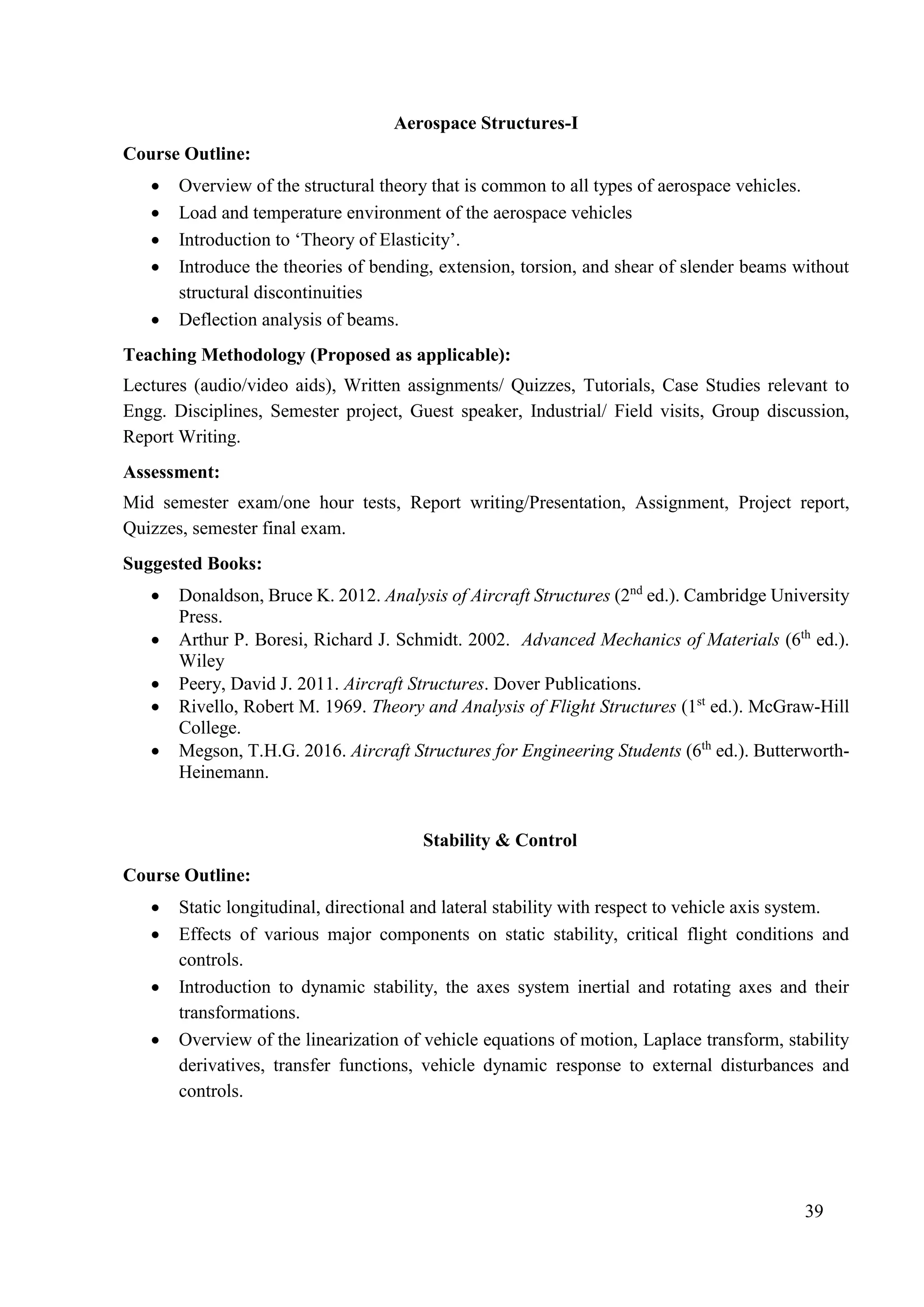
Aerospace Structures-I
Course Outline:
 Overview of the structural theory that is common to all types of aerospace vehicles.
 Load and temperature environment of the aerospace vehicles
 Introduction to ‘Theory of Elasticity’.
 Introduce the theories of bending, extension, torsion, and shear of slender beams without
structural discontinuities
 Deflection analysis of beams.
Teaching Methodology (Proposed as applicable):
Lectures (audio/video aids), Written assignments/ Quizzes, Tutorials, Case Studies relevant to
Engg. Disciplines, Semester project, Guest speaker, Industrial/ Field visits, Group discussion,
Report Writing.
Assessment:
Mid semester exam/one hour tests, Report writing/Presentation, Assignment, Project report,
Quizzes, semester final exam.
Suggested Books:
 Donaldson, Bruce K. 2012. Analysis of Aircraft Structures (2nd
ed.). Cambridge University
Press.
 Arthur P. Boresi, Richard J. Schmidt. 2002. Advanced Mechanics of Materials (6th
ed.).
Wiley
 Peery, David J. 2011. Aircraft Structures. Dover Publications.
 Rivello, Robert M. 1969. Theory and Analysis of Flight Structures (1st
ed.). McGraw-Hill
College.
 Megson, T.H.G. 2016. Aircraft Structures for Engineering Students (6th
ed.). Butterworth-
Heinemann.
Stability & Control
Course Outline:
 Static longitudinal, directional and lateral stability with respect to vehicle axis system.
 Effects of various major components on static stability, critical flight conditions and
controls.
 Introduction to dynamic stability, the axes system inertial and rotating axes and their
transformations.
 Overview of the linearization of vehicle equations of motion, Laplace transform, stability
derivatives, transfer functions, vehicle dynamic response to external disturbances and
controls.
40
Teaching Methodology (Proposed as applicable):
Lectures (audio/video aids), Written assignments/ Quizzes, Tutorials, Case Studies relevant to
Engg. Disciplines, Semester project, Guest speaker, Industrial/ Field visits, Group discussion,
Report Writing.
Assessment:
Mid semester exam/one hour tests, Report writing/Presentation, Assignment, Project report,
Quizzes, semester final exam.
Suggested Books:
 Bandu N. Pamadi, 2015, Performance, Stability, Dynamics & Control of Airplanes, AIAA
Education Series, 3rd Edition.
 Robert C. Nelson, 1988, Flight Stability and Automatic Control, McGraw-Hill, NY, 2nd
Edition.
 Robert C Nelson. 2007. Flight Stability and Automatic Control. (2nd
ed.). McGraw Hill.
Education.
 Lang, James D. 1974. Aircraft Performance, Stability and Control. Dept. of Aeronautics,
USAF.
 Blakelock, John H. 1991. Automatic Control of Aircraft and Missiles (2nd
ed.). John Wiley
& Sons.
 Bernard Etkin, Lloyd Duff Reid. 1995. Dynamics of Flight: Stability and Control, (3rd
ed.).
Wiley.
Engineering Depth Courses
Aerospace Vehicle Design
Course Outline:
 Conceptual design of various types and categories of aerospace vehicle.
 Study of following activities:
o Design layout
o Design analysis.
o Configuration layout
o Pay-load considerations
o Aerodynamics and propulsion
o Structures and loads.
o Weights, stability and control
o Performance and trade studies.
 The student is required to prepare and present a conceptual design of a complete aerospace
vehicle based on certain given specifications.
 Extensive use of computers must be ensured to refine the designed vehicle.
41
Teaching Methodology (Proposed as applicable):
Lectures (audio/video aids), Written assignments/ Quizzes, Tutorials, Case Studies relevant to
Engg. Disciplines, Semester project, Guest speaker, Industrial/ Field visits, Group discussion,
Report Writing.
Assessment:
Mid semester exam/one hour tests, Report writing/Presentation, Assignment, Project report,
Quizzes, semester final exam.
Suggested Books:
 Raymer, Daniel P. 2012. Aircraft Design: A Conceptual Approach (AIAA Education
Series) (5th
Edition). AIAA.
 “Leland M. Nicolai, Grant E. Carichner. 2010. Fundamentals of Aircraft and Airship
Design, Volume 1. AIAA.
Structural Dynamics and Aero-Elasticity
Course Outline:
 Introduction to the Fundamentals of vibration, discrete and continuous systems.
 Free and Forced vibratory SDOF systems, harmonic vibration, rotating unbalance, base
excitation.
 Vibration isolation, transient vibration, systems with two degrees of freedom.
 Fundamentals of aero-elasticity (static and dynamic).
Teaching Methodology (Proposed as applicable):
Lectures (audio/video aids), Written assignments/ Quizzes, Tutorials, Case Studies relevant to
Engg. Disciplines, Semester project, Guest speaker, Industrial/ Field visits, Group discussion,
Report Writing.
Assessment:
Mid semester exam/one hour tests, Report writing/Presentation, Assignment, Project report,
Quizzes, semester final exam.
Suggested Books:
 Rao, Singiresu S. 2017. Mechanical Vibrations (6th
ed.). Pearson.
 Francis S. Tse, Ivan E. Morse, Rolland T. Hinkle. 1978. Mechanical Vibrations Theory
and Applications (2nd
ed.). Pearson.
 Megson, T.H.G. 2016. Aircraft Structures for Engineering Students (6th
ed.). Butterworth-
Heinemann,
 Dewey H. Hodges, Introduction to Structural Dynamics and Aeroelasticity.
 Journals / Periodicals.
 International Journal of Structure Stability & Dynamics
 Structural Dynamics & Vibrations
42
Propulsion and Power Plants
Course Outline:
 Introduction to Gas Turbine:
o Describe the Brayton cycle (gas turbine cycles), components and their thermodynamic
properties, aircraft propulsion (turbojet, turboprop, and ramjet), industrial application,
future possibilities.
 Gas Turbine Cycle Arrangements:
o Explain the open loop cycle, closed loop cycle, single shaft arrangement, multi shaft
arrangement, and multi spool arrangement.
 Shaft Power Cycles:
o State the ideal cycles, assumptions for ideal cycle, simple gas turbine.
 Aircraft Propulsion:
o Interpret performance criteria, propulsive efficiency, thermal efficiency, overall efficiency,
fuel ratio, TSFC, international standard atmosphere, component numbering (turbojet,
turbofan, turboprop, and ramjet).
 Parametric Analysis:
o Give an introduction to notation, design inputs, temperature and pressure relationships in
terms of ratios, steps for parametric analysis, assumptions for ideal gases, ideal turbojet,
cycle analysis (turbojet), calculations, optimum compressor ratios, ideal turbofan, cycle
analysis, optimum bypass ratios, ideal turboprop engine, cycle analysis, optimum turbine
temperature, ideal ramjet engine (analysis).
 Centrifugal Compressor:
o Describe the principle of operation, work done and pressure ratio, diffuser, compressibility
effects, and characteristics.
 Axial Flow Compressor:
o Explain the basic operation, elementary theory, design process. Combustion system:
operational requirements, types of combustion chambers, factors effecting combustion,
combustion process.
 Intake and Propelling Nozzles:
o Understand the working of Intake Diffusers, Propelling Nozzles.
Teaching Methodology (Proposed as applicable):
Lectures (audio/video aids), Written assignments/ Quizzes, Tutorials, Case Studies relevant to
Engg. Disciplines, Semester project, Guest speaker, Industrial/ Field visits, Group discussion,
Report Writing.
Assessment:
Mid semester exam/one hour tests, Report writing/Presentation, Assignment, Project report,
Quizzes, semester final exam.
43
Suggested Books:
 Philip Hill, Carl Peterson. 2009. Mechanics and Thermodynamics of Propulsion (2nd
ed.).
Pearson.
 George P Sutton, Oscar Biblarz. 1992. Rocket Propulsion Elements (6th
ed.). John Wiley,
NY.
 Yahya, S.M. 2011. Turbines, Compressors and Fans (4th
ed.). McGraw Hill.
 H.I.H. Saravanamuttoo, Paul Straznicky, G.F.C. Rogers, H. Cohen, Andrew Nix. 2017.
Gas Turbine Theory. (7th
ed.). Pearson.
 S. L. Dixon, C. A. Hall. 2013. Fluid Mechanics and Thermodynamics of Turbomachinery.
(7th
ed.). Butterworth-Heinemann.
 Journals / Periodicals
 Jack D. Mattingly. Elements of Gas Turbine Propulsion. (1st
ed.).
 Journal of Propulsion & Power
Control Systems
Course Outline:
 Fundamentals of linear control system, mathematical modeling of physical systems,
including both electrical and mechanical systems
 Concept of the digital computer as a tool for solution of differential equations and linear
systems, transient and steady state response
 Open and closed loop response involves time domain analysis and frequency response
analysis
 Classification of control systems and feedback control system such as Transient response,
steady-state accuracy and disturbance rejection are taught during the latter part of the
course
 Root locus, Routh’s criterion, Bode plot, Nyquist criterion and signal flow graphs
 Different type of controllers such as Proportional, phase-lead, phase-lag and PID are used
to achieve desired transient and steady state response
 Multivariable input-output system such as state space system and its close loop response
Teaching Methodology (Proposed as applicable):
Lectures (audio/video aids), Written assignments/ Quizzes, Tutorials, Case Studies relevant to
Engg. Disciplines, Semester project, Guest speaker, Industrial/ Field visits, Group discussion,
Report Writing.
Assessment:
Mid semester exam/one hour tests, Report writing/Presentation, Assignment, Project report,
Quizzes, semester final exam.
Suggested Books:
 Norma S. Nise. 2019. Control System Engineering. (8th
ed.). John Wiley and Sons.
 Charles L. Phillips, John Parr. 2011. Feedback Control Systems (5th
Ed.). Pearson.
44
 Constantine H. Houpis, Stuart N. Sheldon. 2013. Linear Control System Analysis and
Design with MATLAB® (6th
ed.). CRC Press.
Product Design and Development
Course outline:
 Understand the basic functions involved in design and development processes of a new
product
 Analyze the customer needs for a new product development
Teaching Methodology (Proposed as applicable):
Lectures (audio/video aids), Written Assignments/ Quizzes, Case Studies relevant to engg
disciplines, Design Project, Group discussion, Report Writing.
Assessment:
OHTs, Report writing/Presentation, Assignments, Project Report, Quizzes, Semester final exam.
Suggested Books:
 Ulrich & Eppinger. 2019. Product Design & Development (7th
ed.).
Manufacturing Processes and CNC Machines
Course Outline:
 Introduction: Basic concepts of manufacturing processes
 Casting and Moulding: Metal casting processes and equipment, Powder metallurgy,
Plastics
 Forming: Extrusion and drawing, sheet metal forming, forming and shaping plastics and
composite materials
 Metal Cutting Theory/ Cutting Tools
 Machining: Conventional and non-conventional machining processes
 Joining: Welding, brazing, soldering, sintering, adhesive bonding, fastening, Press fitting
 Glass making/float glass process, blow moulding, spinning etc.
 Additive Manufacturing: 3D Printing.
Teaching Methodology (Proposed as applicable):
Lectures (audio/video aids), Written assignments/ Quizzes, Tutorials, Case Studies relevant to Engg.
Disciplines, Semester project, Guest speaker, Industrial/ Field visits, Group discussion, Report Writing.
Assessment:
Mid semester exam/one hour tests, Report writing/Presentation, Assignment, Project report, Quizzes,
Semester final exam.
45
Suggested Books:
 Mikell P Groover. 2019. Fundamental of Modern Manufacturing (Material, Processes &
System) (7th ed.). John. Wiley. NJ. US.
 Begeman, 8th Edition, Wiley; 1987
 Serope Kalpakjian & Steven R. Schmid. (2016) Manufacturing Processes for Engineering
Materials. (6th
ed.). Pearson. ISBN-13: 978-0134290553
 Stanley A. Komacek, Ann E. Lawson & Andrew C. Horton. 1990. Manufacturing
Technology, Glencoe/McGraw-Hill School Pub Co. ISBN-13: 978-0827334625
Computational Structural Analysis
Course Outline:
 Introduction: fundamentals of Finite Element Methods in structure analysis.
 Understanding the finite element methods for the analysis of structures.
 Comparison of analytical approach with the finite element methods.
 Concept of stiffness of a spring and then builds up to formulate element stiffness matrix
for different element using the Hooke’s law and energy theorems.
 Principle of Virtual Work and Minimum Potential Energy
 The load vector and displacement vectors
 Method of solution to solve the model to determine the displacements of the structure at
the nodes.
Teaching Methodology (Proposed as applicable):
Lectures (audio/video aids), Written assignments/ Quizzes, Tutorials, Case Studies relevant to
Engg. Disciplines, Semester project, Guest speaker, Industrial/ Field visits, Group discussion,
Report Writing.
Assessment:
Mid-exam, Report writing/Presentation, Assignment, Project report, Quizzes, Final exam/
assessment.
Suggested Books:
 Mikell P Groover. 2019. Fundamental of Modern Manufacturing (Material, Processes &
System) (7th ed.). John. Wiley. NJ. US.
 Begeman, 8th Edition, Wiley; 1987
 Serope Kalpakjian & Steven R. Schmid. (2016) Manufacturing Processes for Engineering
Materials. (6th
ed.). Pearson. ISBN-13: 978-0134290553
 Stanley A. Komacek, Ann E. Lawson & Andrew C. Horton. 1990. Manufacturing
Technology, Glencoe/McGraw-Hill School Pub Co. ISBN-13: 978-0827334625.
46
Multidisciplinary Engineering Courses
Electric Circuits and Machines
Course Outline:
 Theory and applications of electric circuits and machines for Aerospace majors.
 Derive and explain the concept of:
o Impedance, admittance and transient.
o Phasor notation in the solution of AC circuits.
o Circuit laws, network theorems.
o Resonance.
o Power and energy.
 DC machines (DC generator and DC motor), alternator, transformer etc.
Teaching Methodology (Proposed as applicable):
Lectures (audio/video aids), Written assignments/ Quizzes, Tutorials, Case Studies relevant to
Engg. Disciplines, Semester project, Guest speaker, Industrial/ Field visits, Group discussion,
Report Writing.
Assessment:
Mid semester exam/one hour tests, Report writing/Presentation, Assignment, Project report,
Quizzes, semester final exam.
Suggested Books:
 Charles K. Alexander, Matthew Sadiku, Fundamentals of Electric Circuits (6th
Edition),McGraw-Hill,2016
 Stephen J. Chapman, Electric Machinery Fundamentals (5th
Ed), McGraw-Hill, 2011.
 William H. Hayt, Jack Kammerly, Jamie Phillips, Steven M.Durbin Engineering Circuit
Analysis (9th
Edition), McGraw-Hill, 2018.
 Rosenblatt and Friedman, Direct & Alternating Current Machinery (2nd
Edition), 1990.
Electronics, Analogue & Digital Circuits
Course Outline:
 Develop the ability of aerospace students to understand digital computer fundamentals and
semiconductor based electric circuits.
 Fundamentals of digital computer design.
 Concept of semiconductor theory.
 Functions/operations of diodes and its applications, Transistors and its terminal characteristics.
 Notion of biasing of transistor circuits
 Concept of DC and AC load lines, which is followed by the analysis of various transistor
amplifier configuration.
Teaching Methodology (Proposed as applicable):
47
Lectures (audio/video aids), Written assignments/ Quizzes, Tutorials, Case Studies relevant to
Engg. Disciplines, Semester project, Guest speaker, Industrial/ Field visits, Group discussion,
Report Writing.
Assessment:
Mid-exam, Report writing/Presentation, Assignment, Project report, Quizzes, Final exam/
assessment.
Suggested Books:
 Morris Mano, Charles R. Kime, Tom Martin, 2015 Digital Logic and Computer Design
Fundamentals (5th
Ed.), Peason,
 Ronald L. Schilling, Charles Belore, 1989. Electronics Circuits Discrete and Integrated (3rd
Ed.), McGraw-Hill.
 Adel S. Sedra, Kenneth C. Smith, 2014. Microelectronic Circuits (7th
Ed.). Oxford
University Press.
Occupational Health and Safety
Course Description:
This course introduces the student to the study of workplace occupational health and safety. The
student will learn safe work practices in offices, industry and construction as well as how to
identify and prevent or correct problems associated with occupational safety and health in these
locations as well as in the home.
Learning Outcomes:
Upon successful completion of this course, the student will be able to:
1. Identify hazards in the home, laboratory and workplace that pose a danger or threat to their
safety or health, or that of others.
2. Control unsafe or unhealthy hazards and propose methods to eliminate the hazard.
3. Present a coherent analysis of a potential safety or health hazard both verbally and in writing,
citing the Ontario Occupational Health and Safety Regulations as well as supported legislation.
4. demonstrate a comprehension of the changes created by WHMIS and OSHA legislation in
everyday life.
Course Outline:
(1) Health and safety foundations:
(a) Nature and scope of health and safety
(b) Reasons/benefits and barriers for good practices of health and safety
(c) Legal frame work and OHS Management System
(2) Fostering a safety culture:
(a) Four principles of safety- RAMP (Recognize, Assess, Minimize, Prepare)
48
(b) Re-thinking safety-learning from incidents
(c) Safety ethics and rules
(d) Roles and responsibilities towards safety
(e) Building positive attitude towards safety
(f) Safety cultures in academic institutions
(3) Recognizing and communicating hazards:
(a) Hazards and Risk
(b) Types of hazards: Physical (mechanical and non-mechanical), Chemical (Toxic and
biological agents), electrical, fire, construction, heat and temperature, noise and
vibration, falling and lifting etc.
(c) Learning the language of safety: Signs, symbols and labels
(4) Finding hazard information
(a) Material safety data sheets
(b) Safety data sheets and the GHS (Globally Harmonized Systems)
(5) Accidents & Their Effect on Industry
(a) costs of accidents
(b) time lost
(c) work injuries, parts of the body injured on the job
(d) chemical burn injuries
(e) Construction injuries
(f) Fire injuries
(6) Assessing and Minimizing the Risks from Hazards
(a) Risk Concept and Terminology
(b) Risk assessment procedure
(c) Risk Metric’s
(d) Risk Estimation and Acceptability Criteria
(e) Principles of risk prevention
(f) Selection and implementation of appropriate Risk controls
(g) Hierarchy of controls
(7) Preparing for Emergency Response Procedures
(a) Fire
(b) Chemical Spill
(c) First Aid
(d) Safety Drills / Trainings:
49
 Firefighting
 Evacuation in case of emergency
(8) Stress and Safety at Work environment
(a) Workplace stress and sources
(b) human reaction to workplace stress
(c) measurement of workplace stress
(d) shift work, stress and safety
(e) improving safety by reducing stress
(f) stress in safety managers
(g) stress and workers compensation
(9) Incident investigation
(a) Importance of investigation
(b) recording and reporting
(c) Techniques of investigation
(d) Monitoring
(e) Review
(f) Auditing Health and Safety
Teaching Methodology (Proposed as applicable):
Lectures (audio/video aids), written assignments/quizzes, tutorials, case studies relevant to
engineering disciplines, semester project, guest speaker, industrial/field visits, group discussion,
report writing
Assessment:
Mid-semester exam, report writing/presentation, assignment, project report, quizzes, end-semester
exam
Suggested Books:
 The A-Z of health and safety by Jeremy Stranks, 2006.
 The Manager’s Guide to Health & Safety at Work by Jeremy Stranks, 8th edition, 2006.
 Occupational safety and health law handbook by Ogletree, Deakins, Nash, Smoak and
Stewarts, second edition, 2008.
50
12.2 Non-Engineering Domain
In the following sections, Course Outlines and teaching-assessment approaches are given for
guidance based on a typical semester system. The instructors may adopt or adapt accordingly
defining CLOs.
English Courses
Functional English
Area Scope:
The knowledge units in this area collectively encompass the following:
 Follow English vocabulary and skills to use it in professional life.
 Identify common errors usually made by the Learners of English as a second
language.
 Practice English correctly in speaking and writing.
Course Outlines:
 Public Speaking
 The Art of Creating a PowerPoint Presentation.
 Interacting with the Opposite Gender
 Classroom Etiquettes and Teachers’ Expectations
 Articles:
 Prepositions.
 Homophones:
 Punctuation
 Tenses in English Grammar
 Formal Letter Writing
 Summary writing
 Organizing and planning your writing
 Sensory Perception in writing.
 Critical thinking
 Final Year Project
Teaching Methodology (Proposed as applicable):
Lectures (audio/video aids), Written Assignments/ Quizzes, Tutorials, Case Studies relevant to
engineering disciplines, Semester Project, Guest Speaker, Industrial/ Field Visits, Group
discussion, Report Writing
51
Assessment:
Mid semester exam/one hour tests, Report writing/ Presentation, Assignments, Project Report,
Quizzes, Final semester exam.
Suggested Books:
 P. C. Wren & H. Martin “High School English Grammar & Composition”.
 Colin W. Davis & Andrew J. Watts New Expressway For English 1 (New Edition)
 Hert A. Murphy & Herbert William Hildebrandt. Effective Business Communications
 Diana Hacker. A Writer’s Reference
 Sadat Ali Shah. Exploring The World Of English
 A. J. Thomson and A. V. Martinet. Practical English Grammar, “University Physics”, 13th
Edition.
Communication Skills
Area Scope:
The knowledge units in this area collectively encompass the following:
 Communicate effectively using intermediate- to-advanced level English while
developing the understanding of essentials of communication skills.
 Participate in group discussions by attentive listening, questioning to clarify ideas, eliciting
responses, or disagreeing in a constructive way.
Course Outlines:
By the end of the semester students will have skills including:
Writing Skills
 Vocabulary Building
 Writing Skills: Essays and Letters
 Common Writing Errors
 Purposeful Writing
Reading Skills
 Skimming and Scanning
 Critical Reading
 Reading for Understanding
 Techniques and strategies to develop sound vocabulary.
Listening Skills
 Introduction to Communication Process
52
 Seven Cs of Communication
 Types of Listening
 Listening for Comprehension
Speaking Skills
 Verbal and Non-Verbal Communication
 Basics of Presentation Skills
 Presentation Strategies and public speaking skills.
 Use of Audio-Visual Aids
 Basics of Group Communication
 Listening Skills
 Communicate effectively in job interviews.
Teaching Methodology (Proposed as applicable):
Lectures (audio/video aids), Written Assignments/ Quizzes, Tutorials, Case Studies relevant to
engineering disciplines, Semester Project, Guest Speaker, Industrial/ Field Visits, Group
discussion, Report Writing
Assessment:
Mid semester exam/one hour tests, Report writing/ Presentation, Assignments, Project Report,
Quizzes, Semester final exam.
Suggested Books:
 Anchor in English-II (Lessons 1-5), A SPELT Publication
 Christopher Fry, “Summary Writing (Book-I)”, Oxford University Press
 College Essays by John Langlan
 Barron’s TOFFL iBT Edition
 Communication Skills for Engineers by Sunita Marshal and C.Muralikrishn.
Technical Writing and Presentation Skills
Area Scope:
The knowledge units in this area collectively encompass the following:
 The students will be able to write technically correct statements, assignments, final year
project report, project proposal, short report and research paper
 The students would be able to their write CV, cover letter and business/ professional
Correspondence meeting all criteria
 The students would be able to present their work/ research at a technical forum.
53
Course Outlines:
 Introduction to Technical writing
 Proposal write-up and improvement strategies Introduction to research and research
types choosing research problems and research advisors How to carry out research
 Formulation – Problem statement, Literature
 Review
 Design - Methodology
 Analysis - Data analysis and interpretation Good writing style techniques
 Uses of correct words
 Presenting and publishing research
 Write business/professional correspondence, cover letter and CV
 Writing meeting minutes.
Teaching Methodology (Proposed as applicable):
Lectures (audio/video aids), Written Assignments/ Quizzes, Tutorials, Case Studies relevant to
engineering disciplines, Semester Project, Guest Speaker, Industrial/ Field Visits, Group
discussion, Report Writing
Assessment:
Mid semester exam/one hour tests, Report writing/ Presentation, Assignments, Project Report,
Quizzes, Semester final exam.
Suggested Books:
 The Aims of Argument: A Text and Reader Authors: Timothy W. Crusius; Carolyn E.
Channell Publisher: McGraw-Hill Education (2014) Edition: 8th Edition ISBN-13: 978-
0077592202
 Technical Communication. A Reader Centered Approach Author: Paul. V. Anderson
Edition: 8th ISBN-13: 978-1133309819 Publisher: Cengage Learning; 8th edition (2013).
 Writing for Computer science by Justin Zobel Research Methodologies – A step by step
guide for beginners, Ranjit Kumar.
Mathematics Courses
Linear Algebra
Area Scope:
The knowledge units in this area collectively encompass the following:
 To comprehend basic concepts of Linear Algebra and optimization
54
 To apply techniques of Linear Algebra and optimization for solution of engineering
problems
Course Outline:
System of Linear Equations and Applications
 Overview of linear system of equations, Cases of unique solution, No solution and infinite
solutions,
 Echelon form, Gauss elimination method, Inversion of matrix in the context of solution of
system of equations, LU factorization, Row space and column space
 Relevant engineering case studies such as Network analysis, Traffic Flows, Balancing
chemical reaction, Leontief Input-output model, Finding max stress in compound cylinder,
Applications of linear systems in force balancing of structures, Markov process.
Vector Spaces and Transformations
 Vector Spaces: Real vector spaces, Subspaces, Basis and dimension, Rank, Nullity
 Gram-Schmidt process for finding orthonormal basis
 Linear Transformation, Kernel of Transformation, Range of Transformation, Matrix of
Transformation
 Applications: Cryptography, Coding and decoding, Breaking of codes, Robotic
Applications of linear transformations
Eigenvalues and Eigen Vectors
 Eigenvalues, Eigenvectors, Similar matrices, Diagonalization,
 Quadratic forms, Positive definite Matrices, Singular Value Decomposition, Inner product
Spaces
 Applications of linear Algebra: Constructing curves and surfaces, Computer graphics,
Genetics.
Linear Programming
 Introduction to linear programming, Optimization, Graphical method, Simplex method,
Optimization problems in engineering and economics
 Dual simplex methods, Duality theory, Primal and dual problems, transportation models,
north-west corner, least-cost and Vogel’s approximations methods,
 Assignment model, the transshipment model and other relevant engineering case studies
Application of Linear Algebra in Dynamical Systems
 Numerical System of linear ODEs, Eigenvalue problems, Homogeneous and
nonhomogeneous system of ODE.
 Dynamical systems, Population dynamics, Prey-Predator models, Stability analysis
55
Teaching Methodology (Proposed as applicable):
Lectures (audio/video aids), Written Assignments/ Quizzes, Tutorials, Case Studies relevant to
engineering disciplines, Semester Project, Guest Speaker, Industrial/ Field Visits, Group
discussion, Report Writing
Assessment:
Mid semester exam/one hour tests, Report writing/ Presentation, Assignments, Project Report,
Quizzes, Semester final exam.
Suggested Book:
 Introductory Linear Algebra: By Bernard Kolman and David R. Hill, Latest Edition.
 Elementary Linear Algebra: By Howard Anton and Chris Rorrers, Latest Edition.
 Robert C.Fisher and Allen. D. Zeibur, 1982. Integrated Algebra and Trigonometry with Analytical
Geometry, (4th
edition). Prentice Hall, New Jersey.
Calculus and Analytical Geometry
Area Scope:
 To develop a clear understanding of fundamental concepts of single variable calculus.
 To apply concepts of differentiation and integration to solve complex engineering
problems.
Course Outline:
Analytical Geometry:
 Review of vectors, scalars and vector products.
 Three dimensional coordinate system and equation of straight line and plane
Functions Limit and Continuity:
 Review of functions and graphs,
 Limits & Continuity,
 Techniques of Finding Limits,
 Discontinuity
 Limits of Sine and Cosine and Exponential Functions
Differentiation:
 Introduction to Derivatives
 Examples of Derivatives
 Derivative as Rate of Change
 Derivative’s Rules
 Implicit Differentiation
 Higher order derivatives
 Leibnitz Theorem
Applications of Derivatives:
 Monotonic functions
56
 Optimization problems
 Relative and Absolute extrema
 First and second derivative tests
 Point of inflection
 Concavity
 Curvature
 Indeterminate Forms and L’ Hopital rule
 Differentials
Integration:
 Integrals and Properties of Integrals
 Techniques of Integration
 Integration by Parts
 Definite Integrals
 Integration of Trigonometric
 Exponential and Inverse Functions
 Integration by Partial Fractions
 Reduction Rules
Applications of Integration:
 Applications of Integration
 Area under the curve
 Area between curves
 Solids of Revolution
 Volume of Solids of revolution by disk washer, Cylindrical shell & Cross Section Methods
 Center of Pressure and Depth of Center of Pressure
 Center of mass
 Arc length
Improper Integrals:
 Improper Integral
 Integrals and Singularities
 Convergence of improper integrals
Infinite Sequence and Series:
 Sequence and Infinite Series
 Convergence and Divergence of sequences and series
 Positive Term Series
 Integral Test
 Basic Comparison Test
 Limit Comparison Test
 Ratio and Root tests
 Alternating series
 Absolute and Conditional Convergence
Power and Taylor Series:
 Power Series
 Maclaurin and Taylor Series and their applications.
57
Suggested Books:
 Thomas' Calculus by George B. Thomas, Jr., Maurice D. Weir, Joel R. Hass, Pearson,
USA.
 Swokowski, Onlinick & Pence: Calculus
 Robert T. Smith & Roland B. Minton: Calculus
 Calculus: Early Transcendentals by James Stewart. Brooks/Cole USA.
 G.B. Thomas. R. L. Finney.1995 Calculus and Analytic Geometry (9th
ed.). Addison Wesley.
 Erwin Kreyszig. 2015. Advanced Engineering Mathematics (10th
ed.). John Wiley & Sons.
 Agnew, Ralph Palmer. 1962. Calculus: Analytic Geometry and Calculus, with Vectors. McGraw-
Hill.
 McKay, Louis Toft and A.D.D. 1951. Practical mathematics. Pitman. London.
 Hildebrand, Francis B. 1962. Advanced Calculus for Applications. Prentice-Hall Inc.
 F.W. Bedford, T.D. Dwivedi. 1970. Vector Calculus. McGraw-Hill.
 Zill, Dennis G. 2016. Advanced Engineering Mathematics (6th
ed.). Jones & Bartlett Learning.
Differential Equations
Area Scope:
The knowledge units in this area collectively encompass the following:
 To define basic mathematical concepts related to differential equations
 To describe different types of analytical methods for solution of differential equations
 To formulate different engineering problems in the form of differential equations
Course Outline:
Basic Concepts and Modelling
 Linear Differential equations, Non-Linear Differential equations, Solutions of differential
equations, General solutions, Particular solution, Initial and boundary value problems,
Degree and order of ODEs
 Formulation of first-order ODEs: Case studies related to finding age of fossils, Mixing
problems and free fall motion, Finding temperature of a building, RL, RC circuits,
Airplane take-off problem, Population dynamics and logistic equations etc.
Analytical Methods of Solution for First-order ODEs
 Variable separable method, Reduction to variable separable form, Homogeneous
equations, Differential equations reducible to homogeneous form, Solution of the related
ODE models by these methods
 Exact equations, Integrating factors, Linear equations and related examples, Bernoulli’s
equations, Orthogonal trajectories and solution of the related ODE models by these
methods
58
Mathematical Models Based on Second-order ODEs
 Formulation of a single RLC circuit, Spring mass systems, Earthquake model of a single
story building
 Bungee Jumper model, Bridge collapse problem etc.
Analytical Methods of Solution for Second-order ODEs
 Homogeneous linear ODEs, Method of reduction order , Wronskain determinant to check
independence of the solution, and related examples
 Cauchy-Euler equations and related examples, Non-homogeneous linear ODEs, Method
of undetermined coefficients
 Method of variation of parameters and related example
 Analytical solution of the related ODE models by these methods
Series Solution for Second-order ODEs
 Series solution of ODEs and convergence tests.
 Series solution of Legendre equation, Frobenious method of solution for Bessel equation
and related applications.
Laplace Transform
 Laplace Transform, Derivation of Basic formulae, Inverse Laplace Transform, First shift
theorem
 Laplace transform of integrals and derivative, Solution of second order ODEs by
Laplace Transform, Unit step function and its Laplace transform, Second shift theorem,
Convolution
 Application of Laplace transform to a system of ODEs and related applications
Partial Differential Equations
 Partial Differential Equations and their types, Applications of partial differential equations
in Engineering
 Separation of Variables Method (SVM) and solution of wave equation by the SVM
 Solution of heat equation by the SVM
Teaching Methodology (Proposed as applicable):
Lectures (audio/video aids), Written Assignments/ Quizzes, Tutorials, Case Studies relevant to
engineering disciplines, Semester Project, Guest Speaker, Industrial/ Field Visits, Group
discussion, Report Writing
Assessment:
Mid semester exam/one hour tests, Report writing/ Presentation, Assignments, Project Report,
Quizzes, Semester final exam.
Suggested Book:
 Kreyszig, Erwin. 2011. Advanced Engineering Mathematics. Wiley.
 Zill, Dennis G. 2016. Advanced Engineering Mathematics (6th ed.). Jones & Bartlett Learning.
59
 McKay, Louis Toft and A.D.D. 1951. Practical mathematics. Pitman. London.
 Ross, Shepley L. 1989. Introduction to Ordinary Differential Equations. John Wiley & Sons.
 Rao, K. Sankara. 2010. Introduction To Partial Differential Equations. Phi.
 Dennis G.Zill, Michael R. Cullen. 2009. Differential Equations With Boundary Value Problems.
Brooks/Cole.
Probability & Statistics
Area Scope:
The knowledge units in this area collectively encompass the following:
 To Understand the basic concept of Statistics and Probability and their need in
engineering.
 To Describe properties and classifications of probability density functions, regression
analysis and interval estimation
 To Apply different probability and statistics techniques in engineering problems
Course Outline
Basic Statistics
 Statistics, Branches of Statistics, Importance of statistics, population, sample, observation,
variables, measurement of variable, Data, primary data, secondary data
Data Presentation
 Frequency distribution (grouped, ungrouped), stem and leaf display, histogram, frequency
polygon, cumulative frequency polygon, Simple & Multiple Bar diagrams
Measure of central tendency
 Arithmetic Mean (A.M), Geometric Mean (G.M), Harmonic Mean (H.M), Quantiles
(Median, Quartiles, Deciles, Percentiles), Mode, Applications of Averages
Measure of Dispersion,
 Background, Range, Quartile deviation, Mean deviation, Variance, Standard deviation,
Coefficient of variation, Moments, Moments ratios, Skewness, Kurtosis
 Applications in different Engineering Disciplines
Simple Regression, Correlation and Curve fitting
 Introduction to regression theory, Simple linear regression line, Line fitting by least square
methods, Coefficient of determination,
 Simple correlation, coefficient of correlation, fitting of a first and second degree curve,
fitting of exponential and logarithmic Curves, related problems.
 Principle of least squares.
Probability and random variables,
 Probability review, Laws of probability, Conditional probability, Bayesian theorem,
independent, dependent events.
 Random variables, Discrete and Continuous random variables, Probability mass and
density functions, Distribution functions, Mathematical expectation,
60
 Variance of random variable, Bivariate distribution, Joint probability distribution,
Moment generating function
Probability Distributions,
 Discrete distributions:
 Bernoulli distribution, Binomial, Geometric, Negative binomial, Hyper-geometric,
Poisson distribution, Properties and application of these distributions.
 Continuous Distributions: Uniform Distribution, Exponential distribution, Normal
distribution, Applications
Sampling and Sampling Distributions
 Introduction, Population, Parameter & Statistic, Objects of sampling, Sampling
distribution of Mean, Standard errors, Sampling & Non-Sampling Errors,
 Random Sampling, Sampling with & without replacement, Sequential Sampling, Central
limit theorem.
 Applications in relevant engineering discipline
Statistical Inference and Testing of Hypothesis,
 Introduction to inferential statistics, Estimation, hypothesis testing of population mean,
proportion.
 Variance, Applications in Engineering
Teaching Methodology (Proposed as applicable):
Lectures (audio/video aids), Written Assignments/ Quizzes, Tutorials, Case Studies relevant to
engineering disciplines, Semester Project, Guest Speaker, Industrial/ Field Visits, Group
discussion, Report Writing
Assessment:
Mid semester examination/one hour tests, Report writing/ Presentation, Assignments, Project
Report, Quizzes, semester final exam.
Suggested Books:
 Introduction to Statistical theory part 1, by Sher Muhammad Chuadary (Latest Edition)
 Advanced Engineering Mathematics, by Erwin Kreyszig (Latest Edition)
 Probability and Statistics for Engineers and Scientists, by Antony Hayter.
 Elementary Statistics, by Bluman.
 Walpole, Ronald E. 2009. Introduction to Statistics (5th
ed.). Macmillan.
Multivariate Calculus and Transforms
Area Scope:
The knowledge units in this area collectively encompass the following:
 To develop a clear understanding of fundamental concepts of multivariable variable
calculus
61
 To describe of the concept of gradient, multiple integrals in rectangular, polar, cylindrical
and spherical coordinates, directional derivatives, and optimization problem.
 To apply the concepts line integrals, surface integrals, volume integrals, Green's, Stokes',
Gauss theorems to different engineering problems
 Apply various transforms to solve complex integration.
Course Outline:
Geometry of Space:
● Analytical Space Geometry, Cylindrical and Spherical coordinates, Lines in space,
Intersection of Line and a Plane.
Vector-Valued Functions and Motion in Space:
● Functions of several variables, their limits and continuity, Quadratic Surfaces, Parametric
representation of curves, Velocity and Acceleration, Arc length, Tangent, Normal, Bi-
normal, Curvature & Torsion.
Partial Differentiation:
● Partial derivatives, Total Differentials, Chain Rule with More Variables, Directional
derivatives
Applications of Partial Derivatives:
 Optimization Problems, Extrema of functions of several variables, Conditional extrema,
Lagrange Multipliers and Example.
Multiple Integrals
 Double Integration, Order of Integration, Double Integrals in Polar Coordinates,
Applications: Mass and Average Value, Moment of Inertia, Triple Integrals, Rectangular
and Cylindrical Coordinates, Applications and Examples, Triple Integrals in Spherical
Coordinates.
Vectors in 3-D Space:
 Introduction to vectors, Scalar and vector product, Volume of parallelepiped and
tetrahedron, Gradient of a Scalar Field, Divergence of a Vector Field, Curl of a Vector
Field.
62
Integration in Vector Fields:
 Line Integral, Integration Around Closed Curves. Work Done, Potential and Related
Examples, Conservative and non-Conservative Fields, Green’s Theorem, Divergence
Theorem, Stoke’s Theorem, Applications of Double and Triple integrals.
Power Series:
 Taylor Series, Laurent Series, Singularities, Zeros and poles, Residue integration method,
Residue theorem.
 Conformal mapping
Laplace Transformation:
 Linearity, Scaling, First shifting theorem, Heaviside’s Shifting theorem,
 Inverse Laplace transformation, Properties of inverse Laplace
 Convolution theorem, Applications in relevant engineering discipline
 Special functions (Gamma, Beta functions, Periodic functions, Error function), and
Fourier Transforms.
 Fourier Series, Fourier Sine and Cosine series.
 Fourier transform, Fourier cosine and sine transform, properties.
 Applications in relevant engineering discipline.
Z-Transformation:
 Z-transform, Properties of Z-transform, linearity and scaling, Standard Z-transform,
Inverse Z-transform.
 Inverse Z- transform by using residue, convolution theorem of Z-transform.
 Formation of difference equation and its solution using Z-transform.
Teaching Methodology (Proposed as applicable):
Lectures (audio/video aids), Written Assignments/ Quizzes, Tutorials, Case Studies relevant to
engineering disciplines, Semester Project, Guest Speaker, Industrial/ Field Visits, Group
discussion, Report Writing
Assessment
Mid semester exam/one hour tests, Report writing/ Presentation, Assignments, Project Report,
Quizzes, Semester final exam.
Suggested Book:
 Thomas' Calculus by George B. Thomas, Jr., Maurice D. Weir, Joel R. Hass. Pearson,
USA.
 George B. Thomas, Jr. and Ross L. Finney, Calculus and Analytic Geometry
 Swokowski, Onlinick & Pence: Calculus
 Robert T. Smith & Roland B. Minton: Calculus
 Calculus: Early Transcendental by James Stewart, Brooks/Cole USA.
63
 Advanced Engineering Mathematics, by Erwin Kreyszing, Latest Edition
 R. J. Beerends, Fourier and Laplace Transform, Cambridge University Press, Latest
Edition.
 Jeffry A, Advanced Engineering Mathematics, Elsevier, Latest Edition.
Applied Physics
Course Outline:
1. Vectors:
Review of vectors, Ordinary Differentiation of Vector, Gradient of Scalar field,
Divergence and Curl of Vector Field, Line, surface and volume integrals with their
applications.
2. Mechanics:
Newton Laws and their Applications(Simple Accelerometer, Banked Curve and Rotor),
Frictional Forces and determination of Co-efficient of Friction, Work-Energy Theorem,
applications of law of Conservation of Energy, Angular Momentum, Centre of Mass of
two-particles, Many-particles and Solid Object.
3. Electricity & Magnetism:
Electric field due to Discrete and Continuous Charge Distributions, Electrostatic Potential
of discrete and Continuous charges, Gauss’s Law and its Applications, Lorentz Force and
Hall Effect, Ampere’s Law, Magnetic Field due to current element (Circular Current Loop
and Solenoid)
4. Waves & Oscillations:
Types of Waves and Superposition Principle, Wave Speed on a stretched string, Wave
equation, Energy & Power of a Wave, Principle of Superposition and Standing Waves.
Simple Harmonic oscillations. Forced & damped oscillations.
5. Optics and Lasers:
Huygens Principle, Two-slit interference, Single-Slit Diffraction, Resolving power of
Optical Instruments, Lasers and laser light, Working principle of lasers.
6. Atomic and Nuclear Physics:
Planck’s explanations of Black Body Radiation, Photoelectric Effect, Compton Effect, De-
Broglie Hypothesis, Atomic Nucleus and Properties of Nucleus.
7. Conduction of Electricity in Solids:
The electrical properties of solids, Energy level in a crystalline solid, Insulators, metals,
semiconductors, doped semiconductors. The p-n Junction, The Transistor.
Teaching Methodology (Proposed as applicable):
Lectures (audio/video aids), written assignments/quizzes, tutorials, case studies relevant
to engineering disciplines, semester project, guest speaker, industrial/field visits, group
discussion, report writing
Assessment:
64
Mid-semester exam, report writing/presentation, assignments, project report, quizzes, end-
semester exam
Suggested Books:
 Halliday, Resnick and Walker, “Fundamentals of Physics” 10th Edition Extended
 Hugh D. Young and R.A. Freedman, University Physics. 12th Edition
 Raymond A Serway and John W. Jawett, Jr. Physics for Scientists and Engineers with
modern Physics, 09th
Edition.
Engineering Chemistry
Area Scope:
Knowledge area of this subject collectively provides comprehensive foundation of engineering physics with
emphasis on:
 Demonstrate working knowledge of applied chemistry and its application to aerospace engineering
field.
 Chemical Reactions
 Galvanization
 Electrolysis
 Corrosion
Course Outline:
 Give an introduction to various types of corrosion and its prevention.
 Develop an understanding of Electrochemistry, Galvanic cell, Cell Reactions.
 Explain the concept of Reduction potentials, The Hydrogen electrode, Standard reduction potentials
table, cell potentials.
 Compare electrolytic and galvanic cells, Electrolysis.
 Predict the products in an electrolysis reaction.
 Introduce batteries and the various types of batteries.
 Give examples of types of corrosion and the different types of electrochemical corrosion.
 Give an introduction to thermo-chemistry, Internal energy.
 Introduce the First law of thermodynamics, Heat of combustion, Heat of formation, Heat of
Neutralization.
Teaching Methodology (Proposed as applicable):
Lectures (audio/video aids), Written Assignments/ Quizzes, Tutorials, Case Studies relevant to
engineering disciplines, Semester Project, Guest Speaker, Industrial/ Field Visits, Group
discussion, Report Writing
Assessment
Mid Semester Exam/One hour tests, Report writing/ Presentation, Assignments, Project Report,
Quizzes, Semester Final Exam.
65
Suggested Books:
 Jespersen, Brady and Hyslop. 2015. Chemistry: The Molecular Nature of Matter and
Change. (7th
ed.). John Wiley and Sons, Inc.
 O.V. Roussak and H.D Gesser. 2013. Applied Chemistry: A Text book of Engineers and
Technologists. (2nd
ed.). Springer,
 Petrucci, Herring, Madura and Bisonnette. 2017. General Chemistry: Principles and
Modern Applications (11th
ed.). Pearson
 James E. Brady and Frederick A. Senese. 2007. Chemistry: Matter and its Changes (5th
Edition) John Wiley and Sons.
Social Sciences Courses
Professional Ethics
Area Scope:
The objective of this course is to grasp ideals and principles as they have been spelled out in a
variety of traditional ethical systems and to apply these conceptual structures and guidelines to
major problems and dilemmas of engineering practices in a corporate culture.
Outlines:
 Engineering Ethics, Ethical concepts, and Types
 Moral Autonomy, Kohlberg’s & Gilligan’s Theory
 Profession and Professionalism
 Moral Reasoning, Ethical Theories
 Critique codes of ethics
 Moral frameworks, Personal commitments and professional life
 Engineering as social experimentation
 Involving the public in the design process, Case studies for engineering as social
experimentation
 Assessment of safety and risk, Design considerations, uncertainty
 Risk-benefit analysis, Safe-exit and fail safe systems
 Case Studies for the Design Process Case studies in impact of safety/risk on design
 Employee/employer rights and responsibilities
 Confidentiality and conflict of interest
 Whistle-blowing, case studies on professional behavior/policies on the job
 Environment, sustainable development, Multinational corporations, globalization of
engineering
Teaching Methodology (Proposed as applicable):
Lectures (audio/video aids), Written Assignments/ Quizzes, Case Studies relevant to engg
disciplines, Group discussion, Report Writing.
Assessment:
OHTs, Report writing/Presentation, Assignments, Project Report, Quizzes, Final term
66
Suggested Books:
 Ethics in Engineering 4th edition, by Mike W. Martin, Roland Schinzinger, McGraw-
Hill, New York, 2005.
 Fundamentals of Engineering Economics, 3rd ed., by Chan S. Park
 Engineering Ethics: Concepts and Cases,4th edition, by Charles E. Harris, Michael S.
Pritchard, Michael J. Rabins, Wadsworth, 2008.
 The Seven Habits of Highly effective people by Stephan r. Covey
 Principle Centered Leadership Stephan r. Covey
 Change your lens change your life by (Faiez H. Seyal)
 How to Manage by Ray Wild
 Happiness by Richard Layard
Social Anthropology
Area Scope:
 Learning human nature
 Study of the processes and results of cultural contacts
Course Outline:
 Application of anthropological skills by professional engineers and other related practitioners.
 Generating an understanding of societal growth needs within our own cultural environment.
 Develop the understanding of societal growth needs within our cultural environment, such a body
of applied knowledge will result in improving professional performance of would-be engineers.
 Explain the culture and societal role which play an important part towards human activities.
 Allow students to relate technical skills to the societal needs and requirements.
 Develop the understanding of students to relate the technical skills with societal needs and
requirements.
Teaching Methodology (Proposed as applicable):
Lectures (audio/video aids), Written assignments/ Quizzes, Tutorials, Case Studies relevant to Engg.
Disciplines, Semester project, Guest speaker, Industrial/ Field visits, Group discussion, Report Writing.
Assessment:
Mid-exam, Report writing/Presentation, Assignment, Project report, Quizzes, Final exam/ assessment.
Suggested Books
 Ahmad, Akbar S. 1990. Pakistani Society, Karachi, Royal Books Co.
 Bernard, H. Russel. 1994. Research Methods in Anthropology, Qualitative and
Quantitative Approaches. London: Sage Publications
 Bodley, John H. 1994. Cultural Anthropology, California: Mayfield Publishing Co.
 Brogger, Jan. 1993. Social Anthropology and the Lonely Crowd. New Delhi: Reliance
Publishing
67
 Ember, Carol R. & Ember Melvin. 2005. Anthropology, 11th ed. Englewood Cliffs:
Prentice Hall, Ince. Harper and Row
 Harris Marvin. 1987. Cultural Anthropology. New York: Harper and Row
 Harris Marvin. 1985. Culture, People, Nature; An Introduction to General Anthropology
London: Harper and Row
 Haviland, W. A. (2005). Anthropology: The Human Challenge. New York, Thomson
Learning Inc.
 Hertzler J. O. 1981. The Social Structure of Islam. Cambridge: Cambridge University
Press.
 Keesing, Roger M. 1998. Cultural Anthropology: A contemporary perspective. (3rd
ed.).
New York: Harcourt Brace College Publishers.
 Kottak, Conard Phillip. 2002. Anthropology: The Exploration of Human Diversity. (9th
ed.). Boston: McGraw Hill Higher Education.
 Kennedy, Charles H. 1992. Pakistan London: Westview Press.
 Marron, Stanley. 1057. Pakistani Society and Culture. New Heaven
 Wilson, Richard A. 1996. Human Rights, Culture and Context: Anthropological
Perspective. London: Pluto Press.
Sociology for Engineers
Area Scope:
This course is meant to provide engineering students with an opportunity to view the discipline of
sociology from the engineering perspective and will highlight its application to the engineering
profession. This will also enable the engineers to fit their technical ideas into a socially acceptable
product /project in a more successful manner. The knowledge units in this area collectively
encompass the following:
 To introduce the methods and philosophy of social science to help their understanding of
the socio-cultural dimension of human existence as a fundamental reality in engineering
projects etc.
 To provide opportunity for students to begin the process of considering social problems/
issues while designing engineering products.
 To allow engineers to play a pro-active role in critical discussions of social issues
specifically.
 To demonstrate comprehension of roles and functions of various social institutions, state
organizations, Professional bodies and relationships for analyzing their social impact
Assessment.
Course Outline:
Fundamental Concepts and Importance of Sociology for Engineers
 What is sociology? Nature, Scope, and Importance of Sociology, Sociological
Perspectives and Theories, Social Interactions, Social Groups/ Social Institutions & heir
68
interface with Engineering Project/services, Sociology & Impact of Technology &
Engineering Products/Projects on Society.
Cultural Impacts of Engineering Projects on Society
 Definition of Culture, Types of Culture & Elements of Culture, Culture & Power,
Authority, Dominance Socialization and Personality, Role of Engineering Projects on
Culture, social norms and values of Society, Cultural Infusion of Engineers in Society.
Theoretical Perspective of Sociology: Diffusion and Innovation; Adoption and Adaptation;
Social development; Community Development
 Community Development & Social consequences of Industrialization, Development
Processes of Societal Development, Cooperation and Conflict in Community
Development in Engineering Context.
Understanding of Societal & Ethical Norms and Values for Engineers
 Engineering Ethics, Engineering product/services for Less privileged, Role of Engg &
Technology in addressing Social inequality, Core Social Values/Norms affecting Engg
Performance
Organizational Social Responsibility (OSR) of Engineers
 Extenttowhichdevelopmentintendstosensitizesocietalandunder-privileged needs
 Gender inclusiveness and balance
 Special and Disadvantaged Community of the Area
 Planning for community inclusiveness
 Societal Obligation of Engineers
Engineers, Society and Sustainability
 Social System and Concept of Sustainable Development Technology and Development,
Population Dynamics in Pakistan, Causes and Consequences of Unplanned Urbanization,
Community Development, Programs in Pakistan, Community Organization &
Engineering Projects, Population, Technological & Industrial expansion and Development
with focus on social/human/ethical dimensions.
Industrial & Organizational Psychology
 Interpersonal Relations, Interpersonal Behavior, Formation of Personal Attitudes,
Language and Communication, Motivations and Emotions, Impact of Technology on
human feelings and level of Sensitivity
69
Climate Change and Ecological Friendliness from Engineering Perspective
 Ecological Processes, Ecosystem and Energy, Impact of Engineering Projects on Eco
System & Human Ecology, Industrial & Environmental impact on Population & General
Masses, Technological Intervention, Ecosystem and Physical Environment, Social Impact
of Technology & Engineering Products & Services (Solid Waste Disposal, Pollution
control etc).
Social Approaches and Methodologies for Development Administration & Stakeholders
Analysis:
 All Phases of the Project (pre, post and execution) Structured, Focused Group, Stakeholder
Consultative Dialogues etc. Dynamics of Social Change, Sociology of Change and
Industrial Development, Social Change due to Technology Driven Economic Growth.
SIA (Social Impact Assessment):
 Base line and need-assessment, evaluation and impact assessment surveys of the
development projects. Role of Engg & Technology for Creating Social Cohesiveness &
Societal Integration. Technology Based change in Collective Behavior, Social Audit of
Engineering Projects.
Engineering Intervention for Social Stratification.
 Factors of Social Stratification, Engineering Interventions for addressing Social
Stratification, Social Mobilization through Technological Innovation.
Case Studies of Different Development Projects in Social Context
Teaching Methodology (Proposed as applicable):
Lectures (audio,/video aids), Written Assignments/ Quizzes, Tutorials, Case Studies relevant to
engg disciplines, Semester Project, Guest Speaker, Project / Field Visits, Group discussion,
Community Service, Report Writing, Social Impact Review and Social Audit of Engg Project
Assessment:
Mid semester exam/one hour tests, Report writing/ Presentation, Assignments, Project Report,
Quizzes, Semester Final exam.
Suggested Books:
 Godhade, J. B., and S.T. Hunderkari. 2018. Social Responsibility of Engineers.
International Journal of Academic Research and Development. Vol. 03; Special Issue.
March, 2018.
 Nichols,S.P.andWeldon,W.F.2017. Professional Responsibility: The Role of Engineering
in Society Center for Electro-mechanics, The University of Texas at Austin, USA.
70
 Aslaksen,E.W.2016. The Relationship between Engineers and Society: is it currently
fulfilling its potential? Journal and Proceedings of the Royal Society of New
SouthWales,Vol.148.Nos.455-456. Gumbooya Pty Lte, Allambie Heights, Australia.
 Bell, S. Engineers, Society and Sustainability. Synthesis Lectures on Engineers,
Technology, and Society. Edited by Caroline Baillie, University of Western Australia.
Morgan and Claypool Publishers
 Jamison,A.,Christensen,S.H.,andLars,B.2011.A Hybrid Imagination: Science and
Technology in Cultural Perspective.
 Vermaas,P.,Kroes,P.,Poet,l.,andHoukes,W.2011.APhilosophyofTechnology:FromTechn
ical Artefacts to Socio technical systems.
 Mitcham,C.,andMunoz,D.2010.HumanitarianEngineering.MorganandClaypoolPublishe
rs. Riley,D.2008.Engineering and Social Justice. Morgan and Claypool Publishers.
 Bugliarello,G.1991.TheSocial Functions of Engineering: A Current Assessment, A
Chapter in“ Engineering as A Social Enterprise.
Sociology
Area Scope:
The knowledge units in this area collectively encompass the following:
 To introduce the necessary subject knowledge and understanding required for the
successful study of Sociology and related Social Science disciplines at undergraduate.
 To develop skills of application, analysis and evaluation in the context of the study of
Social Science.
 To develop a knowledge and understanding of sociology both at a global and national
level.
 To introduce the planning and organization skills necessary to develop as independent,
autonomous learners.
 To develop the confidence and competence of the students as learners and to assist them
in taking some responsibility for their own learning through directed study and reading.
Course Outline:
 Introduction: Sociological Perspective,
 The Development of Sociology,
 The Role of Values in Sociology, Prejudice In Early Sociology,
 Theoretical Perspective in Sociology. Culture: Components of Symbolic Culture,
Subcultures and Counter Cultures, Cultural Universals, Animals and Culture,
71
 Technology and Global Village, Sociology and New Technology.
 Socialization: Social Development of Self, Mind, and Emotions.
 Socialization into Gender Social Structure and Interaction.
 Social Institutions. Research in Sociology: Research Model, Research Methods.
Experiments, Ethics.
 Bureaucracy and Formal Organizations, Rationalization of Society, Formal Organizations
and Bureaucracy.
 Voluntary Associations Social Classes, Economy, Politics, Power and Authority, Family,
Medicine, Health and Illness, Population and Urbanization, Social Movements.
 Social Psychology with special reference to attitudes, attributions and behavior, Emotions,
Cognition and Thinking, Reasoning, Problem- Solving and Creativity, Personality,
Intelligence, and Abnormal Behavior, etc.
 Introduction to the Field of Organizational Behaviour.
 Conflict and Negotiation in the Workplace.
 Leadership in Organizational Settings and Organizational Culture.
 Ethics: In General an introduction and the development of ethical theory.
 Ethics in Islam, a comprehensive view with different ethics approaches and Ethics
Theories.
 Research Methods for Society and Sociology.
Teaching Methodology (Proposed as applicable):
Lectures (audio/video aids), Written Assignments/ Quizzes, Tutorials, Case Studies relevant to
engineering disciplines, Semester Project, Guest Speaker, Industrial/ Field Visits, Group
discussion, Report Writing
Assessment:
Mid Semester Exam/One hour tests, Report writing/ Presentation, Assignments, Project Report,
Quizzes, Semester Final Exam.
Suggested Books:
 Henslin, Sociology: A Down-to-Earth Approach, 11th edition.
 D. Kendall, Sociology in our Times. Wadsworth Pub Co.
Social Psychology
Area Scope:
 To impart knowledge of social psychology of attraction; attitudes and prejudice; altruism
and aggression; personal and social identities; conformity; group influence and their
applications in the real world.
Course Outline:
72
 Principles of sociology and psychology with emphasis on the individual and his/her
reciprocal interaction with groups
 Basic psychological factors, attribution and perception of others, attitudes and attitudinal
change, social attitudes, altruism, helping others, aggression, hurting others, prejudice,
disliking others, discrimination and stereotypes
 Language and communication, society and cultures, culture and personality, small groups
and their relation to the individual, leadership and group dynamics. Attraction, attitudes
and prejudice; altruism and aggression; personal and social identities, conformity, group
influence, moral and ethical issues, harassment,
 Corruption and its control, thinking processes and decision making.
Teaching Methodology (Proposed as applicable):
Lectures (audio/video aids), Written Assignments/ Quizzes, Tutorials, Case Studies relevant to
engineering disciplines, Semester Project, Guest Speaker, Industrial/ Field Visits, Group
discussion, Report Writing
Assessment:
Mid semester exam/One hour tests, Report writing/ Presentation, Assignments, Project Report,
Quizzes, Semester final exam.
Suggested Books:
 Edward Alsworth Ross, “Social Psychology”, Macmillan, 2006.
 Emory Stephen Bogardus, “Essentials of Social Psychology”, Univ. of Southern,
California Press, 2006.
 Hewstone, M., & Stroebe, W. (Eds.), “Introduction to Social Psychology”, 3rd
ed., Oxford:
Blackwell Publishers, 2006.
 Lesko, W.A. “Readings in social psychology General, classic, and contemporary
selections, 6th
ed., 2006.
Community Services
Area Scope:
Community service-learning provides a variety of benefits to the students and the community
service has a unique way of developing an individual's leadership skills, sense of community, civic
ethic, self-esteem, and other personal characteristics. Every service activity benefits a specific
individual or group. Whether it is building homes for the poor, serving victims of chronic or
terminal illness, tutoring children, addressing environmental needs or any other service, there is a
person or group who ultimately benefits from your time. Finally, the organization where you
conduct your service benefits enormously. Volunteers can make important contributions to
Community benefit agencies (nonprofit) and government programs in their attempt to deal with
the complex and growing needs of society.
73
Course Outline:
 Develop and implement service programs
 Develop workplace communication strategies
 Analyze impacts of sociological factors on clients in community work and services
 Manage and promote diversity
 Manage legal and ethical compliance
 Facilitate workplace debriefing and support processes
 Reflect on and improve own professional practice
 Manage work health and safety
 Assess co-existing needs
 Coordinate complex case requirements
 Develop, facilitate and review all aspects of case management
 Provide case management supervision
 Undertake project work
 Lead and manage team effectiveness
 Manage personal work priorities and professional development
 Manage meetings
Teaching Methodology (Proposed as applicable):
Lectures (audio/video aids), Written Assignments/ Quizzes, Tutorials, Case Studies relevant to
engineering disciplines, Semester Project, Guest Speaker, Industrial/ Field Visits, Group
discussion, Report Writing
Assessment:
Mid Semester Exam/One hour test, Report writing/ Presentation, Assignments, Project Report,
Quizzes, Semester Final Exam.
Suggested Books:
 Schools and Community: The Communitarian Agenda in Education By James Arthur;
Richard Bailey, Falmer Press, 2000.
 Studying Service-Learning: Innovations in Education Research Methodology by Shelley
H. Billig, Alan S. Waterman , Lawrence Erlbaum Associates, 2003.
Organizational Behavior
Course Outline:
Introduction to Organizational Behavior
 Organizational Disciplines and topics
 Psychological Perspective
 Social-Psychological Perspectives
Structure and Control in Organization
 Introduction of Bureaucracy
 Managerial Work
 Contingency theory
74
 Organizational Design
Individual and Work Learning
 Learning Theories
 Learning and Work
Stress
 Types of Stress and Work
 Occupational Stress Management
Individual Differences
 Personality and its factors
 Personality dimensions and social learning Intelligence
Motivation and Job Satisfaction
 Needs at Work
 Theories of Motivation and job satisfaction o
 Correlates of Job satisfaction
Group and Work
 Social Interaction
 Dramaturgy and impression Management
 Social Skill
Group and Inter group Behavior
 Group Structure & Norms
 Group Processes
 How throne Studies
Leadership
 Leadership as an attribute
 Leadership Style
Patterns of Work
 Work-the classical approach
 Marx, Weber, & The critique of labor
 Foucault & Disciplinary Power
 Conflict and Consent in Work
 The labor Process debate
 Work place control and resistance
 Industrial conflict and industrial relations
Organizational culture
 Organizational culture and strategic management
 Exploring organizational culture
 Evaluating concept of culture
Teaching Methodology (Proposed as applicable):
Lectures (audio/video aids), Written Assignments/ Quizzes, Tutorials, Case Studies relevant to
engineering disciplines, Semester Project, Guest Speaker, Industrial/ Field Visits, Group
discussion, Report Writing
75
Assessment:
Mid semester exam/one hour tests, Report writing/ Presentation, Assignments, Project Report,
Quizzes, Semester Final Exam.
Suggested Books:
 Finchan, R., & Rhodes, P. (2003), Principles of Organizational Behaviour, 3rd
Oxford.
 Noe, R., Hollenbeck, J. Gerhart, B., & Wright, P. (2006), Human Resource Management,
5th ed., McGraw Hill.
 Newstrom John W. (2007), Organizational Behaviour, (12th
Ed), McGraw Hill.
 Luthan Fred, (2005), Organizational Behaviour, McGraw Hill Inc.
 Robins, Stephen, (2005), Organizational Behaviour, McGraw Hill Inc.
Engineering Economics
Course outline:
Engineering Economics
 Role of engineers in business
 Economic decisions v/s design decisions
 Large scale engineering projects and types of strategic economic decisions
 Fundamental principles of engineering economics
Interest Rate and Economic Equivalence
 Interest: The Cost of Money
 Economic Equivalence
 Development of Formulas for Equivalence Calculation
 Unconventional Equivalence Calculations
Understanding Money and Its Management
 Nominal and Effective Interest Rates
 Equivalence Calculations with Effective Interest Rates and with Continuous Payments
 Changing Interest Rates
 Debt Management
 Investing in Financial Assets
Present-Worth Analysis
 Project Cash Flows
 Initial Project Screening Methods: payback Screening and Discounted Cash Flow
Analysis
 Variations of Present-Worth Analysis
 Comparing Mutually Exclusive Alternatives
Annual Equivalent-Worth Analysis
 Annual Equivalent-Worth Criterion
 Capital Costs versus Operating Costs
 Applying Annual-Worth Analysis
 Life-Cycle Cost Analysis
 Design Economics
Rate-of-Return Analysis
 Rate of Return and Methods of Finding It
 Internal Rate-of-Return Criterion
76
 Mutually Exclusive Alternatives
Cost Concepts Relevant to Decision Making
 General Cost Terms; Classifying Costs for Financial Statements
 Cost Classifications for Predicting Cost Behavior
 Future Costs for Business Decisions
 Estimating Profit from Production
Depreciation and Corporate Taxes
 Asset Depreciation: Economic versus Accounting
 Book and Tax Depreciation Methods (MACRS)
 Depletion
 Income Tax Rate to be used in Economic Analysis
 The Need for cash Flow in Engineering Economic Analysis
Developing Project Cash Flows
 Cost-Benefit Estimation for Engineering Projects
 Developing Cash Flow Statements
Project Risk and Uncertainty
 Origins of Project Risk
 Methods of Describing Project Risk: Sensitivity, Break-Even and Scenario Analysis
Special Topics in Engineering Economics
 Replacement Decisions
 Capital Budgeting Decisions
 Economic Analysis in the Service Sector
Teaching Methodology (Proposed as applicable):
Lectures (audio/video aids), Written Assignments/ Quizzes, Tutorials, Case Studies relevant to
engg disciplines, Semester Project, Guest Speaker, Industrial/ Field Visits, Group discussion,
Report Writing
Assessment:
Mid semester examination/one hour tests, Report writing/ Presentation, Assignments, Project
Report, Quizzes, semester final exam.
Suggested Books:
 Contemporary Engineering Economics by Chan S. Park, 6th
edition, Pearson 2015,
ISBN: 9780134105598
 Engineering Economic Analysis by Donal G. Newnan, Jerome P. Lavelle, Ted G.
Eschenbach, 12th
edition, Oxford University Press, ISBN: 978-0199339273
 Engineering Economy by Leland T. Blank and Anthony Tarquin.
 William G. Sullivan, Elin M. Wicks, C. Patrick Koelling. 2012. Engineering Economy
(15th
ed.).
77
Cultural Courses
Islamic Studies and Ethics
Course Description:
The Islam is a religion of peace and harmony for all humans based on knowledge and guidance in
the Holy Quran. The basic teachings of Islam are comprehensive, practicable and universal.
Therefore, this course briefly presents the vision of life and applied aspects of ethical system.
Area Scope:
 To enhance understanding of Islamic Culture and Civilization
 To understand values and social system in Islam
 To improve students’ ethical and professional skill and critical thinking
Course Outline:
1. Islam – Religion of Peace and Harmony
 Basic Concepts – Islam, Quran and Hadith
 Faith and Religious Life
o Selected Verses of Surah Al-Baqara Related to Faith (Verse No-284-286)
o Selected Verses of Surah Al-Mumanoon Related to Characteristics of Faithful
(Verse No-1-11)
2. Islamic Culture and Civilization
 Basic Concepts and of Characteristics of Islamic Culture and Civilization
 Education System of Islam
 Political System of Islam – Dynamics, Sovereignty and Institutions
 Economic System of Islam – Principles, Riba, Trade and Commerce
 Acceptance of Other Religions – Interfaith Harmony
 Foreign Policy
3. Social System of Islam
 Basic Concepts of Social System in Islam
 Elements of Family and their Rights - Parents, Women, Husband & Wife,
Children
 Inheritance – Rights and Laws
 Social Rights – Neighbors, Relatives and Society
 Equality and Brotherhood
o Selected Verses of Surah al-Furqan Related to Social Ethics (Verse No.63-
77)
 Concept of Welfare State – Period of Khilafat-e-Rashida
4. Professional Ethics and Morality
 Basic Concepts - Islam and Ethics
o Selected Verses of Surah Al-Inam Related to Ihkam (Verse No-152-154)
 Profession and Professionalism in Islam
 Characteristics of a Professional
78
o Truthfulness, Honesty, Sincerity, Patience, Gratitude, Meditation and
Research
 Role for Human Safety and Environment
 Time Management
 Prophet Muhammad (PBUH) – Role Model
o Selected Verses of Surah Al-Hujrat Related to Adab Al-Nabi (Verse No-1-
18)
o Selected Versus of Surah Al-Ihzab Related to Adab Al-Nabi (Verse No. 6,
21, 40, 56, 57, 58)
5. Islam and Science
 Islam and Science
 Role of Muslims in Science and Education
 Critical Thinking and Innovation
o Selected Verses of Surah Al-Hashar (18,19,20) Related to thinking, Day of
Judgment
o Selected Verses of Surah Al-Saf Related to Tafakar, Tadabar (Verse No1,14)
Note: All topics should be taught/covered in the light of relevant Verses from Holy Quran and
Ahadiths.
Teaching Methodology (Proposed as applicable):
Lectures (audio/video aids), Written Assignments/ Quizzes, Tutorials, Case Studies relevant to
engg disciplines, Semester Project, Guest Speaker, Industrial/ Field Visits, Group discussion,
Report Writing
Assessment:
Mid Term, Report writing/ Presentation, Assignments, Project Report, Quizzes, Final Term
Suggested Books:
 Al-Qur’ān ‫القرآن‬ (selected text).
 Sayyid Tāhir Rasūl Qādri ‫قرآن‬ ‫دروس‬ 52 (Karachi: Islamic Research Academy, 7th
ed.,
2017).
 Sayyid Hasan-uddin Ahmad, ‫قرآنی‬ ‫تعلیمات‬ 2-vols., (Karachi: Jasarat Publications, 1998).
 Muhammad Shafī‘,‫القرآن‬ ‫معارف‬ (Karachi: Dar-ul-Isha’at, 2000).
 Sayyid Abu’l A‘lā Mawdūdī, ‫القرآن‬ ‫تفہیم‬ 6vols., (Lahore: Islamic Publications, 1998).
[Preambles of all (114) chapters.]
 Amin Ahsan Islahi, ‫تدبرالقرآن‬ (Lahore: Farān Publications, 2005).
 Khawaja Abdul Waheed, ‫زندگی‬ ‫وانسانی‬ ‫قرآن‬ ‫موضوعات‬ (Islamabad: Islamic Research
Institute, 3rd
ed., 1997).
 Khurram Murad, ‫پیغام‬ ‫کا‬ ‫رب‬ (Lahore: Manshūrat, Mansoora, 2000)
 Hameed ullah Muhammad, “Emergence of Islam”, Islamic Research Institute (IRI),
Islamabad
79
 Hameed ullah Muhammad, “Muslim Conduct of State” Sh Muhammad Ashraf, Kashmir
Bazar, India (Latest Edition)
 Hameed ullah Muhammad, “Introduction to Islam” Compiled by The CSS Point,
www.thecsspoint.com
 Hussain Hamid Hassan, “An Introduction to the Study of Islamic Law” leaf Publication
Islamabad, Pakistan, (Latest Edition).
 H.S. Bhatia, “Studies in Islamic Law, Religion and Society” Deep & Deep Publications
New Delhi (1989).
 Islamic Education by A. S. Bukhari & M. D Zafar, Latest Edition.
 Muslim’s character by M. Al-Ghazali, Latest Edition.
Pakistan Studies and Global Perspective
Area Scope:
The knowledge units in this area collectively encompass the following:
 Have a better understanding of the rationale for the creation of Pakistan.
 Enable students to contribute in social, political and economic growth of Pakistan.
 Become a part of strong nation with a sense of ownership and responsibility towards
Pakistan
 Play an active role toward sustainable development of Pakistan in global perspective.
Course outline: Time Duration
1. Historical and Ideological Perspective 5 hrs
a. Pakistan Movement
 Aligarh Movement
 Two Nations Theory
b. Founders of Pakistan
 Allama Muhammad Iqbal
 Quaid-e-Azam Muhammad Ali Jinnah
 Other Leaders (Women and other Pakistan Movement Leaders)
c. Quaid’s Vision for Pakistan
d. Kashmir – An unfinished Agenda of Partition
2. Constitution of Pakistan 4 hrs
a. An overview of constitutional development in Pakistan
80
b. Salient features of the Constitution of 1973
c. Constitutional Amendments
d. Fundamental Rights and Responsibilities of Citizens
3. Contemporary Pakistan 4 hrs
a. Pakistan’s society, culture and demography – celebrating diversity
b. Current Challenges: social, economic, environmental, political and external
c. Nation’s resilience in War on Terror
4. Economy of Pakistan 4 hrs
a. An overview of Economy
b. Services, Manufacturing and Agricultural Profile of Pakistan
c. Regional Economic Cooperation
d. One Belt One Road (OBOR) – CPEC
5. Land of Opportunities 4 hrs
a. Physical features: diversity and beauty
b. Natural resources - mineral, water, energy, agriculture & livestock, and marine
resources
c. Tourism and Culture
6. Pakistan’s Foreign Policy 5 hrs
a. Foreign Policy – Principles and Objectives
b. Relations with Neighbors
c. Major Economies
d. Muslim World
e. Geo-political and strategic significance of Pakistan in Regional and Global
Politics
7. Pakistan in pursuit of Global Agenda 4 hrs
a. SDGs-2030 - Pakistan Goals
b. Commitments on Climate Change
c. Peace and Security
Teaching Methodology (Proposed as applicable):
Lectures (audio/video aids), Written Assignments/ Quizzes, Tutorials, Case Studies relevant to
engg disciplines, Semester Project, Guest Speaker, Industrial/ Field Visits, Group discussion,
Report Writing
81
Assessment:
Mid Term, Report writing/ Presentation, Assignments, Project Report, Quizzes, Final Term
Suggested Books:
 Khalid B. Sayeed, Pakistan: The Formative Phase 1857 – 1948, Pakistan Publishing House,
1960
 Gulam Allana, Quaid-e-Azam: the story of Pakistan, Ferozsons, 1967.
 Shahid M. Amin, Pakistan’s Foreign Policy: A Reappraisal, Oxford University Press, 2010.
 S. Akbar Zaidi, Issues in Pakistan’s economy, Oxford University Press, 2003.
 Hamid Khan, Constitutional & political history of Pakistan, Oxford University Press, 2003
 Rafi Raza, Pakistan in Perspective 1947-1997, Oxford University Press, 2003
 Sharif-ul-Mujahid, The Ideology of Pakistan , Progressive Publishers, 1974.
 Ziring Lawrence, Pakistan in the Twentieth Century, Oxford University Press, 1997 -
 Burke S. M. & Ziring Lawrence, Pakistan’s Foreign Policy, Oxford University Press,
1973. Mohammad Qadeer , Pakistan
 Climate Change Policies-Ministry of Climate Change, Islamabad- http://mocc.gov.pk/
 Sustainable Development Goals (SDGs)- www.pc.gov.web/sdg/sdgpak
 Economic Survey of Pakistan- http://finance.gov.pk/survey_1617.html
 Foreign Policies- Ministry of Foreign Affairs, Pakistan http://mofa.gov.pk/
 Population Census of Pakistan- Economic Survey of Pakistan
http://finance.gov.pk/survey_1617.html
 Issues in Pakistan's Economy by S. Akbar Zaidi, ISBN: 0195790529.
 Pakistan's Foreign Policy: A Reappraisal by Shahid M. Amin. ISBN: 0195798015
 Newspapers editorial and selected journalistic writings on current affairs.
 Pakistan (Lands, Peoples, & Cultures) by Carolyn Black, Bobbie Kalman. ISBN:
0778797147
Management Sciences Courses
Engineering Project Management
Course Outline:
Project Management Concepts
 History of Project Management, Introduction to Project Management, Project, Program &
Portfolio Management, Project characteristics, Objectives& Requirements, Project
Phases/Stages, Project Life Cycle, Project Environment, Project Scope & Project Charter,
Project Manager, Project Stakeholder Analysis.
Project Proposal Development
 Project Proposal, Characteristics of good proposal, Types of Proposals, Request for
Proposal, Request for Quotation etc). Proposal Templates etc.
Project Feasibility
 Brief review of various aspects of Project Feasibility like Technical, Social, Managerial,
Economic, Financial & Marketing, Administrative etc.
Project Selection Criteria (Economic Analysis of Engineering Projects)
82
 Using Break Even Analysis, Cost Benefit Ratio, Internal Rate of Return, Net Present
Value etc.
Project Contract & Procurement Management
 Engineering contracts, Type of contracts, understanding of procurement Process & Cycle,
PPRA Rules
Project Planning and Scheduling
 Project Planning (Resource & HR Planning), Work Breakdown Structure, Project
Network & Scheduling, Manning Schedule and Activity Charts, Critical Path Method
(CPM)/Project Evaluation & Review Techniques
Project Costing & Estimation
 Cost Estimation in Projects, Cost components in projects and methods for cost estimation
in projects, Cost Control in Projects, Estimation of Outstanding Work, Earned Value
Management, Schedule & cost variance analysis
Project HRM & Communication Management
 Effective organization and communication for Successful Projects, Project Organizational
Structures (Project matrix and project based organizations), Project HR Plan preparation,
HR Need Assessment and HR Matrix, Building and Managing effective project team,
Selection & control mechanism of HRM in Projects, Effective Communication Plan.
Project Risk Management
 Definitions Project Risk, Project Risk Management Tools, Types of Project Risk, Project
Risk Assessment, Risk Identification and Mitigation, Monitoring & Controlling Risk,
Generic Risk Management Strategies & Technique.
Computer Application in Project Management
 Basic/Elementary Introduction and hands on basic exposure of use of MS Project &
Primavera P6 Software in Project Management
Project Quality Management
 Defining Quality, Quality Assurance, Quality Management, 7 Quality Improvement Tools
as applied to Project Management, Project Quality Management Plan, Quality
Management Processes and Strategies
Project Closure & Termination
83
 Project Evaluation, defining project success, Project Completion Criteria, Project Audit,
Project Termination &When to close a project, the termination process, Project Close Up
& lesson learnt, & Project Archive
Teaching Methodology (Proposed as applicable):
Lectures (audio/video aids), Written Assignments/ Quizzes, Tutorials, Case Studies relevant to
engg disciplines, Semester Project, Guest Speaker, Industrial/ Field Visits, Group discussion,
Report Writing
Assessment:
Mid semester exam/one hour tests, Report writing/ Presentation, Assignments, Project Report,
Quizzes, Semester final exam.
Suggested Books:
 Project Management: A system Approach to Planning, Scheduling and Controlling 11th
Edition, Harold Kerzner
 Bennett, F. Lawrence. 1996. The management of engineering. New York: Wiley.
 Cleland, David. Field guide to project management. New York: Wiley.
 Eisner, H. Essentials of project management and systems engineering management.
New York: Wiley.
 Frame, J. D. Managing projects in organizations. San Francisco: Jossey-Bass
 Goldratt, Eliyahu. Critical chain. North River Press.
 Haynes, M.E. Project management: From idea to implementation. Los Altos, CA:
Crisp Publications.
 Lewis, James, Project planning, scheduling & control. New York: McGraw-Hill
 Lewis, James, P. 1998. Mastering project management. New York: McGraw-Hill
 Lientz, Bennet & Rea, Kathryn. 1995. Project management for the 21st century. San
Diego: Academic Press.
 Miller, Roger & Lessard, Donald. 2000. The strategic management of large engineering
projects. Cambridge, MA: MIT Press.
 Nicholas, J.M. Managing business & engineering projects. Englewood Cliffs, NJ:
Prentice Hall.
 Shtub, Avraham, Bard, Jonathan, & Globerson, Shlomo. 1994. Project management:
Engineering, technology, and implementation. Englewood Cliffs, Prentice-Hall.
 Project Management by Adrienne Watt
 J.R. Meredith and S.J. Mantel. Project Management: A Managerial Approach. John
Wiley and Sons. New York. 2019. (Reference).
Entrepreneurship
Course Outline:
 Basic Concept-Entrepreneurship
 Innovation and Entrepreneurship
84
 Basic Plan Development Cycle
 Intellectual Rights
 Financial and Legal Modalities
 Marketing
 Industrial Competitiveness
 Gap Analysis, Critical Thinking and Idea Generation
 Business Plan Development
 Successful Case Studies (local)
Teaching Methodology (Proposed as applicable):
Lectures (audio/video aids), Written Assignments/ Quizzes, Tutorials, Case Studies relevant to
engg disciplines, Semester Project, Guest Speaker, Industrial/ Field Visits, Group discussion,
Report Writing
Assessment:
Mid semester exam/one hour tests, Report writing/ Presentation, Assignments, Project Report,
Quizzes, Semester final exam.
Suggested Books:
 Michael J Etzel, Bruce J Walker, William J Stanton, Marketing, McGraw-Hill 2010
 William D. Bygrave and Andrew Zacharak, Entrepreneurship 2nd Edition, Wiley, 2012.
 Entrepreneurship by Hisrich, McGraw- Hill, 2009
 Principles of Marketing, Cotrell McGraw- Hill 2012
 Paul Burns and Jim Dew Hurst: Small Business and Entrepreneurship
 P.N. Singh: Entrepreneurship for Economic Growth
 Peter F. Drucker: Innovation and Entrepreneurship Peter F. Drucker
 John B. Miner: Entrepreneurial Success
 “Marketing that Works: How Entrepreneurial Marketing Can Add Sustainable Value to
Any Sized Company”, by Leonard Lodish, Howard Morgan, Shellye Archambeau and
Jeffrey Babin, Pearson FT Press.
Principles of Management
Area Scope
 The focus will be on the learning fundamental principles of management and of managing
people and organization.
 Develop analytical and conceptual framework of how people are managed in small,
medium and large public and private national and international organizations.
Course Contents:
 Introduction, overview and scope of discipline
 The evolution and emergence of management thought
 Management functions
 Planning concepts, objectives, strategies and policies
85
 Decision making
 Organizing; departmentalization, line/staff authority, commitments and group
decision making
 Staffing: principles of selection, performance, career planning
 Leading: Motivation, leadership, communication
 Controlling: the system, process and techniques of controlling
 Management and Society: future perspective
Teaching Methodology (Proposed as applicable):
Lectures (audio/video aids), Written Assignments/ Quizzes, Tutorials, Case Studies relevant to
engg disciplines, Semester Project, Guest Speaker, Industrial/ Field Visits, Group discussion,
Report Writing
Assessment:
Mid Term, Report writing/ Presentation, Assignments, Project Report, Quizzes, Final Term
Suggested Books:
 Stephen P. Robins, Mary Coulter: Management, latest edition.
 H. Koontz Odonnel and H. Weihrich: Management, latest edition.
 Mc Farland: Management: Foundation and Practice, latest edition.
 Robert M. Fulmer: The New Management, latest edition.
Engineering Management
Course Outlines
 Industrial networks
 Fundamentals of Product and Process development
 Business Community and New Generations of Managers
 Practical Skills Knowledge and Experience in Commercialization of New Technological
Inventions
 Use of Multidisciplinary Science Based Knowledge,
 Problem Solving, Teamwork and Outreach Activity,
 Major steps in proof of concept to intellectual property protection,
 Prototype development
 Fabrication and assembly routes
 Materials procurement,
 Identification and creation of new markets
 Development of business plan
 Appropriate technology and marketing
 Distribution and financing
 Routes and strategies for specific technology under development.
Teaching Methodology (Proposed as applicable):
Lectures (audio/video aids), Written Assignments/ Quizzes, Tutorials, Case Studies relevant to
engg disciplines, Semester Project, Guest Speaker, Industrial/ Field Visits, Group discussion,
86
Report Writing
Assessment:
Mid Term, Report writing/ Presentation, Assignments, Project Report, Quizzes, Final Term
Suggested Books:
 R. A. Bulgelman, Strategic Management of Technology and innovation, latest Edition
McGraw Hill.

Pec obe aerospace engineering curriculum_2019-8-3 2020 (2)

  • 1.
    CURRICULUM OF AEROSPACE ENGINEERING Bachelor ofEngineering Program (Revised 2019) Pakistan Engineering Council & Higher Education Commission Islamabad
  • 2.
    ii Contents PREFACE ...............................................................................................................................iii 1. EngineeringCurriculum Review & Development Committee (ECRDC)............... 1 2. ECRDC Agenda............................................................................................................ 1 3. OBE Based Curriculum Development Framework .................................................. 2 4. PDCA Approach to Curriculum Design and Development...................................... 3 5. ECRDC for Mechanical & Allied Engineering Disciplines ...................................... 4 6. Agenda of ECRDC for Mechanical and Allied Engineering Disciplines................. 7 7. Program Educational Objectvies (PEOs) and Learning Outcomes (PLOs)........... 9 7.1 Program Educational Objectives (PEOs)................................................................... 9 7.2 Program Learning Outcomes (PLOs) ........................................................................ 9 8. Program Salient Features .......................................................................................... 10 9. Framework for Bachelor of Aerospace Engineering .............................................. 15 10. Scheme of Studies for Bachelor of Aerospace Engineering.................................... 17 11. Program Specific Labs............................................................................................... 21 12. Course Details and Teaching-Assessment Approaches........................................... 21 12.1 Engineering Domain................................................................................................... 21 12.2 Non-Engineering Domain…………………………………………………………... 50
  • 3.
    iii PREFACE The curriculum, withvarying definitions, is said to be a roadmap or plan of teaching-learning process that students of an academic programme are required to undergo. It includes objectives and learning outcomes, course contents, scheme of studies, teaching approaches, and assessment methodologies. Since knowledge in all fields and sectors is expanding at a faster pace and new disciplines are also emerging; it is imperative that curricula should be dynamic having regular review and updation. The University Grants Commission (UGC) was designated as the competent authority to develop, review, and revise curricula beyond Class-XII vide Section 3, Sub-Section 2 (ii), Act of Parliament No. X of 1976 titled “Supervision of Curricula and Textbooks and Maintenance of Standard of Education”. With the repeal of UGC Act, the same function was assigned to the Higher Education Commission (HEC) under its Ordinance of 2002, Section 10, Sub-Section 1 (v). In compliance with the above provisions, the HEC had been undertaking the development of curricula for new/ emerging fields and revision of curricula after regular intervals through respective National Curriculum Revision Committees (NCRCs) until 2018. As a policy change and expanding higher education base under HEC, the curriculum review and development task has been shifted to the respective regulators and HEIs. PEC also having mandate under its Act of Parliament and especially after attaining Washington Accord full signatory status and IPEA licensing authority, took up the challenge to review and develop the curricula for engineering programs based on Outcome-Based Education (OBE) System. PEC has therefore constituted an Engineering Curriculum Review and Development Committee (ECRDC) and also subject ECRDCs comprising of eminent engineers and professionals from academia and industry to take up the task of curricula review and updation. Nevertheless, the basic templates developed by HEC NCRCs have been followed as guidelines. Under OBE based curriculum review and development framework, PEC held national and regional level stakeholders and industrial consultation workshops engaging HEIs, industry, technical and consulting organizations. The experts’ feedback and suggestions were translated into the curriculum review process taking into consideration the dynamics of technological advancement, industrial needs and management-cum-soft skills for engineering graduates. This curriculum document would serve as a guideline whereas allowing HEIs to tame/ change within the framework by introducing courses in support of local/ required industrial demand as well as satisfying 12 GAs (Graduate Attributes) covering core and elective courses, considered as hallmark of OBE system in the international environment. At the same time, this curriculum framework would fulfill our national, social and economic needs leading towards attainment of Sustainable Development Goals (SDGs-2030). It would also provide the level of competency specified in Pakistan Qualification Framework to make it compatible with international educational standards.
  • 4.
    1 1. Engineering CurriculumReview & Development Committee (ECRDC) 1. Engr Prof Dr Fazal Ahmed Khalid, Convener, Metallurgy, Materials, Mining Engg & Allied Disciplines Convener 2. 3. Engr Prof Dr Iftikhar Hussain Convener Mechanical Engg & Allied Disciplines Engr Prof Dr M. Younus Javed Convener Electrical Engg & Allied Disciplines Member Member 4. Engr Malik Saleem Ullah Saeed, Convener Chemical Engg & Allied Disciplines Member 5. Engr Dr Wasim Khaliq, Convener, Civil Engg & Allied Discipline Member 6. Engr Dr Muhammad Ashraf, Convener, Agricultural Engg & Allied Disciplines Member 7. Engr Prof Dr Jameel Ahmed Convener, Common to All (Non-Engg Component) Member 8. Engr Muhammad Raza Chohan, Director General, HEC Member 9. Engr Dr Nasir Mahmood Khan, Additional Registrar (Accreditation), PEC Member 10. Engr Dr Ashfaq Ahmed Sheikh, Additional Registrar, CPD Secretary 2. ECRDC Agenda • The ECRDC is responsible to oversee the overall working of curriculum review and development for all engineering programs in terms of strategy, guidance and progress, and thereby submission to the relevant forum for adoption/ notification. • Each Member of ECRDC will also work in the capacity of Convener for respective disciplines as mentioned against their names and as per their ToRs.
  • 5.
    2 3. OBE BasedCurriculum Development Framework Outcome Based Education (OBE) is an approach of teaching and learning that focuses on what students should be able to attain at the end of the educational program. OBE is a students centered system which concerns what the students will know and be able to do as learning outcomes. The curriculum development under OBE is therefore an integration of graduates attributes and stakeholders’ feedback in cognizance with the institution's Vision and Mission. Vision & Mission of HEI Stakeholders Government Industry/ Employer Society/ Parents Alumni Program Educational Objectives (PEOs) Curriculum Design (course contents, duration, PLOs, delivery & assessment mechanism, CQI process) Benchmarking Facilities & Infrastructure Faculty & Support Staff Institutional & Financial Support Outcome-Based Education (OBE) - Curriculum Development Framework Student centered approach HEIs National Needs (social, political, technological, developmental & economic) SDGs-2030 (based on pillars of Sustainable Development (Environment, Social & Economic) IT Tools, Artificial Intelligence, Emerging Technologies, Soft & Life Skills, Entrepreneurship
  • 6.
    3 4. PDCA Approachto Curriculum Design and Development The process of curriculum design and development constitutes various interconnected elements with the objective of achieving the intended purpose of the program. The Plan-Do-Check-Act approach (PDCA) as explained below has been followed in the curriculum development and review process. Plan. This stage begins with an analysis of the stakeholders' needs of faculty, current and past students, employers and society in general. The stakeholders' needs are translated into human resource terminology i.e. graduate competencies which in turn translated into educational taxonomy and learning outcomes. Based on the learning outcomes, curriculum is designed backward to meet PLOs. Do. The plan stage is implemented where curriculum is delivered and learning outcomes are assessed to gauge the achievement of PLOs. Check. This stage involves the analysis of assessment results and feedback from students and faculty. Areas for improvement are identified.
  • 7.
    4 Act. When thelearning outcomes are achieved, the curriculum, learning and teaching strategies and assessment methods are standardized. Best practices are shared and improvement is made for the next cycle of PDCA. 5. ECRDC for Mechanical & Allied Engineering Disciplines The PEC Engineering Curriculum Review and Development Committee (ECRDC) of Mechanical and Allied Engineering Disciplines took up the task to review and update the curriculum for the BE Aerospace Engineering degree program. The subject Committee held meetings on 28-8-2019 and 22-1-2020 at PEC Headquarters Islamabad besides Sub-Group Aerospace Engg meeting on 7- 10-2019. The Committee consisted of following members: 1. Engr Prof Dr Iftikhar Hussain Vice Chancellor University of Engineering & Technology Peshawar Convener 2. Engr Prof Dr Muhammad Tufail Pro Vice Chancellor NED UET Karachi. Member 3. Engr Prof Dr Syed Mushtaq Shah Dean Faculty of Engg. Baluchistan University of Engineering & Technology Khuzdar, Balochistan Member 4. Engr. Prof Dr Shahab Khushnood Professor Faculty of Mechanical & Aeronautical Engineering UET Taxila Member 5. Engr Prof Dr Javaid Iqbal Dean College of EME Peshawar Road Rawalpindi 0300-5107045 Member 6. Engr Meer Abdul Qayyum Babar Chief Engineer (Rtd) WAPDA , Jhelum Member 7. Engr Prof Dr Mohammad Pervez Mughal Chairman Department of Industrial & Manufacturing Engineering University of Engineering & Technology Lahore Member
  • 8.
    5 8. Engr MuhammadShaukat Deputy Manager Mari Petroleum Islamabad Member 9. Engr Prof Dr Rizwan Mehmood Gul Professor, Faculty of Mechanical Engineering University of Engineering & Technology Peshawar Member 10. Engr Dr Alam Zeb General Manager Project Management Organization (PMO) Rawalpindi Member 11. Engr Dr Abdul Rahim Abbasi Principal Engineer Karachi Nuclear Power Plant (KANUPP) Karachi Member 12. Engr Dr Manzar Air Commodore Pakistan Aeronautical Complex Kamra, Distt. Attock Member 13. Engr Prof Dr Iqbal Hussain Professor UET, Lahore Member 14. Dr Hamid Zaigham Professor Faculty of Materials Science and Engineering Ghulam Ishaq Khan Institute of Engineering Sciences and Technology Swabi Member 15. Engr. Dr. Khalid Rahman Associate Professor Faculty of Mechanical Engineering Ghulam Ishaq Khan Institute of Engineering Sciences and Technology Swabi Member 16. Engr Prof Dr M. A. Irfan Mufti Dean Faculty of Mechanical, Chemical, Industrial, Mechatronics & Energy Engineering University of Engineering & Technology Peshawar Member 17. Engr Prof Dr Salim ur Rehman Member
  • 9.
    6 Vice Chancellor Sarhad Universityof Science & Information Technology, Peshawar 18. Engr Dr Ajaz Bashir Janjua Dy. General Manager Heavy Mechanical Complex (HMC) Rawalpindi Member 19. Engr Prof Dr Muhammad Naeem Professor Institute of Space Technology Islamabad Member 20. Engr Dr Ashfaq Ahmed Sheikh Additional Registrar-CPD Pakistan Engineering Council Islamabad Secretary 21. Engr Muhammad Kashif Ali Assistant Registrar-CPD Pakistan Engineering Council Islamabad AR-CPD 5.1.Sub-Group, Aerospace Engineering 1. Engr Prof Dr Salim ur Rehman Vice Chancellor Sarhad University of Science & Information Technology, Peshawar Lead Sub-Group 2. Engr Prof Dr Muhammad Naeem Professor Institute of Space Technology Islamabad Member 3. Engr Meer Abdul Qayyum Babar Chief Engineer (Rtd) WAPDA , Jhelum Member 4. Engr Dr Manzar Air Commodore Pakistan Aeronautical Complex Kamra, Distt. Attock Member 5. Engr Prof Dr Babar Saeed Expert
  • 10.
    7 Professor Air University, Islamabad 6.Engr Prof Dr Abdul Munem Khan Professor Institute of Space Technology Islamabad Expert 7. Engr Prof Dr Iqbal Rasool Professor Institute of Space Technology Islamabad Expert 8. Engr Prof Dr Ibrahim Haneef Professor Department of Mech and Aerospace Engineering Air University, Islamabad Expert 9. Engr Prof Dr Messam Abbas Naqvi AVRID Pakistan Aeronautical Complex, Kamra Expert 10. Engr Dr Ashfaq Ahmad Sheikh Additional Registrar-CPD Pakistan Engineering Council Islamabad Secretary 11. Engr Muhammad Kashif Ali Assistant Registrar-CPD Pakistan Engineering Council Islamabad AR-CPD 6. Agenda of ECRDC for Mechanical and Allied Engineering Disciplines • The Subject ECRDC will work under the overall directions and supervision of main ECRDC comprising all Conveners. • The key driving lines for the development of engineering curriculum for each discipline will be the overall policy of Pakistan Engineering Council in connection with international commitments (Washington Accord, IPEA etc.) and Government policies/ HEC. • Review of polices and stakeholders’ feedback for the sector(s) relevant to the respective discipline • Comparative study of the curricula being offered at various engineering universities/institutions following the OBE-based system
  • 11.
    8 • Development andfinalization of complete scheme and curriculum for respective discipline including all aspects. Engr Prof Dr. Iftikhar Hussain, the Convener highlighted the important benchmarks and international best practices to be considered for the revision of the curriculum while taking into account the Outcome Based Education (OBE) system. He also suggested that the Committee comprising professors and experts from academia, industry and R&D institutions has provided useful inputs and suggestions covering new developments to be incorporated in the curriculum. He also highlighted the importance of the field of Aerospace Engineering for a leadership role in the defence related industry, space technology program, and the commercial airlines while addressing socio-economic issues and challenges envisaged in SDGs-2030 as under and well- mapped within curriculum;  Goal-1: No Poverty  Goal-2: Zero Hunger  Goal-3: Good Health and Well-being  Goal-4: Quality Education  Goal-5: Gender Equality  Goal-8: Decent Work and Economic Growth  Goal-9: Industrial Innovation and Infrastructure  Goal-12: Responsible Consumption and Production The curriculum therefore has been designed based on above SDGs translating into program objectives and mapped with the scheme of study.
  • 12.
    9 7. Program EducationalObjectives (PEOs) and Learning Outcomes (PLOs) As guidance, the sample Program Educational Objectives (PEOs) and Program Learning Outcomes (PLOs) are given below for a typical Aerospace Engineering Program. The HEIs should have their own program objectives, PLOs and CLOs inline with the institution’s Vision and Mission, in cognizance with industrial needs as well as national and international trends. 7.1 Program Educational Objectives (PEOs) The program aims at imparting quality education to Aerospace Engineering graduates for contributing to the society through modern technologies and practices inline with SDGs especially Goal-1, Goal-2, Goal-3, Goal-4, Goal-5, Goal-8, Goal-9 and Goal-12. The Aerospace Engineering graduates should: i. Demonstrate the capacity to assume social, environmental and ethical responsibility in the national and global perspective. ii. Be effective team members and influential leaders in research, design, innovation, implementation and operation of Aerospace related systems. iii. Communicate effectively and possess an enduring desire for enhancing their knowledge and skills. iv. Be responsive and adaptive to an increasingly diverse and challenging global environment. 7.2 Program Learning Outcomes (PLOs) Program outcomes are the narrower statements that describe what students are expected to know and be able to do by the time of graduation. These relate to the knowledge, skills and attitude that the students acquire while progressing through the program. Specifically, it is to be demonstrated that the students have acquired the following graduate attributes (GAs): PLO1 Engineering Knowledge: An ability to apply knowledge of mathematics, science, engineering fundamentals and an engineering specialization to the solution of complex engineering problems. PLO2 Problem Analysis: An ability to identify, formulate, research literature, and analyze complex engineering problems reaching substantiated conclusions using first principles of mathematics, natural sciences and engineering sciences. PLO3 Design/Development of Solutions: An ability to design solutions for complex engineering problems and design systems, components or processes that meet specified needs with appropriate consideration for public health and safety, cultural, societal, and environmental considerations. PLO4 Investigation: An ability to investigate complex engineering problems in a methodical way including literature survey, design and conduct of experiments, analysis and interpretation of experimental data, and synthesis of information to derive valid conclusions.
  • 13.
    10 PLO5 Modern ToolUsage: An ability to create, select and apply appropriate techniques, resources, and modern engineering and IT tools, including prediction and modeling, to complex engineering activities, with an understanding of the limitations. PLO6 The Engineer and Society: An ability to apply reasoning informed by contextual knowledge to assess societal, health, safety, legal and cultural issues and the consequent responsibilities relevant to professional engineering practice and solution to complex engineering problems. PLO7 Environment and Sustainability: An ability to understand the impact of professional engineering solutions in societal and environmental contexts and demonstrate knowledge of and need for sustainable development. PLO8 Ethics: Apply ethical principles and commit to professional ethics and responsibilities and norms of engineering practice. PLO9 Individual and Team Work: An ability to work effectively, as an individual or in a team, on multifaceted and/or multidisciplinary settings. PLO10 Communication: An ability to communicate effectively, orally as well as in writing, on complex engineering activities with the engineering community and with society at large, such as being able to comprehend and write effective reports and design documentation, make effective presentations, and give and receive clear instructions. PLO11 Project Management: An ability to demonstrate management skills and apply engineering principles to one’s own work, as a member and/or leader in a team, to manage projects in a multidisciplinary environment. PLO12 Lifelong Learning: An ability to recognize the importance of, and pursue lifelong learning in the broader context of innovation and technological developments. 8. Program Salient Features The undergraduate engineering program has been based on the following salient features: ● Duration: 4 years ● Number of Semesters: 8 ● Total number of credit hours:130 - 136 o Engineering Domain: minimum 85 credit hours o Non-Engineering Domain: minimum 30 credit Hours (HIEs have flexibility of 15 - 21 Credit Hours to add courses either in Engineering, Non- Engineering or both Domains to fulfill the program mission and objectives in line with the overall Vision of the Institute concerned.) ● Number of weeks per semester: 15 - 18 ● Number of credit hours per semester: 15 - 18
  • 14.
    11 ● Curriculum: Theengineering curriculum is the most important instrument for grooming the students based on 12 Graduate Attributes (GAs) encompassed under the Program Learning Outcomes (PLOs). In order to inculcate different dimensions of thinking – mathematical, computational, design and creative – among students in Cognitive, Psychomotor and Affective domains, the curriculum is based on the following knowledge profiles: WK1 - Natural Sciences: A systematic theory-based understanding of natural sciences applicable to the discipline. WK2 - Mathematics and Computing: The concept-based mathematical thinking, numerical analysis, statistics and formal aspects of computer and information science to support analysis and modelling applicable to the discipline. WK3 - Engineering Fundamentals: A systematic, theory-based formulation of engineering fundamentals required in an engineering discipline. WK4 - Engineering Specialization: The knowledge of engineering specialization that provides theoretical frameworks and bodies of knowledge for the accepted practice areas that are at the forefront in a discipline. WK5 - Engineering Design: The design thinking knowledge that supports engineering design in a practice area of an engineering discipline. WK6 - Engineering Practice: The knowledge of engineering practices (technology) in different practice areas of an engineering discipline. WK7 - Engineering in Society: A systematic, comprehension-based knowledge of the role of engineers in a society and the professional issues related to practicing engineering profession in a discipline: ethics and the professional responsibility of an engineer to public safety including the impact of an engineering activity i.e. economic, social, cultural, environmental and sustainability. WK8 - Research Literature: Engagement with selected knowledge in the research literature of the discipline. ● The curriculum matrix covering above knowledge profiles should therefore be composed of non-engineering domain (humanities, math, management and natural sciences), and engineering domain with computer science, foundation, breadth, depth and multidisciplinary courses (including safety) so that different streams could be encouraged within each discipline, enabling students to undertake a range of Complex Problem Solving and Complex Engineering Activities. The students may select electives from any of the streams with guidelines from their respective advisors.
  • 15.
    12 Knowledge Profile (WK-1 to WK-8)* Knowledge AreaSub-Area Courses Credit Hours Non-Engineering Domain WK-2 Natural Science Math As per program requirements 12 - 15 WK-1 Physics Applied Physics 6 - 9 Chemistry Applied Chemistry Natural Science/ Math Elective As per program requirements WK-7 Humanities English Written, communication and presentation skills 4 - 7 Culture Islamic Studies and Ethics 2 Pakistan Studies and Global Perspective 2 Social Science Social and soft skills 2 - 6 Management Sciences Professional Practice Professional and Project Management 2 - 6 Total (Non-Engineering Domain) min 30 Knowledge Profile* Knowledge Area Sub-Area Courses Credit Hours Engineering Domain WK-2/ WK-4/ WK-5/ WK-6 Computer Science ICT/AI/ Data Science/ Cyber Security 6 - 9 WK-2/ WK-3 Foundation Engg Courses Specific to program objectives and outcomes 22 - 24
  • 16.
    13 WK-1/ WK-2/ WK-4 Core Breadthof Engg discipline Specific to program objectives and outcomes 23 - 24 WK-5/ WK-6 Core Depth of Engg Discipline Specific to program objectives and outcomes 22 - 24 WK-1/ WK-2/ WK-3/ WK-4 Multidisciplinary Engg Courses Specific to program objectives and outcomes 6 - 12 Occupational Health and Safety (mandatory – 01 Cr Hr) WK-6/ WK-7/ WK-8 Final Year Design Project (FYDP/ Capstone Integration of innovative, creative, technical, management and presentation skills of a graduate towards final year. 6 WK-6/ WK-7 Industrial Training atleast 6 - 8 weeks mandatory internship Qualifying WK-2/ WK-4/ WK-5/ WK-6/ WK-7/ WK-8 Innovative and Critical Thinking (under relevant courses): - Complex Problem Solving - Complex Engineering Activities - Semester Project - Case Studies - Open Ended Labs - Problem Based Learning (PBL) Total (Engineering domain) min 85 Total (Credit Hours) 130 - 136 * As a specific or more than one knowledge profile to be covered.  Industrial Training: Internship of atleast 6 - 8 weeks is mandatory part of degree requirements towards 3rd to 4th year of program; must be supervised, monitored, evaluated, and reflected in the transcripts under a prescribed mechanism and with defined and mapped rubrics with program objectives; o Selection of internship inline with elective subjects/ specific streams o Qualifying percentage based on the following weightages: 70% ▪ Atleast 75% attendance is mandatory 10% ▪ Assessment report from the employer 50% ▪ Evaluation at relevant HEIs/ Deptt – presentation 40%
  • 17.
    14  Final YearDesign Project (FYDP)/ Capstone: FYDP aims to challenge innovative, creative, technical, management and presentation skills of a graduate to bring together the learning over the degree programme. o A final year design project (FYDP) is the confluence of an engineering program. Undertaking a final year design project is a compulsory requirement. It should mainly comprise literature search, individual analysis, modeling and simulation, AI (Artificial Intelligence) and computational data analytics, design and putting together various hardware, software, firmware and Algorithm Engineering / Informatics related to the program to demonstrate a functional concept including rapid prototyping, where applicable. o The FYDP shall include complex engineering problems and design systems, components or processes integrating core areas and meeting specific needs with appropriate consideration for public health and safety, cultural, societal, and environmental considerations. o A project of this nature should invariably lead to an integration of the knowledge and practical skills as mandated in the program outcomes. In this context, projects of multidisciplinary nature should be encouraged. o The FYDP should span over two consecutive semesters, i.e. semester 7 & 8, totaling 6-credit hours and should be fully supervised, assessed and reflected in the transcripts under a prescribed mechanism so as to prepare for joining industry after graduation.  Faculty: The faculty must be trained for the Outcome-Based Education (OBE) system. Their familiarity with the program objectives and outcomes, understanding of the Outcome-Based Assessment (OBA) cycle, enthusiasm for developing an effective program, and the ability to become an active player in this regard are the keys to ensure the attainment of program objectives. The faculty is expected to have the ability to ensure proper implementation of the program, and to develop processes for evaluation, assessment and CQI. A formal training program to groom the faculty to become effective instructors in applying pedagogical skills in all aspects of Teaching, Learning and Assessment covering all domains of Knowledge, Skills and Attitude, should be instituted.  Personal Grooming: Personal Grooming of young faculty members and students is very important in order to develop and support their professional skills. Therefore, it is required that HEIs should conduct/arrange sessions or counseling hours on regular basis to provide guidance for personal grooming. Personal Grooming is important for positive self-image and increasing the confidence level of the individuals. It would help in enhancing students’ self-esteem and would go a long way in developing an attractive personality by adopting habits like personal hygiene, clothing, appearance, interaction and expressive skills, etc. This curriculum has been designed to guide and facilitate the universities and departments to formulate their own programs according to the industrial needs, emerging trends and recent developments in the field of Aerospace Engineering. The HEIs have flexibility to incorporate changes in the proposed curriculum within a given range of credit hours for engineering and non- engineering domains.
  • 18.
    15 9. Framework forBachelor of Aerospace Engineering Knowledge Profile (WK-1 to WK-8) Knowledge Area Sub Area Title of Course Theory Lab Total Credit Hours Non-Engineering Domain WK-7 Humanities English English-I (Functional English) 2 0 2 English-II (Communication Skills) 2 0 2 English-III (Technical Writing and Presentation Skills) 2 1 3 Culture Islamic Studies and Ethics 2 0 2 Pakistan Studies and Global Perspective 2 0 2 Social Sciences Elective-I (Sociology for Engineers/ Professional Ethics) 2 0 2 Elective-II (Engg. Economics) 2 0 2 Management Sciences Professional Practice Elective-I (Entrepreneurship & Marketing) 2 0 2 Elective-II (Engineering Management/ Project Management) 3 0 3 WK-2 Natural Sciences Math Calculus and Analytical Geometry 3 0 3 WK-1 Linear Algebra 3 0 3 Multivariate Calculus & Transforms 3 0 3 Differential Equations 3 0 3 Probability & Statistics 2 0 2 Physics Applied Physics 3 1 4 Chemistry Engineering Chemistry 2 1 3 Total (Non-Engineering Domain) 38 3 41 Knowledge Profile (WK-1 to WK-8) Knowledge Area Sub Area Title of Course Theory Lab Total Engineering Domain WK-2/ WK- 4/ WK-5/ WK-6 Computer and Information Sciences ICT/AI/ Data Science/ Cyber Security Information and Communication Technologies (ICT) 2 1 3 Artificial Intelligence 2 1 3 Numerical Methods 2 1 3 WK-2/ WK- 3 Engineering Foundation -- Engineering Mechanics – I (Statics) 3 0 3 Engineering Mechanics – II (Dynamics) 3 0 3
  • 19.
    16 Materials Science andEngineering 3 0 3 Engineering Thermodynamics 3 0 3 Incompressible Aerodynamics 3 1 4 Mechanics of Materials 3 1 4 Introduction to Aerospace Engineering 2 0 2 Engineering Drawing 0 1 1 Computer Aided Drafting 0 1 1 Workshop Technology 1 1 2 WK-1/ WK- 2/ WK-4 Major Based Core (Breadth) Compressible Aerodynamics 3 0 3 Heat and Mass Transfer 3 1 4 Aerospace Vehicle Performance 3 0 3 Stability and Control 3 0 3 Aerospace Structures-I 3 0 3 Aerospace Instrumentation 2 1 3 WK-5/ WK- 6 Major Based Core (Depth) Aerospace Vehicle Design 2 2 4 Structural Dynamics & Aero-elasticity 3 0 3 Propulsion & Power Plants 3 1 4 Control Systems 2 1 3 Elective-I 2 1 3 Elective –II 3 0 3 Elective-III 3 0 3 Elective-IV 3 0 3 WK-1/ WK- 2/ WK-3/ WK-4 Multi- Disciplinary Engineering Courses MDEE-I 3 1 4 MDEE-II 3 0 3 Occupational Health and Safety* 1 0 1 WK-6/ WK- 7/ WK-8 Final Year Design Project (FYDP)/ Capstone Industrial/ Innovative/ Creative Project FYDP (Part-I) 0 3 3 FYDP (Part-II) 0 3 3 WK-6/ WK- 7 Industrial Training Atleast 6 – 8 weeks Mandatory Internship 0 0 0 WK-2/ WK- 4/ WK-5/ WK-6/ WK- 7/ WK-8 Innovative and Critical Thinking (under relevant courses): - Complex Problem Solving - Complex Engineering Activities - Semester Project - Case Studies - Open ended labs - Problem-based learning (PBL) Total (Engineering Domain) 72 22 94 Total (Credit Hours) 110 25 135 * to be taught during 1st year of program.
  • 20.
    17 10. Scheme ofStudies for Bachelor of Aerospace Engineering Course Title LecLabTotal Course Title LecLabTotal First Year First Semester Second Semester Functional English 2 0 2 Communication Skills 2 0 2 Calculus and Analytical Geometry 3 0 3 Engineering Mechanics-I (Statics) 3 0 3 Applied Physics 3 1 4 Linear Algebra 3 0 3 Pakistan Studies and Global Perspective 2 0 2 Engineering Chemistry 2 1 3 Workshop Technology 1 1 2 Engineering Drawing 0 1 1 Information and Communication Technologies (ICT) 2 1 3 MDEE-I 3 1 4 Introduction to Aerospace Engg 2 0 2 Islamic Studies and Ethics 2 0 2 Total 15 3 18 Total 15 3 18 Second Year Third Semester Fourth Semester Incompressible Aerodynamics 3 1 4 Engineering Mechanics-II (Dynamics) 3 0 3 Artificial Intelligence 2 1 3 Differential Equations 3 0 3 Multivariate Calculus and Transforms 3 0 3 Compressible Aerodynamics 3 0 3 Material Science and Engineering 3 0 3 Mechanics of Materials 3 1 4 Engineering Thermodynamics 3 0 3 Aerospace Instrumentation 2 1 3 Probability and Statistics 2 0 2 Computer Aided Drafting 0 1 1 Occupational Health and Safety 1 0 1 Total 16 2 18 Total 15 3 18 Third Year Fifth Semester Sixth Semester Tech writing and presentation skills 2 1 3 Structural Dynamics & Aero-elasticity 3 0 3 Aerospace Structures-I 3 0 3 Stability & Control 3 0 3 Control System 2 1 3 Propulsion & Power Plants 3 1 4 Heat and Mass Transfer 3 1 4 Social Science-II 2 0 2 Aero Vehicle Performance 3 0 3 Management Science-I 2 0 2 Social Sciences I 2 0 2 Numerical Methods 2 1 3 Total 15 3 18 Total 15 2 17 Final Year Seventh Semester Eighth Semester Final Year Design Project-I 0 3 3 Final Year Design Project-II 0 3 3 Aerospace Vehicle Design 2 2 4 IDEE-II 3 0 3 Elective-I 2 1 3 Elective-III 3 0 3 Management Science-II 3 0 3 Elective-IV 3 0 3 Elective-II 3 0 3 Total 10 6 16 Total 9 3 12 Total Credit Hours 135
  • 21.
    18 Proposed List ofElective Courses – BE Aerospace Engg ● Computational Fluid Dynamics ● Turbulent Fluid Flow ● Rotorcraft Dynamics ● Applied/ Industrial Aerodynamics ● Finite Element Methods ● Aero Vehicle Loading and Structural Analysis ● Advanced Mechanics of Materials ● Engineering Mechanics of Composite Structures ● Mechanical Behavior of Materials ● Structures and Machine Design ● Orbital Mechanics ● Spacecraft Dynamics and Control ● Inertial Navigation ● Guidance and Navigation of Aerospace Vehicles ● Celestial Mechanics ● Digital Control System ● Systems Engineering and Analysis ● Space Astronomy ● Space Propulsion ● Heating ventilation and Air Conditioning ● Turbo Machinery ● Digital logic design and PLC’s ● Fuzzy Logic and Control ● Engineering Circuit Analysis – DC Circuits ● Analogue and Digital Circuits ● Professional Communication Skills ● Electrical Circuits and Machines ● Electronic Warfare ● Wind Tunnel Testing ● Statistical Quality Control ● Engineering Economy ● Astrodynamics ● Rotorcraft Dynamics ● Advance Engineering Chemistry ● Industrial Control Electronics ● Automation and Robotics ● Mechanics of Machines ● Instrumentation and Sensors ● Modern Control Theory
  • 22.
    19 ● Manufacturing Processesand CNC Machines ● Joining Technology for Modern Materials ● Flexible Manufacturing ● Introduction to Industrial Engineering ● Production Management and Control ● Character Building and Leadership ● Computer Aided Design ● Product Design and Development ● Satellite Systems and Engineering ● Aeroelasticity ● Aeroacoustics ● Decelerator Aerodynamics ● Hovercraft Design ● Astronautics ● Spacecraft Design ● Tribology ● Occupational Safety and Health Electives for Social Science ● Sociology for Engineers ● Professional Ethics ● Economics for Engineers ● Sociology ● Social Anthropology ● Understanding Psychology and Human ● Social Psychology ● Organizational Behavior ● Critical Thinking ● Philosophy ● Human Resource Development ● Culture and Society ● Engineering Law
  • 23.
    20 Electives for ManagementSciences ● Entrepreneurship ● Entrepreneurship and Marketing ● Engineering Project Management ● Principle of Management ● Engineering Management ● Quality Management Systems ● Textile Marketing ● Industrial Engineering and Management ● Total Quality Management ● Supply Chain Management ● Production Management Courses for Computer Sciences ● Information and Communication Technologies (ICT) ● Artificial Intelligence ● Cyber Security ● Data Science ● Modelling and Simulation ● Computer Programming and Design
  • 24.
    21 11. Program SpecificLabs The following labs specific to engineering discipline be ensured to cover relevant knowledge domains but not limited to: ● Aerodynamics Lab ● Propulsion and Heat Transfer Lab ● Structures lab ● Material Science Lab ● Numerical Analysis Lab ● Fluid Dynamics Lab ● Flight Vehicle Dynamics Lab ● Instrumentation Lab ● Engineering Workshop ● Project & Research Lab 12. Course Details and Teaching-Assessment Approaches In the following sections, Course Outlines and teaching-assessment approaches are given for guidance based on a typical semester system. The instructors may adopt or adapt accordingly defining CLOs, course delivery plan, innovative teaching approaches and assessment techniques for which an example is annexed. 12.1 Engineering Domain Computer and Information Sciences Courses Information and Communication Technologies (ICT) Course Outline: Introducing Computer Systems: Basic Definitions  Computer and Communication Technology  The applications of ICT - particularly for Engineers Basic operations and components of a generic computer system  Basic operations: Input, Processing, Output, Storage Basic components: Hardware, Software, Data, Users  Types of storage devices Processing Data  Transforming data into information  How computers represent and process data?  Processing Devices  CPU architectures
  • 25.
    22 The Internet  TheInternet and the World Wide Web- browsers, HTML  URLs/ How DNS works  Email and other programs Introduction to Embedded Systems  What is an Embedded System?  Applications  Components  Programming Languages  Popular Development Platforms Networking Basics  Uses of networks  Common types of networks (LAN, WAN, MAN etc.)  Introduction to OSI Model  Future of Networks Database Management  Hierarchy of Data  Maintaining Data  Database Management Systems Exposure to ICT Tools and Blogs (Student Assignment) Protecting your privacy, your computer and your data  Basic Security Concepts  Threats to users  Threats to hardware  Threats to Data ICT in Education Future Trends in ICT Final Presentations Tools / Software Requirement  Microsoft Office, Windows, Virtual Box, Netbeans Teaching Methodology (Proposed as applicable): Lectures (audio/video aids), Written Assignments/ Quizzes, Tutorials, Case Studies relevant to engg disciplines, Semester Project, Guest Speaker, Industrial/ Field Visits, Group discussion, Report Writing Assessment Mid semester exam/one hour tests, Report writing/ Presentation, Assignments, Project Report, Quizzes, Semester final exam. Suggested Books:
  • 26.
    23  “Introduction toComputers”, Peter Norton, 7th Edition, 2013, McGraw-Hill  “Computing Essentials”, Timothy O’Leary and Linda O’Leary, 2010, McGraw-Hill.  Using Information Technology: A Practical Introduction to Computers & Communications”, Williams Sawyer, 6th Edition, 2005, McGraw-Hill.  “Discovering Computers, Complete: Your Interactive Guide to the Digital World. Cengage Learning” Shelly GB, Vermaat ME, 2012 Ed.  Brian K. Williams, Stacey C. Sawyer, 2015. Using Information Technology: A Practical Introduction to Computer & Communications, (11th ed.). McGraw-Hills.  Alexis Leon and Mathews Leon., 2019, Fundamentals of Information Technology. (2nd ed.). VIKAS Publishing. Computer Programming Area Scope: Introduction of computer programming (C++ / Fortran / VB / C#) and its implementation in aerospace engineering. Course Outline:  Give an overview of introduction to digital computers,  Explain the main components and functions of respective language i.e. C++ / Fortran/.  Explain elements of programming,  Illustrate the concept of flow charts,  Ensure practical training in programming using any language. Teaching Methodology (Proposed as applicable): Lectures (audio/video aids), Written Assignments/ Quizzes, Tutorials, Case Studies relevant to engg disciplines, Semester Project, Guest Speaker, Industrial/ Field Visits, Group discussion, Report Writing Assessment: Mid semester exam/one hour tests, Report writing/ Presentation, Assignments, Project Report, Quizzes, Semester final exam. Suggested Books:  The C Programming Language (2nd Ed.) by Kernighan and Ritchie, 1988.  Code Complete (2nd Ed.) by Steve McConnell, 2004.  The Art of Computer Programming (TAOCP) by Donald E. Knuth, 1968.  Lafore, Robert. 2001. Object-Oriented Programming in C++ (4th ed.). Sams Publishing.  Paul J. Deitel, Harvey Deitel. 2017. C++ How to Program (10th ed.). Pearson.
  • 27.
    24 Numerical Methods Course Outline ErrorAnalysis and Interpolation  Error analysis, Types of error, Sources of error, Norms of vectors and matrices, Computer arithmetic, Condition number of a matrix, Significant digits and loss of significant digits, Floating point arithmetic, Binary and decimal representation, Single and double precision.  Interpolation: Newton forward and backward difference formula for interpolation, Central difference interpolation formulae, Lagrange’s interpolation, Error in interpolation, Linear least square approximation, Interpolation versus least square approximation, Relevant engineering case studies. Numerical Differentiation and Integration  Derivation of numerical differentiation of first order and second order derivatives using two points, three points, and five points formulas along with its application in engineering, Relevant case studies  Numerical integration: Trapezoidal rule, Simpson’s rules, Composite Trapezoidal Simpson Rules and Romberg integration, Applications of numerical in engineering, Relevant case studies Methods of solution for a system of Linear Equations  Solution of system of linear algebraic equations, Gauss elimination method  LU factorization, Tridiagonal solver  Applications of these methods in engineering disciplines, Relevant case studies Iterative Methods for Linear and Nonlinear Equations  Numerical Solution of nonlinear equations: Bisection method, Newton’s method, Secant method, Convergence analysis of these methods  Newton’s method for system of nonlinear equations  Solution of system of linear equations by Jacobi, Gauss Seidel and SOR methods, Applications of these methods in engineering disciplines, Relevant case studies Numerical Methods for IVPs and BVPs  Euler’s method and its variations, Taylor’s higher order methods, Error analysis, Consistency, stability and convergence  Runge-Kutta methods of order 2, 3, and 4, Stiff ODEs, Consistency, stability and convergence  Linear multistep methods, Numerical solution of system of ODEs  Numerical solution of BVPs by Finite Difference Method  Applications in engineering: Some relevant case studies Numerical Methods for Computing Eigenvalues  Eigenvalues and Eigenvectors of matrix: power method,  Inverse power method, Shifted inverse power method.  Applications of eigenvalues in engineering disciplines. Numerical Optimization
  • 28.
    25  Unconstrained Optimization, Golden search ratio, Lagrange Multipliers,  Method of steepest descent  Applications of optimization in engineering disciplines Teaching Methodology (Proposed as applicable): Lectures (audio/video aids), Written Assignments/ Quizzes, Tutorials, Case Studies relevant to engineering disciplines, Semester Project, Guest Speaker, Industrial/ Field Visits, Group discussion, Report Writing Assessment: Mid semester exam/one hour tests, Report writing/ Presentation, Assignments, Project Report, Quizzes, Semester final exam. Suggested Books:  Numerical methods for scientists and engineers by R.W. Hamming (Latest Edition)  Numerical methods for Engineers by Steven C. Chapra and R. P. Canale (Latest Edition)  Richard L. Burden, J. Douglas Faires, Annette M. Burden. 2015. Numerical Analysis. Cengage Learning.  Kellison, Stephen G., 1975, Fundamentals of numerical analysis.  Pennington, Ralph H., 1970, Introductory Computer Methods and Numerical Analysis (2nd ed.). The Macmillan Company.  Erwin Kreyszig. 2015. Advanced Engineering Mathematics (10th ed.). John Wiley & Sons.  Anthony Ralston, Philip Rabinowitz. 2001. A First Course in Numerical Analysis. Courier Corporation.  Nielsen, Kaj Leo. 1964. Methods in Numerical Analysis (2nd ed.). Macmillan. NY Computer Aided Drawing Course Outline:  Introduction to AutoCAD  Use basic drawing and text commands  Use basic editing commands (move, copy, erase, etc)  Use advanced editing commands (mirror, fillet, etc)  Dimensioning capabilities of AutoCad  Create and use layers  Print or plot a drawing  Create and using blocks  Be familiar with hatching capabilities of AutoCad  Curves
  • 29.
    26  3D modeling Multiple Lines  Geometric Shapes  Isometric drawings  Polar Arrays Teaching Methodology (Proposed as applicable): Lectures (audio/video aids), Written Assignments/ Quizzes, Tutorials, Case Studies relevant to engg disciplines, Semester Project, Guest Speaker, Industrial/ Field Visits, Group discussion, Report Writing Assessment: Mid semester exam/One hours tests, Report writing/ Presentation, Assignments, Lab/Project Report, Quizzes, Semester final exam. Suggested Books:  Mastering AutoCAD 2017 and AutoCAD LT 2017 by George Omura with Brian Benton, (latest edition), 2016.  AutoCAD® 2015 And AutoCAD Lt® 2015 No Experience required by Donnie Gladfelter.  Thomas E. French, Charles J. Vierck. 1966. Fundamentals of Engineering Drawing. McGraw-Hill, NY.  French T. E., Vierck C. J. 1978. The Fundamentals of Engineering Drawing and Graphic Technology (4th ed.). McGraw-Hill. New York.  Bhatt, N. D. 2011. Engineering Drawing, Plane and Solid Geometry (5th ed.). Charotar Book Stall.  Frederick E. Giesecke, Alva Mitchell, Henry C. Spencer, Ivan L. Hill, John T. Dygdon, James E. Novak, Robert Olin Loving. 2003. Engineering Graphics (8th ed.). Peachpit Press.  Electronic PCB Design software Tutorials. Artificial Intelligence Course Outline This course gives a broad overview of the fundamental theories and techniques of Artificial Intelligence.  Overview of AI Problems;  Intelligent Behavior: Turing Test, Rationale versus Non-rationale Reasoning;  Problem Characteristics: Fully versus Partially Observable,
  • 30.
    27  Single versusMulti agent; Intelligent Agents: reactive, deliberative, goal-driven, utility- driven, and learning agents; Uninformed Search: Depth First, Breadth First, Depth First with Iterative Deepening;  Informed Search: Hill climbing, A*- Search and their Time and Space Complexity, Local Search, Genetic Algorithm; Game Playing: Minimax, Evaluation functions, Alpha-beta pruning; Propositional and Predicate Logic; Resolution and Theorem Proving; Forward and Backward Chaining;  Machine Learning: Introduction,  Supervised learning: Instance based learning, Decision tree, Artificial neural networks, Unsupervised Learning: K-means Clustering, Reinforcement Learning. Teaching Methodology (Proposed as applicable): Lectures (audio/video aids), Written assignments/Quizzes, Case Studies relevant to Engg. disciplines, Semester project, Guest speaker, Industrial/Field visits, Group discussion, Report Writing. Assessment: Mid-term, Report writing/Presentation, Assignment, Project report, Quizzes, Final exam. Suggested Books:  Stuart J. Russell and Peter Norvig, “Artificial Intelligence: A Modern Approach”, latest Edition, Prentice Hall, ISBN-13: 978-0136042594.  Elaine Rich and Kevin Knight, “Artificial Intelligence”, latest Edition, McGraw-Hill, ISBN-13: 978-0070522633.  R. J. Schalkoff, “Artificial Intelligence in Engineering Approach”, latest edition, McGraw Hill, ISBN-13: 978-0070550841.  Peter Jackson, “Introduction to Expert Systems”, latest Edition, Addison Wesley, ISBN- 13: 978-0201876864.  Ivan Bratko, “Prolog Programming for Artificial Intelligence”, latest Edition, Addison Wesley, ISBN-13: 978-0321417466. Engineering Foundation Courses Introduction to Aerospace Engineering Course Outline:  Provide an overview of the history of aerospace and fundamental elements of aerodynamics.  Provide an overview of historical experimentation in aerospace.  Ensure an understanding of the basics of airfoils and wings.  Develop the concept of the performance, stability and control of an airplane.  Explain various aircraft propulsion systems.  Explain the basics aircraft structures and avionics.  Give an introduction of the aerospace vehicle conceptual design.  Introduce to space environment, orbital mechanism satellite system engineering. Teaching Methodology (Proposed as applicable):
  • 31.
    28 Lectures (audio/video aids),Written assignments/ Quizzes, Tutorials, Case Studies relevant to Engg. Disciplines, Semester project, Guest speaker, Industrial/ Field visits, Group discussion, Report Writing. Assessment: Mid semester exam/one hour tests, Report writing/Presentation, Assignment, Project report, Quizzes, semester final exam. Suggested Books:  Dave Newman. 2002. Interactive Aerospace Engineering and Design, MIT, Massachusetts Ave.  Theodore A. Talay. 1975. Introduction to the Aerodynamics of Flight  Jack D. Mattingly. 2006. Elements of Propulsion, Gas Turbines and Rockets (2nd ed).  Wilfried Ley, Klaus Wittmann. Willi Hallmann. 2011. Handbook of Space Technology (Aerospace Series) (3rd ed). John Wiley & Sons.  John Anderson. 2015. Introduction to Flight (8th ed) McGraw-Hill  Jack D Mattingly, William H. Heiser, David T. Pratt, Keith M. Boyer, Brenda A. Haven. 2018. Aircraft engine design (3rd ed).  Ian Moir and Allan Seabridge. 2006 Military Avionics Systems. Aerospace Series. Mechanics of Materials Course Outline:  Principles of stress and strain.  Hook’ Law and its application.  Statically determinate and indeterminate problems in axial and shear modes.  Shear force and bending moment diagrams.  Flexural and shear force for beams.  Theory of torsion; thin walled pressure vessel. Teaching Methodology (Proposed as applicable): Lectures (audio/video aids), Written assignments/ Quizzes, Tutorials, Case Studies relevant to Engg. Disciplines, Semester project, Guest speaker, Industrial/ Field visits, Group discussion, Report Writing. Assessment: Mid semester exam/one hour tests, Report writing/Presentation, Assignment, Project report, Quizzes, semester final exam. Suggested Books:  Hibbeler, Russell C. 2016. Mechanics of Materials (10th ed). Pearson.  Ferdinand P. Beer, Johnston Jr., E. Russell, John T. DeWolf, David Mazurek. 2019. Mechanics of Materials (8th ed.) McGraw-Hill Education.  Archie Higdon, Mechanics of Materials (4th Edition). John Wiley, NY.
  • 32.
    29 Engineering Thermodynamics Course Outline: Introduction and Basic Concepts: Thermodynamics and Energy, Importance of Dimensions & Units, Systems and Control Volumes, Properties of a System, Density and Specific Gravity, State and Equilibrium, Processes and Cycles, Temperature and Zeroth Law of Thermodynamics, The Pressure, The Manometer, The Barometer and Atmospheric Pressure.  Energy, Energy Transfer and General Energy Analysis: Introduction, Forms of Energy, Energy Transfer by Heat, Energy Transfer by Work, Mechanical Forms of Work, The First Law Of Thermodynamics, Energy Conversion Efficiencies, Energy and Environment.  Properties of Pure Substances: Pure Substance, Phases of a Pure Substance, Phase- Change Processes of Pure Substance, Property Diagrams for Phase-Change Processes, Property Tables, The Ideal-Gas Equation of State, Compressibility Factor—A measure of Deviation from Ideal-Gas Behavior, Other Equations of state.  Energy Analysis of Closed Systems: Moving Boundary Work, Energy Balance for Closed System, Specific Heats, Internal Energy, Enthalpy and Specific Heats of Ideal Gases, Internal Energy, Enthalpy and Specific Heats of Solids & Liquids.  Mass and Energy Analysis of Control Volumes: Conservation of Mass, Flow Work and the Energy of a Flowing Fluid, Energy Analysis of Steady-Flow Systems, Some Steady- Flow Engineering Devices, Energy Analysis of Unsteady-Flow Processes.  The Second Law of Thermodynamics: Introduction to the Second Law, Thermal Energy Reservoirs, Heat Engines, Refrigerators and Heat Pumps, Perpetual Motion Machines, Reversible and Irreversible Processes, The Carnot Cycle, The Carnot Principles, The Thermodynamic Temperature Scale, The Carnot Heat Engine, The Carnot Refrigerator and Heat Pump.  Entropy: Entropy, Increase of Entropy Principle, Entropy Change of Pure Substances, Isentropic Processes, Property Diagrams involving Entropy, T ds Relations, Entropy Change of Liquids and Solids, Entropy Change of Ideal Gases, Reversible Steady Flow Work, Isentropic Efficiencies of steady flow devices, Entropy Balance.  Exergy--A Measure of Work Potential: Exergy, Reversible Work and Irreversibility, Second-Law Efficiency, Exergy Change of a System, Exergy Transfer by Heat, Work, and Mass, Exergy Balance: Closed Systems and Control Volumes.  Gas Power Cycles: Basic considerations in the analysis, The Carnot Cycle, Air Standard Assumption, Reciprocating Engines, Otto Cycle, Diesel Cycle, Brayton Cycle, Ideal Jet Propulsion Cycles.
  • 33.
    30 Teaching Methodology (Proposedas applicable): Lectures (audio/video aids), Written assignments/ Quizzes, Tutorials, Case Studies relevant to Engg. Disciplines, Semester project, Guest speaker, Industrial/ Field visits, Group discussion, Report Writing. Assessment: Mid semester exam/one hour test, Report writing/Presentation, Assignment, Project report, Quizzes, semester final exam. Suggested Books:  Yunus Cengel, Michael Boles, Mehmet Kanoglu. 2019. Thermodynamics: An Engineering Approach (9th ed.). McGraw Hill.  Michael J. Moran, Howard N. Shapiro, Daisie D. Boettner, Margaret B. Bailey. 2018. Fundamentals of Engineering Thermodynamics (9th ed.). Wiley.  J B Jones/G A Hawkins. 1995. Engineering Thermodynamics. Prentice Hall. 1995.  J.B. Jones, G.A. Hawkins. Engineering Thermodynamics: An Introductory Textbook (2nd ed.). 1986. John Wiley & Sons. Incompressible Aerodynamics Course Outline:  Concept of incompressible fluid flows.  Statics and Dynamics fluid flows  Calculation of the mass flow rate, forces and energy flux.  Analysis of potential flows and their superposition.  Dimensional analysis and boundary layer theory.  Comparison of ideal and real flows.  Characteristics of airfoil  Thin airfoil theory  High lift devices  Wing characteristics  Prandtl’s lifting line theory and drag on the aircraft. Teaching Methodology (Proposed as applicable): Lectures (audio/video aids), Written assignments/ Quizzes, Tutorials, Case Studies relevant to Engg. Disciplines, Semester project, Guest speaker, Industrial/ Field visits, Group discussion, Report Writing. Assessment: Mid semester exam/one hour tests, Report writing/Presentation, Assignment, Project report, Quizzes, semester final exam. Suggested Books:  Jr., John D. Anderson. 2016. Fundamentals of Aerodynamics (6th . ed.). McGraw-Hill.
  • 34.
    31  Jr., JohnD. Anderson. 2016. Introduction to Flight (8th . ed.). McGraw-Hill  White, Frank. 2017. Fluid Mechanics (8th Ed.). McGraw-Hill,  Barlow J.B, Alan Pope. 2014. Low-Speed Wind Tunnel Testing (3rd . ed.). Wiley.  Hansen, Arthur G. 1967. Fluid mechanics. Wiley.  Theodore Allen, Jr., Richard L. Ditsworth. 1972. Fluid mechanics. McGraw-Hill.  Daniel O. Dommasch, Sydney S. Sherby, Thomas F. Connolly. 1967. Airplane Aerodynamics (4th ed.). Pitman.  Karamcheti, K. 1980. Principles of Ideal-Fluid Aerodynamics (2nd . ed.). Krieger.  Journals / Periodicals: Fluid Mechanics. Engineering Mechanics-I (Statics) Course Outline:  Develop the ability to solve the complex; o Force Systems o Moments o Couples and resultants o Moment of interties  Free body diagram concept and equation of equilibrium in two and three dimensions.  Analysis of two and three-dimensional problems.  Application of equilibrium principles to simple trusses, frames and machines.  Frictional effects and fluid statics. Teaching Methodology (Proposed as applicable): Lectures (audio/video aids), Written assignments/ Quizzes, Tutorials, Case Studies relevant to Engg. Disciplines, Semester project, Guest speaker, Industrial/ Field visits, Group discussion, Report Writing. Assessment: Mid semester exam/one hour tests, Report writing/Presentation, Assignment, Project report, Quizzes, semester final exam. Suggested Books:  James L. Mariam, L. G. Kraige, Jeffrey N. Bolton. 2014. Engineering Mechanics: Statics. (8th ed). John Wiley and Sons.  Shames, Irving H. 1996. Engineering Mechanics: Statics and Dynamics. (4th Ed.) Prentice Hall.  Ferdinand P. Beer, Johnston Jr., E. Russell, David Mazurek. 2018. Vector Mechanics for Engineers: Statics. (12th Ed.) McGraw-Hill Education, January 30, 2018.  Hibbeler, Russell C. 2012. Engineering Mechanics: Statics, (13th Ed). Prentice Hall.
  • 35.
    32 Engineering Mechanics-II (Dynamics) CourseOutline:  Kinematics of Particles,  Develop detailed understanding of the three basic methods: o Force-mass-acceleration o Work-energy o Impulse-momentum.  Concept of the equations of relative velocity and relative acceleration.  Vector geometry, problems and solutions.  Basic equations for all categories of plane motion.  Equation of motion in rotating frames. Teaching Methodology (Proposed as applicable): Lectures (audio/video aids), Written assignments/ Quizzes, Tutorials, Case Studies relevant to Engg. Disciplines, Semester project, Guest speaker, Industrial/ Field visits, Group discussion, Report Writing. Assessment: Mid semester exam/one hour tests, Report writing/Presentation, Assignment, Project report, Quizzes, semester final exam. Suggested Books:  James L. Mariam, L. G. Kraige, Jeffrey N. Bolton. 2015. Engineering Mechanics: Dynamics (8th ed.). John Wiley and Sons.  Hibbeler, R, C. 2015. Engineering Mechanics: Dynamics (14th ed.). Pearson.  Archie Higdon, William B. Stiles. 1968. Engineering Mechanics: Dynamics (3rd ed.). Prentice Hall.  Ferdinand P. Beer, Johnston Jr., E. Russell, Phillip J. Cornwell, Brian Self. 2018. Vector Mechanics for Engineers: Dynamics (12th ed.). McGraw-Hill Education. Material Science and Engineering Course Outline:  Fundamentals of both conventional and advanced materials and its application in aerospace engineering  Internal atomic structure, crystal structures and crystal systems in metals.  Structural imperfection, phase diagrams and their analysis.  Concept of manufacturing processes of ferrous and non-ferrous materials and their mechanical properties, heat treatment, surface treatment and TTT diagrams.  Introduction of polymers, polymer composites, type of fibres, metal matrix composites, ceramic matrix composites, inter metallic composites, powder metallurgy, conductors and magnetic materials.
  • 36.
    33 Teaching Methodology (Proposedas applicable): Lectures (audio/video aids), Written assignments/ Quizzes, Tutorials, Case Studies relevant to Engg. Disciplines, Semester project, Guest speaker, Industrial/ Field visits, Group discussion, Report Writing. Assessment: Mid semester exam/ one hour tests, Report writing/Presentation, Assignment, Project report, Quizzes, semester final exam. Suggested Books:  William F. Smith, Javad Hashemi. 2018. Foundations of Materials Science and Engineering (6th ed.). McGraw-Hill.  L. H. Van Vlack. 1989. Elements of Materials Science and Engineering (6th ed.). Pearson.  Pollack, H. 1988. Materials Science and Metallurgy (4th ed.). Pearson.  Shackelford, James F. 2014. Introduction to Materials Science for Engineers (8th ed.). Pearson. Workshop Technology Course Outline:  Information and safety aspects in the field of general engineering workshop technology and practices.  Introduction to commonly used metals, measurement and layout tools used in metalworking shops.  Introduction to different hand tools, fasteners, taps and dies, drill machines, sawing and cutoff machines and grinding machines.  Soldering, brazing, gas welding, arc welding and other modern welding techniques are covered.  Introduction to woodworking with emphasis on commonly used woods and joints. Teaching Methodology (Proposed as applicable): Lectures (audio/video aids), Written assignments/ Quizzes, Tutorials, Case Studies relevant to Engg. Disciplines, Semester project, Guest speaker, Industrial/ Field visits, Group discussion, Report Writing. Assessment: Mid semester exam/one hour tests, Report writing/Presentation, Assignment, Project report, Quizzes, semester final exam. Suggested Books:  W A J. Chapman. 2016 Workshop Technology (Part-1). (5th ed.).Routledge, London.  John R Walker and Kenneth W Stier. 2018. Modern Metal Working. The Goodheart- Willcox, Company, incorp.
  • 37.
    34  S FKrar, A R Gill & Peter Smid. 2020. Introduction to Technology of Machine Tools. (8th ed.),. McGraw-Hill, NY. Engineering Drawing Course Outline:  Various types of Orthographic Drawings  Graphical geometry and then continues with progressive practice in making and understanding of various types of orthographic drawings.  Give detailed emphasis on: o Principle Views, o Auxiliary Views o Sectional Views.  Concept of Assembly level drawings Teaching Methodology (Proposed as applicable): Lectures (audio/video aids), Written assignments/ Quizzes, Tutorials, Case Studies relevant to Engg. Disciplines, Semester project, Guest speaker, Industrial/ Field visits, Group discussion, Report Writing. Assessment: Mid semester exam/one hour tests, Report writing/Presentation, Assignment, Project report, Quizzes, semester final exam. Suggested Books:  Thomas E. French, Charles J. Vierck. 1966. Fundamentals of engineering drawing McGraw-Hill. NY.  French T. E., Vierck C. J. 1978. The fundamentals of engineering drawing and graphic technology (4th ed.). McGraw-Hill. New York.  Bhatt, N. D. 2011. Engineering Drawing, Plane and Solid Geometry (5th ed.). Charotar Book Stall.  Frederick E. Giesecke, Alva Mitchell, Henry C. Spencer, Ivan L. Hill, John T. Dygdon, James E. Novak, Robert Olin Loving. 2003. Engineering Graphics, 8th ed. Peachpit Press.  Electronic PCB Design software Tutorials  Class handouts  Software manual and tutorials. Computer Aided Drafting Course Outline:  Detail introduction of the computer software to be used during the course.  Enabling the students to make 2-D drawings with the help of CAD software such as Solid Edge/ CATIA etc.
  • 38.
    35  Familiarize thestudents with various 2-D drawing commands including the dimensioning commands and advanced editing techniques and drafting of 3-D drawings on computers.  Familiarize the students with various basic and advanced 3-D drawing commands for enabling them to draft any type of 3-D drawing on the computers in a perfect, precise and efficient manner.  Ensure the in depth understanding of 3D CAD parts and finally transforming the individual parts into complex assemblies.  Introduction to the CAD AutoLISP software Teaching Methodology (Proposed as applicable): Lectures (audio/video aids), Written assignments/ Quizzes, Tutorials, Case Studies relevant to Engg. Disciplines, Semester project, Guest speaker, Industrial/ Field visits, Group discussion, Report Writing. Assessment: Mid semester exam/one hour tests, Report writing/Presentation, Assignment, Project report, Quizzes, semester final exam. Suggested Books:  Thomas E. French, Charles J. Vierck. 1966. Fundamentals of Engineering Drawing. McGraw-Hill, NY.  French T. E., Vierck C. J. 1978. The Fundamentals of Engineering Drawing and Graphic Technology (4th ed.). McGraw-Hill. New York.  Bhatt, N. D. 2011. Engineering Drawing, Plane and Solid Geometry (5th ed.). Charotar Book Stall.  Frederick E. Giesecke, Alva Mitchell, Henry C. Spencer, Ivan L. Hill, John T. Dygdon, James E. Novak, Robert Olin Loving. 2003. Engineering Graphics (8th ed.). Peachpit Press,  Electronic PCB Design software Tutorials.  Class handouts.  Software manual and tutorials. Engineering Breadth Courses Heat and Mass Transfer Course Outline:  Basics of Heat Transfer: Why heat transfer study?, Relation of heat transfer to thermodynamics, Heat and other forms of energy, Heat transfer modes / mechanisms, Thermal conductivity & diffusivity, Simultaneous heat transfer mechanisms.  Heat Conduction: Introduction, Steady versus transient heat transfer, Multidimensional heat transfer, Heat generation, One-dimensional heat conduction equation, General / Multidimensional heat conduction equation, Boundary and initial conditions, Solution of steady one-dimensional heat conduction problems, Steady heat conduction in plane walls, Thermal contact resistance, Generalized thermal resistance networks, Heat conduction in
  • 39.
    36 cylinders and spheres,Overall heat transfer coefficient, Critical thickness / radius of insulation, Heat transfer from finned surfaces, Numerical methods of analysis.  Convection Heat Transfer: Introduction, Physical mechanism of convection, Classification of fluid flows, Velocity and thermal boundary layers, Laminar and turbulent flows, Differential convection equations, Fluid friction and heat transfer, Heat transfer in high speed flow, Liquid metal heat transfer, External forced convection, Internal forced convection, Heat transfer in flows over bodies, Thermal insulation, Natural convection, Free convection and empirical relations, Non Newtonian fluids, Simplified equations of air, Combined free and forced convection.  Heat Transfer by Radiation: Introduction, Thermal radiation, Blackbody radiation, Radiation properties, Radiation view / shape factor, View factor relations, Heat exchange between non-black bodies, Radiation shields.  Heat Exchangers: Basic types, Overall heat transfer coefficient, fouling factor, Log mean temperature difference method, Heat exchanger effectiveness – NTU method, Selection / Design considerations.  Mass Transfer: Analogy between heat and mass transfer, Mass diffusion, Fick’s law of diffusion, Mass transfer Coefficient, Water vapor migration in buildings, Diffusion in a moving medium, Simultaneous heat and mass transfer. Teaching Methodology (Proposed as applicable): Lectures (audio/video aids), Written assignments/ Quizzes, Tutorials, Case Studies relevant to Engg. Disciplines, Semester project, Guest speaker, Industrial/ Field visits, Group discussion, Report Writing. Assessment: Mid semester exam/one hour tests, Report writing/Presentation, Assignment, Project report, Quizzes, semester final exam. Suggested Books:  Yunus A. Cengel / Robert H. Turner. Fundamentals of Thermal Fluid Sciences (5th ed.). McGraw-Hill Higher Education.  Younus A Cengel, Afshin J. Gajar, Heat and Mass Transfer: Fundamentals and Applications (6th ed.).  Theodore L. Bergman, Adirenne S. Lavine, Frank P. Incropera & David P. DeWitt. 2011. Introduction to Heat Transfer (6th ed.). Wiley.  Jack P. Holman. 2009. Heat Transfer (10th ed.). McGraw Hill.  Frank Keith, Raj M.Manglik, 2017. Principles of Heat Transfer (8th ed.). Cengage.
  • 40.
    37 Aerospace Instrumentation Course Outline: Measurement standards and dimensional units of measurement, sensors, and counters.  Displacement and dimensional measurements  Stress & strain measurement  Fluid flow measurement  Temperature measurement  Motion measurement. Teaching Methodology (Proposed as applicable): Lectures (audio/video aids), Written Assignments/ Quizzes, Case Studies relevant to engg disciplines, Semester Project, Guest Speaker, Industrial/ Field Visits, Group discussion, Report Writing Assessment: Mid semester exam/one hour tests, Report writing/ Presentation, Assignments, Project Report, Quizzes, semester final exam. Suggested Books:  William F. Riley, James W. Dally, Kenneth G. McConnell. 2010. Instrumentation for Engineering Measurements (2nd ed.). Wiley.  Thomas G. Beckwith, Roy D. Marangoni, John H. Lienhard. 2007. Mechanical Measurements (6th ed.). Pearson. Aerospace Vehicle Performance Course Outline:  Basic performance characteristics.  Standard atmosphere and aircraft/static system of an aircraft.  Concept of performance parameters such as endurance, aircraft ceiling, range, climb, descent and glide, take-off and landing performance.  Accelerated performance parameters using Energy State Approximation and results are compared with exact solutions.  Turning performance both instantaneous and sustained.  Flight mechanics and performance evaluation of a spacecraft. Teaching Methodology (Proposed as applicable): Lectures (audio/video aids), Written assignments/ Quizzes, Tutorials, Case Studies relevant to Engg. Disciplines, Semester project, Guest speaker, Industrial/ Field visits, Group discussion, Report Writing. Assessment:
  • 41.
    38 Mid semester exam/onehour tests, Report writing/Presentation, Assignment, Project report, Quizzes, semester final exam. Suggested Books:  Anderson. Jr, John D. 2010. Aircraft Performance & Design. McGraw Hill.  Raymer, Daniel P. 2012. Aircraft Design: A Conceptual Approach (5th ed.). AIAA.  Lang, James D. 1974. Aircraft Performance, Stability and Control. Dept. of Aeronautics, USAF.  Anderson, John. D. 2016. Introduction to Flight (8th ed.). McGraw-Hill,  David Anderson, Scott Eberhardt. 2009. Understanding Flight (2nd ed.). McGraw-Hill. Compressible Aerodynamics Course Outline:  Wave propagation and speed of sound  Notion of isentropic flow through variable area.  Overview of converging and converging- diverging nozzles and formation of normal shock waves and their application to wind tunnel and supersonic diffusers.  Introduce oblique shock waves and Prandtl-Mayer flow and its application to supersonic airfoils.  Overview of flows with friction and heat addition. Teaching Methodology (Proposed as applicable): Lectures (audio/video aids), Written assignments/ Quizzes, Tutorials, Case Studies relevant to Engg. Disciplines, Semester project, Guest speaker, Industrial/ Field visits, Group discussion, Report Writing. Assessment: Mid semester exam/one hour tests, Report writing/Presentation, Assignment, Project report, Quizzes, semester final exam. Suggested Books:  Patrick H. Oosthuizen & William E. Carscallen 2014, “Introduction to Compressible Fluid Flow” CRC Press, (2nd Edition).  James E.A. John, Theo G. Keith. 2005. Gas Dynamic (3rd ed.). Pearson.  Shapiro, Ascher H. 1953. The Dynamics and Thermodynamics of Compressible Fluid Flow (1st ed.). John Wiley & Sons.  Anderson, John D. 2012. Modern Compressible Flow: With Historical Perspective (3rd ed.). Tata McGraw-Hill.  B W Imrie. 1973. Compressible Fluid Flow. Butterworths, cop. London.  Maurice J. Zucrow, Joe D. Hoffman. 1976. Gas Dynamics. Wiley.
  • 42.
    39 Aerospace Structures-I Course Outline: Overview of the structural theory that is common to all types of aerospace vehicles.  Load and temperature environment of the aerospace vehicles  Introduction to ‘Theory of Elasticity’.  Introduce the theories of bending, extension, torsion, and shear of slender beams without structural discontinuities  Deflection analysis of beams. Teaching Methodology (Proposed as applicable): Lectures (audio/video aids), Written assignments/ Quizzes, Tutorials, Case Studies relevant to Engg. Disciplines, Semester project, Guest speaker, Industrial/ Field visits, Group discussion, Report Writing. Assessment: Mid semester exam/one hour tests, Report writing/Presentation, Assignment, Project report, Quizzes, semester final exam. Suggested Books:  Donaldson, Bruce K. 2012. Analysis of Aircraft Structures (2nd ed.). Cambridge University Press.  Arthur P. Boresi, Richard J. Schmidt. 2002. Advanced Mechanics of Materials (6th ed.). Wiley  Peery, David J. 2011. Aircraft Structures. Dover Publications.  Rivello, Robert M. 1969. Theory and Analysis of Flight Structures (1st ed.). McGraw-Hill College.  Megson, T.H.G. 2016. Aircraft Structures for Engineering Students (6th ed.). Butterworth- Heinemann. Stability & Control Course Outline:  Static longitudinal, directional and lateral stability with respect to vehicle axis system.  Effects of various major components on static stability, critical flight conditions and controls.  Introduction to dynamic stability, the axes system inertial and rotating axes and their transformations.  Overview of the linearization of vehicle equations of motion, Laplace transform, stability derivatives, transfer functions, vehicle dynamic response to external disturbances and controls.
  • 43.
    40 Teaching Methodology (Proposedas applicable): Lectures (audio/video aids), Written assignments/ Quizzes, Tutorials, Case Studies relevant to Engg. Disciplines, Semester project, Guest speaker, Industrial/ Field visits, Group discussion, Report Writing. Assessment: Mid semester exam/one hour tests, Report writing/Presentation, Assignment, Project report, Quizzes, semester final exam. Suggested Books:  Bandu N. Pamadi, 2015, Performance, Stability, Dynamics & Control of Airplanes, AIAA Education Series, 3rd Edition.  Robert C. Nelson, 1988, Flight Stability and Automatic Control, McGraw-Hill, NY, 2nd Edition.  Robert C Nelson. 2007. Flight Stability and Automatic Control. (2nd ed.). McGraw Hill. Education.  Lang, James D. 1974. Aircraft Performance, Stability and Control. Dept. of Aeronautics, USAF.  Blakelock, John H. 1991. Automatic Control of Aircraft and Missiles (2nd ed.). John Wiley & Sons.  Bernard Etkin, Lloyd Duff Reid. 1995. Dynamics of Flight: Stability and Control, (3rd ed.). Wiley. Engineering Depth Courses Aerospace Vehicle Design Course Outline:  Conceptual design of various types and categories of aerospace vehicle.  Study of following activities: o Design layout o Design analysis. o Configuration layout o Pay-load considerations o Aerodynamics and propulsion o Structures and loads. o Weights, stability and control o Performance and trade studies.  The student is required to prepare and present a conceptual design of a complete aerospace vehicle based on certain given specifications.  Extensive use of computers must be ensured to refine the designed vehicle.
  • 44.
    41 Teaching Methodology (Proposedas applicable): Lectures (audio/video aids), Written assignments/ Quizzes, Tutorials, Case Studies relevant to Engg. Disciplines, Semester project, Guest speaker, Industrial/ Field visits, Group discussion, Report Writing. Assessment: Mid semester exam/one hour tests, Report writing/Presentation, Assignment, Project report, Quizzes, semester final exam. Suggested Books:  Raymer, Daniel P. 2012. Aircraft Design: A Conceptual Approach (AIAA Education Series) (5th Edition). AIAA.  “Leland M. Nicolai, Grant E. Carichner. 2010. Fundamentals of Aircraft and Airship Design, Volume 1. AIAA. Structural Dynamics and Aero-Elasticity Course Outline:  Introduction to the Fundamentals of vibration, discrete and continuous systems.  Free and Forced vibratory SDOF systems, harmonic vibration, rotating unbalance, base excitation.  Vibration isolation, transient vibration, systems with two degrees of freedom.  Fundamentals of aero-elasticity (static and dynamic). Teaching Methodology (Proposed as applicable): Lectures (audio/video aids), Written assignments/ Quizzes, Tutorials, Case Studies relevant to Engg. Disciplines, Semester project, Guest speaker, Industrial/ Field visits, Group discussion, Report Writing. Assessment: Mid semester exam/one hour tests, Report writing/Presentation, Assignment, Project report, Quizzes, semester final exam. Suggested Books:  Rao, Singiresu S. 2017. Mechanical Vibrations (6th ed.). Pearson.  Francis S. Tse, Ivan E. Morse, Rolland T. Hinkle. 1978. Mechanical Vibrations Theory and Applications (2nd ed.). Pearson.  Megson, T.H.G. 2016. Aircraft Structures for Engineering Students (6th ed.). Butterworth- Heinemann,  Dewey H. Hodges, Introduction to Structural Dynamics and Aeroelasticity.  Journals / Periodicals.  International Journal of Structure Stability & Dynamics  Structural Dynamics & Vibrations
  • 45.
    42 Propulsion and PowerPlants Course Outline:  Introduction to Gas Turbine: o Describe the Brayton cycle (gas turbine cycles), components and their thermodynamic properties, aircraft propulsion (turbojet, turboprop, and ramjet), industrial application, future possibilities.  Gas Turbine Cycle Arrangements: o Explain the open loop cycle, closed loop cycle, single shaft arrangement, multi shaft arrangement, and multi spool arrangement.  Shaft Power Cycles: o State the ideal cycles, assumptions for ideal cycle, simple gas turbine.  Aircraft Propulsion: o Interpret performance criteria, propulsive efficiency, thermal efficiency, overall efficiency, fuel ratio, TSFC, international standard atmosphere, component numbering (turbojet, turbofan, turboprop, and ramjet).  Parametric Analysis: o Give an introduction to notation, design inputs, temperature and pressure relationships in terms of ratios, steps for parametric analysis, assumptions for ideal gases, ideal turbojet, cycle analysis (turbojet), calculations, optimum compressor ratios, ideal turbofan, cycle analysis, optimum bypass ratios, ideal turboprop engine, cycle analysis, optimum turbine temperature, ideal ramjet engine (analysis).  Centrifugal Compressor: o Describe the principle of operation, work done and pressure ratio, diffuser, compressibility effects, and characteristics.  Axial Flow Compressor: o Explain the basic operation, elementary theory, design process. Combustion system: operational requirements, types of combustion chambers, factors effecting combustion, combustion process.  Intake and Propelling Nozzles: o Understand the working of Intake Diffusers, Propelling Nozzles. Teaching Methodology (Proposed as applicable): Lectures (audio/video aids), Written assignments/ Quizzes, Tutorials, Case Studies relevant to Engg. Disciplines, Semester project, Guest speaker, Industrial/ Field visits, Group discussion, Report Writing. Assessment: Mid semester exam/one hour tests, Report writing/Presentation, Assignment, Project report, Quizzes, semester final exam.
  • 46.
    43 Suggested Books:  PhilipHill, Carl Peterson. 2009. Mechanics and Thermodynamics of Propulsion (2nd ed.). Pearson.  George P Sutton, Oscar Biblarz. 1992. Rocket Propulsion Elements (6th ed.). John Wiley, NY.  Yahya, S.M. 2011. Turbines, Compressors and Fans (4th ed.). McGraw Hill.  H.I.H. Saravanamuttoo, Paul Straznicky, G.F.C. Rogers, H. Cohen, Andrew Nix. 2017. Gas Turbine Theory. (7th ed.). Pearson.  S. L. Dixon, C. A. Hall. 2013. Fluid Mechanics and Thermodynamics of Turbomachinery. (7th ed.). Butterworth-Heinemann.  Journals / Periodicals  Jack D. Mattingly. Elements of Gas Turbine Propulsion. (1st ed.).  Journal of Propulsion & Power Control Systems Course Outline:  Fundamentals of linear control system, mathematical modeling of physical systems, including both electrical and mechanical systems  Concept of the digital computer as a tool for solution of differential equations and linear systems, transient and steady state response  Open and closed loop response involves time domain analysis and frequency response analysis  Classification of control systems and feedback control system such as Transient response, steady-state accuracy and disturbance rejection are taught during the latter part of the course  Root locus, Routh’s criterion, Bode plot, Nyquist criterion and signal flow graphs  Different type of controllers such as Proportional, phase-lead, phase-lag and PID are used to achieve desired transient and steady state response  Multivariable input-output system such as state space system and its close loop response Teaching Methodology (Proposed as applicable): Lectures (audio/video aids), Written assignments/ Quizzes, Tutorials, Case Studies relevant to Engg. Disciplines, Semester project, Guest speaker, Industrial/ Field visits, Group discussion, Report Writing. Assessment: Mid semester exam/one hour tests, Report writing/Presentation, Assignment, Project report, Quizzes, semester final exam. Suggested Books:  Norma S. Nise. 2019. Control System Engineering. (8th ed.). John Wiley and Sons.  Charles L. Phillips, John Parr. 2011. Feedback Control Systems (5th Ed.). Pearson.
  • 47.
    44  Constantine H.Houpis, Stuart N. Sheldon. 2013. Linear Control System Analysis and Design with MATLAB® (6th ed.). CRC Press. Product Design and Development Course outline:  Understand the basic functions involved in design and development processes of a new product  Analyze the customer needs for a new product development Teaching Methodology (Proposed as applicable): Lectures (audio/video aids), Written Assignments/ Quizzes, Case Studies relevant to engg disciplines, Design Project, Group discussion, Report Writing. Assessment: OHTs, Report writing/Presentation, Assignments, Project Report, Quizzes, Semester final exam. Suggested Books:  Ulrich & Eppinger. 2019. Product Design & Development (7th ed.). Manufacturing Processes and CNC Machines Course Outline:  Introduction: Basic concepts of manufacturing processes  Casting and Moulding: Metal casting processes and equipment, Powder metallurgy, Plastics  Forming: Extrusion and drawing, sheet metal forming, forming and shaping plastics and composite materials  Metal Cutting Theory/ Cutting Tools  Machining: Conventional and non-conventional machining processes  Joining: Welding, brazing, soldering, sintering, adhesive bonding, fastening, Press fitting  Glass making/float glass process, blow moulding, spinning etc.  Additive Manufacturing: 3D Printing. Teaching Methodology (Proposed as applicable): Lectures (audio/video aids), Written assignments/ Quizzes, Tutorials, Case Studies relevant to Engg. Disciplines, Semester project, Guest speaker, Industrial/ Field visits, Group discussion, Report Writing. Assessment: Mid semester exam/one hour tests, Report writing/Presentation, Assignment, Project report, Quizzes, Semester final exam.
  • 48.
    45 Suggested Books:  MikellP Groover. 2019. Fundamental of Modern Manufacturing (Material, Processes & System) (7th ed.). John. Wiley. NJ. US.  Begeman, 8th Edition, Wiley; 1987  Serope Kalpakjian & Steven R. Schmid. (2016) Manufacturing Processes for Engineering Materials. (6th ed.). Pearson. ISBN-13: 978-0134290553  Stanley A. Komacek, Ann E. Lawson & Andrew C. Horton. 1990. Manufacturing Technology, Glencoe/McGraw-Hill School Pub Co. ISBN-13: 978-0827334625 Computational Structural Analysis Course Outline:  Introduction: fundamentals of Finite Element Methods in structure analysis.  Understanding the finite element methods for the analysis of structures.  Comparison of analytical approach with the finite element methods.  Concept of stiffness of a spring and then builds up to formulate element stiffness matrix for different element using the Hooke’s law and energy theorems.  Principle of Virtual Work and Minimum Potential Energy  The load vector and displacement vectors  Method of solution to solve the model to determine the displacements of the structure at the nodes. Teaching Methodology (Proposed as applicable): Lectures (audio/video aids), Written assignments/ Quizzes, Tutorials, Case Studies relevant to Engg. Disciplines, Semester project, Guest speaker, Industrial/ Field visits, Group discussion, Report Writing. Assessment: Mid-exam, Report writing/Presentation, Assignment, Project report, Quizzes, Final exam/ assessment. Suggested Books:  Mikell P Groover. 2019. Fundamental of Modern Manufacturing (Material, Processes & System) (7th ed.). John. Wiley. NJ. US.  Begeman, 8th Edition, Wiley; 1987  Serope Kalpakjian & Steven R. Schmid. (2016) Manufacturing Processes for Engineering Materials. (6th ed.). Pearson. ISBN-13: 978-0134290553  Stanley A. Komacek, Ann E. Lawson & Andrew C. Horton. 1990. Manufacturing Technology, Glencoe/McGraw-Hill School Pub Co. ISBN-13: 978-0827334625.
  • 49.
    46 Multidisciplinary Engineering Courses ElectricCircuits and Machines Course Outline:  Theory and applications of electric circuits and machines for Aerospace majors.  Derive and explain the concept of: o Impedance, admittance and transient. o Phasor notation in the solution of AC circuits. o Circuit laws, network theorems. o Resonance. o Power and energy.  DC machines (DC generator and DC motor), alternator, transformer etc. Teaching Methodology (Proposed as applicable): Lectures (audio/video aids), Written assignments/ Quizzes, Tutorials, Case Studies relevant to Engg. Disciplines, Semester project, Guest speaker, Industrial/ Field visits, Group discussion, Report Writing. Assessment: Mid semester exam/one hour tests, Report writing/Presentation, Assignment, Project report, Quizzes, semester final exam. Suggested Books:  Charles K. Alexander, Matthew Sadiku, Fundamentals of Electric Circuits (6th Edition),McGraw-Hill,2016  Stephen J. Chapman, Electric Machinery Fundamentals (5th Ed), McGraw-Hill, 2011.  William H. Hayt, Jack Kammerly, Jamie Phillips, Steven M.Durbin Engineering Circuit Analysis (9th Edition), McGraw-Hill, 2018.  Rosenblatt and Friedman, Direct & Alternating Current Machinery (2nd Edition), 1990. Electronics, Analogue & Digital Circuits Course Outline:  Develop the ability of aerospace students to understand digital computer fundamentals and semiconductor based electric circuits.  Fundamentals of digital computer design.  Concept of semiconductor theory.  Functions/operations of diodes and its applications, Transistors and its terminal characteristics.  Notion of biasing of transistor circuits  Concept of DC and AC load lines, which is followed by the analysis of various transistor amplifier configuration. Teaching Methodology (Proposed as applicable):
  • 50.
    47 Lectures (audio/video aids),Written assignments/ Quizzes, Tutorials, Case Studies relevant to Engg. Disciplines, Semester project, Guest speaker, Industrial/ Field visits, Group discussion, Report Writing. Assessment: Mid-exam, Report writing/Presentation, Assignment, Project report, Quizzes, Final exam/ assessment. Suggested Books:  Morris Mano, Charles R. Kime, Tom Martin, 2015 Digital Logic and Computer Design Fundamentals (5th Ed.), Peason,  Ronald L. Schilling, Charles Belore, 1989. Electronics Circuits Discrete and Integrated (3rd Ed.), McGraw-Hill.  Adel S. Sedra, Kenneth C. Smith, 2014. Microelectronic Circuits (7th Ed.). Oxford University Press. Occupational Health and Safety Course Description: This course introduces the student to the study of workplace occupational health and safety. The student will learn safe work practices in offices, industry and construction as well as how to identify and prevent or correct problems associated with occupational safety and health in these locations as well as in the home. Learning Outcomes: Upon successful completion of this course, the student will be able to: 1. Identify hazards in the home, laboratory and workplace that pose a danger or threat to their safety or health, or that of others. 2. Control unsafe or unhealthy hazards and propose methods to eliminate the hazard. 3. Present a coherent analysis of a potential safety or health hazard both verbally and in writing, citing the Ontario Occupational Health and Safety Regulations as well as supported legislation. 4. demonstrate a comprehension of the changes created by WHMIS and OSHA legislation in everyday life. Course Outline: (1) Health and safety foundations: (a) Nature and scope of health and safety (b) Reasons/benefits and barriers for good practices of health and safety (c) Legal frame work and OHS Management System (2) Fostering a safety culture: (a) Four principles of safety- RAMP (Recognize, Assess, Minimize, Prepare)
  • 51.
    48 (b) Re-thinking safety-learningfrom incidents (c) Safety ethics and rules (d) Roles and responsibilities towards safety (e) Building positive attitude towards safety (f) Safety cultures in academic institutions (3) Recognizing and communicating hazards: (a) Hazards and Risk (b) Types of hazards: Physical (mechanical and non-mechanical), Chemical (Toxic and biological agents), electrical, fire, construction, heat and temperature, noise and vibration, falling and lifting etc. (c) Learning the language of safety: Signs, symbols and labels (4) Finding hazard information (a) Material safety data sheets (b) Safety data sheets and the GHS (Globally Harmonized Systems) (5) Accidents & Their Effect on Industry (a) costs of accidents (b) time lost (c) work injuries, parts of the body injured on the job (d) chemical burn injuries (e) Construction injuries (f) Fire injuries (6) Assessing and Minimizing the Risks from Hazards (a) Risk Concept and Terminology (b) Risk assessment procedure (c) Risk Metric’s (d) Risk Estimation and Acceptability Criteria (e) Principles of risk prevention (f) Selection and implementation of appropriate Risk controls (g) Hierarchy of controls (7) Preparing for Emergency Response Procedures (a) Fire (b) Chemical Spill (c) First Aid (d) Safety Drills / Trainings:
  • 52.
    49  Firefighting  Evacuationin case of emergency (8) Stress and Safety at Work environment (a) Workplace stress and sources (b) human reaction to workplace stress (c) measurement of workplace stress (d) shift work, stress and safety (e) improving safety by reducing stress (f) stress in safety managers (g) stress and workers compensation (9) Incident investigation (a) Importance of investigation (b) recording and reporting (c) Techniques of investigation (d) Monitoring (e) Review (f) Auditing Health and Safety Teaching Methodology (Proposed as applicable): Lectures (audio/video aids), written assignments/quizzes, tutorials, case studies relevant to engineering disciplines, semester project, guest speaker, industrial/field visits, group discussion, report writing Assessment: Mid-semester exam, report writing/presentation, assignment, project report, quizzes, end-semester exam Suggested Books:  The A-Z of health and safety by Jeremy Stranks, 2006.  The Manager’s Guide to Health & Safety at Work by Jeremy Stranks, 8th edition, 2006.  Occupational safety and health law handbook by Ogletree, Deakins, Nash, Smoak and Stewarts, second edition, 2008.
  • 53.
    50 12.2 Non-Engineering Domain Inthe following sections, Course Outlines and teaching-assessment approaches are given for guidance based on a typical semester system. The instructors may adopt or adapt accordingly defining CLOs. English Courses Functional English Area Scope: The knowledge units in this area collectively encompass the following:  Follow English vocabulary and skills to use it in professional life.  Identify common errors usually made by the Learners of English as a second language.  Practice English correctly in speaking and writing. Course Outlines:  Public Speaking  The Art of Creating a PowerPoint Presentation.  Interacting with the Opposite Gender  Classroom Etiquettes and Teachers’ Expectations  Articles:  Prepositions.  Homophones:  Punctuation  Tenses in English Grammar  Formal Letter Writing  Summary writing  Organizing and planning your writing  Sensory Perception in writing.  Critical thinking  Final Year Project Teaching Methodology (Proposed as applicable): Lectures (audio/video aids), Written Assignments/ Quizzes, Tutorials, Case Studies relevant to engineering disciplines, Semester Project, Guest Speaker, Industrial/ Field Visits, Group discussion, Report Writing
  • 54.
    51 Assessment: Mid semester exam/onehour tests, Report writing/ Presentation, Assignments, Project Report, Quizzes, Final semester exam. Suggested Books:  P. C. Wren & H. Martin “High School English Grammar & Composition”.  Colin W. Davis & Andrew J. Watts New Expressway For English 1 (New Edition)  Hert A. Murphy & Herbert William Hildebrandt. Effective Business Communications  Diana Hacker. A Writer’s Reference  Sadat Ali Shah. Exploring The World Of English  A. J. Thomson and A. V. Martinet. Practical English Grammar, “University Physics”, 13th Edition. Communication Skills Area Scope: The knowledge units in this area collectively encompass the following:  Communicate effectively using intermediate- to-advanced level English while developing the understanding of essentials of communication skills.  Participate in group discussions by attentive listening, questioning to clarify ideas, eliciting responses, or disagreeing in a constructive way. Course Outlines: By the end of the semester students will have skills including: Writing Skills  Vocabulary Building  Writing Skills: Essays and Letters  Common Writing Errors  Purposeful Writing Reading Skills  Skimming and Scanning  Critical Reading  Reading for Understanding  Techniques and strategies to develop sound vocabulary. Listening Skills  Introduction to Communication Process
  • 55.
    52  Seven Csof Communication  Types of Listening  Listening for Comprehension Speaking Skills  Verbal and Non-Verbal Communication  Basics of Presentation Skills  Presentation Strategies and public speaking skills.  Use of Audio-Visual Aids  Basics of Group Communication  Listening Skills  Communicate effectively in job interviews. Teaching Methodology (Proposed as applicable): Lectures (audio/video aids), Written Assignments/ Quizzes, Tutorials, Case Studies relevant to engineering disciplines, Semester Project, Guest Speaker, Industrial/ Field Visits, Group discussion, Report Writing Assessment: Mid semester exam/one hour tests, Report writing/ Presentation, Assignments, Project Report, Quizzes, Semester final exam. Suggested Books:  Anchor in English-II (Lessons 1-5), A SPELT Publication  Christopher Fry, “Summary Writing (Book-I)”, Oxford University Press  College Essays by John Langlan  Barron’s TOFFL iBT Edition  Communication Skills for Engineers by Sunita Marshal and C.Muralikrishn. Technical Writing and Presentation Skills Area Scope: The knowledge units in this area collectively encompass the following:  The students will be able to write technically correct statements, assignments, final year project report, project proposal, short report and research paper  The students would be able to their write CV, cover letter and business/ professional Correspondence meeting all criteria  The students would be able to present their work/ research at a technical forum.
  • 56.
    53 Course Outlines:  Introductionto Technical writing  Proposal write-up and improvement strategies Introduction to research and research types choosing research problems and research advisors How to carry out research  Formulation – Problem statement, Literature  Review  Design - Methodology  Analysis - Data analysis and interpretation Good writing style techniques  Uses of correct words  Presenting and publishing research  Write business/professional correspondence, cover letter and CV  Writing meeting minutes. Teaching Methodology (Proposed as applicable): Lectures (audio/video aids), Written Assignments/ Quizzes, Tutorials, Case Studies relevant to engineering disciplines, Semester Project, Guest Speaker, Industrial/ Field Visits, Group discussion, Report Writing Assessment: Mid semester exam/one hour tests, Report writing/ Presentation, Assignments, Project Report, Quizzes, Semester final exam. Suggested Books:  The Aims of Argument: A Text and Reader Authors: Timothy W. Crusius; Carolyn E. Channell Publisher: McGraw-Hill Education (2014) Edition: 8th Edition ISBN-13: 978- 0077592202  Technical Communication. A Reader Centered Approach Author: Paul. V. Anderson Edition: 8th ISBN-13: 978-1133309819 Publisher: Cengage Learning; 8th edition (2013).  Writing for Computer science by Justin Zobel Research Methodologies – A step by step guide for beginners, Ranjit Kumar. Mathematics Courses Linear Algebra Area Scope: The knowledge units in this area collectively encompass the following:  To comprehend basic concepts of Linear Algebra and optimization
  • 57.
    54  To applytechniques of Linear Algebra and optimization for solution of engineering problems Course Outline: System of Linear Equations and Applications  Overview of linear system of equations, Cases of unique solution, No solution and infinite solutions,  Echelon form, Gauss elimination method, Inversion of matrix in the context of solution of system of equations, LU factorization, Row space and column space  Relevant engineering case studies such as Network analysis, Traffic Flows, Balancing chemical reaction, Leontief Input-output model, Finding max stress in compound cylinder, Applications of linear systems in force balancing of structures, Markov process. Vector Spaces and Transformations  Vector Spaces: Real vector spaces, Subspaces, Basis and dimension, Rank, Nullity  Gram-Schmidt process for finding orthonormal basis  Linear Transformation, Kernel of Transformation, Range of Transformation, Matrix of Transformation  Applications: Cryptography, Coding and decoding, Breaking of codes, Robotic Applications of linear transformations Eigenvalues and Eigen Vectors  Eigenvalues, Eigenvectors, Similar matrices, Diagonalization,  Quadratic forms, Positive definite Matrices, Singular Value Decomposition, Inner product Spaces  Applications of linear Algebra: Constructing curves and surfaces, Computer graphics, Genetics. Linear Programming  Introduction to linear programming, Optimization, Graphical method, Simplex method, Optimization problems in engineering and economics  Dual simplex methods, Duality theory, Primal and dual problems, transportation models, north-west corner, least-cost and Vogel’s approximations methods,  Assignment model, the transshipment model and other relevant engineering case studies Application of Linear Algebra in Dynamical Systems  Numerical System of linear ODEs, Eigenvalue problems, Homogeneous and nonhomogeneous system of ODE.  Dynamical systems, Population dynamics, Prey-Predator models, Stability analysis
  • 58.
    55 Teaching Methodology (Proposedas applicable): Lectures (audio/video aids), Written Assignments/ Quizzes, Tutorials, Case Studies relevant to engineering disciplines, Semester Project, Guest Speaker, Industrial/ Field Visits, Group discussion, Report Writing Assessment: Mid semester exam/one hour tests, Report writing/ Presentation, Assignments, Project Report, Quizzes, Semester final exam. Suggested Book:  Introductory Linear Algebra: By Bernard Kolman and David R. Hill, Latest Edition.  Elementary Linear Algebra: By Howard Anton and Chris Rorrers, Latest Edition.  Robert C.Fisher and Allen. D. Zeibur, 1982. Integrated Algebra and Trigonometry with Analytical Geometry, (4th edition). Prentice Hall, New Jersey. Calculus and Analytical Geometry Area Scope:  To develop a clear understanding of fundamental concepts of single variable calculus.  To apply concepts of differentiation and integration to solve complex engineering problems. Course Outline: Analytical Geometry:  Review of vectors, scalars and vector products.  Three dimensional coordinate system and equation of straight line and plane Functions Limit and Continuity:  Review of functions and graphs,  Limits & Continuity,  Techniques of Finding Limits,  Discontinuity  Limits of Sine and Cosine and Exponential Functions Differentiation:  Introduction to Derivatives  Examples of Derivatives  Derivative as Rate of Change  Derivative’s Rules  Implicit Differentiation  Higher order derivatives  Leibnitz Theorem Applications of Derivatives:  Monotonic functions
  • 59.
    56  Optimization problems Relative and Absolute extrema  First and second derivative tests  Point of inflection  Concavity  Curvature  Indeterminate Forms and L’ Hopital rule  Differentials Integration:  Integrals and Properties of Integrals  Techniques of Integration  Integration by Parts  Definite Integrals  Integration of Trigonometric  Exponential and Inverse Functions  Integration by Partial Fractions  Reduction Rules Applications of Integration:  Applications of Integration  Area under the curve  Area between curves  Solids of Revolution  Volume of Solids of revolution by disk washer, Cylindrical shell & Cross Section Methods  Center of Pressure and Depth of Center of Pressure  Center of mass  Arc length Improper Integrals:  Improper Integral  Integrals and Singularities  Convergence of improper integrals Infinite Sequence and Series:  Sequence and Infinite Series  Convergence and Divergence of sequences and series  Positive Term Series  Integral Test  Basic Comparison Test  Limit Comparison Test  Ratio and Root tests  Alternating series  Absolute and Conditional Convergence Power and Taylor Series:  Power Series  Maclaurin and Taylor Series and their applications.
  • 60.
    57 Suggested Books:  Thomas'Calculus by George B. Thomas, Jr., Maurice D. Weir, Joel R. Hass, Pearson, USA.  Swokowski, Onlinick & Pence: Calculus  Robert T. Smith & Roland B. Minton: Calculus  Calculus: Early Transcendentals by James Stewart. Brooks/Cole USA.  G.B. Thomas. R. L. Finney.1995 Calculus and Analytic Geometry (9th ed.). Addison Wesley.  Erwin Kreyszig. 2015. Advanced Engineering Mathematics (10th ed.). John Wiley & Sons.  Agnew, Ralph Palmer. 1962. Calculus: Analytic Geometry and Calculus, with Vectors. McGraw- Hill.  McKay, Louis Toft and A.D.D. 1951. Practical mathematics. Pitman. London.  Hildebrand, Francis B. 1962. Advanced Calculus for Applications. Prentice-Hall Inc.  F.W. Bedford, T.D. Dwivedi. 1970. Vector Calculus. McGraw-Hill.  Zill, Dennis G. 2016. Advanced Engineering Mathematics (6th ed.). Jones & Bartlett Learning. Differential Equations Area Scope: The knowledge units in this area collectively encompass the following:  To define basic mathematical concepts related to differential equations  To describe different types of analytical methods for solution of differential equations  To formulate different engineering problems in the form of differential equations Course Outline: Basic Concepts and Modelling  Linear Differential equations, Non-Linear Differential equations, Solutions of differential equations, General solutions, Particular solution, Initial and boundary value problems, Degree and order of ODEs  Formulation of first-order ODEs: Case studies related to finding age of fossils, Mixing problems and free fall motion, Finding temperature of a building, RL, RC circuits, Airplane take-off problem, Population dynamics and logistic equations etc. Analytical Methods of Solution for First-order ODEs  Variable separable method, Reduction to variable separable form, Homogeneous equations, Differential equations reducible to homogeneous form, Solution of the related ODE models by these methods  Exact equations, Integrating factors, Linear equations and related examples, Bernoulli’s equations, Orthogonal trajectories and solution of the related ODE models by these methods
  • 61.
    58 Mathematical Models Basedon Second-order ODEs  Formulation of a single RLC circuit, Spring mass systems, Earthquake model of a single story building  Bungee Jumper model, Bridge collapse problem etc. Analytical Methods of Solution for Second-order ODEs  Homogeneous linear ODEs, Method of reduction order , Wronskain determinant to check independence of the solution, and related examples  Cauchy-Euler equations and related examples, Non-homogeneous linear ODEs, Method of undetermined coefficients  Method of variation of parameters and related example  Analytical solution of the related ODE models by these methods Series Solution for Second-order ODEs  Series solution of ODEs and convergence tests.  Series solution of Legendre equation, Frobenious method of solution for Bessel equation and related applications. Laplace Transform  Laplace Transform, Derivation of Basic formulae, Inverse Laplace Transform, First shift theorem  Laplace transform of integrals and derivative, Solution of second order ODEs by Laplace Transform, Unit step function and its Laplace transform, Second shift theorem, Convolution  Application of Laplace transform to a system of ODEs and related applications Partial Differential Equations  Partial Differential Equations and their types, Applications of partial differential equations in Engineering  Separation of Variables Method (SVM) and solution of wave equation by the SVM  Solution of heat equation by the SVM Teaching Methodology (Proposed as applicable): Lectures (audio/video aids), Written Assignments/ Quizzes, Tutorials, Case Studies relevant to engineering disciplines, Semester Project, Guest Speaker, Industrial/ Field Visits, Group discussion, Report Writing Assessment: Mid semester exam/one hour tests, Report writing/ Presentation, Assignments, Project Report, Quizzes, Semester final exam. Suggested Book:  Kreyszig, Erwin. 2011. Advanced Engineering Mathematics. Wiley.  Zill, Dennis G. 2016. Advanced Engineering Mathematics (6th ed.). Jones & Bartlett Learning.
  • 62.
    59  McKay, LouisToft and A.D.D. 1951. Practical mathematics. Pitman. London.  Ross, Shepley L. 1989. Introduction to Ordinary Differential Equations. John Wiley & Sons.  Rao, K. Sankara. 2010. Introduction To Partial Differential Equations. Phi.  Dennis G.Zill, Michael R. Cullen. 2009. Differential Equations With Boundary Value Problems. Brooks/Cole. Probability & Statistics Area Scope: The knowledge units in this area collectively encompass the following:  To Understand the basic concept of Statistics and Probability and their need in engineering.  To Describe properties and classifications of probability density functions, regression analysis and interval estimation  To Apply different probability and statistics techniques in engineering problems Course Outline Basic Statistics  Statistics, Branches of Statistics, Importance of statistics, population, sample, observation, variables, measurement of variable, Data, primary data, secondary data Data Presentation  Frequency distribution (grouped, ungrouped), stem and leaf display, histogram, frequency polygon, cumulative frequency polygon, Simple & Multiple Bar diagrams Measure of central tendency  Arithmetic Mean (A.M), Geometric Mean (G.M), Harmonic Mean (H.M), Quantiles (Median, Quartiles, Deciles, Percentiles), Mode, Applications of Averages Measure of Dispersion,  Background, Range, Quartile deviation, Mean deviation, Variance, Standard deviation, Coefficient of variation, Moments, Moments ratios, Skewness, Kurtosis  Applications in different Engineering Disciplines Simple Regression, Correlation and Curve fitting  Introduction to regression theory, Simple linear regression line, Line fitting by least square methods, Coefficient of determination,  Simple correlation, coefficient of correlation, fitting of a first and second degree curve, fitting of exponential and logarithmic Curves, related problems.  Principle of least squares. Probability and random variables,  Probability review, Laws of probability, Conditional probability, Bayesian theorem, independent, dependent events.  Random variables, Discrete and Continuous random variables, Probability mass and density functions, Distribution functions, Mathematical expectation,
  • 63.
    60  Variance ofrandom variable, Bivariate distribution, Joint probability distribution, Moment generating function Probability Distributions,  Discrete distributions:  Bernoulli distribution, Binomial, Geometric, Negative binomial, Hyper-geometric, Poisson distribution, Properties and application of these distributions.  Continuous Distributions: Uniform Distribution, Exponential distribution, Normal distribution, Applications Sampling and Sampling Distributions  Introduction, Population, Parameter & Statistic, Objects of sampling, Sampling distribution of Mean, Standard errors, Sampling & Non-Sampling Errors,  Random Sampling, Sampling with & without replacement, Sequential Sampling, Central limit theorem.  Applications in relevant engineering discipline Statistical Inference and Testing of Hypothesis,  Introduction to inferential statistics, Estimation, hypothesis testing of population mean, proportion.  Variance, Applications in Engineering Teaching Methodology (Proposed as applicable): Lectures (audio/video aids), Written Assignments/ Quizzes, Tutorials, Case Studies relevant to engineering disciplines, Semester Project, Guest Speaker, Industrial/ Field Visits, Group discussion, Report Writing Assessment: Mid semester examination/one hour tests, Report writing/ Presentation, Assignments, Project Report, Quizzes, semester final exam. Suggested Books:  Introduction to Statistical theory part 1, by Sher Muhammad Chuadary (Latest Edition)  Advanced Engineering Mathematics, by Erwin Kreyszig (Latest Edition)  Probability and Statistics for Engineers and Scientists, by Antony Hayter.  Elementary Statistics, by Bluman.  Walpole, Ronald E. 2009. Introduction to Statistics (5th ed.). Macmillan. Multivariate Calculus and Transforms Area Scope: The knowledge units in this area collectively encompass the following:  To develop a clear understanding of fundamental concepts of multivariable variable calculus
  • 64.
    61  To describeof the concept of gradient, multiple integrals in rectangular, polar, cylindrical and spherical coordinates, directional derivatives, and optimization problem.  To apply the concepts line integrals, surface integrals, volume integrals, Green's, Stokes', Gauss theorems to different engineering problems  Apply various transforms to solve complex integration. Course Outline: Geometry of Space: ● Analytical Space Geometry, Cylindrical and Spherical coordinates, Lines in space, Intersection of Line and a Plane. Vector-Valued Functions and Motion in Space: ● Functions of several variables, their limits and continuity, Quadratic Surfaces, Parametric representation of curves, Velocity and Acceleration, Arc length, Tangent, Normal, Bi- normal, Curvature & Torsion. Partial Differentiation: ● Partial derivatives, Total Differentials, Chain Rule with More Variables, Directional derivatives Applications of Partial Derivatives:  Optimization Problems, Extrema of functions of several variables, Conditional extrema, Lagrange Multipliers and Example. Multiple Integrals  Double Integration, Order of Integration, Double Integrals in Polar Coordinates, Applications: Mass and Average Value, Moment of Inertia, Triple Integrals, Rectangular and Cylindrical Coordinates, Applications and Examples, Triple Integrals in Spherical Coordinates. Vectors in 3-D Space:  Introduction to vectors, Scalar and vector product, Volume of parallelepiped and tetrahedron, Gradient of a Scalar Field, Divergence of a Vector Field, Curl of a Vector Field.
  • 65.
    62 Integration in VectorFields:  Line Integral, Integration Around Closed Curves. Work Done, Potential and Related Examples, Conservative and non-Conservative Fields, Green’s Theorem, Divergence Theorem, Stoke’s Theorem, Applications of Double and Triple integrals. Power Series:  Taylor Series, Laurent Series, Singularities, Zeros and poles, Residue integration method, Residue theorem.  Conformal mapping Laplace Transformation:  Linearity, Scaling, First shifting theorem, Heaviside’s Shifting theorem,  Inverse Laplace transformation, Properties of inverse Laplace  Convolution theorem, Applications in relevant engineering discipline  Special functions (Gamma, Beta functions, Periodic functions, Error function), and Fourier Transforms.  Fourier Series, Fourier Sine and Cosine series.  Fourier transform, Fourier cosine and sine transform, properties.  Applications in relevant engineering discipline. Z-Transformation:  Z-transform, Properties of Z-transform, linearity and scaling, Standard Z-transform, Inverse Z-transform.  Inverse Z- transform by using residue, convolution theorem of Z-transform.  Formation of difference equation and its solution using Z-transform. Teaching Methodology (Proposed as applicable): Lectures (audio/video aids), Written Assignments/ Quizzes, Tutorials, Case Studies relevant to engineering disciplines, Semester Project, Guest Speaker, Industrial/ Field Visits, Group discussion, Report Writing Assessment Mid semester exam/one hour tests, Report writing/ Presentation, Assignments, Project Report, Quizzes, Semester final exam. Suggested Book:  Thomas' Calculus by George B. Thomas, Jr., Maurice D. Weir, Joel R. Hass. Pearson, USA.  George B. Thomas, Jr. and Ross L. Finney, Calculus and Analytic Geometry  Swokowski, Onlinick & Pence: Calculus  Robert T. Smith & Roland B. Minton: Calculus  Calculus: Early Transcendental by James Stewart, Brooks/Cole USA.
  • 66.
    63  Advanced EngineeringMathematics, by Erwin Kreyszing, Latest Edition  R. J. Beerends, Fourier and Laplace Transform, Cambridge University Press, Latest Edition.  Jeffry A, Advanced Engineering Mathematics, Elsevier, Latest Edition. Applied Physics Course Outline: 1. Vectors: Review of vectors, Ordinary Differentiation of Vector, Gradient of Scalar field, Divergence and Curl of Vector Field, Line, surface and volume integrals with their applications. 2. Mechanics: Newton Laws and their Applications(Simple Accelerometer, Banked Curve and Rotor), Frictional Forces and determination of Co-efficient of Friction, Work-Energy Theorem, applications of law of Conservation of Energy, Angular Momentum, Centre of Mass of two-particles, Many-particles and Solid Object. 3. Electricity & Magnetism: Electric field due to Discrete and Continuous Charge Distributions, Electrostatic Potential of discrete and Continuous charges, Gauss’s Law and its Applications, Lorentz Force and Hall Effect, Ampere’s Law, Magnetic Field due to current element (Circular Current Loop and Solenoid) 4. Waves & Oscillations: Types of Waves and Superposition Principle, Wave Speed on a stretched string, Wave equation, Energy & Power of a Wave, Principle of Superposition and Standing Waves. Simple Harmonic oscillations. Forced & damped oscillations. 5. Optics and Lasers: Huygens Principle, Two-slit interference, Single-Slit Diffraction, Resolving power of Optical Instruments, Lasers and laser light, Working principle of lasers. 6. Atomic and Nuclear Physics: Planck’s explanations of Black Body Radiation, Photoelectric Effect, Compton Effect, De- Broglie Hypothesis, Atomic Nucleus and Properties of Nucleus. 7. Conduction of Electricity in Solids: The electrical properties of solids, Energy level in a crystalline solid, Insulators, metals, semiconductors, doped semiconductors. The p-n Junction, The Transistor. Teaching Methodology (Proposed as applicable): Lectures (audio/video aids), written assignments/quizzes, tutorials, case studies relevant to engineering disciplines, semester project, guest speaker, industrial/field visits, group discussion, report writing Assessment:
  • 67.
    64 Mid-semester exam, reportwriting/presentation, assignments, project report, quizzes, end- semester exam Suggested Books:  Halliday, Resnick and Walker, “Fundamentals of Physics” 10th Edition Extended  Hugh D. Young and R.A. Freedman, University Physics. 12th Edition  Raymond A Serway and John W. Jawett, Jr. Physics for Scientists and Engineers with modern Physics, 09th Edition. Engineering Chemistry Area Scope: Knowledge area of this subject collectively provides comprehensive foundation of engineering physics with emphasis on:  Demonstrate working knowledge of applied chemistry and its application to aerospace engineering field.  Chemical Reactions  Galvanization  Electrolysis  Corrosion Course Outline:  Give an introduction to various types of corrosion and its prevention.  Develop an understanding of Electrochemistry, Galvanic cell, Cell Reactions.  Explain the concept of Reduction potentials, The Hydrogen electrode, Standard reduction potentials table, cell potentials.  Compare electrolytic and galvanic cells, Electrolysis.  Predict the products in an electrolysis reaction.  Introduce batteries and the various types of batteries.  Give examples of types of corrosion and the different types of electrochemical corrosion.  Give an introduction to thermo-chemistry, Internal energy.  Introduce the First law of thermodynamics, Heat of combustion, Heat of formation, Heat of Neutralization. Teaching Methodology (Proposed as applicable): Lectures (audio/video aids), Written Assignments/ Quizzes, Tutorials, Case Studies relevant to engineering disciplines, Semester Project, Guest Speaker, Industrial/ Field Visits, Group discussion, Report Writing Assessment Mid Semester Exam/One hour tests, Report writing/ Presentation, Assignments, Project Report, Quizzes, Semester Final Exam.
  • 68.
    65 Suggested Books:  Jespersen,Brady and Hyslop. 2015. Chemistry: The Molecular Nature of Matter and Change. (7th ed.). John Wiley and Sons, Inc.  O.V. Roussak and H.D Gesser. 2013. Applied Chemistry: A Text book of Engineers and Technologists. (2nd ed.). Springer,  Petrucci, Herring, Madura and Bisonnette. 2017. General Chemistry: Principles and Modern Applications (11th ed.). Pearson  James E. Brady and Frederick A. Senese. 2007. Chemistry: Matter and its Changes (5th Edition) John Wiley and Sons. Social Sciences Courses Professional Ethics Area Scope: The objective of this course is to grasp ideals and principles as they have been spelled out in a variety of traditional ethical systems and to apply these conceptual structures and guidelines to major problems and dilemmas of engineering practices in a corporate culture. Outlines:  Engineering Ethics, Ethical concepts, and Types  Moral Autonomy, Kohlberg’s & Gilligan’s Theory  Profession and Professionalism  Moral Reasoning, Ethical Theories  Critique codes of ethics  Moral frameworks, Personal commitments and professional life  Engineering as social experimentation  Involving the public in the design process, Case studies for engineering as social experimentation  Assessment of safety and risk, Design considerations, uncertainty  Risk-benefit analysis, Safe-exit and fail safe systems  Case Studies for the Design Process Case studies in impact of safety/risk on design  Employee/employer rights and responsibilities  Confidentiality and conflict of interest  Whistle-blowing, case studies on professional behavior/policies on the job  Environment, sustainable development, Multinational corporations, globalization of engineering Teaching Methodology (Proposed as applicable): Lectures (audio/video aids), Written Assignments/ Quizzes, Case Studies relevant to engg disciplines, Group discussion, Report Writing. Assessment: OHTs, Report writing/Presentation, Assignments, Project Report, Quizzes, Final term
  • 69.
    66 Suggested Books:  Ethicsin Engineering 4th edition, by Mike W. Martin, Roland Schinzinger, McGraw- Hill, New York, 2005.  Fundamentals of Engineering Economics, 3rd ed., by Chan S. Park  Engineering Ethics: Concepts and Cases,4th edition, by Charles E. Harris, Michael S. Pritchard, Michael J. Rabins, Wadsworth, 2008.  The Seven Habits of Highly effective people by Stephan r. Covey  Principle Centered Leadership Stephan r. Covey  Change your lens change your life by (Faiez H. Seyal)  How to Manage by Ray Wild  Happiness by Richard Layard Social Anthropology Area Scope:  Learning human nature  Study of the processes and results of cultural contacts Course Outline:  Application of anthropological skills by professional engineers and other related practitioners.  Generating an understanding of societal growth needs within our own cultural environment.  Develop the understanding of societal growth needs within our cultural environment, such a body of applied knowledge will result in improving professional performance of would-be engineers.  Explain the culture and societal role which play an important part towards human activities.  Allow students to relate technical skills to the societal needs and requirements.  Develop the understanding of students to relate the technical skills with societal needs and requirements. Teaching Methodology (Proposed as applicable): Lectures (audio/video aids), Written assignments/ Quizzes, Tutorials, Case Studies relevant to Engg. Disciplines, Semester project, Guest speaker, Industrial/ Field visits, Group discussion, Report Writing. Assessment: Mid-exam, Report writing/Presentation, Assignment, Project report, Quizzes, Final exam/ assessment. Suggested Books  Ahmad, Akbar S. 1990. Pakistani Society, Karachi, Royal Books Co.  Bernard, H. Russel. 1994. Research Methods in Anthropology, Qualitative and Quantitative Approaches. London: Sage Publications  Bodley, John H. 1994. Cultural Anthropology, California: Mayfield Publishing Co.  Brogger, Jan. 1993. Social Anthropology and the Lonely Crowd. New Delhi: Reliance Publishing
  • 70.
    67  Ember, CarolR. & Ember Melvin. 2005. Anthropology, 11th ed. Englewood Cliffs: Prentice Hall, Ince. Harper and Row  Harris Marvin. 1987. Cultural Anthropology. New York: Harper and Row  Harris Marvin. 1985. Culture, People, Nature; An Introduction to General Anthropology London: Harper and Row  Haviland, W. A. (2005). Anthropology: The Human Challenge. New York, Thomson Learning Inc.  Hertzler J. O. 1981. The Social Structure of Islam. Cambridge: Cambridge University Press.  Keesing, Roger M. 1998. Cultural Anthropology: A contemporary perspective. (3rd ed.). New York: Harcourt Brace College Publishers.  Kottak, Conard Phillip. 2002. Anthropology: The Exploration of Human Diversity. (9th ed.). Boston: McGraw Hill Higher Education.  Kennedy, Charles H. 1992. Pakistan London: Westview Press.  Marron, Stanley. 1057. Pakistani Society and Culture. New Heaven  Wilson, Richard A. 1996. Human Rights, Culture and Context: Anthropological Perspective. London: Pluto Press. Sociology for Engineers Area Scope: This course is meant to provide engineering students with an opportunity to view the discipline of sociology from the engineering perspective and will highlight its application to the engineering profession. This will also enable the engineers to fit their technical ideas into a socially acceptable product /project in a more successful manner. The knowledge units in this area collectively encompass the following:  To introduce the methods and philosophy of social science to help their understanding of the socio-cultural dimension of human existence as a fundamental reality in engineering projects etc.  To provide opportunity for students to begin the process of considering social problems/ issues while designing engineering products.  To allow engineers to play a pro-active role in critical discussions of social issues specifically.  To demonstrate comprehension of roles and functions of various social institutions, state organizations, Professional bodies and relationships for analyzing their social impact Assessment. Course Outline: Fundamental Concepts and Importance of Sociology for Engineers  What is sociology? Nature, Scope, and Importance of Sociology, Sociological Perspectives and Theories, Social Interactions, Social Groups/ Social Institutions & heir
  • 71.
    68 interface with EngineeringProject/services, Sociology & Impact of Technology & Engineering Products/Projects on Society. Cultural Impacts of Engineering Projects on Society  Definition of Culture, Types of Culture & Elements of Culture, Culture & Power, Authority, Dominance Socialization and Personality, Role of Engineering Projects on Culture, social norms and values of Society, Cultural Infusion of Engineers in Society. Theoretical Perspective of Sociology: Diffusion and Innovation; Adoption and Adaptation; Social development; Community Development  Community Development & Social consequences of Industrialization, Development Processes of Societal Development, Cooperation and Conflict in Community Development in Engineering Context. Understanding of Societal & Ethical Norms and Values for Engineers  Engineering Ethics, Engineering product/services for Less privileged, Role of Engg & Technology in addressing Social inequality, Core Social Values/Norms affecting Engg Performance Organizational Social Responsibility (OSR) of Engineers  Extenttowhichdevelopmentintendstosensitizesocietalandunder-privileged needs  Gender inclusiveness and balance  Special and Disadvantaged Community of the Area  Planning for community inclusiveness  Societal Obligation of Engineers Engineers, Society and Sustainability  Social System and Concept of Sustainable Development Technology and Development, Population Dynamics in Pakistan, Causes and Consequences of Unplanned Urbanization, Community Development, Programs in Pakistan, Community Organization & Engineering Projects, Population, Technological & Industrial expansion and Development with focus on social/human/ethical dimensions. Industrial & Organizational Psychology  Interpersonal Relations, Interpersonal Behavior, Formation of Personal Attitudes, Language and Communication, Motivations and Emotions, Impact of Technology on human feelings and level of Sensitivity
  • 72.
    69 Climate Change andEcological Friendliness from Engineering Perspective  Ecological Processes, Ecosystem and Energy, Impact of Engineering Projects on Eco System & Human Ecology, Industrial & Environmental impact on Population & General Masses, Technological Intervention, Ecosystem and Physical Environment, Social Impact of Technology & Engineering Products & Services (Solid Waste Disposal, Pollution control etc). Social Approaches and Methodologies for Development Administration & Stakeholders Analysis:  All Phases of the Project (pre, post and execution) Structured, Focused Group, Stakeholder Consultative Dialogues etc. Dynamics of Social Change, Sociology of Change and Industrial Development, Social Change due to Technology Driven Economic Growth. SIA (Social Impact Assessment):  Base line and need-assessment, evaluation and impact assessment surveys of the development projects. Role of Engg & Technology for Creating Social Cohesiveness & Societal Integration. Technology Based change in Collective Behavior, Social Audit of Engineering Projects. Engineering Intervention for Social Stratification.  Factors of Social Stratification, Engineering Interventions for addressing Social Stratification, Social Mobilization through Technological Innovation. Case Studies of Different Development Projects in Social Context Teaching Methodology (Proposed as applicable): Lectures (audio,/video aids), Written Assignments/ Quizzes, Tutorials, Case Studies relevant to engg disciplines, Semester Project, Guest Speaker, Project / Field Visits, Group discussion, Community Service, Report Writing, Social Impact Review and Social Audit of Engg Project Assessment: Mid semester exam/one hour tests, Report writing/ Presentation, Assignments, Project Report, Quizzes, Semester Final exam. Suggested Books:  Godhade, J. B., and S.T. Hunderkari. 2018. Social Responsibility of Engineers. International Journal of Academic Research and Development. Vol. 03; Special Issue. March, 2018.  Nichols,S.P.andWeldon,W.F.2017. Professional Responsibility: The Role of Engineering in Society Center for Electro-mechanics, The University of Texas at Austin, USA.
  • 73.
    70  Aslaksen,E.W.2016. TheRelationship between Engineers and Society: is it currently fulfilling its potential? Journal and Proceedings of the Royal Society of New SouthWales,Vol.148.Nos.455-456. Gumbooya Pty Lte, Allambie Heights, Australia.  Bell, S. Engineers, Society and Sustainability. Synthesis Lectures on Engineers, Technology, and Society. Edited by Caroline Baillie, University of Western Australia. Morgan and Claypool Publishers  Jamison,A.,Christensen,S.H.,andLars,B.2011.A Hybrid Imagination: Science and Technology in Cultural Perspective.  Vermaas,P.,Kroes,P.,Poet,l.,andHoukes,W.2011.APhilosophyofTechnology:FromTechn ical Artefacts to Socio technical systems.  Mitcham,C.,andMunoz,D.2010.HumanitarianEngineering.MorganandClaypoolPublishe rs. Riley,D.2008.Engineering and Social Justice. Morgan and Claypool Publishers.  Bugliarello,G.1991.TheSocial Functions of Engineering: A Current Assessment, A Chapter in“ Engineering as A Social Enterprise. Sociology Area Scope: The knowledge units in this area collectively encompass the following:  To introduce the necessary subject knowledge and understanding required for the successful study of Sociology and related Social Science disciplines at undergraduate.  To develop skills of application, analysis and evaluation in the context of the study of Social Science.  To develop a knowledge and understanding of sociology both at a global and national level.  To introduce the planning and organization skills necessary to develop as independent, autonomous learners.  To develop the confidence and competence of the students as learners and to assist them in taking some responsibility for their own learning through directed study and reading. Course Outline:  Introduction: Sociological Perspective,  The Development of Sociology,  The Role of Values in Sociology, Prejudice In Early Sociology,  Theoretical Perspective in Sociology. Culture: Components of Symbolic Culture, Subcultures and Counter Cultures, Cultural Universals, Animals and Culture,
  • 74.
    71  Technology andGlobal Village, Sociology and New Technology.  Socialization: Social Development of Self, Mind, and Emotions.  Socialization into Gender Social Structure and Interaction.  Social Institutions. Research in Sociology: Research Model, Research Methods. Experiments, Ethics.  Bureaucracy and Formal Organizations, Rationalization of Society, Formal Organizations and Bureaucracy.  Voluntary Associations Social Classes, Economy, Politics, Power and Authority, Family, Medicine, Health and Illness, Population and Urbanization, Social Movements.  Social Psychology with special reference to attitudes, attributions and behavior, Emotions, Cognition and Thinking, Reasoning, Problem- Solving and Creativity, Personality, Intelligence, and Abnormal Behavior, etc.  Introduction to the Field of Organizational Behaviour.  Conflict and Negotiation in the Workplace.  Leadership in Organizational Settings and Organizational Culture.  Ethics: In General an introduction and the development of ethical theory.  Ethics in Islam, a comprehensive view with different ethics approaches and Ethics Theories.  Research Methods for Society and Sociology. Teaching Methodology (Proposed as applicable): Lectures (audio/video aids), Written Assignments/ Quizzes, Tutorials, Case Studies relevant to engineering disciplines, Semester Project, Guest Speaker, Industrial/ Field Visits, Group discussion, Report Writing Assessment: Mid Semester Exam/One hour tests, Report writing/ Presentation, Assignments, Project Report, Quizzes, Semester Final Exam. Suggested Books:  Henslin, Sociology: A Down-to-Earth Approach, 11th edition.  D. Kendall, Sociology in our Times. Wadsworth Pub Co. Social Psychology Area Scope:  To impart knowledge of social psychology of attraction; attitudes and prejudice; altruism and aggression; personal and social identities; conformity; group influence and their applications in the real world. Course Outline:
  • 75.
    72  Principles ofsociology and psychology with emphasis on the individual and his/her reciprocal interaction with groups  Basic psychological factors, attribution and perception of others, attitudes and attitudinal change, social attitudes, altruism, helping others, aggression, hurting others, prejudice, disliking others, discrimination and stereotypes  Language and communication, society and cultures, culture and personality, small groups and their relation to the individual, leadership and group dynamics. Attraction, attitudes and prejudice; altruism and aggression; personal and social identities, conformity, group influence, moral and ethical issues, harassment,  Corruption and its control, thinking processes and decision making. Teaching Methodology (Proposed as applicable): Lectures (audio/video aids), Written Assignments/ Quizzes, Tutorials, Case Studies relevant to engineering disciplines, Semester Project, Guest Speaker, Industrial/ Field Visits, Group discussion, Report Writing Assessment: Mid semester exam/One hour tests, Report writing/ Presentation, Assignments, Project Report, Quizzes, Semester final exam. Suggested Books:  Edward Alsworth Ross, “Social Psychology”, Macmillan, 2006.  Emory Stephen Bogardus, “Essentials of Social Psychology”, Univ. of Southern, California Press, 2006.  Hewstone, M., & Stroebe, W. (Eds.), “Introduction to Social Psychology”, 3rd ed., Oxford: Blackwell Publishers, 2006.  Lesko, W.A. “Readings in social psychology General, classic, and contemporary selections, 6th ed., 2006. Community Services Area Scope: Community service-learning provides a variety of benefits to the students and the community service has a unique way of developing an individual's leadership skills, sense of community, civic ethic, self-esteem, and other personal characteristics. Every service activity benefits a specific individual or group. Whether it is building homes for the poor, serving victims of chronic or terminal illness, tutoring children, addressing environmental needs or any other service, there is a person or group who ultimately benefits from your time. Finally, the organization where you conduct your service benefits enormously. Volunteers can make important contributions to Community benefit agencies (nonprofit) and government programs in their attempt to deal with the complex and growing needs of society.
  • 76.
    73 Course Outline:  Developand implement service programs  Develop workplace communication strategies  Analyze impacts of sociological factors on clients in community work and services  Manage and promote diversity  Manage legal and ethical compliance  Facilitate workplace debriefing and support processes  Reflect on and improve own professional practice  Manage work health and safety  Assess co-existing needs  Coordinate complex case requirements  Develop, facilitate and review all aspects of case management  Provide case management supervision  Undertake project work  Lead and manage team effectiveness  Manage personal work priorities and professional development  Manage meetings Teaching Methodology (Proposed as applicable): Lectures (audio/video aids), Written Assignments/ Quizzes, Tutorials, Case Studies relevant to engineering disciplines, Semester Project, Guest Speaker, Industrial/ Field Visits, Group discussion, Report Writing Assessment: Mid Semester Exam/One hour test, Report writing/ Presentation, Assignments, Project Report, Quizzes, Semester Final Exam. Suggested Books:  Schools and Community: The Communitarian Agenda in Education By James Arthur; Richard Bailey, Falmer Press, 2000.  Studying Service-Learning: Innovations in Education Research Methodology by Shelley H. Billig, Alan S. Waterman , Lawrence Erlbaum Associates, 2003. Organizational Behavior Course Outline: Introduction to Organizational Behavior  Organizational Disciplines and topics  Psychological Perspective  Social-Psychological Perspectives Structure and Control in Organization  Introduction of Bureaucracy  Managerial Work  Contingency theory
  • 77.
    74  Organizational Design Individualand Work Learning  Learning Theories  Learning and Work Stress  Types of Stress and Work  Occupational Stress Management Individual Differences  Personality and its factors  Personality dimensions and social learning Intelligence Motivation and Job Satisfaction  Needs at Work  Theories of Motivation and job satisfaction o  Correlates of Job satisfaction  Correlates of Job satisfaction Group and Work  Social Interaction  Dramaturgy and impression Management  Social Skill Group and Inter group Behavior  Group Structure & Norms  Group Processes  How throne Studies Leadership  Leadership as an attribute  Leadership Style Patterns of Work  Work-the classical approach  Marx, Weber, & The critique of labor  Foucault & Disciplinary Power  Conflict and Consent in Work  The labor Process debate  Work place control and resistance  Industrial conflict and industrial relations Organizational culture  Organizational culture and strategic management  Exploring organizational culture  Evaluating concept of culture Teaching Methodology (Proposed as applicable): Lectures (audio/video aids), Written Assignments/ Quizzes, Tutorials, Case Studies relevant to engineering disciplines, Semester Project, Guest Speaker, Industrial/ Field Visits, Group discussion, Report Writing
  • 78.
    75 Assessment: Mid semester exam/onehour tests, Report writing/ Presentation, Assignments, Project Report, Quizzes, Semester Final Exam. Suggested Books:  Finchan, R., & Rhodes, P. (2003), Principles of Organizational Behaviour, 3rd Oxford.  Noe, R., Hollenbeck, J. Gerhart, B., & Wright, P. (2006), Human Resource Management, 5th ed., McGraw Hill.  Newstrom John W. (2007), Organizational Behaviour, (12th Ed), McGraw Hill.  Luthan Fred, (2005), Organizational Behaviour, McGraw Hill Inc.  Robins, Stephen, (2005), Organizational Behaviour, McGraw Hill Inc. Engineering Economics Course outline: Engineering Economics  Role of engineers in business  Economic decisions v/s design decisions  Large scale engineering projects and types of strategic economic decisions  Fundamental principles of engineering economics Interest Rate and Economic Equivalence  Interest: The Cost of Money  Economic Equivalence  Development of Formulas for Equivalence Calculation  Unconventional Equivalence Calculations Understanding Money and Its Management  Nominal and Effective Interest Rates  Equivalence Calculations with Effective Interest Rates and with Continuous Payments  Changing Interest Rates  Debt Management  Investing in Financial Assets Present-Worth Analysis  Project Cash Flows  Initial Project Screening Methods: payback Screening and Discounted Cash Flow Analysis  Variations of Present-Worth Analysis  Comparing Mutually Exclusive Alternatives Annual Equivalent-Worth Analysis  Annual Equivalent-Worth Criterion  Capital Costs versus Operating Costs  Applying Annual-Worth Analysis  Life-Cycle Cost Analysis  Design Economics Rate-of-Return Analysis  Rate of Return and Methods of Finding It  Internal Rate-of-Return Criterion
  • 79.
    76  Mutually ExclusiveAlternatives Cost Concepts Relevant to Decision Making  General Cost Terms; Classifying Costs for Financial Statements  Cost Classifications for Predicting Cost Behavior  Future Costs for Business Decisions  Estimating Profit from Production Depreciation and Corporate Taxes  Asset Depreciation: Economic versus Accounting  Book and Tax Depreciation Methods (MACRS)  Depletion  Income Tax Rate to be used in Economic Analysis  The Need for cash Flow in Engineering Economic Analysis Developing Project Cash Flows  Cost-Benefit Estimation for Engineering Projects  Developing Cash Flow Statements Project Risk and Uncertainty  Origins of Project Risk  Methods of Describing Project Risk: Sensitivity, Break-Even and Scenario Analysis Special Topics in Engineering Economics  Replacement Decisions  Capital Budgeting Decisions  Economic Analysis in the Service Sector Teaching Methodology (Proposed as applicable): Lectures (audio/video aids), Written Assignments/ Quizzes, Tutorials, Case Studies relevant to engg disciplines, Semester Project, Guest Speaker, Industrial/ Field Visits, Group discussion, Report Writing Assessment: Mid semester examination/one hour tests, Report writing/ Presentation, Assignments, Project Report, Quizzes, semester final exam. Suggested Books:  Contemporary Engineering Economics by Chan S. Park, 6th edition, Pearson 2015, ISBN: 9780134105598  Engineering Economic Analysis by Donal G. Newnan, Jerome P. Lavelle, Ted G. Eschenbach, 12th edition, Oxford University Press, ISBN: 978-0199339273  Engineering Economy by Leland T. Blank and Anthony Tarquin.  William G. Sullivan, Elin M. Wicks, C. Patrick Koelling. 2012. Engineering Economy (15th ed.).
  • 80.
    77 Cultural Courses Islamic Studiesand Ethics Course Description: The Islam is a religion of peace and harmony for all humans based on knowledge and guidance in the Holy Quran. The basic teachings of Islam are comprehensive, practicable and universal. Therefore, this course briefly presents the vision of life and applied aspects of ethical system. Area Scope:  To enhance understanding of Islamic Culture and Civilization  To understand values and social system in Islam  To improve students’ ethical and professional skill and critical thinking Course Outline: 1. Islam – Religion of Peace and Harmony  Basic Concepts – Islam, Quran and Hadith  Faith and Religious Life o Selected Verses of Surah Al-Baqara Related to Faith (Verse No-284-286) o Selected Verses of Surah Al-Mumanoon Related to Characteristics of Faithful (Verse No-1-11) 2. Islamic Culture and Civilization  Basic Concepts and of Characteristics of Islamic Culture and Civilization  Education System of Islam  Political System of Islam – Dynamics, Sovereignty and Institutions  Economic System of Islam – Principles, Riba, Trade and Commerce  Acceptance of Other Religions – Interfaith Harmony  Foreign Policy 3. Social System of Islam  Basic Concepts of Social System in Islam  Elements of Family and their Rights - Parents, Women, Husband & Wife, Children  Inheritance – Rights and Laws  Social Rights – Neighbors, Relatives and Society  Equality and Brotherhood o Selected Verses of Surah al-Furqan Related to Social Ethics (Verse No.63- 77)  Concept of Welfare State – Period of Khilafat-e-Rashida 4. Professional Ethics and Morality  Basic Concepts - Islam and Ethics o Selected Verses of Surah Al-Inam Related to Ihkam (Verse No-152-154)  Profession and Professionalism in Islam  Characteristics of a Professional
  • 81.
    78 o Truthfulness, Honesty,Sincerity, Patience, Gratitude, Meditation and Research  Role for Human Safety and Environment  Time Management  Prophet Muhammad (PBUH) – Role Model o Selected Verses of Surah Al-Hujrat Related to Adab Al-Nabi (Verse No-1- 18) o Selected Versus of Surah Al-Ihzab Related to Adab Al-Nabi (Verse No. 6, 21, 40, 56, 57, 58) 5. Islam and Science  Islam and Science  Role of Muslims in Science and Education  Critical Thinking and Innovation o Selected Verses of Surah Al-Hashar (18,19,20) Related to thinking, Day of Judgment o Selected Verses of Surah Al-Saf Related to Tafakar, Tadabar (Verse No1,14) Note: All topics should be taught/covered in the light of relevant Verses from Holy Quran and Ahadiths. Teaching Methodology (Proposed as applicable): Lectures (audio/video aids), Written Assignments/ Quizzes, Tutorials, Case Studies relevant to engg disciplines, Semester Project, Guest Speaker, Industrial/ Field Visits, Group discussion, Report Writing Assessment: Mid Term, Report writing/ Presentation, Assignments, Project Report, Quizzes, Final Term Suggested Books:  Al-Qur’ān ‫القرآن‬ (selected text).  Sayyid Tāhir Rasūl Qādri ‫قرآن‬ ‫دروس‬ 52 (Karachi: Islamic Research Academy, 7th ed., 2017).  Sayyid Hasan-uddin Ahmad, ‫قرآنی‬ ‫تعلیمات‬ 2-vols., (Karachi: Jasarat Publications, 1998).  Muhammad Shafī‘,‫القرآن‬ ‫معارف‬ (Karachi: Dar-ul-Isha’at, 2000).  Sayyid Abu’l A‘lā Mawdūdī, ‫القرآن‬ ‫تفہیم‬ 6vols., (Lahore: Islamic Publications, 1998). [Preambles of all (114) chapters.]  Amin Ahsan Islahi, ‫تدبرالقرآن‬ (Lahore: Farān Publications, 2005).  Khawaja Abdul Waheed, ‫زندگی‬ ‫وانسانی‬ ‫قرآن‬ ‫موضوعات‬ (Islamabad: Islamic Research Institute, 3rd ed., 1997).  Khurram Murad, ‫پیغام‬ ‫کا‬ ‫رب‬ (Lahore: Manshūrat, Mansoora, 2000)  Hameed ullah Muhammad, “Emergence of Islam”, Islamic Research Institute (IRI), Islamabad
  • 82.
    79  Hameed ullahMuhammad, “Muslim Conduct of State” Sh Muhammad Ashraf, Kashmir Bazar, India (Latest Edition)  Hameed ullah Muhammad, “Introduction to Islam” Compiled by The CSS Point, www.thecsspoint.com  Hussain Hamid Hassan, “An Introduction to the Study of Islamic Law” leaf Publication Islamabad, Pakistan, (Latest Edition).  H.S. Bhatia, “Studies in Islamic Law, Religion and Society” Deep & Deep Publications New Delhi (1989).  Islamic Education by A. S. Bukhari & M. D Zafar, Latest Edition.  Muslim’s character by M. Al-Ghazali, Latest Edition. Pakistan Studies and Global Perspective Area Scope: The knowledge units in this area collectively encompass the following:  Have a better understanding of the rationale for the creation of Pakistan.  Enable students to contribute in social, political and economic growth of Pakistan.  Become a part of strong nation with a sense of ownership and responsibility towards Pakistan  Play an active role toward sustainable development of Pakistan in global perspective. Course outline: Time Duration 1. Historical and Ideological Perspective 5 hrs a. Pakistan Movement  Aligarh Movement  Two Nations Theory b. Founders of Pakistan  Allama Muhammad Iqbal  Quaid-e-Azam Muhammad Ali Jinnah  Other Leaders (Women and other Pakistan Movement Leaders) c. Quaid’s Vision for Pakistan d. Kashmir – An unfinished Agenda of Partition 2. Constitution of Pakistan 4 hrs a. An overview of constitutional development in Pakistan
  • 83.
    80 b. Salient featuresof the Constitution of 1973 c. Constitutional Amendments d. Fundamental Rights and Responsibilities of Citizens 3. Contemporary Pakistan 4 hrs a. Pakistan’s society, culture and demography – celebrating diversity b. Current Challenges: social, economic, environmental, political and external c. Nation’s resilience in War on Terror 4. Economy of Pakistan 4 hrs a. An overview of Economy b. Services, Manufacturing and Agricultural Profile of Pakistan c. Regional Economic Cooperation d. One Belt One Road (OBOR) – CPEC 5. Land of Opportunities 4 hrs a. Physical features: diversity and beauty b. Natural resources - mineral, water, energy, agriculture & livestock, and marine resources c. Tourism and Culture 6. Pakistan’s Foreign Policy 5 hrs a. Foreign Policy – Principles and Objectives b. Relations with Neighbors c. Major Economies d. Muslim World e. Geo-political and strategic significance of Pakistan in Regional and Global Politics 7. Pakistan in pursuit of Global Agenda 4 hrs a. SDGs-2030 - Pakistan Goals b. Commitments on Climate Change c. Peace and Security Teaching Methodology (Proposed as applicable): Lectures (audio/video aids), Written Assignments/ Quizzes, Tutorials, Case Studies relevant to engg disciplines, Semester Project, Guest Speaker, Industrial/ Field Visits, Group discussion, Report Writing
  • 84.
    81 Assessment: Mid Term, Reportwriting/ Presentation, Assignments, Project Report, Quizzes, Final Term Suggested Books:  Khalid B. Sayeed, Pakistan: The Formative Phase 1857 – 1948, Pakistan Publishing House, 1960  Gulam Allana, Quaid-e-Azam: the story of Pakistan, Ferozsons, 1967.  Shahid M. Amin, Pakistan’s Foreign Policy: A Reappraisal, Oxford University Press, 2010.  S. Akbar Zaidi, Issues in Pakistan’s economy, Oxford University Press, 2003.  Hamid Khan, Constitutional & political history of Pakistan, Oxford University Press, 2003  Rafi Raza, Pakistan in Perspective 1947-1997, Oxford University Press, 2003  Sharif-ul-Mujahid, The Ideology of Pakistan , Progressive Publishers, 1974.  Ziring Lawrence, Pakistan in the Twentieth Century, Oxford University Press, 1997 -  Burke S. M. & Ziring Lawrence, Pakistan’s Foreign Policy, Oxford University Press, 1973. Mohammad Qadeer , Pakistan  Climate Change Policies-Ministry of Climate Change, Islamabad- http://mocc.gov.pk/  Sustainable Development Goals (SDGs)- www.pc.gov.web/sdg/sdgpak  Economic Survey of Pakistan- http://finance.gov.pk/survey_1617.html  Foreign Policies- Ministry of Foreign Affairs, Pakistan http://mofa.gov.pk/  Population Census of Pakistan- Economic Survey of Pakistan http://finance.gov.pk/survey_1617.html  Issues in Pakistan's Economy by S. Akbar Zaidi, ISBN: 0195790529.  Pakistan's Foreign Policy: A Reappraisal by Shahid M. Amin. ISBN: 0195798015  Newspapers editorial and selected journalistic writings on current affairs.  Pakistan (Lands, Peoples, & Cultures) by Carolyn Black, Bobbie Kalman. ISBN: 0778797147 Management Sciences Courses Engineering Project Management Course Outline: Project Management Concepts  History of Project Management, Introduction to Project Management, Project, Program & Portfolio Management, Project characteristics, Objectives& Requirements, Project Phases/Stages, Project Life Cycle, Project Environment, Project Scope & Project Charter, Project Manager, Project Stakeholder Analysis. Project Proposal Development  Project Proposal, Characteristics of good proposal, Types of Proposals, Request for Proposal, Request for Quotation etc). Proposal Templates etc. Project Feasibility  Brief review of various aspects of Project Feasibility like Technical, Social, Managerial, Economic, Financial & Marketing, Administrative etc. Project Selection Criteria (Economic Analysis of Engineering Projects)
  • 85.
    82  Using BreakEven Analysis, Cost Benefit Ratio, Internal Rate of Return, Net Present Value etc. Project Contract & Procurement Management  Engineering contracts, Type of contracts, understanding of procurement Process & Cycle, PPRA Rules Project Planning and Scheduling  Project Planning (Resource & HR Planning), Work Breakdown Structure, Project Network & Scheduling, Manning Schedule and Activity Charts, Critical Path Method (CPM)/Project Evaluation & Review Techniques Project Costing & Estimation  Cost Estimation in Projects, Cost components in projects and methods for cost estimation in projects, Cost Control in Projects, Estimation of Outstanding Work, Earned Value Management, Schedule & cost variance analysis Project HRM & Communication Management  Effective organization and communication for Successful Projects, Project Organizational Structures (Project matrix and project based organizations), Project HR Plan preparation, HR Need Assessment and HR Matrix, Building and Managing effective project team, Selection & control mechanism of HRM in Projects, Effective Communication Plan. Project Risk Management  Definitions Project Risk, Project Risk Management Tools, Types of Project Risk, Project Risk Assessment, Risk Identification and Mitigation, Monitoring & Controlling Risk, Generic Risk Management Strategies & Technique. Computer Application in Project Management  Basic/Elementary Introduction and hands on basic exposure of use of MS Project & Primavera P6 Software in Project Management Project Quality Management  Defining Quality, Quality Assurance, Quality Management, 7 Quality Improvement Tools as applied to Project Management, Project Quality Management Plan, Quality Management Processes and Strategies Project Closure & Termination
  • 86.
    83  Project Evaluation,defining project success, Project Completion Criteria, Project Audit, Project Termination &When to close a project, the termination process, Project Close Up & lesson learnt, & Project Archive Teaching Methodology (Proposed as applicable): Lectures (audio/video aids), Written Assignments/ Quizzes, Tutorials, Case Studies relevant to engg disciplines, Semester Project, Guest Speaker, Industrial/ Field Visits, Group discussion, Report Writing Assessment: Mid semester exam/one hour tests, Report writing/ Presentation, Assignments, Project Report, Quizzes, Semester final exam. Suggested Books:  Project Management: A system Approach to Planning, Scheduling and Controlling 11th Edition, Harold Kerzner  Bennett, F. Lawrence. 1996. The management of engineering. New York: Wiley.  Cleland, David. Field guide to project management. New York: Wiley.  Eisner, H. Essentials of project management and systems engineering management. New York: Wiley.  Frame, J. D. Managing projects in organizations. San Francisco: Jossey-Bass  Goldratt, Eliyahu. Critical chain. North River Press.  Haynes, M.E. Project management: From idea to implementation. Los Altos, CA: Crisp Publications.  Lewis, James, Project planning, scheduling & control. New York: McGraw-Hill  Lewis, James, P. 1998. Mastering project management. New York: McGraw-Hill  Lientz, Bennet & Rea, Kathryn. 1995. Project management for the 21st century. San Diego: Academic Press.  Miller, Roger & Lessard, Donald. 2000. The strategic management of large engineering projects. Cambridge, MA: MIT Press.  Nicholas, J.M. Managing business & engineering projects. Englewood Cliffs, NJ: Prentice Hall.  Shtub, Avraham, Bard, Jonathan, & Globerson, Shlomo. 1994. Project management: Engineering, technology, and implementation. Englewood Cliffs, Prentice-Hall.  Project Management by Adrienne Watt  J.R. Meredith and S.J. Mantel. Project Management: A Managerial Approach. John Wiley and Sons. New York. 2019. (Reference). Entrepreneurship Course Outline:  Basic Concept-Entrepreneurship  Innovation and Entrepreneurship
  • 87.
    84  Basic PlanDevelopment Cycle  Intellectual Rights  Financial and Legal Modalities  Marketing  Industrial Competitiveness  Gap Analysis, Critical Thinking and Idea Generation  Business Plan Development  Successful Case Studies (local) Teaching Methodology (Proposed as applicable): Lectures (audio/video aids), Written Assignments/ Quizzes, Tutorials, Case Studies relevant to engg disciplines, Semester Project, Guest Speaker, Industrial/ Field Visits, Group discussion, Report Writing Assessment: Mid semester exam/one hour tests, Report writing/ Presentation, Assignments, Project Report, Quizzes, Semester final exam. Suggested Books:  Michael J Etzel, Bruce J Walker, William J Stanton, Marketing, McGraw-Hill 2010  William D. Bygrave and Andrew Zacharak, Entrepreneurship 2nd Edition, Wiley, 2012.  Entrepreneurship by Hisrich, McGraw- Hill, 2009  Principles of Marketing, Cotrell McGraw- Hill 2012  Paul Burns and Jim Dew Hurst: Small Business and Entrepreneurship  P.N. Singh: Entrepreneurship for Economic Growth  Peter F. Drucker: Innovation and Entrepreneurship Peter F. Drucker  John B. Miner: Entrepreneurial Success  “Marketing that Works: How Entrepreneurial Marketing Can Add Sustainable Value to Any Sized Company”, by Leonard Lodish, Howard Morgan, Shellye Archambeau and Jeffrey Babin, Pearson FT Press. Principles of Management Area Scope  The focus will be on the learning fundamental principles of management and of managing people and organization.  Develop analytical and conceptual framework of how people are managed in small, medium and large public and private national and international organizations. Course Contents:  Introduction, overview and scope of discipline  The evolution and emergence of management thought  Management functions  Planning concepts, objectives, strategies and policies
  • 88.
    85  Decision making Organizing; departmentalization, line/staff authority, commitments and group decision making  Staffing: principles of selection, performance, career planning  Leading: Motivation, leadership, communication  Controlling: the system, process and techniques of controlling  Management and Society: future perspective Teaching Methodology (Proposed as applicable): Lectures (audio/video aids), Written Assignments/ Quizzes, Tutorials, Case Studies relevant to engg disciplines, Semester Project, Guest Speaker, Industrial/ Field Visits, Group discussion, Report Writing Assessment: Mid Term, Report writing/ Presentation, Assignments, Project Report, Quizzes, Final Term Suggested Books:  Stephen P. Robins, Mary Coulter: Management, latest edition.  H. Koontz Odonnel and H. Weihrich: Management, latest edition.  Mc Farland: Management: Foundation and Practice, latest edition.  Robert M. Fulmer: The New Management, latest edition. Engineering Management Course Outlines  Industrial networks  Fundamentals of Product and Process development  Business Community and New Generations of Managers  Practical Skills Knowledge and Experience in Commercialization of New Technological Inventions  Use of Multidisciplinary Science Based Knowledge,  Problem Solving, Teamwork and Outreach Activity,  Major steps in proof of concept to intellectual property protection,  Prototype development  Fabrication and assembly routes  Materials procurement,  Identification and creation of new markets  Development of business plan  Appropriate technology and marketing  Distribution and financing  Routes and strategies for specific technology under development. Teaching Methodology (Proposed as applicable): Lectures (audio/video aids), Written Assignments/ Quizzes, Tutorials, Case Studies relevant to engg disciplines, Semester Project, Guest Speaker, Industrial/ Field Visits, Group discussion,
  • 89.
    86 Report Writing Assessment: Mid Term,Report writing/ Presentation, Assignments, Project Report, Quizzes, Final Term Suggested Books:  R. A. Bulgelman, Strategic Management of Technology and innovation, latest Edition McGraw Hill.