Co-Teaching in Student Teaching: A
       Value Added Model


        St. C loud State University – College of E ducation
          Funded by a Teacher Quality Enhancement Partnership Grant from the U.S.
                                                        Department of Education

                              © 2010, Teacher Quality Enhancement Center, St. Cloud State University
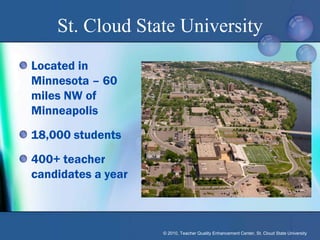
St. Cloud State University
Located in
Minnesota – 60
miles NW of
Minneapolis
18,000 students
400+ teacher
candidates a year


                    © 2010, Teacher Quality Enhancement Center, St. Cloud State University
St. Cloud TQE Initiative
• 5 year U.S. Dept. of Education, Teacher Quality
  Enhancement Partnership Grant - awarded in October 2003
   • Looked at Co-Teaching In Student Teaching

   • Collected 4 years of data (qualitative and quantitative)

   • Training and Support for Cooperating Teachers and
     University Supervisors
   • Teacher Candidates get co-teaching as a part of their
     program
   • Workshop for Pairs


                               © 2010, Teacher Quality Enhancement Center, St. Cloud State University
Co-Teaching

Co-Teaching is defined as two teachers
working together in a classroom with
groups of students; sharing the planning,
organization, delivery and assessment of
instruction as well as the physical space.

Both teachers are actively involved and engaged in all
               aspects of instruction.


                         © 2010, Teacher Quality Enhancement Center, St. Cloud State University
What Do You Mean Value-Added?

Who Benefits From Co-Teaching?
     P-12 Students
     Cooperating Teachers
     Teacher Candidates
     School Partnerships


                   © 2010, Teacher Quality Enhancement Center, St. Cloud State University
“Value Added” for
  P-12 Students


        © 2010, Teacher Quality Enhancement Center, St. Cloud State University
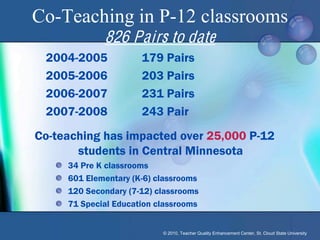
Co-Teaching in P-12 classrooms
             826 Pairs to date
 2004-2005            179 Pairs
 2005-2006            203 Pairs
 2006-2007            231 Pairs
 2007-2008            243 Pair
Co-teaching has impacted over 25,000 P-12
       students in Central Minnesota
     34 Pre K classrooms
     601 Elementary (K-6) classrooms
     120 Secondary (7-12) classrooms
     71 Special Education classrooms


                           © 2010, Teacher Quality Enhancement Center, St. Cloud State University
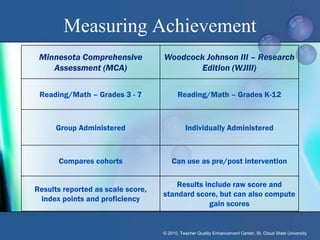
Measuring Achievement
 Minnesota Comprehensive           Woodcock Johnson III – Research
    Assessment (MCA)                       Edition (WJIII)

 Reading/Math – Grades 3 - 7             Reading/Math – Grades K-12


      Group Administered                     Individually Administered


      Compares cohorts                 Can use as pre/post intervention

                                       Results include raw score and
Results reported as scale score,
                                   standard score, but can also compute
 index points and proficiency
                                                gain scores


                                   © 2010, Teacher Quality Enhancement Center, St. Cloud State University
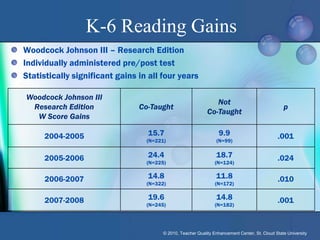
K-6 Reading Gains
Woodcock Johnson III – Research Edition
Individually administered pre/post test
Statistically significant gains in all four years

Woodcock Johnson III
                                                                Not
 Research Edition               Co-Taught                                                         p
                                                             Co-Taught
  W Score Gains

     2004-2005                    15.7                             9.9                         .001
                                  (N=221)                        (N=99)


     2005-2006                    24.4                           18.7                          .024
                                  (N=225)                        (N=124)


     2006-2007                    14.8                           11.8                          .010
                                  (N=322)                        (N=172)


     2007-2008                    19.6                           14.8                          .001
                                  (N=245)                        (N=182)


                                        © 2010, Teacher Quality Enhancement Center, St. Cloud State University
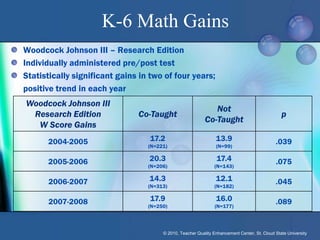
K-6 Math Gains
Woodcock Johnson III – Research Edition
Individually administered pre/post test
Statistically significant gains in two of four years;
positive trend in each year
Woodcock Johnson III
                                                              Not
 Research Edition              Co-Taught                                                        p
                                                           Co-Taught
  W Score Gains
      2004-2005                    17.2                         13.9                         .039
                                  (N=221)                       (N=99)


      2005-2006                   20.3                          17.4                         .075
                                  (N=206)                      (N=143)


      2006-2007                   14.3                          12.1                         .045
                                  (N=313)                      (N=182)


      2007-2008                    17.9                         16.0                         .089
                                  (N=250)                       (N=177)


                                       © 2010, Teacher Quality Enhancement Center, St. Cloud State University
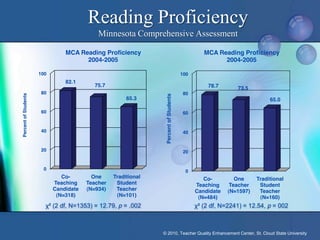
Reading Proficiency
                                            Minnesota Comprehensive Assessment

                                MCA Reading Proficiency                                         MCA Reading Proficiency
                                      2004-2005                                                       2004-2005

                      100                                                              100
                                82.1
                                           75.7                                                  78.7       73.5
                       80                                                               80
Percent of Students


                                                                 Percent of Students
                                                       65.3                                                              65.0

                       60                                                               60


                       40                                                               40


                       20                                                               20


                        0                                                                0
                               Co-        One     Traditional                                   Co-         One     Traditional
                            Teaching    Teacher    Student                                   Teaching     Teacher    Student
                            Candidate   (N=934)    Teacher                                   Candidate   (N=1597)    Teacher
                             (N=318)               (N=101)                                    (N=484)                (N=160)
                        χ² (2 df, N=1353) = 12.79, p = .002                                  χ² (2 df, N=2241) = 12.54, p = 002


                                                                © 2010, Teacher Quality Enhancement Center, St. Cloud State University
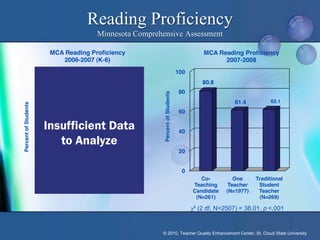
Reading Proficiency
                                         Minnesota Comprehensive Assessment

                           MCA Reading Proficiency                                         MCA Reading Proficiency
                              2006-2007 (K-6)                                                    2007-2008
                                                                                 100
                                                                                           80.8
                                                                                 80


                                                           Percent of Students
                                                                                                       61.4         62.1
Percent of Students


                                                                                 60

                          Insufficient Data                                      40
                             to Analyze
                                                                                 20


                                                                                  0
                      0                                                                   Co-         One     Traditional
                                                                                       Teaching     Teacher    Student
                                                                                       Candidate   (N=1977)    Teacher
                                                                                        (N=261)                (N=269)

                                                                                       χ² (2 df, N=2507) = 38.01, p <.001


                                                          © 2010, Teacher Quality Enhancement Center, St. Cloud State University
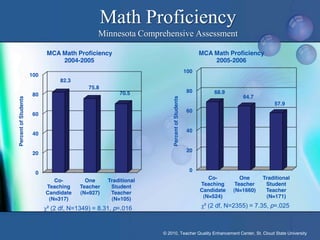
Math Proficiency
                                               Minnesota Comprehensive Assessment

                             MCA Math Proficiency                                                 MCA Math Proficiency
                                 2004-2005                                                            2005-2006
                                                                                            100
                      100
                                 82.3
                                            75.8
                                                       70.5                                 80         68.9
                      80                                                                                         64.7


                                                                      Percent of Students
Percent of Students


                                                                                                                             57.9
                                                                                            60
                      60


                                                                                            40
                      40


                                                                                            20
                      20


                        0                                                                    0
                               Co-         One     Traditional                                       Co-         One     Traditional
                            Teaching     Teacher    Student                                       Teaching     Teacher    Student
                            Candidate    (N=927)    Teacher                                       Candidate   (N=1660)    Teacher
                             (N=317)                (N=105)                                        (N=524)                (N=171)

                            χ² (2 df, N=1349) = 8.31, p=.016                                      χ² (2 df, N=2355) = 7.35, p=.025


                                                                 © 2010, Teacher Quality Enhancement Center, St. Cloud State University
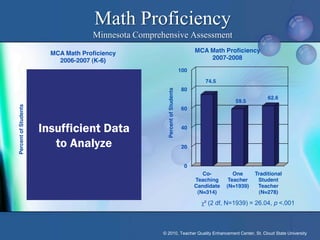
Math Proficiency
                                      Minnesota Comprehensive Assessment
                          MCA Math Proficiency                                       MCA Math Proficiency
                            2006-2007 (K-6)                                              2007-2008
                                                                               100

                                                                                        74.5
                                                                               80


                                                         Percent of Students
                                                                                                                 62.6
                                                                                                    59.5
Percent of Students


                                                                               60


                      Insufficient Data                                        40


                         to Analyze                                            20


                                                                                0
                                                                                        Co-         One     Traditional
                                                                                     Teaching     Teacher    Student
                      0                                                              Candidate   (N=1939)    Teacher
                                                                                      (N=314)                (N=278)

                                                                                       χ² (2 df, N=1939) = 26.04, p <.001


                                                       © 2010, Teacher Quality Enhancement Center, St. Cloud State University
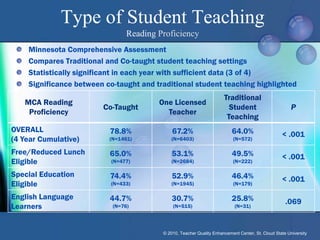
Type of Student Teaching
                                Reading Proficiency
    Minnesota Comprehensive Assessment
    Compares Traditional and Co-taught student teaching settings
    Statistically significant in each year with sufficient data (3 of 4)
    Significance between co-taught and traditional student teaching highlighted
                                                                      Traditional
   MCA Reading                          One Licensed
                        Co-Taught                                       Student                        P
    Proficiency                           Teacher
                                                                       Teaching
OVERALL                   78.8%              67.2%                        64.0%                   < .001
(4 Year Cumulative)       (N=1461)           (N=6403)                      (N=572)

Free/Reduced Lunch        65.0%              53.1%                        49.5%                   < .001
Eligible                   (N=477)           (N=2684)                      (N=222)

Special Education         74.4%              52.9%                        46.4%                   < .001
Eligible                   (N=433)           (N=1945)                      (N=179)

English Language          44.7%              30.7%                        25.8%                     .069
Learners                   (N=76)            (N=515)                       (N=31)


                                         © 2010, Teacher Quality Enhancement Center, St. Cloud State University
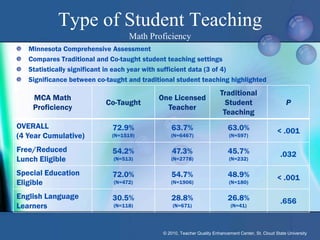
Type of Student Teaching
                                   Math Proficiency
   Minnesota Comprehensive Assessment
   Compares Traditional and Co-taught student teaching settings
   Statistically significant in each year with sufficient data (3 of 4)
   Significance between co-taught and traditional student teaching highlighted
                                                                        Traditional
    MCA Math                                One Licensed
                           Co-Taught                                      Student                       P
    Proficiency                               Teacher
                                                                         Teaching
OVERALL                      72.9%               63.7%                      63.0%                   < .001
(4 Year Cumulative)          (N=1519)           (N=6467)                     (N=597)

Free/Reduced                 54.2%               47.3%                      45.7%                     .032
Lunch Eligible               (N=513)            (N=2778)                     (N=232)

Special Education            72.0%              54.7%                       48.9%                   < .001
Eligible                     (N=472)            (N=1906)                     (N=180)

English Language             30.5%               28.8%                      26.8%                     .656
Learners                     (N=118)             (N=671)                     (N=41)


                                             © 2010, Teacher Quality Enhancement Center, St. Cloud State University
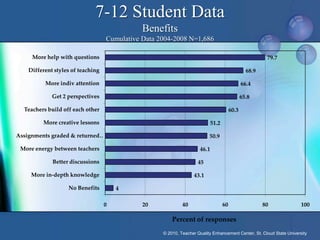
7-12 Student Data
                                              Benefits
                                   Cumulative Data 2004-2008 N=1,686

     More help with questions                                                                            79.7

    Different styles of teaching                                                                 68.9

          More indiv attention                                                                 66.4

             Get 2 perspectives                                                                65.8

  Teachers build off each other                                                         60.3

         More creative lessons                                              51.2

Assignments graded & returned 
                             …                                            50.9

 More energy between teachers                                        46.1

             Better discussions                                     45

     More in‑depth knowledge                                      43.1

                   No Benefits         4

                                   0          20             40                    60                   80             100

                                                        Percent of responses
                                                    © 2010, Teacher Quality Enhancement Center, St. Cloud State University
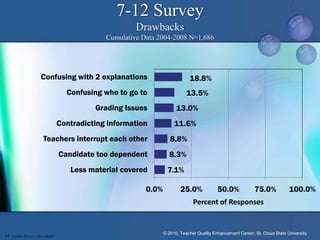
7-12 Survey
                                                   Drawbacks
                                          Cumulative Data 2004-2008 N=1,686


                  Confusing with 2 explanations                          18.8%
                               Confusing who to go to                   13.5%
                                       Grading Issues              13.0%
                             Contradicting information            11.6%
                   Teachers interrupt each other                8.8%
                             Candidate too dependent           8.3%
                                Less material covered          7.1%

                                                      0.0%           25.0%             50.0%             75.0%            100.0%
                                                                           Percent of Responses


                                                             © 2010, Teacher Quality Enhancement Center, St. Cloud State University
ST. CLOUD STATE UNIVERSITY
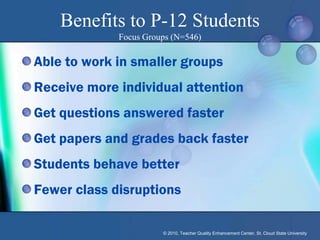
Benefits to P-12 Students
             Focus Groups (N=546)

Able to work in smaller groups
Receive more individual attention
Get questions answered faster
Get papers and grades back faster
Students behave better
Fewer class disruptions

                       © 2010, Teacher Quality Enhancement Center, St. Cloud State University
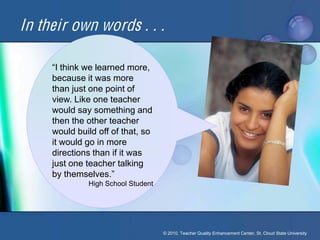
In their own words . . .

     “I think we learned more, 
     because it was more
     than just one point of
     view. Like one teacher
     would say something and
     then the other teacher
     would build off of that, so
     it would go in more
     directions than if it was
     just one teacher talking
     by themselves.”
              High School Student


                                    © 2010, Teacher Quality Enhancement Center, St. Cloud State University
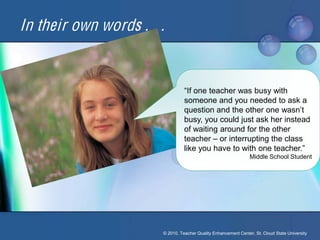
In their own words . . .


                                 “If one teacher was busy with
                                 someone and you needed to ask a
                                 question and the other one wasn’t 
                                 busy, you could just ask her instead
                                 of waiting around for the other
                                 teacher – or interrupting the class
                                 like you have to with one teacher.”
                                                                 Middle School Student


                       © 2010, Teacher Quality Enhancement Center, St. Cloud State University
“Value Added” for
Teacher Candidates


         © 2010, Teacher Quality Enhancement Center, St. Cloud State University
Benefits to Teacher Candidates
               End of Experience Survey (N=249)


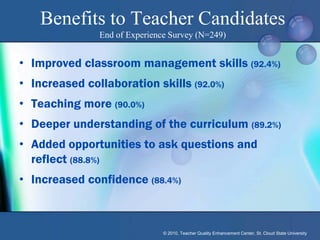
• Improved classroom management skills (92.4%)
• Increased collaboration skills (92.0%)
• Teaching more (90.0%)
• Deeper understanding of the curriculum (89.2%)
• Added opportunities to ask questions and
  reflect (88.8%)
• Increased confidence (88.4%)


                               © 2010, Teacher Quality Enhancement Center, St. Cloud State University
Benefits to Teacher Candidates
              Focus Groups (N=136)


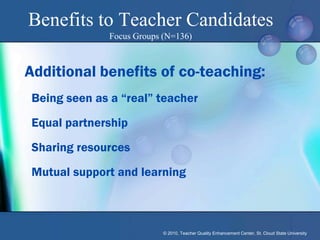
Additional benefits of co-teaching:
Being seen as a “real” teacher
Equal partnership
Sharing resources
Mutual support and learning


                           © 2010, Teacher Quality Enhancement Center, St. Cloud State University
In their own words . . .

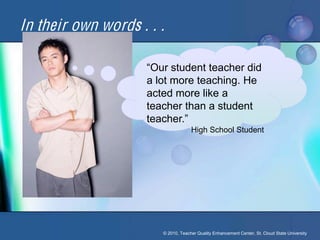
                     “Our student teacher did
                     a lot more teaching. He
                     acted more like a
                     teacher than a student
                     teacher.”
                                     High School Student


                        © 2010, Teacher Quality Enhancement Center, St. Cloud State University
In their own words . . .


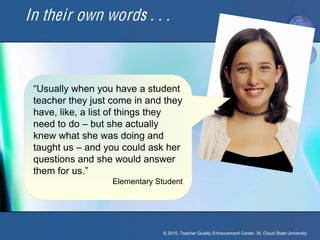
 “Usually when you have a student
 teacher they just come in and they
 have, like, a list of things they
 need to do – but she actually
 knew what she was doing and
 taught us – and you could ask her
 questions and she would answer
 them for us.”
                   Elementary Student


                                © 2010, Teacher Quality Enhancement Center, St. Cloud State University
“Value Added” for
Cooperating Teachers


          © 2010, Teacher Quality Enhancement Center, St. Cloud State University
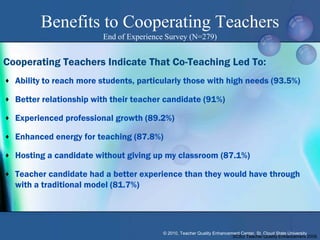
Benefits to Cooperating Teachers
                         End of Experience Survey (N=279)


Cooperating Teachers Indicate That Co-Teaching Led To:
 Ability to reach more students, particularly those with high needs (93.5%)

 Better relationship with their teacher candidate (91%)

 Experienced professional growth (89.2%)

 Enhanced energy for teaching (87.8%)

 Hosting a candidate without giving up my classroom (87.1%)

 Teacher candidate had a better experience than they would have through
  with a traditional model (81.7%)


                                         © 2010, Teacher Quality Enhancement Center, St. Cloud State University
                                                                         SCSU Teacher Quality Enhancement 2008
Benefits to Cooperating Teachers
                      Focus Groups (N=92)

Additional Benefits of Co-Teaching:

    Ability to do projects more successfully

    Class time is more productive

    Modeling and participating in teamwork

    Candidates become competent more quickly


                                © 2010, Teacher Quality Enhancement Center, St. Cloud State University
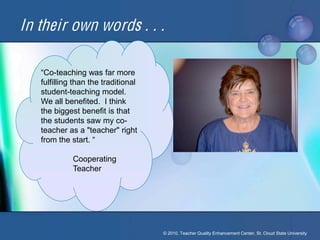
In their own words . . .

   “Co-teaching was far more
   fulfilling than the traditional
   student-teaching model.
   We all benefited. I think
   the biggest benefit is that
   the students saw my co-
   teacher as a "teacher" right
   from the start. “

             Cooperating
             Teacher


                                     © 2010, Teacher Quality Enhancement Center, St. Cloud State University
“Value Added” for
School Partnerships


         © 2010, Teacher Quality Enhancement Center, St. Cloud State University
School Partnerships

Strengthened our partnerships with districts
Teachers felt a “part” of the teacher preparation
program
More cooperating teachers then teacher
candidates (in most areas)


                        © 2010, Teacher Quality Enhancement Center, St. Cloud State University
In their own words . . .

“The results are proven as far as I’m concerned 
       we have better student teachers,
     we have better cooperating teachers,
     so it’s the best of both worlds for me.”

  “I think it’s a blueprint for teacher preparation 
                 institutions to follow.”
                                                          Mike Spanier
                                         Sartell Middle School Principal


                           © 2010, Teacher Quality Enhancement Center, St. Cloud State University
What Now?
 Institutionalization of Project
 Dissemination of Findings
   Presentations
   Publications
   Train-the-trainer workshop
   DVD
   Handbook


 www.stcloudstate.edu/coe/tqe


                           © 2010, Teacher Quality Enhancement Center, St. Cloud State University
Contact Us
 Teacher Quality Enhancement Center
Nancy Bacharach - nlbacharach@stcloudstate.edu
     Beth Mann - bjmann@stcloudstate.edu
 Teresa Washut Heck - twheck@stcloudstate.edu


        www.stcloudstate.edu/coe/tqe


                       © 2010, Teacher Quality Enhancement Center, St. Cloud State University

Pds Value Added

  • 1.
    Co-Teaching in StudentTeaching: A Value Added Model St. C loud State University – College of E ducation Funded by a Teacher Quality Enhancement Partnership Grant from the U.S. Department of Education © 2010, Teacher Quality Enhancement Center, St. Cloud State University
  • 2.
    St. Cloud StateUniversity Located in Minnesota – 60 miles NW of Minneapolis 18,000 students 400+ teacher candidates a year © 2010, Teacher Quality Enhancement Center, St. Cloud State University
  • 3.
    St. Cloud TQEInitiative • 5 year U.S. Dept. of Education, Teacher Quality Enhancement Partnership Grant - awarded in October 2003 • Looked at Co-Teaching In Student Teaching • Collected 4 years of data (qualitative and quantitative) • Training and Support for Cooperating Teachers and University Supervisors • Teacher Candidates get co-teaching as a part of their program • Workshop for Pairs © 2010, Teacher Quality Enhancement Center, St. Cloud State University
  • 4.
    Co-Teaching Co-Teaching is definedas two teachers working together in a classroom with groups of students; sharing the planning, organization, delivery and assessment of instruction as well as the physical space. Both teachers are actively involved and engaged in all aspects of instruction. © 2010, Teacher Quality Enhancement Center, St. Cloud State University
  • 5.
    What Do YouMean Value-Added? Who Benefits From Co-Teaching?  P-12 Students  Cooperating Teachers  Teacher Candidates  School Partnerships © 2010, Teacher Quality Enhancement Center, St. Cloud State University
  • 6.
    “Value Added” for P-12Students © 2010, Teacher Quality Enhancement Center, St. Cloud State University
  • 7.
    Co-Teaching in P-12classrooms 826 Pairs to date 2004-2005 179 Pairs 2005-2006 203 Pairs 2006-2007 231 Pairs 2007-2008 243 Pair Co-teaching has impacted over 25,000 P-12 students in Central Minnesota 34 Pre K classrooms 601 Elementary (K-6) classrooms 120 Secondary (7-12) classrooms 71 Special Education classrooms © 2010, Teacher Quality Enhancement Center, St. Cloud State University
  • 8.
    Measuring Achievement MinnesotaComprehensive Woodcock Johnson III – Research Assessment (MCA) Edition (WJIII) Reading/Math – Grades 3 - 7 Reading/Math – Grades K-12 Group Administered Individually Administered Compares cohorts Can use as pre/post intervention Results include raw score and Results reported as scale score, standard score, but can also compute index points and proficiency gain scores © 2010, Teacher Quality Enhancement Center, St. Cloud State University
  • 9.
    K-6 Reading Gains WoodcockJohnson III – Research Edition Individually administered pre/post test Statistically significant gains in all four years Woodcock Johnson III Not Research Edition Co-Taught p Co-Taught W Score Gains 2004-2005 15.7 9.9 .001 (N=221) (N=99) 2005-2006 24.4 18.7 .024 (N=225) (N=124) 2006-2007 14.8 11.8 .010 (N=322) (N=172) 2007-2008 19.6 14.8 .001 (N=245) (N=182) © 2010, Teacher Quality Enhancement Center, St. Cloud State University
  • 10.
    K-6 Math Gains WoodcockJohnson III – Research Edition Individually administered pre/post test Statistically significant gains in two of four years; positive trend in each year Woodcock Johnson III Not Research Edition Co-Taught p Co-Taught W Score Gains 2004-2005 17.2 13.9 .039 (N=221) (N=99) 2005-2006 20.3 17.4 .075 (N=206) (N=143) 2006-2007 14.3 12.1 .045 (N=313) (N=182) 2007-2008 17.9 16.0 .089 (N=250) (N=177) © 2010, Teacher Quality Enhancement Center, St. Cloud State University
  • 11.
    Reading Proficiency Minnesota Comprehensive Assessment MCA Reading Proficiency MCA Reading Proficiency 2004-2005 2004-2005 100 100 82.1 75.7 78.7 73.5 80 80 Percent of Students Percent of Students 65.3 65.0 60 60 40 40 20 20 0 0 Co- One Traditional Co- One Traditional Teaching Teacher Student Teaching Teacher Student Candidate (N=934) Teacher Candidate (N=1597) Teacher (N=318) (N=101) (N=484) (N=160) χ² (2 df, N=1353) = 12.79, p = .002 χ² (2 df, N=2241) = 12.54, p = 002 © 2010, Teacher Quality Enhancement Center, St. Cloud State University
  • 12.
    Reading Proficiency Minnesota Comprehensive Assessment MCA Reading Proficiency MCA Reading Proficiency 2006-2007 (K-6) 2007-2008 100 80.8 80 Percent of Students 61.4 62.1 Percent of Students 60 Insufficient Data 40 to Analyze 20 0 0 Co- One Traditional Teaching Teacher Student Candidate (N=1977) Teacher (N=261) (N=269) χ² (2 df, N=2507) = 38.01, p <.001 © 2010, Teacher Quality Enhancement Center, St. Cloud State University
  • 13.
    Math Proficiency Minnesota Comprehensive Assessment MCA Math Proficiency MCA Math Proficiency 2004-2005 2005-2006 100 100 82.3 75.8 70.5 80 68.9 80 64.7 Percent of Students Percent of Students 57.9 60 60 40 40 20 20 0 0 Co- One Traditional Co- One Traditional Teaching Teacher Student Teaching Teacher Student Candidate (N=927) Teacher Candidate (N=1660) Teacher (N=317) (N=105) (N=524) (N=171) χ² (2 df, N=1349) = 8.31, p=.016 χ² (2 df, N=2355) = 7.35, p=.025 © 2010, Teacher Quality Enhancement Center, St. Cloud State University
  • 14.
    Math Proficiency Minnesota Comprehensive Assessment MCA Math Proficiency MCA Math Proficiency 2006-2007 (K-6) 2007-2008 100 74.5 80 Percent of Students 62.6 59.5 Percent of Students 60 Insufficient Data 40 to Analyze 20 0 Co- One Traditional Teaching Teacher Student 0 Candidate (N=1939) Teacher (N=314) (N=278) χ² (2 df, N=1939) = 26.04, p <.001 © 2010, Teacher Quality Enhancement Center, St. Cloud State University
  • 15.
    Type of StudentTeaching Reading Proficiency Minnesota Comprehensive Assessment Compares Traditional and Co-taught student teaching settings Statistically significant in each year with sufficient data (3 of 4) Significance between co-taught and traditional student teaching highlighted Traditional MCA Reading One Licensed Co-Taught Student P Proficiency Teacher Teaching OVERALL 78.8% 67.2% 64.0% < .001 (4 Year Cumulative) (N=1461) (N=6403) (N=572) Free/Reduced Lunch 65.0% 53.1% 49.5% < .001 Eligible (N=477) (N=2684) (N=222) Special Education 74.4% 52.9% 46.4% < .001 Eligible (N=433) (N=1945) (N=179) English Language 44.7% 30.7% 25.8% .069 Learners (N=76) (N=515) (N=31) © 2010, Teacher Quality Enhancement Center, St. Cloud State University
  • 16.
    Type of StudentTeaching Math Proficiency Minnesota Comprehensive Assessment Compares Traditional and Co-taught student teaching settings Statistically significant in each year with sufficient data (3 of 4) Significance between co-taught and traditional student teaching highlighted Traditional MCA Math One Licensed Co-Taught Student P Proficiency Teacher Teaching OVERALL 72.9% 63.7% 63.0% < .001 (4 Year Cumulative) (N=1519) (N=6467) (N=597) Free/Reduced 54.2% 47.3% 45.7% .032 Lunch Eligible (N=513) (N=2778) (N=232) Special Education 72.0% 54.7% 48.9% < .001 Eligible (N=472) (N=1906) (N=180) English Language 30.5% 28.8% 26.8% .656 Learners (N=118) (N=671) (N=41) © 2010, Teacher Quality Enhancement Center, St. Cloud State University
  • 17.
    7-12 Student Data Benefits Cumulative Data 2004-2008 N=1,686 More help with questions 79.7 Different styles of teaching 68.9 More indiv attention 66.4 Get 2 perspectives 65.8 Teachers build off each other 60.3 More creative lessons 51.2 Assignments graded & returned  … 50.9 More energy between teachers 46.1 Better discussions 45 More in‑depth knowledge 43.1 No Benefits 4 0 20 40 60 80 100 Percent of responses © 2010, Teacher Quality Enhancement Center, St. Cloud State University
  • 18.
    7-12 Survey Drawbacks Cumulative Data 2004-2008 N=1,686 Confusing with 2 explanations 18.8% Confusing who to go to 13.5% Grading Issues 13.0% Contradicting information 11.6% Teachers interrupt each other 8.8% Candidate too dependent 8.3% Less material covered 7.1% 0.0% 25.0% 50.0% 75.0% 100.0% Percent of Responses © 2010, Teacher Quality Enhancement Center, St. Cloud State University ST. CLOUD STATE UNIVERSITY
  • 19.
    Benefits to P-12Students Focus Groups (N=546) Able to work in smaller groups Receive more individual attention Get questions answered faster Get papers and grades back faster Students behave better Fewer class disruptions © 2010, Teacher Quality Enhancement Center, St. Cloud State University
  • 20.
    In their ownwords . . . “I think we learned more,  because it was more than just one point of view. Like one teacher would say something and then the other teacher would build off of that, so it would go in more directions than if it was just one teacher talking by themselves.” High School Student © 2010, Teacher Quality Enhancement Center, St. Cloud State University
  • 21.
    In their ownwords . . . “If one teacher was busy with someone and you needed to ask a question and the other one wasn’t  busy, you could just ask her instead of waiting around for the other teacher – or interrupting the class like you have to with one teacher.” Middle School Student © 2010, Teacher Quality Enhancement Center, St. Cloud State University
  • 22.
    “Value Added” for Teacher Candidates © 2010, Teacher Quality Enhancement Center, St. Cloud State University
  • 23.
    Benefits to TeacherCandidates End of Experience Survey (N=249) • Improved classroom management skills (92.4%) • Increased collaboration skills (92.0%) • Teaching more (90.0%) • Deeper understanding of the curriculum (89.2%) • Added opportunities to ask questions and reflect (88.8%) • Increased confidence (88.4%) © 2010, Teacher Quality Enhancement Center, St. Cloud State University
  • 24.
    Benefits to TeacherCandidates Focus Groups (N=136) Additional benefits of co-teaching: Being seen as a “real” teacher Equal partnership Sharing resources Mutual support and learning © 2010, Teacher Quality Enhancement Center, St. Cloud State University
  • 25.
    In their ownwords . . . “Our student teacher did a lot more teaching. He acted more like a teacher than a student teacher.” High School Student © 2010, Teacher Quality Enhancement Center, St. Cloud State University
  • 26.
    In their ownwords . . . “Usually when you have a student teacher they just come in and they have, like, a list of things they need to do – but she actually knew what she was doing and taught us – and you could ask her questions and she would answer them for us.” Elementary Student © 2010, Teacher Quality Enhancement Center, St. Cloud State University
  • 27.
    “Value Added” for Cooperating Teachers © 2010, Teacher Quality Enhancement Center, St. Cloud State University
  • 28.
    Benefits to CooperatingTeachers End of Experience Survey (N=279) Cooperating Teachers Indicate That Co-Teaching Led To:  Ability to reach more students, particularly those with high needs (93.5%)  Better relationship with their teacher candidate (91%)  Experienced professional growth (89.2%)  Enhanced energy for teaching (87.8%)  Hosting a candidate without giving up my classroom (87.1%)  Teacher candidate had a better experience than they would have through with a traditional model (81.7%) © 2010, Teacher Quality Enhancement Center, St. Cloud State University SCSU Teacher Quality Enhancement 2008
  • 29.
    Benefits to CooperatingTeachers Focus Groups (N=92) Additional Benefits of Co-Teaching:  Ability to do projects more successfully  Class time is more productive  Modeling and participating in teamwork  Candidates become competent more quickly © 2010, Teacher Quality Enhancement Center, St. Cloud State University
  • 30.
    In their ownwords . . . “Co-teaching was far more fulfilling than the traditional student-teaching model. We all benefited. I think the biggest benefit is that the students saw my co- teacher as a "teacher" right from the start. “ Cooperating Teacher © 2010, Teacher Quality Enhancement Center, St. Cloud State University
  • 31.
    “Value Added” for School Partnerships © 2010, Teacher Quality Enhancement Center, St. Cloud State University
  • 32.
    School Partnerships Strengthened ourpartnerships with districts Teachers felt a “part” of the teacher preparation program More cooperating teachers then teacher candidates (in most areas) © 2010, Teacher Quality Enhancement Center, St. Cloud State University
  • 33.
    In their ownwords . . . “The results are proven as far as I’m concerned  we have better student teachers, we have better cooperating teachers, so it’s the best of both worlds for me.” “I think it’s a blueprint for teacher preparation  institutions to follow.” Mike Spanier Sartell Middle School Principal © 2010, Teacher Quality Enhancement Center, St. Cloud State University
  • 34.
    What Now? Institutionalizationof Project Dissemination of Findings Presentations Publications Train-the-trainer workshop DVD Handbook www.stcloudstate.edu/coe/tqe © 2010, Teacher Quality Enhancement Center, St. Cloud State University
  • 35.
    Contact Us TeacherQuality Enhancement Center Nancy Bacharach - nlbacharach@stcloudstate.edu Beth Mann - bjmann@stcloudstate.edu Teresa Washut Heck - twheck@stcloudstate.edu www.stcloudstate.edu/coe/tqe © 2010, Teacher Quality Enhancement Center, St. Cloud State University