Pre-Departure Orientation
Seminar for OFWs Bound for
South Korea
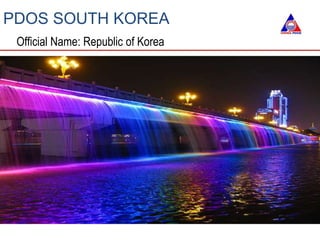
PDOS SOUTH KOREA
Official Name: Republic of Korea
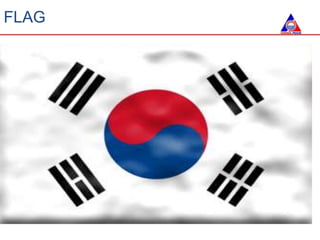
FLAG
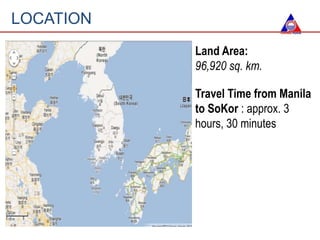
LOCATION
Travel Time from Manila
to SoKor : approx. 3
hours, 30 minutes
Land Area:
96,920 sq. km.
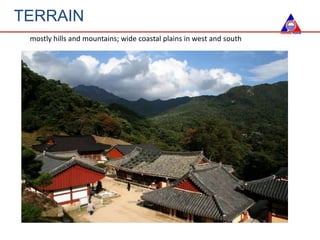
TERRAIN
mostly hills and mountains; wide coastal plains in west and south
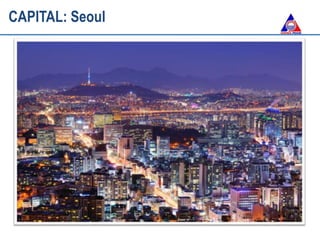
CAPITAL: Seoul
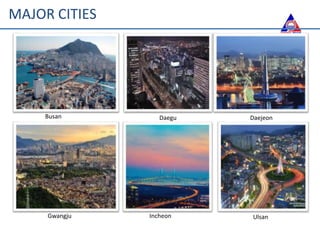
MAJOR CITIES
Busan Daegu Daejeon
Gwangju Incheon Ulsan
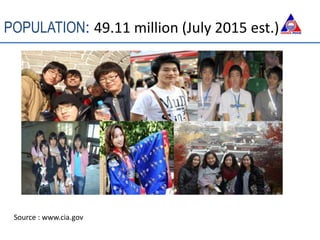
POPULATION: 49.11 million (July 2015 est.)
Source : www.cia.gov
GOVERNMENT
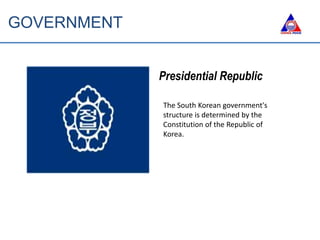
Presidential Republic
The South Korean government's
structure is determined by the
Constitution of the Republic of
Korea.
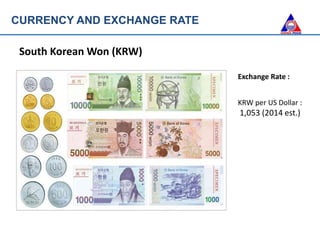
CURRENCY AND EXCHANGE RATE
South Korean Won (KRW)
Exchange Rate :
KRW per US Dollar :
1,053 (2014 est.)
COMMUNICATION
When Calling from South
Korea to Philippines:
Dial 001 + 63 + area
code+ tel. no.
When Calling from the
Philippines to Korea:
Dial 00 + 82 + area code +
tel. no.
Internet Country Code: .kr
Time Difference: 1 hour
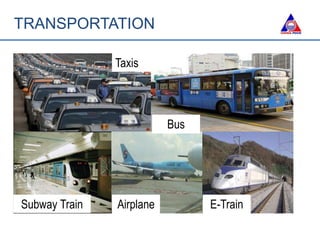
TRANSPORTATION
Taxis
Bus
Subway Train Airplane E-Train
DRIVING TIPS
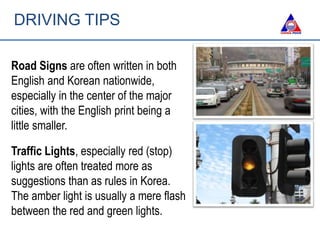
Road Signs are often written in both
English and Korean nationwide,
especially in the center of the major
cities, with the English print being a
little smaller.
Traffic Lights, especially red (stop)
lights are often treated more as
suggestions than as rules in Korea.
The amber light is usually a mere flash
between the red and green lights.
DRIVING TIPS
• Parking is a serious problem in
Korea. In Seoul, there are simply
too many automobiles. The streets
are too narrow and parking spaces
are very scarce.
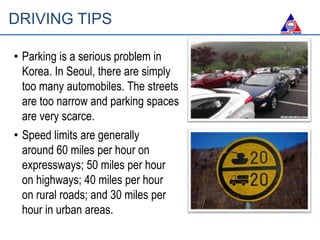
• Speed limits are generally
around 60 miles per hour on
expressways; 50 miles per hour
on highways; 40 miles per hour
on rural roads; and 30 miles per
hour in urban areas.
BUSINESS HOURS
Banks
Weekdays: 09:00 am– 4:00 pm
Weekends and National Holidays: Closed
Government Offices and Organizations
Weekdays: 09:00 am– 6:00 pm
Weekends and National Holidays: Closed
Post Offices
Weekdays: 09:00 am – 6:00 pm
Public Holidays: Closed
Department Stores
10:30 am – 8:00 pm
* Typically, department stores are closed to the public once a month usually on a
Monday. However, closings will vary according to each store.
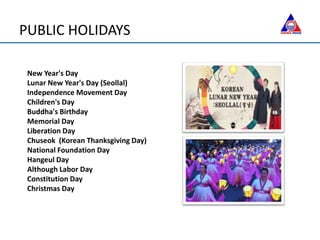
PUBLIC HOLIDAYS
New Year's Day
Lunar New Year's Day (Seollal)
Independence Movement Day
Children's Day
Buddha's Birthday
Memorial Day
Liberation Day
Chuseok (Korean Thanksgiving Day)
National Foundation Day
Hangeul Day
Although Labor Day
Constitution Day
Christmas Day
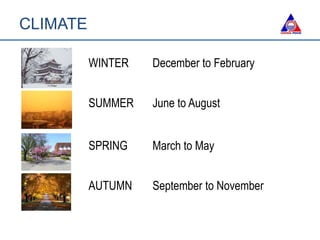
CLIMATE
WINTER December to February
SPRING March to May
SUMMER June to August
AUTUMN September to November
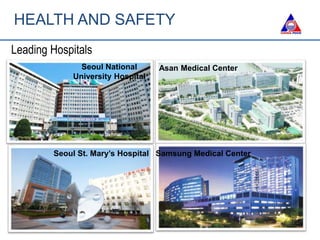
HEALTH AND SAFETY
Leading Hospitals
Seoul National
University Hospital
Seoul St. Mary’s Hospital Samsung Medical Center
Asan Medical Center
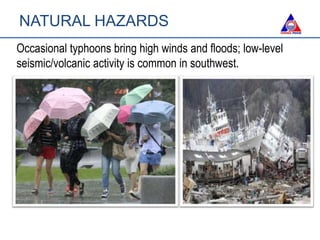
Occasional typhoons bring high winds and floods; low-level
seismic/volcanic activity is common in southwest.
NATURAL HAZARDS
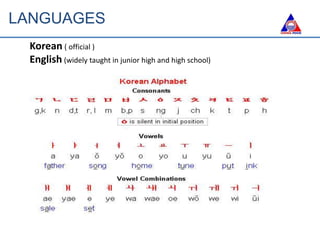
LANGUAGES
Korean ( official )
English (widely taught in junior high and high school)
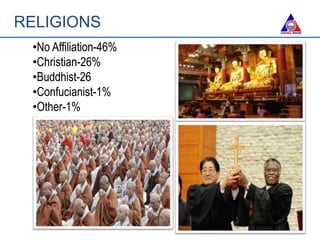
RELIGIONS
•No Affiliation-46%
•Christian-26%
•Buddhist-26
•Confucianist-1%
•Other-1%
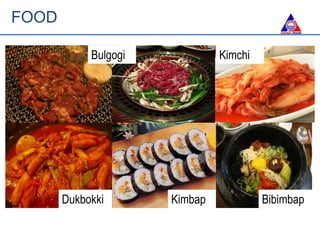
FOOD
Bulgogi
Dukbokki
Kimchi
BibimbapKimbap
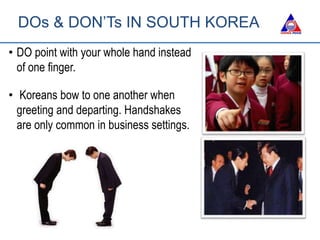
DOs & DON’Ts IN SOUTH KOREA
• DO point with your whole hand instead
of one finger.
• Koreans bow to one another when
greeting and departing. Handshakes
are only common in business settings.
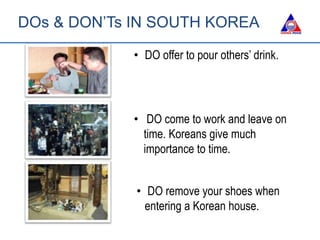
• DO offer to pour others’ drink.
• DO come to work and leave on
time. Koreans give much
importance to time.
• DO remove your shoes when
entering a Korean house.
DOs & DON’Ts IN SOUTH KOREA
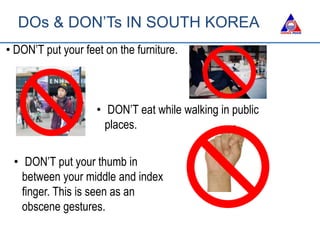
• DON’T put your feet on the furniture.
• DON’T eat while walking in public
places.
• DON’T put your thumb in
between your middle and index
finger. This is seen as an
obscene gestures.
DOs & DON’Ts IN SOUTH KOREA
STATISTICAL INFORMATION ON OVERSEAS FILIPINOS
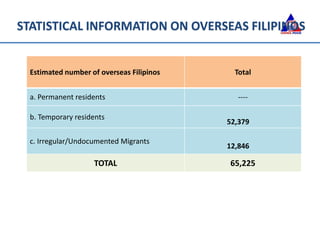
Estimated number of overseas Filipinos Total
a. Permanent residents ----
b. Temporary residents
52,379
c. Irregular/Undocumented Migrants
12,846
TOTAL 65,225
PREVAILING LAWS AND POLICIES AFFECTING OFWs
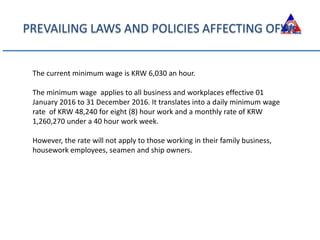
The current minimum wage is KRW 6,030 an hour.
The minimum wage applies to all business and workplaces effective 01
January 2016 to 31 December 2016. It translates into a daily minimum wage
rate of KRW 48,240 for eight (8) hour work and a monthly rate of KRW
1,260,270 under a 40 hour work week.
However, the rate will not apply to those working in their family business,
housework employees, seamen and ship owners.
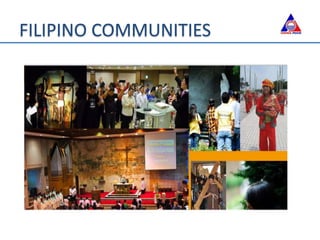
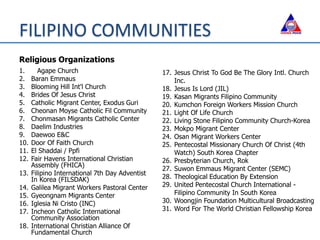
FILIPINO COMMUNITIES
1. Agape Church
2. Baran Emmaus
3. Blooming Hill Int'l Church
4. Brides Of Jesus Christ
5. Catholic Migrant Center, Exodus Guri
6. Cheonan Moyse Catholic Fil Community
7. Chonmasan Migrants Catholic Center
8. Daelim Industries
9. Daewoo E&C
10. Door Of Faith Church
11. El Shaddai / Ppfi
12. Fair Havens International Christian
Assembly (FHICA)
13. Filipino International 7th Day Adventist
In Korea (FILSDAK)
14. Galilea Migrant Workers Pastoral Center
15. Gyeongnam Migrants Center
16. Iglesia Ni Cristo (INC)
17. Incheon Catholic International
Community Association
18. International Christian Alliance Of
Fundamental Church
17. Jesus Christ To God Be The Glory Intl. Church
Inc.
18. Jesus Is Lord (JIL)
19. Kasan Migrants Filipino Community
20. Kumchon Foreign Workers Mission Church
21. Light Of Life Church
22. Living Stone Filipino Community Church-Korea
23. Mokpo Migrant Center
24. Osan Migrant Workers Center
25. Pentecostal Missionary Church Of Christ (4th
Watch) South Korea Chapter
26. Presbyterian Church, Rok
27. Suwon Emmaus Migrant Center (SEMC)
28. Theological Education By Extension
29. United Pentecostal Church International -
Filipino Community In South Korea
30. Woongjin Foundation Multicultural Broadcasting
31. Word For The World Christian Fellowship Korea
Religious Organizations
FILIPINO COMMUNITIES
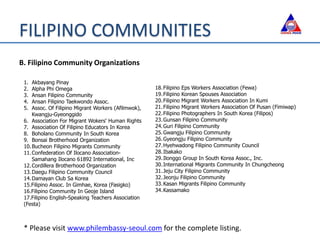
B. Filipino Community Organizations
1. Akbayang Pinay
2. Alpha Phi Omega
3. Ansan Filipino Community
4. Ansan Filipino Taekwondo Assoc.
5. Assoc. Of Filipino Migrant Workers (Afilmwok),
Kwangju-Gyeonggido
6. Association For Migrant Wokers' Human Rights
7. Association Of Filipino Educators In Korea
8. Boholano Community In South Korea
9. Bonsai Brotherhood Organization
10.Bucheon Filipino Migrants Community
11.Confederation Of Ilocano Association-
Samahang Ilocano 61892 International, Inc
12.Cordillera Brotherhood Organization
13.Daegu Filipino Community Council
14.Damayan Club Sa Korea
15.Filipino Assoc. In Gimhae, Korea (Fasigko)
16.Filipino Community In Geoje Island
17.Filipino English-Speaking Teachers Association
(Festa)
18.Filipino Eps Workers Association (Fewa)
19.Filipino Korean Spouses Association
20.Filipino Migrant Workers Association In Kumi
21.Filipino Migrant Workers Association Of Pusan (Fimiwap)
22.Filipino Photographers In South Korea (Filipos)
23.Gunsan Filipino Community
24.Guri Filipino Community
25.Gwangju Filipino Community
26.Gyeongju Filipino Community
27.Hyehwadong Filipino Community Council
28.Ibakako
29.Ilonggo Group In South Korea Assoc., Inc.
30.International Migrants Community In Chungcheong
31.Jeju City Filipino Community
32.Jeonju Filipino Community
33.Kasan Migrants Filipino Community
34.Kassamako
* Please visit www.philembassy-seoul.com for the complete listing.
FILIPINO COMMUNITIES
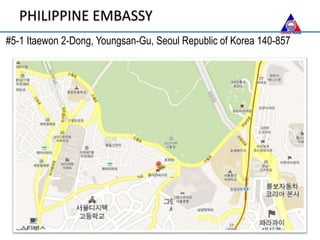
#5-1 Itaewon 2-Dong, Youngsan-Gu, Seoul Republic of Korea 140-857
PHILIPPINE EMBASSY
(822) 3785-3634, 3785-3635
(8210) 4573 6290
(8210) 4573 6290
(8210) 9054 0694
labor@philembassy-seoul.com;
polokor@gmail.com
owwaseoul@gmail.com
PHILIPPINE EMBASSY
http://www.lonelyplanet.com/south-korea/work-study-volunteering/work
http://www.culturecrossing.net/basics_business_student_details.php?Id=9&CID=110
http://www.nationmaster.com/country/ks-korea-south
http://www.southkoreagovernment.com/
https://www.cia.gov/library/publications/resources/the-world-factbook/geos/ks.html
http://www.korea.net/
http://english.visitkorea.or.kr/
http://www.moel.go.kr/english/main.jsp
http://www.philembassy-seoul.com/
REFERENCES

PDOS ONLINE | MODULE 2.1 | Working Overseas - Korea

  • 1.
    Pre-Departure Orientation Seminar forOFWs Bound for South Korea
  • 2.
    PDOS SOUTH KOREA OfficialName: Republic of Korea
  • 3.
  • 4.
    LOCATION Travel Time fromManila to SoKor : approx. 3 hours, 30 minutes Land Area: 96,920 sq. km.
  • 5.
    TERRAIN mostly hills andmountains; wide coastal plains in west and south
  • 6.
  • 7.
    MAJOR CITIES Busan DaeguDaejeon Gwangju Incheon Ulsan
  • 8.
    POPULATION: 49.11 million(July 2015 est.) Source : www.cia.gov
  • 9.
    GOVERNMENT Presidential Republic The SouthKorean government's structure is determined by the Constitution of the Republic of Korea.
  • 10.
    CURRENCY AND EXCHANGERATE South Korean Won (KRW) Exchange Rate : KRW per US Dollar : 1,053 (2014 est.)
  • 11.
    COMMUNICATION When Calling fromSouth Korea to Philippines: Dial 001 + 63 + area code+ tel. no. When Calling from the Philippines to Korea: Dial 00 + 82 + area code + tel. no. Internet Country Code: .kr Time Difference: 1 hour
  • 12.
  • 13.
    DRIVING TIPS Road Signsare often written in both English and Korean nationwide, especially in the center of the major cities, with the English print being a little smaller. Traffic Lights, especially red (stop) lights are often treated more as suggestions than as rules in Korea. The amber light is usually a mere flash between the red and green lights.
  • 14.
    DRIVING TIPS • Parkingis a serious problem in Korea. In Seoul, there are simply too many automobiles. The streets are too narrow and parking spaces are very scarce. • Speed limits are generally around 60 miles per hour on expressways; 50 miles per hour on highways; 40 miles per hour on rural roads; and 30 miles per hour in urban areas.
  • 15.
    BUSINESS HOURS Banks Weekdays: 09:00am– 4:00 pm Weekends and National Holidays: Closed Government Offices and Organizations Weekdays: 09:00 am– 6:00 pm Weekends and National Holidays: Closed Post Offices Weekdays: 09:00 am – 6:00 pm Public Holidays: Closed Department Stores 10:30 am – 8:00 pm * Typically, department stores are closed to the public once a month usually on a Monday. However, closings will vary according to each store.
  • 16.
    PUBLIC HOLIDAYS New Year'sDay Lunar New Year's Day (Seollal) Independence Movement Day Children's Day Buddha's Birthday Memorial Day Liberation Day Chuseok (Korean Thanksgiving Day) National Foundation Day Hangeul Day Although Labor Day Constitution Day Christmas Day
  • 17.
    CLIMATE WINTER December toFebruary SPRING March to May SUMMER June to August AUTUMN September to November
  • 18.
    HEALTH AND SAFETY LeadingHospitals Seoul National University Hospital Seoul St. Mary’s Hospital Samsung Medical Center Asan Medical Center
  • 19.
    Occasional typhoons bringhigh winds and floods; low-level seismic/volcanic activity is common in southwest. NATURAL HAZARDS
  • 20.
    LANGUAGES Korean ( official) English (widely taught in junior high and high school)
  • 21.
  • 22.
  • 23.
    DOs & DON’TsIN SOUTH KOREA • DO point with your whole hand instead of one finger. • Koreans bow to one another when greeting and departing. Handshakes are only common in business settings.
  • 24.
    • DO offerto pour others’ drink. • DO come to work and leave on time. Koreans give much importance to time. • DO remove your shoes when entering a Korean house. DOs & DON’Ts IN SOUTH KOREA
  • 25.
    • DON’T putyour feet on the furniture. • DON’T eat while walking in public places. • DON’T put your thumb in between your middle and index finger. This is seen as an obscene gestures. DOs & DON’Ts IN SOUTH KOREA
  • 26.
    STATISTICAL INFORMATION ONOVERSEAS FILIPINOS Estimated number of overseas Filipinos Total a. Permanent residents ---- b. Temporary residents 52,379 c. Irregular/Undocumented Migrants 12,846 TOTAL 65,225
  • 27.
    PREVAILING LAWS ANDPOLICIES AFFECTING OFWs The current minimum wage is KRW 6,030 an hour. The minimum wage applies to all business and workplaces effective 01 January 2016 to 31 December 2016. It translates into a daily minimum wage rate of KRW 48,240 for eight (8) hour work and a monthly rate of KRW 1,260,270 under a 40 hour work week. However, the rate will not apply to those working in their family business, housework employees, seamen and ship owners.
  • 28.
  • 29.
    1. Agape Church 2.Baran Emmaus 3. Blooming Hill Int'l Church 4. Brides Of Jesus Christ 5. Catholic Migrant Center, Exodus Guri 6. Cheonan Moyse Catholic Fil Community 7. Chonmasan Migrants Catholic Center 8. Daelim Industries 9. Daewoo E&C 10. Door Of Faith Church 11. El Shaddai / Ppfi 12. Fair Havens International Christian Assembly (FHICA) 13. Filipino International 7th Day Adventist In Korea (FILSDAK) 14. Galilea Migrant Workers Pastoral Center 15. Gyeongnam Migrants Center 16. Iglesia Ni Cristo (INC) 17. Incheon Catholic International Community Association 18. International Christian Alliance Of Fundamental Church 17. Jesus Christ To God Be The Glory Intl. Church Inc. 18. Jesus Is Lord (JIL) 19. Kasan Migrants Filipino Community 20. Kumchon Foreign Workers Mission Church 21. Light Of Life Church 22. Living Stone Filipino Community Church-Korea 23. Mokpo Migrant Center 24. Osan Migrant Workers Center 25. Pentecostal Missionary Church Of Christ (4th Watch) South Korea Chapter 26. Presbyterian Church, Rok 27. Suwon Emmaus Migrant Center (SEMC) 28. Theological Education By Extension 29. United Pentecostal Church International - Filipino Community In South Korea 30. Woongjin Foundation Multicultural Broadcasting 31. Word For The World Christian Fellowship Korea Religious Organizations FILIPINO COMMUNITIES
  • 30.
    B. Filipino CommunityOrganizations 1. Akbayang Pinay 2. Alpha Phi Omega 3. Ansan Filipino Community 4. Ansan Filipino Taekwondo Assoc. 5. Assoc. Of Filipino Migrant Workers (Afilmwok), Kwangju-Gyeonggido 6. Association For Migrant Wokers' Human Rights 7. Association Of Filipino Educators In Korea 8. Boholano Community In South Korea 9. Bonsai Brotherhood Organization 10.Bucheon Filipino Migrants Community 11.Confederation Of Ilocano Association- Samahang Ilocano 61892 International, Inc 12.Cordillera Brotherhood Organization 13.Daegu Filipino Community Council 14.Damayan Club Sa Korea 15.Filipino Assoc. In Gimhae, Korea (Fasigko) 16.Filipino Community In Geoje Island 17.Filipino English-Speaking Teachers Association (Festa) 18.Filipino Eps Workers Association (Fewa) 19.Filipino Korean Spouses Association 20.Filipino Migrant Workers Association In Kumi 21.Filipino Migrant Workers Association Of Pusan (Fimiwap) 22.Filipino Photographers In South Korea (Filipos) 23.Gunsan Filipino Community 24.Guri Filipino Community 25.Gwangju Filipino Community 26.Gyeongju Filipino Community 27.Hyehwadong Filipino Community Council 28.Ibakako 29.Ilonggo Group In South Korea Assoc., Inc. 30.International Migrants Community In Chungcheong 31.Jeju City Filipino Community 32.Jeonju Filipino Community 33.Kasan Migrants Filipino Community 34.Kassamako * Please visit www.philembassy-seoul.com for the complete listing. FILIPINO COMMUNITIES
  • 31.
    #5-1 Itaewon 2-Dong,Youngsan-Gu, Seoul Republic of Korea 140-857 PHILIPPINE EMBASSY
  • 32.
    (822) 3785-3634, 3785-3635 (8210)4573 6290 (8210) 4573 6290 (8210) 9054 0694 labor@philembassy-seoul.com; polokor@gmail.com owwaseoul@gmail.com PHILIPPINE EMBASSY
  • 33.

Editor's Notes

  • #3 The Korean Peninsula extends southward from the northeast part of the Asian continent. The country has a long history and proud tradition. Buddhism and Confucianism have influenced the nation's society and culture.  Koreans, like many other Asian peoples, are descendants of the Mongolian Tungus stock. They differ from the neighboring Japanese and Chinese, however, in that Koreans are a homogeneous ethnic group with their own language, culture, and customs. Over the last several decades, Korea has transformed herself from an agrarian society to an industrial leader on the world economic scene. Progress is being made in education, science and technology and social welfare.  In 2002 South Korea has co-hosted, the FIFA World CupTM tournament. 
  • #4 The flag, called "Tae Kuk," symbolizes the thought, philosophy, and mysticism of the Far East.  The circle in the center, red upper half and blue lower half, represents absolute, or the essential unity of all being. The Yang (positive) and the Yin (negative) divisions within the circle represent duality. Examples of duality are heaven and hell, fire and water, life and death, good and evil, or night and day  The four trigrams also indicate the duality of opposites and balances. In the upper left trigram, three unbroken lines symbolize Heaven; opposite them in the lower right, three broken lines represent Earth. In the upper right trigram, two broken lines separated by an unbroken line is the symbol of Water; opposite them is Fire, symbolized by two unbroken lines separated by a broken line. Symbolic of the nation is the white background (the land), the circle (people), and the four trigrams (the government). All three make up the essential elements of the nation
  • #7 Administrative divisions 9 provinces 6 metropolitan cities 1 special city 1 special self-governing city  Provinces:  Chungbuk (North Chungcheong) Chungnam (South Chungcheong) Gangwon Gyeongbuk (North Gyeongsang) Gyeonggi Gyeongnam (South Gyeongsang) Jeju Jeonbuk (North Jeolla) Jeonnam (South Jeolla) Metropolitan Cities:  Busan (Pusan) Daegu (Taegu) Daejeon (Taejon) Gwangju (Kwangju) Incheon (Inch'on) Ulsan special city: Seoul special self-governing city: Sejong
  • #17 PUBLIC HOLIDAYS
  • #33 #5-1 Itaewon 2-Dong, Youngsan-Gu, Seoul Republic of Korea 140-857 LOCAL: (822) 7967387 to 89 INTERNATIONAL: (82)+1093652312 (822) 7960827 seoul.pe@dfa.gov.ph seoulpe@philembassy-seoul.com www.philembassy-seoul.com