TLE-IA-SMAW – Grade10
Alternative Delivery Mode
Quarter 1 – Module 1: WELD CARBON STEEL PLATES IN FLAT POSITION (1G)
First Edition, 2020
Republic Act 8293, section 176 states that: No copyright shall subsist in any
work of the Government of the Philippines. However, prior approval of the government
agency or office wherein the work is created shall be necessary for exploitation of such
work for profit. Such agency or office may, among other things, impose as a condition
the payment of royalties.
Borrowed materials (i.e., songs, stories, poems, pictures, photos, brand names,
trademarks, etc.) included in this module are owned by their respective copyright
holders. Every effort has been exerted to locate and seek permission to use these
materials from their respective copyright owners. The publisher and authors do not
represent nor claim ownership over them.
Published by the Department of Education
Secretary: Leonor Magtolis Briones
Undersecretary: Diosdado M. San Antonio
Printed in the Philippines by ________________________
Department of Education –Region VII Schools Division of Negros Oriental
Office Address: Kagawasan, Ave., Daro, Dumaguete City, Negros Oriental
Tele #: (035) 225 2376 / 541 1117
E-mail Address: negros.oriental@deped.gov.ph
Development Team of the Module
Writer: Elde R. Ebas
Editors: Jonathan L. Bayaton, Jesusa D. Paladar, Mark Dave M. Vendiola
Reviewers: Dennis S. Calinao, Gemuel C. Ibero, Howel Jay M. Caluyo, Alden B. Deguit,
Jonathan L. Bayaton, Jesusa D. Paladar, Mark Dave M. Vendiola
Typesetter: Enrey P. Alam-alam
Layout Artist: Enrey P. Alam-alam
Management Team: Senen Priscillo P. Paulin, CESO V Rosela R. Abiera
Fay C. Luarez, TM, Ed.D., Ph.D. Maricel S. Rasid
Adolf P. Aguilar, Ed.D., TM Elmar L. Cabrera
Nilita R. Ragay, Ed.D.
Antonio B. Baguio Jr., Ed.D.
1
This module containsinformation and suggested learning activities on welding
carbon steel plates in flat position (1G). The module has 1 lesson namely: Lesson 1
– Four Basic Welding Positions (1G)
Content Standard
The learner demonstrates an understanding of the concepts and underlying
principles in Shielded Metal Arc Welding (SMAW).
Performance Standard
The learner independently performs Shielded Metal Arc Welding (SMAW)
processes based on market standards.
Learning Competency (TLE_IAAW9-12GW-Ia-j-1)
LO 1. WELD CARBON STEEL PLATES IN FLAT POSITION (1G)
Learning Objectives
• Identify the basic welding position
• Perform the different welding position
• Practice with safety welding carbon steel plates in flat position
What I Know
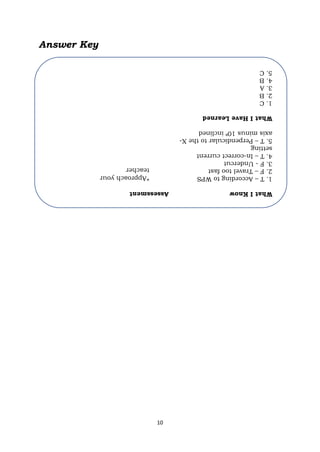
Directions: Encircle F if the statement is false and provide the correct answer, and
encircle T if the statement is true. Write your answer in your notebook.
T F 1. The length of an arc is determined by the size of the electrode.
T F 2. A narrow weld bead with pointed ripples results if the travel is too slow.
T F 3. Welding with too high current results in overlapping.
T F 4. Undercutting can occur if the current is set to high.
T F 5. The work angle of an electrode is approximately 90⁰ when depositing
continuous bead.
What I Need to Know
5.
2
Lesson
1
FOUR BASIC WELDING
POSITIONS(1G)
We know the fact that skill is one of the demands here in our country as well as in
abroad. One of the important positions in SMAW that students must possess is what
we call flat position(1G). As we go deeper on the topics of SMAW, we encounter the
different positions in welding.
What’s In
In the previous topic we discussed about fillet weld and their positions. What do
you think the difference between fillet and groove?
What’s New
Today, it is a healthy competition to everyone with respects to their skills. One of the
secrets to earn skills is constant correct practice and attitude towards work. Types
of welding positions is one of the keys for success in the field of welding.
What Is It
Types of Welding Positions
The welding position refers to the position of the welding operator towards the
workpiece to be welded. Because of gravity, the welding position affects the flow of
molten filler metal. It’s important to understand the types of welding positions as
different welding processes require to be performed at a certain position of the welder.
There are four main types of welding positions, which we will cover below.
6.
3
4 Basic WeldingPositions
Flat welding position
The welding position used to weld from the upper side of the joint at a point
where the weld axis is approximately horizontal, and the weld face lies in an
approximately horizontal plane. See welding positions.
1 - stands for the flat position (F) 2 - stands for the horizontal position (H) 3 - stands
for the vertical position (V) 4 - stands for the overhead position (O) F - stands for a
filler weld joint G - stands for a groove weld joint.
Base metal
The metal or alloy being welded, brazed, soldered, or cut. See base material
and substrate. Base metal test specimen. A test specimen composed wholly of base
metal.
Base Metal Zone (BMZ)
The portion of base metal adjacent to a weld, braze or solder joint or thermal
cut and unaffected by welding, brazing, soldering, or thermal cutting. See heat-
affected zone and weld metal zone.
Edge preparation
The preparation of the edges of the joint members, by cutting, cleaning,
plating, or other means. Edge shape. The shape of the edge of the joint member. See
also skewed joint. Effective throat. The minimum distance from the fillet weld face,
minus any convexity, and the weld root. In the case of a fillet weld combined with a
groove weld, the weld root of the groove weld shall be used. See concave and convex
fillet weld. Electrode. A component of the secondary circuit terminating at the arc,
molten conductive slag, or base metal. See consumable electrode, cutting electrode,
non-consumable electrode, resistance welding electrode, tungsten electrode, and
7.
4
welding electrode. Electrodeadapter, resistance welding. A device used to adapt an
electrode to an electrode holder. Electrode cap.
A replaceable electrode adapter tip used for resistance spot welding. Electrode
extension. The length of electrode extending beyond the electrode holder or cutting
torch (carbon arc cutting). See constricted arc.
Bevel angle
The angle between the bevel of a joint member and a plane perpendicular to
the surface of the member. Bevel edge shape. A type of edge shape in which the
prepared surface or surfaces lies at some angle other than perpendicular to the
material surface. Bevel radius. The radius used to form a J-edge shape.
Double-bevel edge shape
A type of bevel edge shape having two prepared surfaces adjacent to opposite
sides of the material.
Double-bevel groove
A double-sided weld groove formed by the combination of a butting member
having a double-bevel edge shape abutting a planar surface of a companion member.
Double-bevel groove weld. A weld in a double-bevel groove welded from both sides.
1G, plate
A welding test position designation for a linear groove weld applied to a joint,
in which the weld is made in the flat welding position. See figure below:
A. Prepare weld materials with complete bevel
8.
5
Carbon Steel Plates
C.Fit up weld materials using SMAW process
Fit up weld materials
D. Final preparation of weld materials for 1G position
9.
6
What’s More
In yourown words and interpretation, make a procedure on how to conduct groove
welding using the flat position.
What I Have Learned
Direction: Read and analyze the statement carefully. Choose the best answer and
write the letter only in your answer sheet.
1. The welding position refers to the position of the welding operator towards the
workpiece to be welded. Because of gravity, the welding position affects the flow
of molten filler metal.
A. Overhead position C. Flat position
B. Horizontal position D. Vertical position
2. In every position there is a corresponding numerical figure of number and the
position with a number of 3 means.
A. Flat position C. Horizontal position
B. Vertical position D. Overhead position
3. The portion of base metal adjacent to a weld, braze or solder joint or thermal cut
and unaffected by welding, brazing, soldering, or thermal cutting.
A. Heat affected zone C. Thermal contraction
B. Thermal expansion D. Thermal conductivity
4. The preparation of the joint members, is by cutting, cleaning and plating. The joint
member has the minimum distance from the fillet weld face, minus any convexity,
and the weld root.
A. Bevel angle C. Base metal
B. Edge preparation D. Welding test position
5. A welding test position designation for a linear groove weld applied to a joint, in
which the weld is made in the flat welding position.
A. 3G position C. 1G position
B. 2G position D. 4G position
10.
7
What I CanDo
Perform Root Pass (Optional): To be performed during face-to-face classroom
schedules.
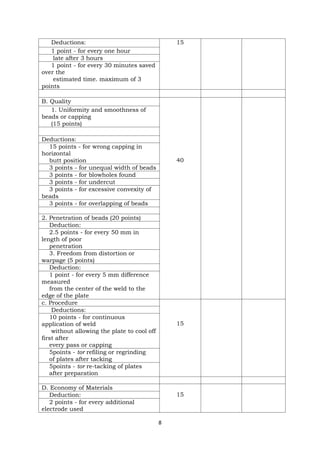
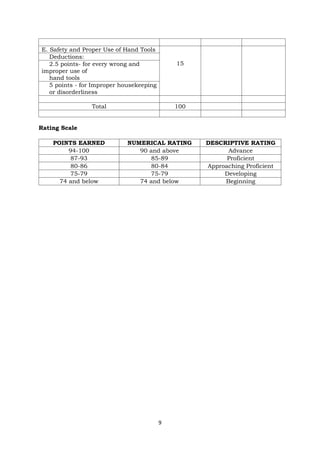
1. Fit-up weld materials
2. Tapping the Weld test Materials
3. Perform root pass with root penetration not
exceeding the allowable tolerances
Assessment
Your teacher will evaluate your performance based on the criteria in the following
Rubrics evaluation sheet:
Performance Evaluation Sheet
Criteria
Allotted
Points
Points
Deducted Points
Earned
A. Speed:
Time started __ _
Time finished __ _
11.
8
Deductions: 15
1 point- for every one hour
late after 3 hours
1 point - for every 30 minutes saved
over the
estimated time. maximum of 3
points
B. Quality
1. Uniformity and smoothness of
beads or capping
(15 points)
Deductions:
40
15 points - for wrong capping in
horizontal
butt position
3 points - for unequal width of beads
3 points - for blowholes found
3 points - for undercut
3 points - for excessive convexity of
beads
3 points - for overlapping of beads
2. Penetration of beads (20 points)
Deduction:
2.5 points - for every 50 mm in
length of poor
penetration
3. Freedom from distortion or
warpage (5 points)
Deduction:
1 point - for every 5 mm difference
measured
from the center of the weld to the
edge of the plate
c. Procedure
15
Deductions:
10 points - for continuous
application of weld
without allowing the plate to cool off
first after
every pass or capping
5points - tor refiling or regrinding
of plates after tacking
5points - tor re-tacking of plates
after preparation
D. Economy of Materials
15
Deduction:
2 points - for every additional
electrode used
12.
9
E. Safety andProper Use of Hand Tools
15
Deductions:
2.5 points- for every wrong and
improper use of
hand tools
5 points - for Improper housekeeping
or disorderliness
Total 100
Rating Scale
POINTS EARNED NUMERICAL RATING DESCRIPTIVE RATING
94-100 90 and above Advance
87-93 85-89 Proficient
80-86 80-84 Approaching Proficient
75-79 75-79 Developing
74 and below 74 and below Beginning
11
References
Book Reference:
• CompetencyBased Learning Material (CBLM) SMAW NC 1- Metal and
Engineering by: Ebas, Elde R.
• Austin, John Benjamen. Electric Arc Welding Checago: American Welding
Society 1952
• Boyd, Gardner I. Metalworking, Illinois: Goodheart. Willcox Co. 1982
• Feirer, John L. Modern Metalcraft. Illinois Chas A. Benet Co. 1946
• Groneman, Chris H. and Feirer, John L. General Shop. New York: Mc Graw.
Hill Book Co. 1969
• Kennedy, Gowen A. Welding Technology. Indianapolis: Bobbs. Merill
Education Publishing 1982
• Ludwig, Oswold A. Metalwork Technology and Practices Illinois 1947 Walker,
John R. Modern Metal Working Illinois Goodheart. Wilcox Co. 1981
15.
12
For inquiries orfeedback, please write or call:
Department of Education – Schools Division of Negros Oriental
Kagawasan, Avenue, Daro, Dumaguete City, Negros Oriental
Tel #: (035) 225 2376 / 541 1117
Email Address: negros.oriental@deped.gov.ph
Website: lrmds.depednodis.net