Hypospadia
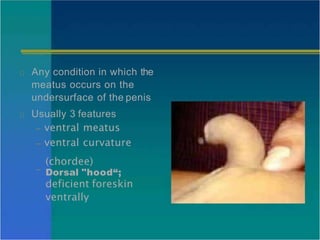
Any condition in which the
meatus occurs on the
undersurface of the penis
Usually 3 features
– ventral meatus
– ventral curvature
–
(chordee)
Dorsal "hood“;
deficient foreskin
ventrally
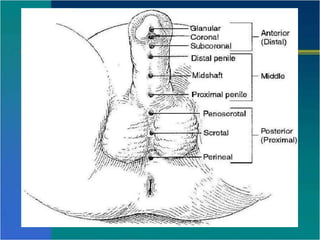
Classification
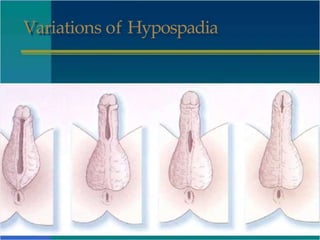
Variations of Hypospadia
Incidence
1:300 live male births
6000 boys each year in the US
Some genetic component
– 8% of patients have father with hypospadias
– 14% of patients have male siblings with
hypospadias
– If child with hypospadias, risk to next child
12% risk with negative family history
19% if cousin or uncle with hypospadias
26% if father or sibling
More common in Caucasians (Jews andItalians)
Higher incidence in monozygotic twins (8.5x)
Associated Anomalies
Undescended testes 9% and inguinal
hernia 9%
Upper tract anomalies rare (1-3%)
Ut r ic ulus m a s c u l i n u s
– 10 to 15% in perineal or
penoscrotal hypospadias
– Incomplete mullerian duct
regression
Associated Anomalies
R
c
r
u
y
l
p
e
to
r
u
ct
hindtiesrmsex,especially with
– Adrenogenital syndrome
– Mixed gonadal dysgenesis
– Incomplete
pseudohermaphroditism
– True hermaphrotidism
Associated Anomalies
hypospadias and cryptorchidism
– high index of suspicion for an intersex
state
Walsh reported the incidence of intersexuality
in children with cryptorchidism, hypospadias,
a
2
n
7
d
%otherwise nonambiguous genitalia to be
– nonpalpable testis were at least
threefold more likely to have an intersex
condition than those with a palpable
undescended testis (50% versus 15% )
Associated Anomalies
The idea that evaluation for an endocrine
abnormality and/or intersex state should be
undertaken in those with posterior
hypospadias, regardless of gonadal position
or palpability, is controversial but is supported
in the literature, because significant,
identifiable, and treatable abnormalities are
common
Further Evaluation
Only with severe hypospadias and sexual
ambiguity
– Includes testicular abnormalities
– Up to 25% of these patients haveenlarged
utricles or other female structures
The incidence of abnormalities with other
forms of hypospadias approximates that of
the general population
– Therefore no further evaluation is indicated
Acute Complications
Wound infection
Poor wound healing 2 to ischemia o
f
flaps
Edema
Drain tubes if free graft is used
Erections
Chronic Complications
Urethrocutaneous fistula
Urethral diverticulum
Residual chordee
Persistent hypospadias
Urethral stricture
H
M
a
e
i
a
r
t
b
a
e
la
s
t
r
e
i
n
n
g
oskisin
Excess skin
Balanitis xerotica obliterans
Hypospadias Repair
Over 150 operations have be described
Distal hypospadias
– Tubulization of the incised urethral plate
(Snodgrass)
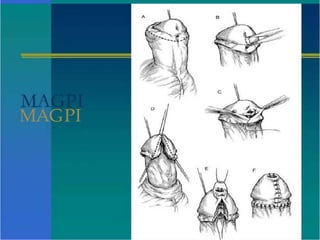
– Meatal advancement (MAGPI)
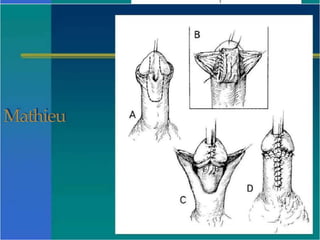
– Meatal-based flaps (Mathieu)
Proximal hypospadias
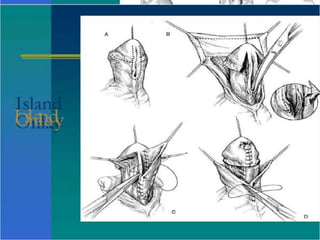
– Onlay grafts
– Vascularized inner preputial transfer flaps
(Duckett)
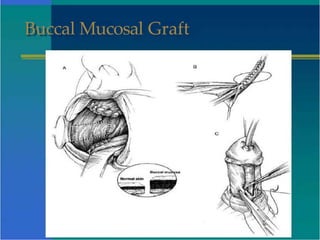
– Free grafts (skin, buccal mucosa)
MAGPI
Mathieu
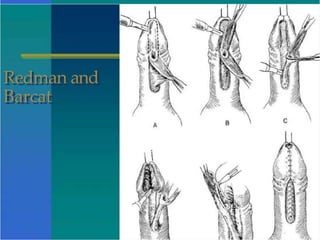
Redman and
Barcat
I
O
s
l
n
a
l
n
a
d
y
Buccal Mucosal Graft
Hypospadias - Conclusions
Common
Genetic component exists
Evaluation for associated anomolies
with severe proximal hypospadias
Rule out intersex, especially with
cryptorchidism
Multiple repairs exist, tailor to the
patient, anatomy, and previous repairs

Pdf hypospadias-sdc

  • 1.
  • 2.
    Any condition inwhich the meatus occurs on the undersurface of the penis Usually 3 features – ventral meatus – ventral curvature – (chordee) Dorsal "hood“; deficient foreskin ventrally
  • 3.
  • 4.
  • 5.
    Incidence 1:300 live malebirths 6000 boys each year in the US Some genetic component – 8% of patients have father with hypospadias – 14% of patients have male siblings with hypospadias – If child with hypospadias, risk to next child 12% risk with negative family history 19% if cousin or uncle with hypospadias 26% if father or sibling More common in Caucasians (Jews andItalians) Higher incidence in monozygotic twins (8.5x)
  • 6.
    Associated Anomalies Undescended testes9% and inguinal hernia 9% Upper tract anomalies rare (1-3%) Ut r ic ulus m a s c u l i n u s – 10 to 15% in perineal or penoscrotal hypospadias – Incomplete mullerian duct regression
  • 7.
    Associated Anomalies R c r u y l p e to r u ct hindtiesrmsex,especially with –Adrenogenital syndrome – Mixed gonadal dysgenesis – Incomplete pseudohermaphroditism – True hermaphrotidism
  • 8.
    Associated Anomalies hypospadias andcryptorchidism – high index of suspicion for an intersex state Walsh reported the incidence of intersexuality in children with cryptorchidism, hypospadias, a 2 n 7 d %otherwise nonambiguous genitalia to be – nonpalpable testis were at least threefold more likely to have an intersex condition than those with a palpable undescended testis (50% versus 15% )
  • 9.
    Associated Anomalies The ideathat evaluation for an endocrine abnormality and/or intersex state should be undertaken in those with posterior hypospadias, regardless of gonadal position or palpability, is controversial but is supported in the literature, because significant, identifiable, and treatable abnormalities are common
  • 10.
    Further Evaluation Only withsevere hypospadias and sexual ambiguity – Includes testicular abnormalities – Up to 25% of these patients haveenlarged utricles or other female structures The incidence of abnormalities with other forms of hypospadias approximates that of the general population – Therefore no further evaluation is indicated
  • 11.
    Acute Complications Wound infection Poorwound healing 2 to ischemia o f flaps Edema Drain tubes if free graft is used Erections
  • 12.
    Chronic Complications Urethrocutaneous fistula Urethraldiverticulum Residual chordee Persistent hypospadias Urethral stricture H M a e i a r t b a e la s t r e i n n g oskisin Excess skin Balanitis xerotica obliterans
  • 13.
    Hypospadias Repair Over 150operations have be described Distal hypospadias – Tubulization of the incised urethral plate (Snodgrass) – Meatal advancement (MAGPI) – Meatal-based flaps (Mathieu) Proximal hypospadias – Onlay grafts – Vascularized inner preputial transfer flaps (Duckett) – Free grafts (skin, buccal mucosa)
  • 14.
  • 15.
  • 16.
  • 17.
  • 18.
  • 19.
    Hypospadias - Conclusions Common Geneticcomponent exists Evaluation for associated anomolies with severe proximal hypospadias Rule out intersex, especially with cryptorchidism Multiple repairs exist, tailor to the patient, anatomy, and previous repairs