PERSONAL
DEVELOPMENT
W E E K 5
THE LOUISIAN PRAYER
O God, wellspring of goodness and
blessings, we give you thanks and
praise as one Louisian community.
The graces You incessantly grant
upon us and Your divine providence
have sustained our beloved
University throughout the years of
mission and excellence.
THE LOUISIAN PRAYER
Having been founded by the Congregation of the
Immaculate Heart of Mary, we pray that You keep
us committed and dedicated to our mission and
identity to serve the Church and the society as we
become living witnesses to the Gospel values
proclaimed by Jesus. For if we are steadfast in our
good and beautiful mission, our works will bring
success not only to ourselves but also to those
whom we are bound to love and serve.
THE LOUISIAN PRAYER
Inspired by St. Louis our Patron Saint, who was
filled with a noble spirit that stirred him to love
You above all things , may we also live believing
that we are born for a greater purpose and
mission as we dwell in Your presence all the
days of our life.
Grant all these supplications through the
intercession of Mother Mary and through Christ
our Lord. Amen.
DAY 1
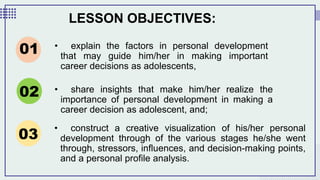
LESSON OBJECTIVES:
• explain the factors in personal development
that may guide him/her in making important
career decisions as adolescents,
01
02
03
• share insights that make him/her realize the
importance of personal development in making a
career decision as adolescent, and;
• construct a creative visualization of his/her personal
development through of the various stages he/she went
through, stressors, influences, and decision-making points,
and a personal profile analysis.
Pass the
Message!
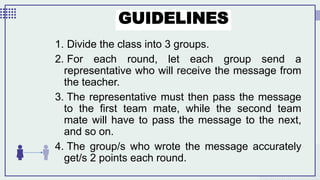
GUIDELINES
1. Divide the class into 3 groups.
2. For each round, let each group send a
representative who will receive the message from
the teacher.
3. The representative must then pass the message
to the first team mate, while the second team
mate will have to pass the message to the next,
and so on.
4. The group/s who wrote the message accurately
get/s 2 points each round.
Insights into One’s
Personal
Development
What is the first thing that comes to your mind when
you think of yourself?
What were your goals for yourself a year ago? How
realistic were they?
Which of your goals have you accomplished so far?
How did you achieve them?
• According to humanistic psychology, human being strive for
self-actualization.
• When you are trying to accomplish something big, you tend to
ask the WHY but rarely the HOW because the path to achieving
your goals is far from obvious.
Personal Development As An Important
Component of Setting Career and Life
Goals
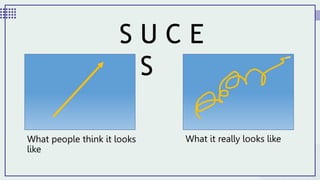
What people think it looks
like
S U C E
S S
What it really looks like
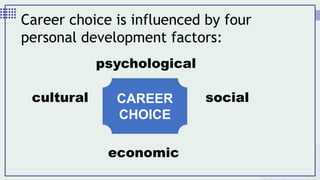
Career choice is influenced by four
personal development factors:
CAREER
CHOICE
psychological
social
economic
cultural
• The first factors that can impact an individual’s
occupational choice are psychological factors.
These factors consist of interest, aptitude, or
intelligence.
PSYCHOLOGICAL FACTORS
I N T E R E S T
What do I like? What I don’t like?
Deciding on a career that suits your interests should always
be a top consideration. An individual’s performance in any
career is closely related to his/her interest, which is either
expressed in word or manifested in action.
A P T I T U D E S
What are my Strengths?
The potential that one has for learning in the future. It
is the skills that one has at present or other learning
that has taken place in the past.
INTELLIGENCE
Am I intelligent?
Each profession whether skilled or semi-skilled requires a
level of intellectual ability for the individual to enter into and
perform efficiently in it.
Report cards, test results, teachers and guidance comments
can help with intelligence assessment.
DAY 2
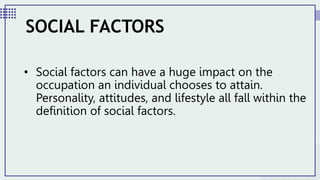
• Social factors can have a huge impact on the
occupation an individual chooses to attain.
Personality, attitudes, and lifestyle all fall within the
definition of social factors.
SOCIAL FACTORS
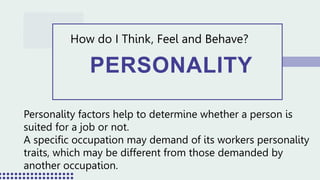
PERSONALITY
How do I Think, Feel and Behave?
Personality factors help to determine whether a person is
suited for a job or not.
A specific occupation may demand of its workers personality
traits, which may be different from those demanded by
another occupation.
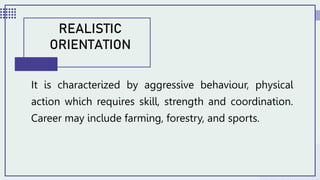
It is characterized by aggressive behaviour, physical
action which requires skill, strength and coordination.
Career may include farming, forestry, and sports.
REALISTIC
ORIENTATION
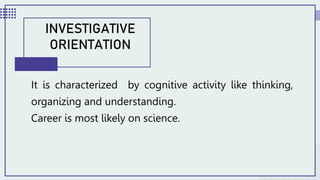
It is characterized by cognitive activity like thinking,
organizing and understanding.
Career is most likely on science.
INVESTIGATIVE
ORIENTATION
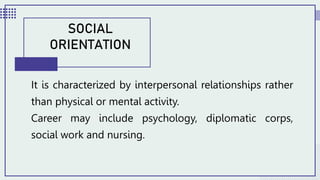
It is characterized by interpersonal relationships rather
than physical or mental activity.
Career may include psychology, diplomatic corps,
social work and nursing.

SOCIAL
ORIENTATION
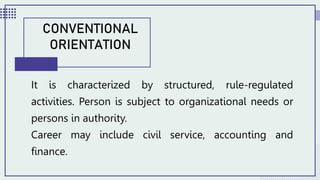
It is characterized by structured, rule-regulated
activities. Person is subject to organizational needs or
persons in authority.
Career may include civil service, accounting and
finance.
CONVENTIONAL
ORIENTATION
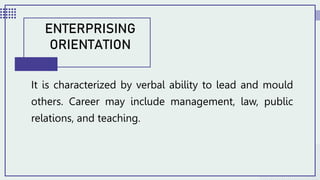
It is characterized by verbal ability to lead and mould
others. Career may include management, law, public
relations, and teaching.
ENTERPRISING
ORIENTATION
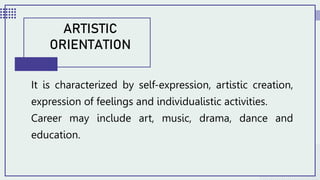
It is characterized by self-expression, artistic creation,
expression of feelings and individualistic activities.

Career may include art, music, drama, dance and
education.
ARTISTIC
ORIENTATION
DAY 3
A T T I T U D E S
What are my opinions and beliefs?
Two of the most important attitudes in career decision making are
planfulness and curiosity. Attitudes toward planning reflect a future
orientation, an awareness of choices to be made upon choosing
career. Attitude toward exploration means curiosity about the world
of work and one’s place in it.
L I F E S T Y L E
What are my preferences in life?
Preferences which included criteria such as salary, work/life
balance, and location are considered being the most
influential factor in career choice.
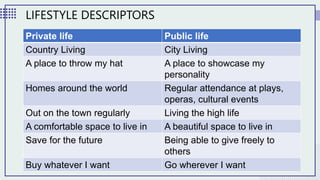
LIFESTYLE DESCRIPTORS
Private life Public life
Country Living City Living
A place to throw my hat A place to showcase my
personality
Homes around the world Regular attendance at plays,
operas, cultural events
Out on the town regularly Living the high life
A comfortable space to live in A beautiful space to live in
Save for the future Being able to give freely to
others
Buy whatever I want Go wherever I want
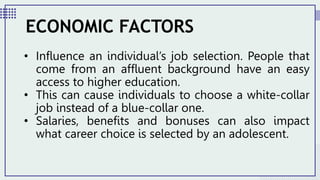
• Influence an individual’s job selection. People that
come from an affluent background have an easy
access to higher education.
• This can cause individuals to choose a white-collar
job instead of a blue-collar one.
• Salaries, benefits and bonuses can also impact
what career choice is selected by an adolescent.
ECONOMIC FACTORS
• Culture refers to the community people live in, and
the values that they hold.
• Most Filipinos are more likely to choose a career
path based on their family’s wishes rather than
their own interests.
CULTURAL FACTORS
• Reasons why personal development is important:
1. It helps you understand yourself better.
2. It assist you in creating your goals and life purpose.
3. It guides you in managing and spending your time effectively.
4. It enhances your ability to handle stress, adversity and change.
5. It supports you in managing your finances more wisely.
6. It teaches you to build better relationship with people.
7. It allows you to live a balanced lifestyle.
8. It provides an opportunity to take care of your health.
Importance of Personal Development in
Career Decisions
DAY 4
ASSESSMENT
WRITTEN WORK 2
THANK YOU!

PDEV- FINAL TERM WEEK 5.pptx

  • 1.
  • 2.
    THE LOUISIAN PRAYER OGod, wellspring of goodness and blessings, we give you thanks and praise as one Louisian community. The graces You incessantly grant upon us and Your divine providence have sustained our beloved University throughout the years of mission and excellence.
  • 3.
    THE LOUISIAN PRAYER Havingbeen founded by the Congregation of the Immaculate Heart of Mary, we pray that You keep us committed and dedicated to our mission and identity to serve the Church and the society as we become living witnesses to the Gospel values proclaimed by Jesus. For if we are steadfast in our good and beautiful mission, our works will bring success not only to ourselves but also to those whom we are bound to love and serve.
  • 4.
    THE LOUISIAN PRAYER Inspiredby St. Louis our Patron Saint, who was filled with a noble spirit that stirred him to love You above all things , may we also live believing that we are born for a greater purpose and mission as we dwell in Your presence all the days of our life. Grant all these supplications through the intercession of Mother Mary and through Christ our Lord. Amen.
  • 5.
  • 6.
    LESSON OBJECTIVES: • explainthe factors in personal development that may guide him/her in making important career decisions as adolescents, 01 02 03 • share insights that make him/her realize the importance of personal development in making a career decision as adolescent, and; • construct a creative visualization of his/her personal development through of the various stages he/she went through, stressors, influences, and decision-making points, and a personal profile analysis.
  • 7.
  • 8.
    GUIDELINES 1. Divide theclass into 3 groups. 2. For each round, let each group send a representative who will receive the message from the teacher. 3. The representative must then pass the message to the first team mate, while the second team mate will have to pass the message to the next, and so on. 4. The group/s who wrote the message accurately get/s 2 points each round.
  • 9.
  • 10.
    What is thefirst thing that comes to your mind when you think of yourself? What were your goals for yourself a year ago? How realistic were they? Which of your goals have you accomplished so far? How did you achieve them?
  • 13.
    • According tohumanistic psychology, human being strive for self-actualization. • When you are trying to accomplish something big, you tend to ask the WHY but rarely the HOW because the path to achieving your goals is far from obvious. Personal Development As An Important Component of Setting Career and Life Goals
  • 14.
    What people thinkit looks like S U C E S S What it really looks like
  • 15.
    Career choice isinfluenced by four personal development factors: CAREER CHOICE psychological social economic cultural
  • 16.
    • The firstfactors that can impact an individual’s occupational choice are psychological factors. These factors consist of interest, aptitude, or intelligence. PSYCHOLOGICAL FACTORS
  • 17.
    I N TE R E S T What do I like? What I don’t like? Deciding on a career that suits your interests should always be a top consideration. An individual’s performance in any career is closely related to his/her interest, which is either expressed in word or manifested in action.
  • 18.
    A P TI T U D E S What are my Strengths? The potential that one has for learning in the future. It is the skills that one has at present or other learning that has taken place in the past.
  • 19.
    INTELLIGENCE Am I intelligent? Eachprofession whether skilled or semi-skilled requires a level of intellectual ability for the individual to enter into and perform efficiently in it. Report cards, test results, teachers and guidance comments can help with intelligence assessment.
  • 20.
  • 21.
    • Social factorscan have a huge impact on the occupation an individual chooses to attain. Personality, attitudes, and lifestyle all fall within the definition of social factors. SOCIAL FACTORS
  • 22.
    PERSONALITY How do IThink, Feel and Behave? Personality factors help to determine whether a person is suited for a job or not. A specific occupation may demand of its workers personality traits, which may be different from those demanded by another occupation.
  • 23.
    It is characterizedby aggressive behaviour, physical action which requires skill, strength and coordination. Career may include farming, forestry, and sports. REALISTIC ORIENTATION
  • 24.
    It is characterizedby cognitive activity like thinking, organizing and understanding. Career is most likely on science. INVESTIGATIVE ORIENTATION
  • 25.
    It is characterizedby interpersonal relationships rather than physical or mental activity. Career may include psychology, diplomatic corps, social work and nursing. SOCIAL ORIENTATION
  • 26.
    It is characterizedby structured, rule-regulated activities. Person is subject to organizational needs or persons in authority. Career may include civil service, accounting and finance. CONVENTIONAL ORIENTATION
  • 27.
    It is characterizedby verbal ability to lead and mould others. Career may include management, law, public relations, and teaching. ENTERPRISING ORIENTATION
  • 28.
    It is characterizedby self-expression, artistic creation, expression of feelings and individualistic activities. Career may include art, music, drama, dance and education. ARTISTIC ORIENTATION
  • 29.
  • 30.
    A T TI T U D E S What are my opinions and beliefs? Two of the most important attitudes in career decision making are planfulness and curiosity. Attitudes toward planning reflect a future orientation, an awareness of choices to be made upon choosing career. Attitude toward exploration means curiosity about the world of work and one’s place in it.
  • 31.
    L I FE S T Y L E What are my preferences in life? Preferences which included criteria such as salary, work/life balance, and location are considered being the most influential factor in career choice.
  • 32.
    LIFESTYLE DESCRIPTORS Private lifePublic life Country Living City Living A place to throw my hat A place to showcase my personality Homes around the world Regular attendance at plays, operas, cultural events Out on the town regularly Living the high life A comfortable space to live in A beautiful space to live in Save for the future Being able to give freely to others Buy whatever I want Go wherever I want
  • 33.
    • Influence anindividual’s job selection. People that come from an affluent background have an easy access to higher education. • This can cause individuals to choose a white-collar job instead of a blue-collar one. • Salaries, benefits and bonuses can also impact what career choice is selected by an adolescent. ECONOMIC FACTORS
  • 34.
    • Culture refersto the community people live in, and the values that they hold. • Most Filipinos are more likely to choose a career path based on their family’s wishes rather than their own interests. CULTURAL FACTORS
  • 35.
    • Reasons whypersonal development is important: 1. It helps you understand yourself better. 2. It assist you in creating your goals and life purpose. 3. It guides you in managing and spending your time effectively. 4. It enhances your ability to handle stress, adversity and change. 5. It supports you in managing your finances more wisely. 6. It teaches you to build better relationship with people. 7. It allows you to live a balanced lifestyle. 8. It provides an opportunity to take care of your health. Importance of Personal Development in Career Decisions
  • 36.
  • 37.
  • 38.

Editor's Notes

  • #16 With so many choices and so much to consider, finding the right career path is a challenge for many high school students.