• Prince Harry
• Phone hacking scandal
“Press Complaints Commission to close in wake of phone-hacking scandal”
The opportunity to access voicemail messages came down to a simple security oversight. Mobile
phones used to be supplied with a default factory-set personal identification number that could be
used to access voicemail from another phone or abroad. Customers were encouraged to change
that Pin, but very few did. That meant that anyone could call the phone and if the owner did not
answer, the caller could use the Pin to access the voicemail and any stored messages.
More than 4,000 people were identified by police as possible victims of phone hacking by the
News Of The World. The prosecutions have 600 identifiable victims. The alleged targets included
politicians, celebrities, actors, sports people, relatives of dead UK soldiers and people who were
caught up in the 7/7 London bombings.
The Sunday newspaper was one of the oldest in the UK and sold some 2.8m copies every week. Its
fondness for sex scandals gained it the nickname "News of the Screws". Rupert Murdoch closed it
down in the wake of the Milly Dowler revelations. Its final front page declared "Thank you and
goodbye".
At the time public outrage about phone hacking was such that few people stepped in to
challenge the leaders‟ view, except the PCC itself. It put out a statement saying that the
organisation was being used as a „convenient scalp‟: „We do not accept that the scandal of
phone hacking should claim, as a convenient scalp, the Press Complaints Commission. The
work of the PCC, and of a press allowed to have freedom of expression, has been grossly
undervalued today‟ (8 July 2011).
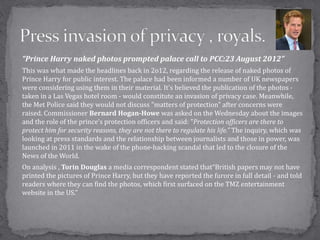
“Prince Harry naked photos prompted palace call to PCC:23 August 2012”
This was what made the headlines back in 2o12, regarding the release of naked photos of
Prince Harry for public interest. The palace had been informed a number of UK newspapers
were considering using them in their material. It’s believed the publication of the photos -
taken in a Las Vegas hotel room - would constitute an invasion of privacy case. Meanwhile,
the Met Police said they would not discuss "matters of protection" after concerns were
raised. Commissioner Bernard Hogan-Howe was asked on the Wednesday about the images
and the role of the prince's protection officers and said: "Protection officers are there to
protect him for security reasons, they are not there to regulate his life.” The inquiry, which was
looking at press standards and the relationship between journalists and those in power, was
launched in 2011 in the wake of the phone-hacking scandal that led to the closure of the
News of the World.
On analysis , Torin Douglas a media correspondent stated that“British papers may not have
printed the pictures of Prince Harry, but they have reported the furore in full detail - and told
readers where they can find the photos, which first surfaced on the TMZ entertainment
website in the US.”
"Whenever the public interest is invoked, the PCC will require editors to
demonstrate fully that they reasonably believed that publication, or
journalistic activity undertaken with a view to publication, would be in
the public interest and how, and with whom, that was established at the
time.“
This quote comes directly from the PCC , editors code. It’s a balancing act
within the media as to how those in power decide what breaches privacy
conduct and what is public interest. The balance between privacy and
freedom of expression is in constant consideration in the wake of Leveson
and as the UK's Information Commissioner sets about drawing up
guidance on the Data Protection Act 1998 (DPA) as it relates to
journalism. The answer is clear, no body can really draw a line but rather
an invisible boundary that can only be seen by a select few. The codes will
continue to exist in the press and there will always be a regulatory
conduct. However, the will also always be public interest and a need to
keep people asking questions about those in power.
In terms of the situation with Prince Harry, we as an
audience would receive this invasion of privacy as
barbaric especially because it involves a well known and
likeable face, but in addition to this because of the
individuals status. The phone hacking scandal affected
people on a more emotional level as false hope began to
circulate with the disappearance of a young girl at the
time.

Pcc

  • 1.
    • Prince Harry •Phone hacking scandal
  • 2.
    “Press Complaints Commissionto close in wake of phone-hacking scandal” The opportunity to access voicemail messages came down to a simple security oversight. Mobile phones used to be supplied with a default factory-set personal identification number that could be used to access voicemail from another phone or abroad. Customers were encouraged to change that Pin, but very few did. That meant that anyone could call the phone and if the owner did not answer, the caller could use the Pin to access the voicemail and any stored messages. More than 4,000 people were identified by police as possible victims of phone hacking by the News Of The World. The prosecutions have 600 identifiable victims. The alleged targets included politicians, celebrities, actors, sports people, relatives of dead UK soldiers and people who were caught up in the 7/7 London bombings. The Sunday newspaper was one of the oldest in the UK and sold some 2.8m copies every week. Its fondness for sex scandals gained it the nickname "News of the Screws". Rupert Murdoch closed it down in the wake of the Milly Dowler revelations. Its final front page declared "Thank you and goodbye". At the time public outrage about phone hacking was such that few people stepped in to challenge the leaders‟ view, except the PCC itself. It put out a statement saying that the organisation was being used as a „convenient scalp‟: „We do not accept that the scandal of phone hacking should claim, as a convenient scalp, the Press Complaints Commission. The work of the PCC, and of a press allowed to have freedom of expression, has been grossly undervalued today‟ (8 July 2011).
  • 3.
    “Prince Harry nakedphotos prompted palace call to PCC:23 August 2012” This was what made the headlines back in 2o12, regarding the release of naked photos of Prince Harry for public interest. The palace had been informed a number of UK newspapers were considering using them in their material. It’s believed the publication of the photos - taken in a Las Vegas hotel room - would constitute an invasion of privacy case. Meanwhile, the Met Police said they would not discuss "matters of protection" after concerns were raised. Commissioner Bernard Hogan-Howe was asked on the Wednesday about the images and the role of the prince's protection officers and said: "Protection officers are there to protect him for security reasons, they are not there to regulate his life.” The inquiry, which was looking at press standards and the relationship between journalists and those in power, was launched in 2011 in the wake of the phone-hacking scandal that led to the closure of the News of the World. On analysis , Torin Douglas a media correspondent stated that“British papers may not have printed the pictures of Prince Harry, but they have reported the furore in full detail - and told readers where they can find the photos, which first surfaced on the TMZ entertainment website in the US.”
  • 4.
    "Whenever the publicinterest is invoked, the PCC will require editors to demonstrate fully that they reasonably believed that publication, or journalistic activity undertaken with a view to publication, would be in the public interest and how, and with whom, that was established at the time.“ This quote comes directly from the PCC , editors code. It’s a balancing act within the media as to how those in power decide what breaches privacy conduct and what is public interest. The balance between privacy and freedom of expression is in constant consideration in the wake of Leveson and as the UK's Information Commissioner sets about drawing up guidance on the Data Protection Act 1998 (DPA) as it relates to journalism. The answer is clear, no body can really draw a line but rather an invisible boundary that can only be seen by a select few. The codes will continue to exist in the press and there will always be a regulatory conduct. However, the will also always be public interest and a need to keep people asking questions about those in power.
  • 5.
    In terms ofthe situation with Prince Harry, we as an audience would receive this invasion of privacy as barbaric especially because it involves a well known and likeable face, but in addition to this because of the individuals status. The phone hacking scandal affected people on a more emotional level as false hope began to circulate with the disappearance of a young girl at the time.