Agenda
•What is aPattern?
•What Makes a Pattern?
•Pattern Categories
•Relationships between Patterns
•Pattern Description
•Patterns and Software Architecture
3.
What is aPattern?
•A recurring, good solution to a common problem in a specific context.
•Captures proven expertise and design experience.
•Analogy: Architectural patterns (e.g., arch, dome) – proven solutions for
structural problems.
4.
Pattern Components
-Name: Ahandle for referencing the pattern.
- Problem: Describes when to apply the pattern.
- Context: Conditions under which the pattern is applicable.
- Forces: Constraints or issues that influence the problem and solution.
- Solution: A general arrangement of objects and classes.
- Consequences: Results and trade-offs of applying the pattern.
- Examples: Real-world usage scenarios.
5.
Features
• A patternaddresses a recurring design problem that arises in specific design
situations, and presents a solution to it.
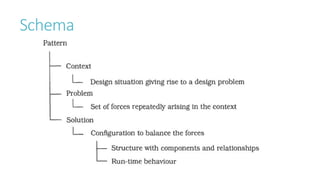
• Each pattern is a three-part rule, which expresses a relation between a certain
context, a problem, and a solution.
• Patterns identify and specify abstractions that are above the level of single classes
and instances, or of components
• Patterns document existing, well-proven design experience.
• Patterns provide a common vocabulary and understanding for design principles
• Patterns are a means of documenting software architectures
• Patterns support the construction of software with defined properties.
• Patterns help you build complex and heterogeneous sofhoare architectures.
6.
Pattern is Definedas …
• A pattern for software architecture describes a
particular recurring design problem that arises
in specific design contexts, and presents a
well-proven generic scheme for its solution.
• The solution scheme is specified by describing
its constituent components, their
responsibilities and relationships, and the
ways in which they collaborate.
7.
Why Use Patterns?
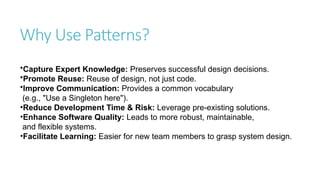
•CaptureExpert Knowledge: Preserves successful design decisions.
•Promote Reuse: Reuse of design, not just code.
•Improve Communication: Provides a common vocabulary
(e.g., "Use a Singleton here").
•Reduce Development Time & Risk: Leverage pre-existing solutions.
•Enhance Software Quality: Leads to more robust, maintainable,
and flexible systems.
•Facilitate Learning: Easier for new team members to grasp system design.
8.
Making a Pattern
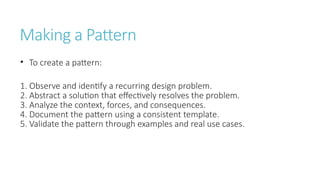
•To create a pattern:
1. Observe and identify a recurring design problem.
2. Abstract a solution that effectively resolves the problem.
3. Analyze the context, forces, and consequences.
4. Document the pattern using a consistent template.
5. Validate the pattern through examples and real use cases.
What Makes aPattern? (Structure)
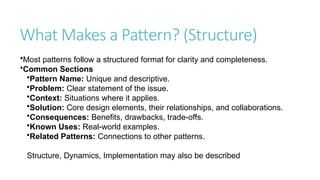
•Most patterns follow a structured format for clarity and completeness.
•Common Sections
•Pattern Name: Unique and descriptive.
•Problem: Clear statement of the issue.
•Context: Situations where it applies.
•Solution: Core design elements, their relationships, and collaborations.
•Consequences: Benefits, drawbacks, trade-offs.
•Known Uses: Real-world examples.
•Related Patterns: Connections to other patterns.
Structure, Dynamics, Implementation may also be described
11.
Pattern Categories- ASpectrum of
Abstraction
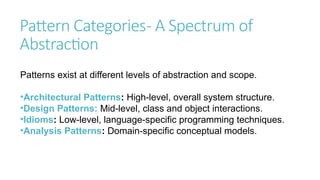
Patterns exist at different levels of abstraction and scope.
•Architectural Patterns: High-level, overall system structure.
•Design Patterns: Mid-level, class and object interactions.
•Idioms: Low-level, language-specific programming techniques.
•Analysis Patterns: Domain-specific conceptual models.
12.
Pattern Categories- Details
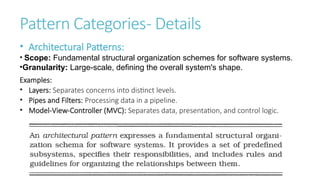
•Architectural Patterns:
• Scope: Fundamental structural organization schemes for software systems.
•Granularity: Large-scale, defining the overall system's shape.
Examples:
• Layers: Separates concerns into distinct levels.
• Pipes and Filters: Processing data in a pipeline.
• Model-View-Controller (MVC): Separates data, presentation, and control logic.
Relationships Between Patterns
Patternsrarely stand alone; they form a "system" or "language."
•Complementary: Work well together to achieve a larger goal
(e.g., MVC often uses Observer).
•Alternative: Solve similar problems with different trade-offs.
•Refinement: One pattern provides a more detailed solution for another.
•Composition: A larger pattern built from several smaller ones.
•Variation: One pattern is a specific adaptation of another.
Pattern Systems andLanguages
• A pattern system is a cohesive set of patterns that work together.
• A pattern language organizes patterns to guide the entire software
design.
• It defines how patterns interconnect, providing a roadmap for
developing complex systems.
18.
Pattern Description (Recap)
•A standardized format is crucial for clear communication and effective application.
• Purpose: To make patterns understandable, shareable, and applicable across
projects.
• Key Sections (summarized):
• Name, Problem, Context, Solution, Consequences.
• Structural and behavioral aspects (often with diagrams).
• Implementation notes, examples, known uses.
• Relationships to other patterns. Image Suggestion: A blueprint graphic or a
document icon with a magnifying glass.
19.
Patterns and SoftwareArchitecture
•Architectural Drivers: Patterns are fundamental for designing robust,
scalable, and maintainable systems.
•Blueprint for Design: Architectural patterns provide the high-level structural
foundation.
•Common Language: Facilitate communication among architects and
developers.
•System of Patterns: Architectures often arise from the thoughtful composition
and interaction of multiple patterns.
•Addresses Non-Functional Requirements: Patterns help achieve qualities
like performance, security, flexibility, and extensibility.
•Promotes Evolution: Well-architected systems using patterns are easier to
adapt and extend over time.
20.
Summary
•What are Patterns?Proven solutions to recurring problems in a given
context.
•Why use them? Enhance quality, communication, productivity, and
maintainability.
•Categories: Range from high-level architectural patterns to low-level idioms
and domain-specific analysis patterns.
•Relationships: Patterns are interconnected, forming a "system of patterns."
•Impact on Architecture: Essential for constructing resilient, flexible, and
understandable software systems.
21.
References
• - Buschmann,F., Meunier, R., Rohnert, H., Sommerlad, P., & Stal, M.
(1996). Pattern-Oriented Software Architecture – A System of Patterns.
Wiley.
- Gamma et al. (1994). Design Patterns: Elements of Reusable Object-
Oriented Software.
- Alexander, C. (1977). A Pattern Language.
Editor's Notes
#3 Patterns provide proven solutions to recurring design problems in software architecture. They encapsulate design wisdom and experience into a structured format that is reusable and adaptable. Originally inspired by Christopher Alexander's work in architecture, patterns became vital tools in software engineering.
#7 Patterns facilitate effective communication among developers, reduce development time, and improve code maintainability. They represent collective knowledge and best practices, helping teams avoid reinventing the wheel.
#12 Architectural patterns define the fundamental structure of software systems. They establish the relationships between subsystems and components.
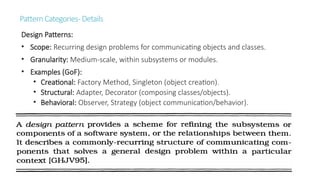
#13 Design patterns address problems of object creation and interaction. They are categorized into:
- Creational Patterns (e.g., Factory Method, Singleton)
- Structural Patterns (e.g., Adapter, Composite)
- Behavioral Patterns (e.g., Observer, Strategy, Command)
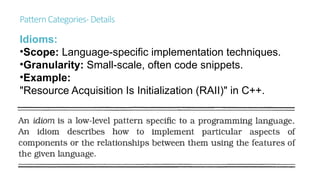
#14 Idioms are low-level patterns specific to a programming language. They capture best practices and techniques for implementing recurring coding constructs.
Examples:
- C++: Smart Pointers, RAII (Resource Acquisition Is Initialization)
- Java: Try-with-resources
- Python: Context Managers using 'with' statement
#19 Patterns are essential for defining and documenting software architecture. They aid in making architectural decisions, improving system modularity, scalability, and maintainability. They also offer a common vocabulary for discussing architectural design.
#20 Patterns are foundational tools in software design and architecture. They provide reusable, proven solutions that help manage complexity, promote best practices, and ensure consistency across projects. Understanding pattern types and relationships enhances the ability to design robust software systems.