SOFTWARE DESIGN
PATTERNS
By:-
NANCY GOEL
USN-1MS09IS059
M.S.RAMIAH INSTITUTE OF TECHNOLOGY
INFORMATION SCIENCE AND ENGINEERING
1
INTRODUCTION
 A design pattern is a descriptions of
communicating objects and classes that are
customized to solve a general design problem in a
particular context.
“Each pattern describes a problem which occurs
over and over again in our environment and then
describes the core of the solution to that
problem, in such a way that you can use this
solution a million times over, without ever doing it
in the same way twice”
2
CONTD…
 A pattern is a recurring solution to a standard
problem.
 Patterns capture the static and dynamic structure
and collaboration among key participants in software
designs
 A pattern is made by four elements:
• name
• problem
• solution
• consequences
3
NAME OF DESIGN PATTERN
 Describe a design problems and its solutions in a
word or two.
 Used to talk about design pattern with our
colleagues.
 Used in the documentation.
 Increase our design vocabulary.
 Have to be coherent and evocative.4
PROBLEM
 Describes when to apply the patterns.
 Explains the problem and its context.
 Sometimes include a list of conditions that
must be met before it makes sense to apply the
pattern.
 Have to occur over and over again in our
environment.
5
SOLUTION
 Describes the elements that make up the
design, their relationships, responsibilities and
collaborations.
 Does not describe a concrete design or
implementation.
 Has to be well proven in some projects.
6
CONSEQUENCES
 Results and trade-offs of applying the pattern.
 Helpful for describe design decisions, for
evaluating design alternatives.
 Benefits of applying a pattern.
 Impacts on a system’s flexibility , extensibility or
portability.
7
DESCRIPTION OF DESIGN
PATTERN
 Pattern name and classification
 Intent
 Participants
 Collaborations
 Consequences
 Implementation
 Design
8
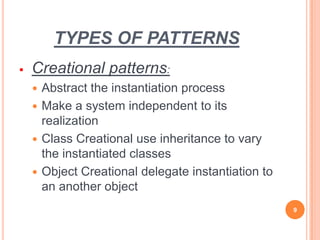
TYPES OF PATTERNS
 Creational patterns:
 Abstract the instantiation process
 Make a system independent to its
realization
 Class Creational use inheritance to vary
the instantiated classes
 Object Creational delegate instantiation to
an another object
9
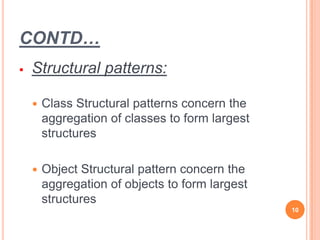
CONTD…
 Structural patterns:
 Class Structural patterns concern the
aggregation of classes to form largest
structures
 Object Structural pattern concern the
aggregation of objects to form largest
structures
10
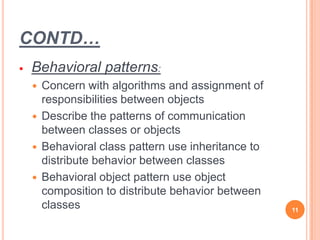
CONTD…
 Behavioral patterns:
 Concern with algorithms and assignment of
responsibilities between objects
 Describe the patterns of communication
between classes or objects
 Behavioral class pattern use inheritance to
distribute behavior between classes
 Behavioral object pattern use object
composition to distribute behavior between
classes 11
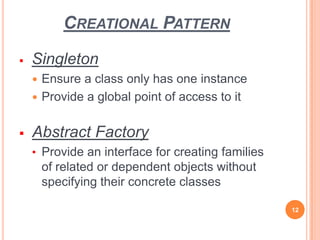
CREATIONAL PATTERN
 Singleton
 Ensure a class only has one instance
 Provide a global point of access to it
 Abstract Factory
• Provide an interface for creating families
of related or dependent objects without
specifying their concrete classes
12
CONTD…
 Factory Method
 Define an interface for creating an object
but let subclasses decide which class to
instantiate
 Lets a class defer instantiation to
subclasses
13
STRUCTURAL PATTERN
 Decorator
 Attach additional responsibilities to an object
dynamically
 Provide a flexible alternative to sub classing for
extending functionality
 Adapter
 Convert the interface of a class into another
interface clients expect
 Lets classes work together that couldn’t
otherwise because of incompatible interfaces 14
CONTD…
 Bridge
• Decouple an abstraction from its
implementation so that the two can vary
independently
 Façade
 Provide a unified interface to a set of
interfaces in a subsystem
 Defines an higher-level interface that
makes the system easier to use 15
BEHAVIORAL PATTERN
 Observer
 Define a one-to-many dependency
between objects so when one of them
change state all its dependents are
updated automatically
 Strategy
 Define a family of algorithms
 Encapsulate each one
 Make them interchangeable
 Lets the algorithms vary independently
from clients that use it 16
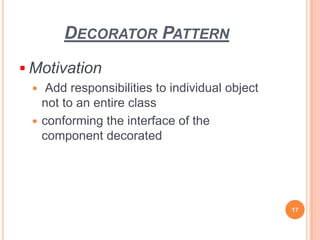
DECORATOR PATTERN
 Motivation
 Add responsibilities to individual object
not to an entire class
 conforming the interface of the
component decorated
17
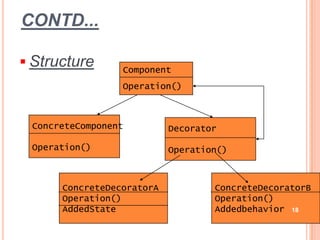
CONTD...
 Structure Component
Operation()
ConcreteComponent
Operation()
Decorator
Operation()
ConcreteDecoratorA
Operation()
AddedState
ConcreteDecoratorB
Operation()
Addedbehavior 18
CONTD…
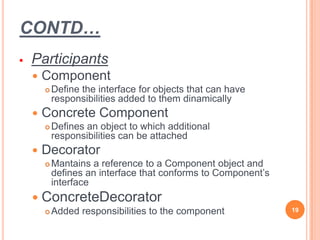
 Participants
 Component
 Define the interface for objects that can have
responsibilities added to them dinamically
 Concrete Component
 Defines an object to which additional
responsibilities can be attached
 Decorator
 Mantains a reference to a Component object and
defines an interface that conforms to Component’s
interface
 ConcreteDecorator
 Added responsibilities to the component 19
CONTD…
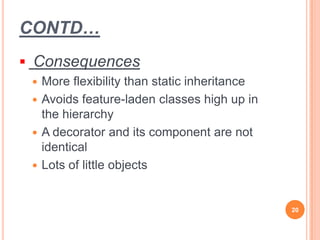
 Consequences
 More flexibility than static inheritance
 Avoids feature-laden classes high up in
the hierarchy
 A decorator and its component are not
identical
 Lots of little objects
20
CONTD…
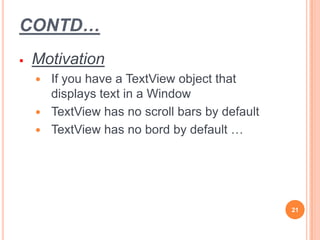
 Motivation
 If you have a TextView object that
displays text in a Window
 TextView has no scroll bars by default
 TextView has no bord by default …
21
EXAMPLE
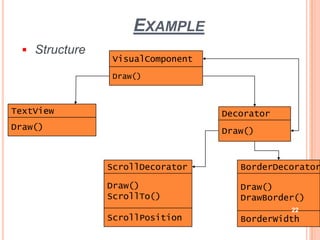
 Structure
VisualComponent
Draw()
TextView
Draw()
Decorator
Draw()
ScrollDecorator BorderDecorator
Draw()
ScrollTo()
ScrollPosition
Draw()
DrawBorder()
BorderWidth
22
BENEFITS OF DESIGN PATTERNS
 Design patterns enable large-scale reuse of
software architectures and also help document
systems
 Patterns explicitly capture expert knowledge and
design tradeoffs and make it more widely available
 Patterns help improve developer communication
 Pattern names form a common vocabulary
23
DRAWBACKS TO DESIGN PATTERNS
 Patterns do not lead to direct code reuse
 Patterns are deceptively simple
 Teams may suffer from pattern overload
 Patterns are validated by experience and
discussion rather than by automated testing
 Integrating patterns into a software development
process is a human-intensive activity.
24
THANK
YOU!!!!!!
25

Final sdp ppt

  • 1.
    SOFTWARE DESIGN PATTERNS By:- NANCY GOEL USN-1MS09IS059 M.S.RAMIAHINSTITUTE OF TECHNOLOGY INFORMATION SCIENCE AND ENGINEERING 1
  • 2.
    INTRODUCTION  A designpattern is a descriptions of communicating objects and classes that are customized to solve a general design problem in a particular context. “Each pattern describes a problem which occurs over and over again in our environment and then describes the core of the solution to that problem, in such a way that you can use this solution a million times over, without ever doing it in the same way twice” 2
  • 3.
    CONTD…  A patternis a recurring solution to a standard problem.  Patterns capture the static and dynamic structure and collaboration among key participants in software designs  A pattern is made by four elements: • name • problem • solution • consequences 3
  • 4.
    NAME OF DESIGNPATTERN  Describe a design problems and its solutions in a word or two.  Used to talk about design pattern with our colleagues.  Used in the documentation.  Increase our design vocabulary.  Have to be coherent and evocative.4
  • 5.
    PROBLEM  Describes whento apply the patterns.  Explains the problem and its context.  Sometimes include a list of conditions that must be met before it makes sense to apply the pattern.  Have to occur over and over again in our environment. 5
  • 6.
    SOLUTION  Describes theelements that make up the design, their relationships, responsibilities and collaborations.  Does not describe a concrete design or implementation.  Has to be well proven in some projects. 6
  • 7.
    CONSEQUENCES  Results andtrade-offs of applying the pattern.  Helpful for describe design decisions, for evaluating design alternatives.  Benefits of applying a pattern.  Impacts on a system’s flexibility , extensibility or portability. 7
  • 8.
    DESCRIPTION OF DESIGN PATTERN Pattern name and classification  Intent  Participants  Collaborations  Consequences  Implementation  Design 8
  • 9.
    TYPES OF PATTERNS Creational patterns:  Abstract the instantiation process  Make a system independent to its realization  Class Creational use inheritance to vary the instantiated classes  Object Creational delegate instantiation to an another object 9
  • 10.
    CONTD…  Structural patterns: Class Structural patterns concern the aggregation of classes to form largest structures  Object Structural pattern concern the aggregation of objects to form largest structures 10
  • 11.
    CONTD…  Behavioral patterns: Concern with algorithms and assignment of responsibilities between objects  Describe the patterns of communication between classes or objects  Behavioral class pattern use inheritance to distribute behavior between classes  Behavioral object pattern use object composition to distribute behavior between classes 11
  • 12.
    CREATIONAL PATTERN  Singleton Ensure a class only has one instance  Provide a global point of access to it  Abstract Factory • Provide an interface for creating families of related or dependent objects without specifying their concrete classes 12
  • 13.
    CONTD…  Factory Method Define an interface for creating an object but let subclasses decide which class to instantiate  Lets a class defer instantiation to subclasses 13
  • 14.
    STRUCTURAL PATTERN  Decorator Attach additional responsibilities to an object dynamically  Provide a flexible alternative to sub classing for extending functionality  Adapter  Convert the interface of a class into another interface clients expect  Lets classes work together that couldn’t otherwise because of incompatible interfaces 14
  • 15.
    CONTD…  Bridge • Decouplean abstraction from its implementation so that the two can vary independently  Façade  Provide a unified interface to a set of interfaces in a subsystem  Defines an higher-level interface that makes the system easier to use 15
  • 16.
    BEHAVIORAL PATTERN  Observer Define a one-to-many dependency between objects so when one of them change state all its dependents are updated automatically  Strategy  Define a family of algorithms  Encapsulate each one  Make them interchangeable  Lets the algorithms vary independently from clients that use it 16
  • 17.
    DECORATOR PATTERN  Motivation Add responsibilities to individual object not to an entire class  conforming the interface of the component decorated 17
  • 18.
  • 19.
    CONTD…  Participants  Component Define the interface for objects that can have responsibilities added to them dinamically  Concrete Component  Defines an object to which additional responsibilities can be attached  Decorator  Mantains a reference to a Component object and defines an interface that conforms to Component’s interface  ConcreteDecorator  Added responsibilities to the component 19
  • 20.
    CONTD…  Consequences  Moreflexibility than static inheritance  Avoids feature-laden classes high up in the hierarchy  A decorator and its component are not identical  Lots of little objects 20
  • 21.
    CONTD…  Motivation  Ifyou have a TextView object that displays text in a Window  TextView has no scroll bars by default  TextView has no bord by default … 21
  • 22.
  • 23.
    BENEFITS OF DESIGNPATTERNS  Design patterns enable large-scale reuse of software architectures and also help document systems  Patterns explicitly capture expert knowledge and design tradeoffs and make it more widely available  Patterns help improve developer communication  Pattern names form a common vocabulary 23
  • 24.
    DRAWBACKS TO DESIGNPATTERNS  Patterns do not lead to direct code reuse  Patterns are deceptively simple  Teams may suffer from pattern overload  Patterns are validated by experience and discussion rather than by automated testing  Integrating patterns into a software development process is a human-intensive activity. 24
  • 25.