Introduction to Design
Patterns
Design patterns are essential tools for software developers, providing
reusable solutions to common problems in software design. They
represent the collective experience of skilled developers and
architects and serve as a guide for creating scalable and maintainable
software systems.
BY: Mohammed Babaqi
What are Design Patterns?
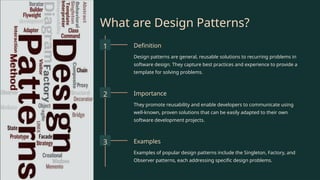
1 Definition
Design patterns are general, reusable solutions to recurring problems in
software design. They capture best practices and experience to provide a
template for solving problems.
2 Importance
They promote reusability and enable developers to communicate using
well-known, proven solutions that can be easily adapted to their own
software development projects.
3 Examples
Examples of popular design patterns include the Singleton, Factory, and
Observer patterns, each addressing specific design problems.
Types of Design Patterns
Creational
This type of design
pattern is focused on
object creation
mechanisms, often hiding
methods of object
creation or abstracting
the details away from the
developer.
Structural
Structural patterns help in
organizing different
classes and objects to
form larger, flexible
structures and provide
ways to realize
relationships between
classes or objects.
Behavioral
Behavioral patterns focus
on communication
between objects, making
the design of different
classes and objects
flexible and efficient.
Creational Design Patterns
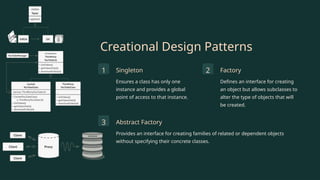
1 Singleton
Ensures a class has only one
instance and provides a global
point of access to that instance.
2 Factory
Defines an interface for creating
an object but allows subclasses to
alter the type of objects that will
be created.
3 Abstract Factory
Provides an interface for creating families of related or dependent objects
without specifying their concrete classes.
Structural Design Patterns
Flexible Structure
Allows for the composition
of objects into larger
structures, while keeping
each object independent.
Class Relationships
Describes how objects and
classes can be combined to
form larger structures.
Container Management
Focuses on managing
relationships between
entities, often optimizing
data access and storage.
Behavioral Design Patterns
Observer
Defines a one-to-many
dependency between
objects, ensuring that
when one object
changes state, all its
dependents are notified
and updated
automatically.
Strategy
Defines a family of
algorithms,
encapsulates each one,
and makes them
interchangeable, which
allows the client to
choose the appropriate
algorithm strategy at
runtime.
Command
Encapsulates a request
as an object, thereby
allowing for
parameterization of
clients with queues,
requests, and
operations.
Advantages of Using Design Patterns
1
Reusability
Patterns promote reusability and flexibility
in the design and implementation of
software systems.
2
Scalability
They make it easier to manage and grow
large, complex software solutions over time.
3
Maintenance
Patterns facilitate easier maintenance and
updates to software applications, reducing
time and effort.
4
Community Standards
They provide a common language for
developers, enhancing communication and
knowledge transfer within the community.
Loading...
Conclusion
Key Concepts
Design patterns are
fundamental to software
architecture and provide
a systematic approach to
solving common design
problems.
Continuous Learning
Adopting design patterns
fosters a culture of
continuous learning and
improvement in software
development practices.
Industry Best Practices
Understanding and
implementing design
patterns aligns with
industry best practices
and promotes
professional growth.

sample Pattern Design explaine .pptx

  • 1.
    Introduction to Design Patterns Designpatterns are essential tools for software developers, providing reusable solutions to common problems in software design. They represent the collective experience of skilled developers and architects and serve as a guide for creating scalable and maintainable software systems. BY: Mohammed Babaqi
  • 2.
    What are DesignPatterns? 1 Definition Design patterns are general, reusable solutions to recurring problems in software design. They capture best practices and experience to provide a template for solving problems. 2 Importance They promote reusability and enable developers to communicate using well-known, proven solutions that can be easily adapted to their own software development projects. 3 Examples Examples of popular design patterns include the Singleton, Factory, and Observer patterns, each addressing specific design problems.
  • 3.
    Types of DesignPatterns Creational This type of design pattern is focused on object creation mechanisms, often hiding methods of object creation or abstracting the details away from the developer. Structural Structural patterns help in organizing different classes and objects to form larger, flexible structures and provide ways to realize relationships between classes or objects. Behavioral Behavioral patterns focus on communication between objects, making the design of different classes and objects flexible and efficient.
  • 4.
    Creational Design Patterns 1Singleton Ensures a class has only one instance and provides a global point of access to that instance. 2 Factory Defines an interface for creating an object but allows subclasses to alter the type of objects that will be created. 3 Abstract Factory Provides an interface for creating families of related or dependent objects without specifying their concrete classes.
  • 5.
    Structural Design Patterns FlexibleStructure Allows for the composition of objects into larger structures, while keeping each object independent. Class Relationships Describes how objects and classes can be combined to form larger structures. Container Management Focuses on managing relationships between entities, often optimizing data access and storage.
  • 6.
    Behavioral Design Patterns Observer Definesa one-to-many dependency between objects, ensuring that when one object changes state, all its dependents are notified and updated automatically. Strategy Defines a family of algorithms, encapsulates each one, and makes them interchangeable, which allows the client to choose the appropriate algorithm strategy at runtime. Command Encapsulates a request as an object, thereby allowing for parameterization of clients with queues, requests, and operations.
  • 7.
    Advantages of UsingDesign Patterns 1 Reusability Patterns promote reusability and flexibility in the design and implementation of software systems. 2 Scalability They make it easier to manage and grow large, complex software solutions over time. 3 Maintenance Patterns facilitate easier maintenance and updates to software applications, reducing time and effort. 4 Community Standards They provide a common language for developers, enhancing communication and knowledge transfer within the community.
  • 8.
    Loading... Conclusion Key Concepts Design patternsare fundamental to software architecture and provide a systematic approach to solving common design problems. Continuous Learning Adopting design patterns fosters a culture of continuous learning and improvement in software development practices. Industry Best Practices Understanding and implementing design patterns aligns with industry best practices and promotes professional growth.