PATIENTCOUNSELLING
BY SURYAKANT SHASHI
B.PHARM 4TH YEAR
DEFINITION:
• Patient counselling is defined as providing
medication information orally or in a written form
to the patient or their representatives on direction
of use advice on side effects precaution , storage
diet and lifestyle modification.
OBJECTIVES:
• Patient should recognize the importance of medication .
• Patient should ensure better patient compliance.
• A working relationship and a foundation for continuous interaction
and consultation should be established.
• Patient understanding of strategies to deal with medication side
effect and drug interaction should be improved.
• Should ensure better patient compliance.
• Patient becomes an informed ,efficient And active participant in
disease treatment and self care management
• Pharmacist should perceived as a professional who offers
pharmaceutical care.
• Drug interaction and adverse drug reactions should be prevented.
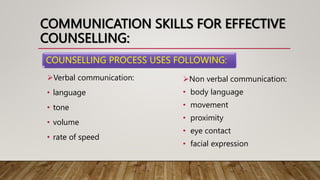
COMMUNICATION SKILLS FOR EFFECTIVE
COUNSELLING:
Verbal communication:
• language
• tone
• volume
• rate of speed
Non verbal communication:
• body language
• movement
• proximity
• eye contact
• facial expression
COUNSELLING PROCESS USES FOLLOWING:
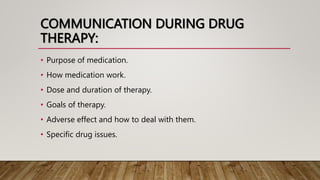
COMMUNICATION DURING DRUG
THERAPY:
• Purpose of medication.
• How medication work.
• Dose and duration of therapy.
• Goals of therapy.
• Adverse effect and how to deal with them.
• Specific drug issues.
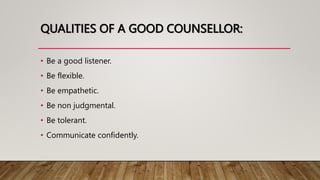
QUALITIES OF A GOOD COUNSELLOR:
• Be a good listener.
• Be flexible.
• Be empathetic.
• Be non judgmental.
• Be tolerant.
• Communicate confidently.
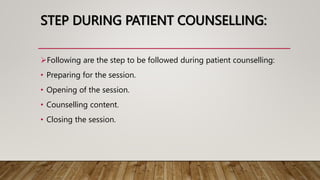
STEP DURING PATIENT COUNSELLING:
Following are the step to be followed during patient counselling:
• Preparing for the session.
• Opening of the session.
• Counselling content.
• Closing the session.
STEP 1: PREPARING FOR THE SESSION
• Counselling develop upon the knowledge and skills of the
counsellor.
• Pharmacist should know as much possible about the patient
treatment details.
• In community pharmacy the source of information include patient
and prescription or a record of previous dispensing.
• If the pharmacist is unfamiliar about drug which is received from the
patient ,go for drug information reference.
• Before counselling ,you have to consider about mental physical
status.
STEP 2 :OPENING FOR THE SESSION
• The pharmacist should introduce himself/herself to the patient and
treat them by name.
• It is best to use title such as Mr. ,Mrs. ,miss. E.g. -hello Mr., any name
, my name is Suryakant shashi and I am your clinical pharmacist.
• I would like to tell about the medication.
• Do you have a few minutes to spend with me.
• Pharmacist gather information from the patient disease, medication.
• Other information may relevant include previous drug allergies,
past medication history, personal habit such as diet, smoking,
alcohol consumption etc.
• Use open ended question, such as 'what did your doctor tell you
about your illness?', what do you know about your disease, 'can
you tell me about the symptoms’, etc.
• During counselling ,the pharmacist should avoid asking question
directly in embarrassing way.
COUNSELLING CONTENT:
• Name and strength of medication.
• The reason why it has been prescribed, or how it work.
• How to take the medication.
• Expected duration of treatment.
• Expected benefit of treatment.
• Possible adverse effect.
• Possible medication or dietary interaction.
• Storage recommendation.
• Minimum duration required to show therapeutic benefit.
• What to do if a dose is missed.
• Special monitoring requirement, for ex-blood test.
CLOSING THE SESSION
• Before closing the session, it is essential to check patient
understanding.
• This can be achieved by feedback question, such as can you
remember what is this medication is for?
• Or how long should you take this medication?
• Ask the patient about any doubt.
• Before final closure and if time permits summarize the main point in
logical order.
REFERENCE:
• Dr. Hazare A. Community Pharmacy & Management. Nirali Publication,
2022, 1st edition, pp: 5.1-5.42.
• Mistry S. Patient counseling. Solution Pharmacy, 2022. Available from:
https://solutionpharmacy.in/patient-counseling/
• Dr. Yadav AV, Dubai A. Community Pharmacy & Management. Nirali
Publication 2022, 1st edition, Chapter 5.
• Ganpisetti R. Strategies to overcome barriers of patient counselling. Slide
share, 2018. Available from:
https://www.slideshare.net/rameshganpisetti/strategies-to-overcome-
barriers-of-patient-counselling
PATIENTCOUNSELLING  in.pptx

PATIENTCOUNSELLING in.pptx

  • 1.
  • 2.
    DEFINITION: • Patient counsellingis defined as providing medication information orally or in a written form to the patient or their representatives on direction of use advice on side effects precaution , storage diet and lifestyle modification.
  • 3.
    OBJECTIVES: • Patient shouldrecognize the importance of medication . • Patient should ensure better patient compliance. • A working relationship and a foundation for continuous interaction and consultation should be established. • Patient understanding of strategies to deal with medication side effect and drug interaction should be improved. • Should ensure better patient compliance.
  • 4.
    • Patient becomesan informed ,efficient And active participant in disease treatment and self care management • Pharmacist should perceived as a professional who offers pharmaceutical care. • Drug interaction and adverse drug reactions should be prevented.
  • 5.
    COMMUNICATION SKILLS FOREFFECTIVE COUNSELLING: Verbal communication: • language • tone • volume • rate of speed Non verbal communication: • body language • movement • proximity • eye contact • facial expression COUNSELLING PROCESS USES FOLLOWING:
  • 6.
    COMMUNICATION DURING DRUG THERAPY: •Purpose of medication. • How medication work. • Dose and duration of therapy. • Goals of therapy. • Adverse effect and how to deal with them. • Specific drug issues.
  • 7.
    QUALITIES OF AGOOD COUNSELLOR: • Be a good listener. • Be flexible. • Be empathetic. • Be non judgmental. • Be tolerant. • Communicate confidently.
  • 8.
    STEP DURING PATIENTCOUNSELLING: Following are the step to be followed during patient counselling: • Preparing for the session. • Opening of the session. • Counselling content. • Closing the session.
  • 9.
    STEP 1: PREPARINGFOR THE SESSION • Counselling develop upon the knowledge and skills of the counsellor. • Pharmacist should know as much possible about the patient treatment details. • In community pharmacy the source of information include patient and prescription or a record of previous dispensing. • If the pharmacist is unfamiliar about drug which is received from the patient ,go for drug information reference. • Before counselling ,you have to consider about mental physical status.
  • 10.
    STEP 2 :OPENINGFOR THE SESSION • The pharmacist should introduce himself/herself to the patient and treat them by name. • It is best to use title such as Mr. ,Mrs. ,miss. E.g. -hello Mr., any name , my name is Suryakant shashi and I am your clinical pharmacist. • I would like to tell about the medication. • Do you have a few minutes to spend with me. • Pharmacist gather information from the patient disease, medication.
  • 11.
    • Other informationmay relevant include previous drug allergies, past medication history, personal habit such as diet, smoking, alcohol consumption etc. • Use open ended question, such as 'what did your doctor tell you about your illness?', what do you know about your disease, 'can you tell me about the symptoms’, etc. • During counselling ,the pharmacist should avoid asking question directly in embarrassing way.
  • 12.
    COUNSELLING CONTENT: • Nameand strength of medication. • The reason why it has been prescribed, or how it work. • How to take the medication. • Expected duration of treatment. • Expected benefit of treatment. • Possible adverse effect. • Possible medication or dietary interaction.
  • 13.
    • Storage recommendation. •Minimum duration required to show therapeutic benefit. • What to do if a dose is missed. • Special monitoring requirement, for ex-blood test.
  • 14.
    CLOSING THE SESSION •Before closing the session, it is essential to check patient understanding. • This can be achieved by feedback question, such as can you remember what is this medication is for? • Or how long should you take this medication? • Ask the patient about any doubt. • Before final closure and if time permits summarize the main point in logical order.
  • 15.
    REFERENCE: • Dr. HazareA. Community Pharmacy & Management. Nirali Publication, 2022, 1st edition, pp: 5.1-5.42. • Mistry S. Patient counseling. Solution Pharmacy, 2022. Available from: https://solutionpharmacy.in/patient-counseling/ • Dr. Yadav AV, Dubai A. Community Pharmacy & Management. Nirali Publication 2022, 1st edition, Chapter 5. • Ganpisetti R. Strategies to overcome barriers of patient counselling. Slide share, 2018. Available from: https://www.slideshare.net/rameshganpisetti/strategies-to-overcome- barriers-of-patient-counselling