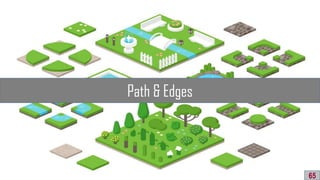
Path & Edges
65
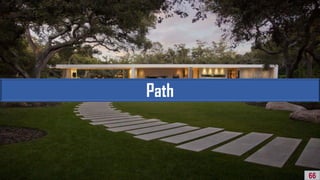
Path
66
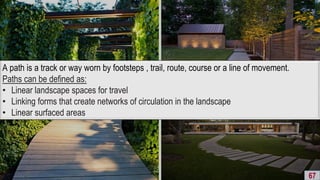
A path is a track or way worn by footsteps , trail, route, course or a line of movement.
Paths can be defined as:
• Linear landscape spaces for travel
• Linking forms that create networks of circulation in the landscape
• Linear surfaced areas
67
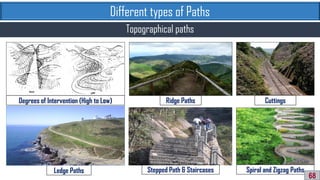
Topographical paths
Different types of Paths
Degrees of Intervention (High to Low)
Ledge Paths
CuttingsRidge Paths
Spiral and Zigzag PathsStepped Path & Staircases
68
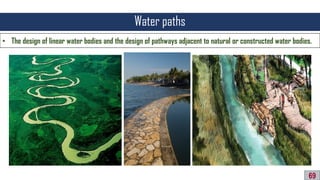
Water paths
• The design of linear water bodies and the design of pathways adjacent to natural or constructed water bodies.
69
Built paths
Streets Backs
Covered Walks
Raised Walks
Streets
70
Vegetation paths
Avenues
Forest Paths
Green
Tunnels
Hedged PathsMeadow Paths
71
Edges
72
An edge can be defined as:
1. The linear interface between two spaces or regions of a landscape that have different functions and/or
physical characters.
2. In-between linear zone
3. Interlock
4. An Eco tone
5. A boundary
6. A horizon.
73
Ecotone
• An ecotone is a
transition area
between two biomes.
• It is where two
communities meet and
integrate.
• The circular boundary of the
part of the earth's surface
visible from a particular point,
• Horizons are visual and
symbolic edges where earth or
sea meets sky.
Horizons
74
Topographical edges
Different types of edges
Spurred edges
Stacked edges
Banks
Ridges
Ditches
75
Steps as edges
Cliffs or chasam
Topographical edges
76
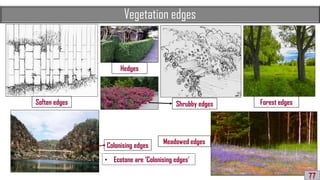
Vegetation edges
Soften edges
Colonising edges
• Ecotone are ‘Colonising edges’
Hedges
Shrubby edges
Meadowed edges
Forest edges
77
Water’s edges
Beaches
Platforms, piers and broad walks
Promenades
Wetlands and
marginal water
places
78
Built edges
Buildings
Buttressed and indented walls
Permeable structures
79

Path and edges