Patent Marking
Guidelines
Kristen J. Hansen
June 26, 2025
This presentation is for information purposes only and does not constitute legal advice.
Overview
• Intro to Patent Marking
• Legal Requirements
• Benefits/Best Practices
• Real Life Case Cautionary Tale
• Worldwide Marking
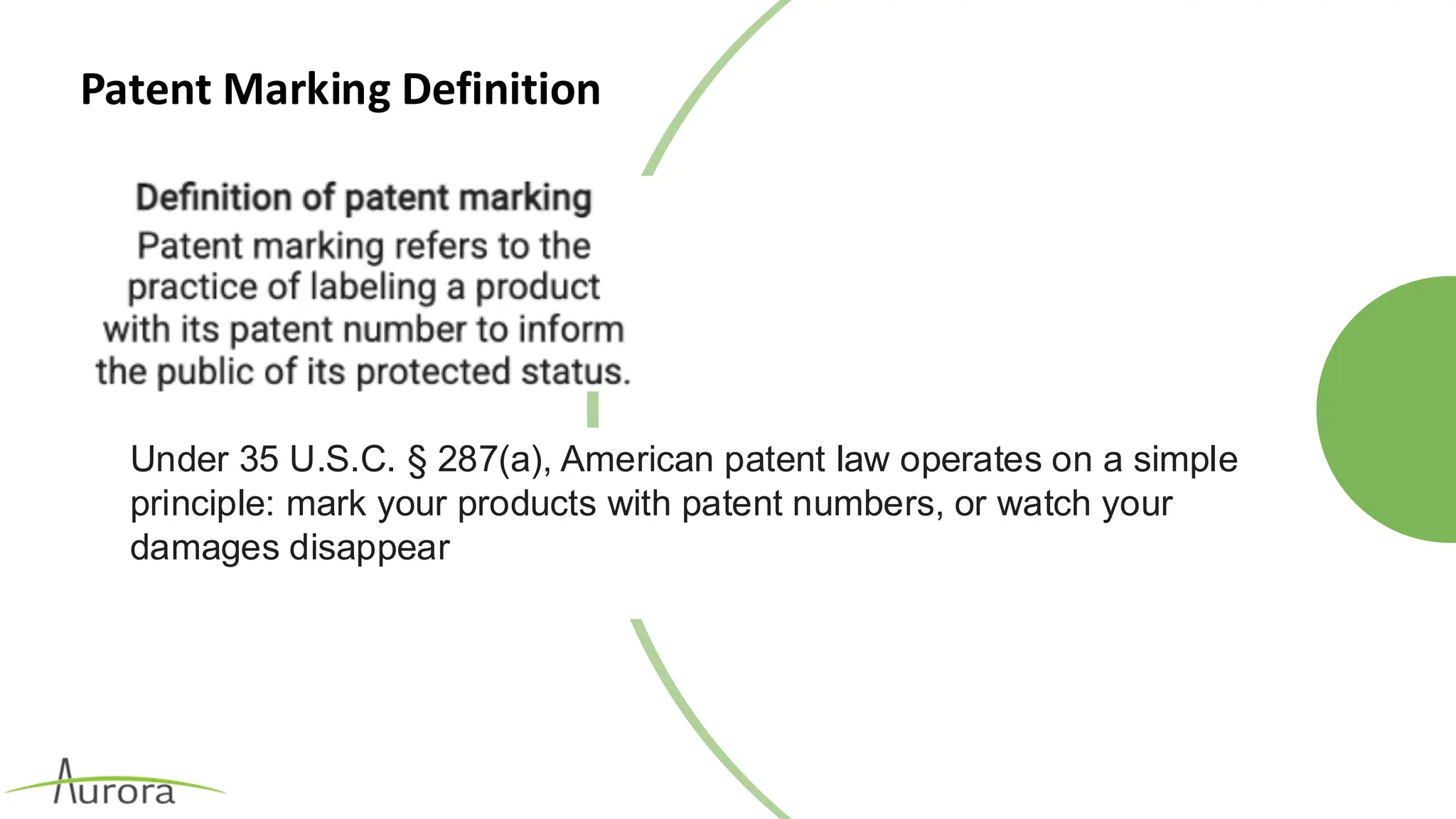
Patent Marking Definition
Under 35 U.S.C. § 287(a), American patent law operates on a simple
principle: mark your products with patent numbers, or watch your
damages disappear
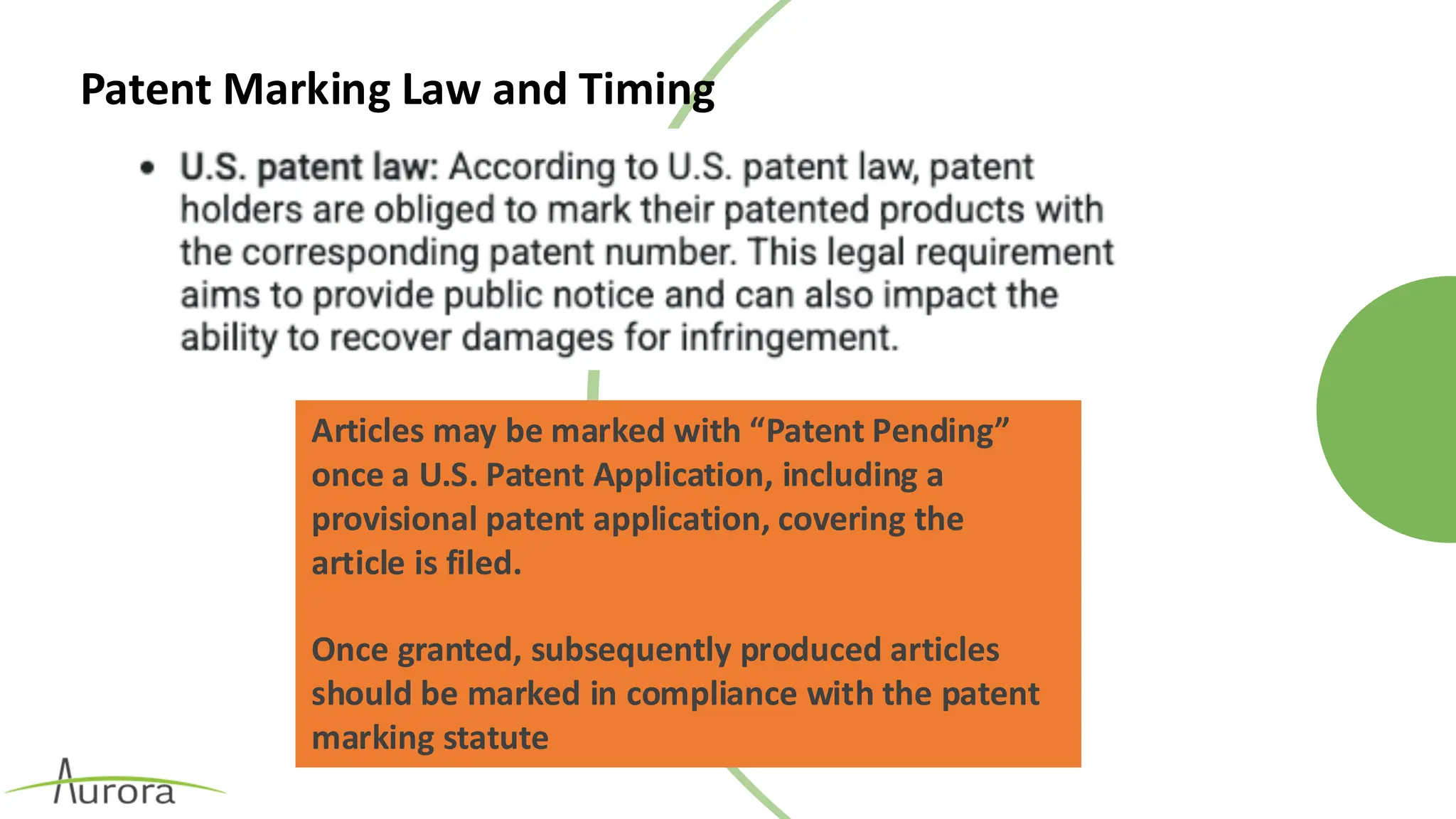
Patent Marking Law and Timing
Articles may be marked with “Patent Pending”
once a U.S. Patent Application, including a
provisional patent application, covering the
article is filed.
Once granted, subsequently produced articles
should be marked in compliance with the patent
marking statute
Physically Mark or Virtually Mark?
▪ Since 2011, the AIA allows patentees to virtually mark their products
instead of physically marking their products
▪ If marking a product is not feasible due to size constraints:
▪ a package or label may be marked instead
▪ if words are printed on the product itself, the patent number or web
address should also be included on the product
▪ Virtual marking allows a company to update its product(s) without having
to re-label or re-produce a line of products when a new patent issues
covering the product(s)
Physical Patent Marking Basics
Constructive Notice vs. Actual Notice
Patent Marking Basics
A patent owner may obtain damages dating back
to a date on which the patent owner provided an
infringer with notice of the infringement. Marking
is a way to provide this notice.
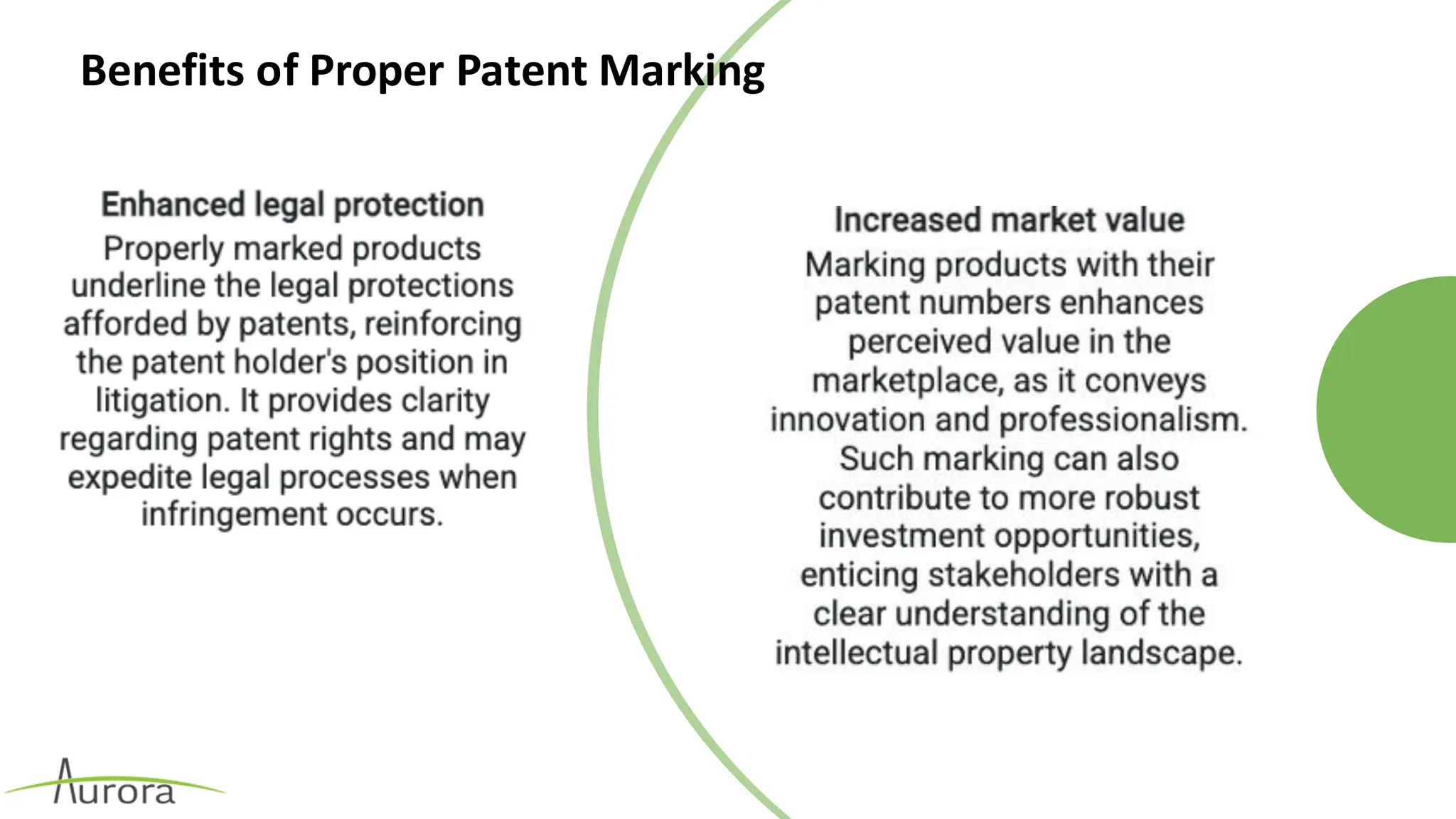
Benefits of Proper Patent Marking
Best Practices for Physically Marking Products
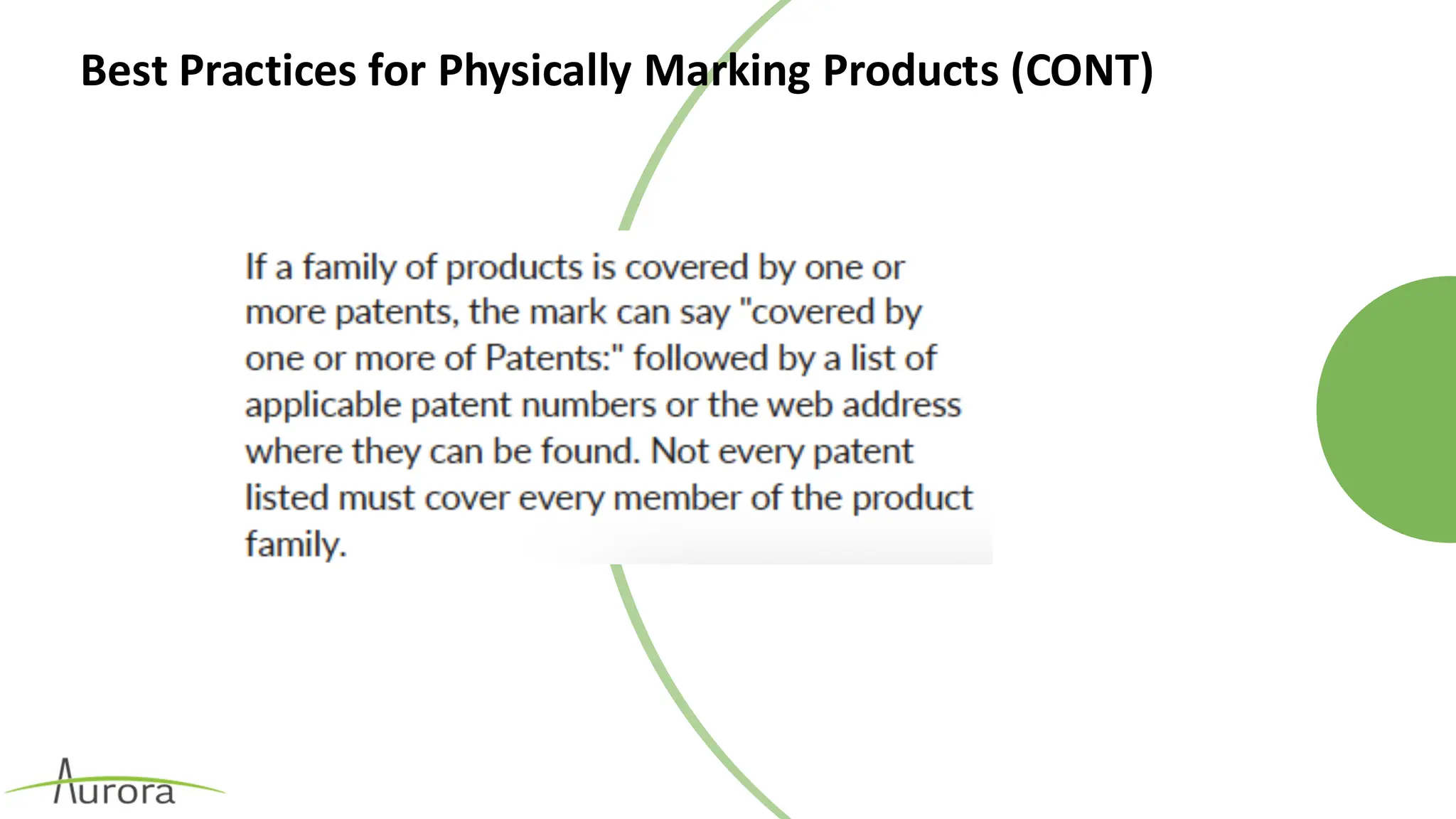
Best Practices for Physically Marking Products (CONT)
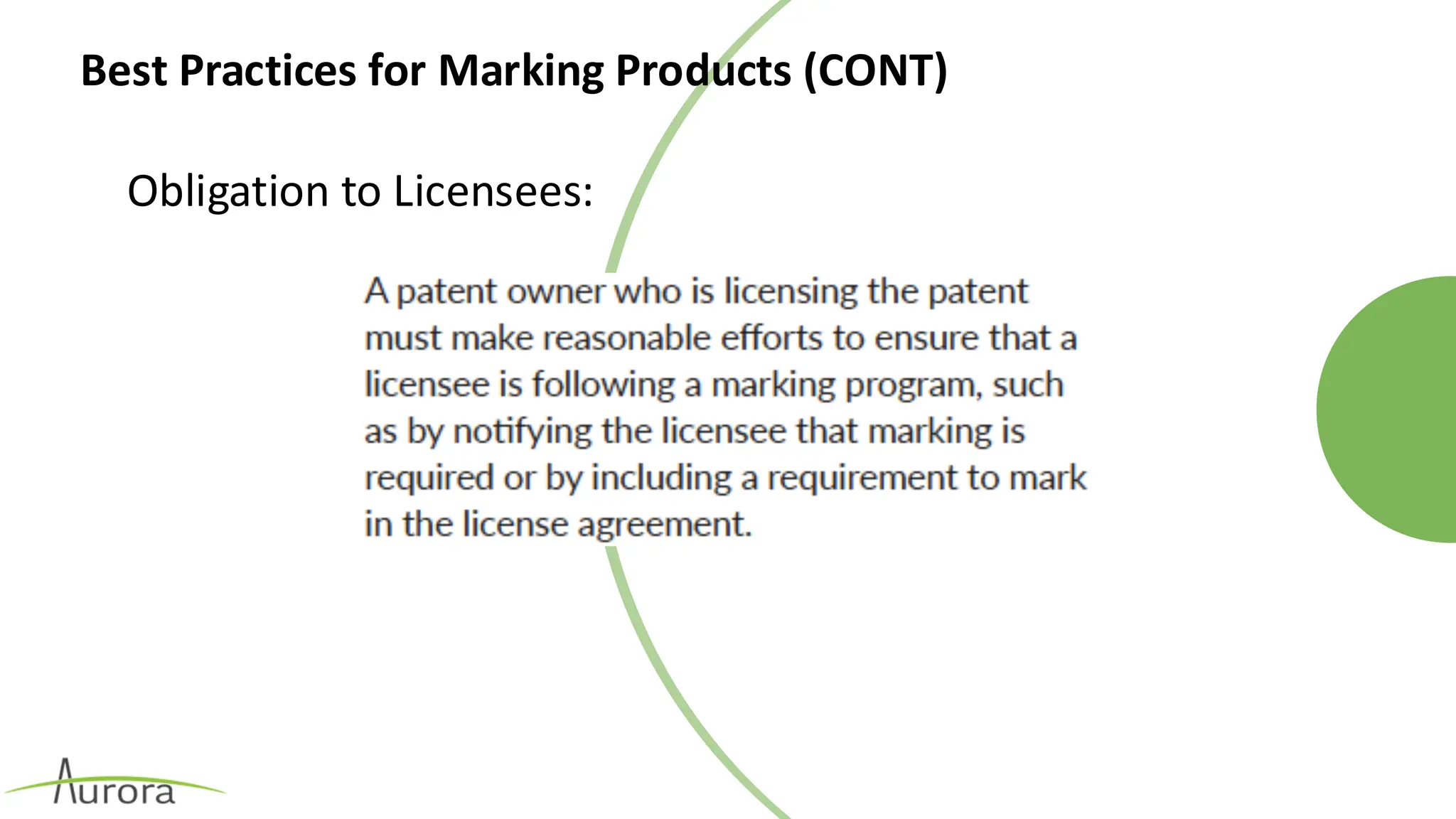
Best Practices for Marking Products (CONT)
Obligation to Licensees:
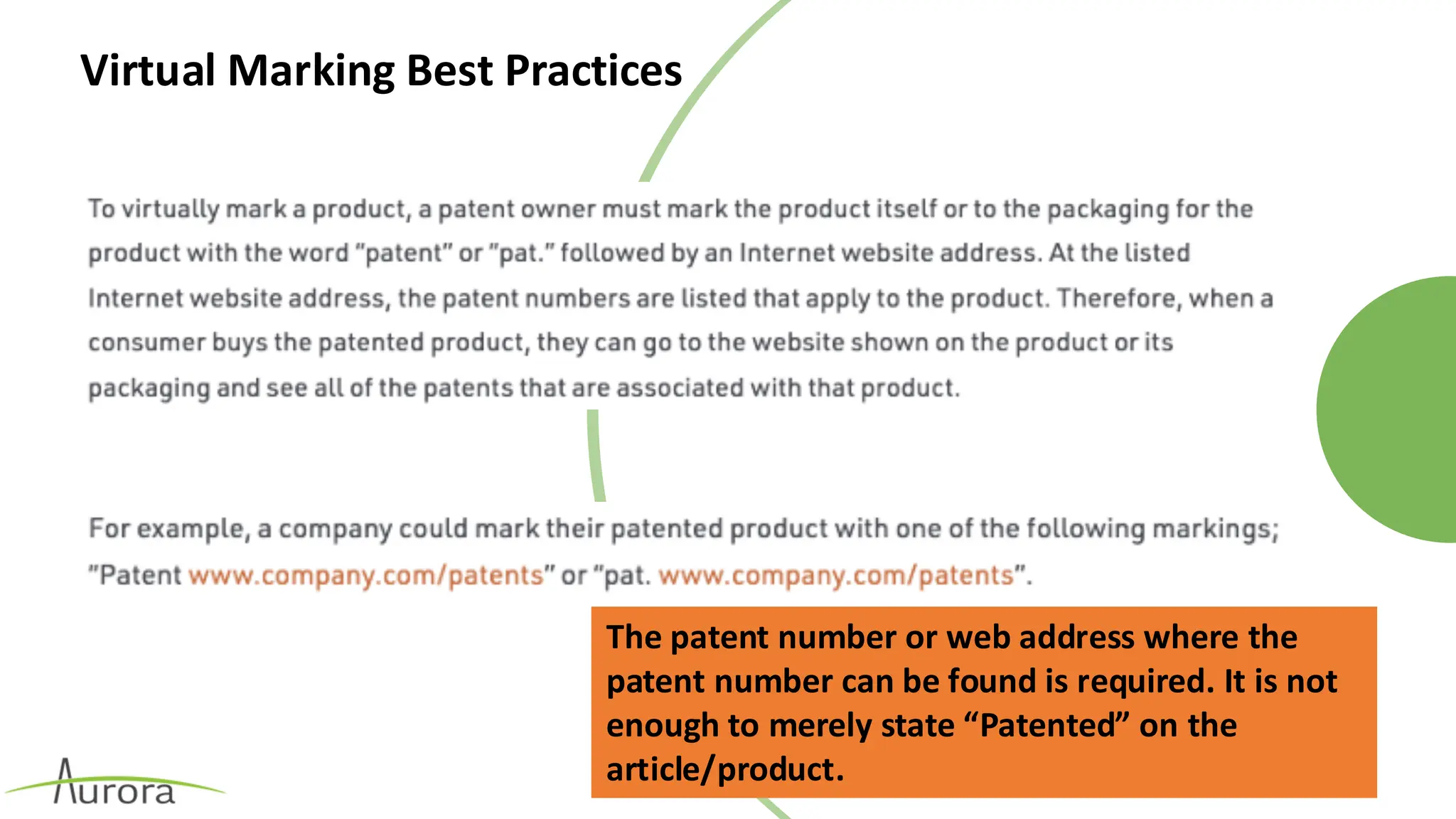
Virtual Marking Best Practices
The patent number or web address where the
patent number can be found is required. It is not
enough to merely state “Patented” on the
article/product.
Virtual Marking Best Practices (CONT)
▪ If marking a product is not feasible due to size constraints:
▪ a package or label may be marked instead
▪ if words are printed on the product itself, the patent
number or web address should also be included on the
product
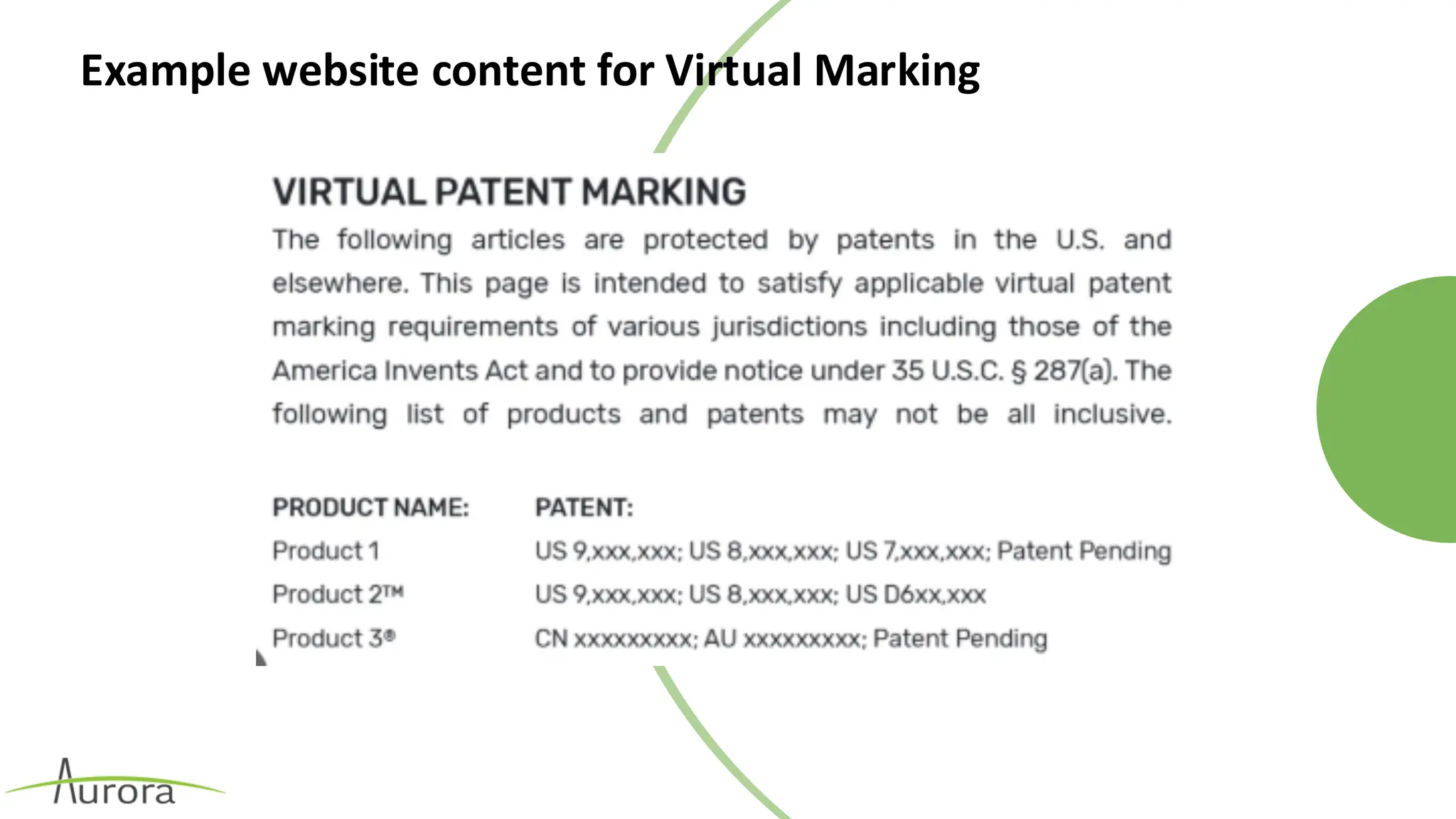
Example website content for Virtual Marking
Virtual Marking Best Practices for Software
▪ Virtually mark patented software on a web page specifically
generated for virtual markings in the same fashion as virtually
marking physical products
▪ Map the product to the patent(s) on the web page
▪ It has been found appropriate in some cases to mark patented
software on a UI, but it is not best practice
▪ Ambiguity on the marking webpage may render markings
improper
▪ Update timely and often (e.g., expiration, new
continuations/family members issued, etc.)
Virtual Marking Best Practices for Software (CONT)
▪ Courts have held that method claims create no marking
obligation because it is not possible to mark a step or action
performed in accordance with a patented method*
▪ If software is covered by apparatus or system claims, the
software should be marked, to the extent there is a tangible
item to mark**
▪ If software is covered by computer-readable medium claims,
then it is likely (according to case law***) best to mark
Interesting note: for patents containing both apparatus and
method claims, a patentee can still avoid marking requirements by
asserting only method claims in litigation
*Crown Packaging Technology, Inc. v. Rexam Beverage Can Co., 559 F.3d 1308, 1317 (Fed. Cir. 2009)
**Am. Med. Sys., Inc. v. Med. Eng'g Corp., 6F.3d 1523, 1538–39 (Fed. Cir. 1993)
***Finjan v. Secure Computing Corp., 626F.3d 1197, 1203-1204 (Fed. Cir. 2010)
Virtually Marking Partially Covered - Software
Q: What if a product only is covered by some portion of a patent
claim?
A: Use “For use under U.S. X,XXX,XXX” language in your marking
strategy
TIP: consider the downstream intended uses of products. If the
patent owner anticipates that those products will be combined
with other components, and the resulting combination would
meet all elements of the patent owner's claim, then the patent
owner should 1) mark the product "for use under" the patent or 2)
contractually require its customers to mark the product with the
patent number.
False Patent Marking
• False marking is a significant risk and includes:
• Using patent numbers without authorization
• Marking products not actually covered by the patents
listed
• Stating “Patent Pending” when no application is
pending
• any intent to deceive can still expose the company to
fines and civil claims
Arctic Cat v. Bombardier Marking Case
In Arctic Cat v. Bombardier, the Fed Circuit clarified the impact of failure to
mark products on the recovery of pre-suit damages under 35 U.S.C. §
287(a) – the court held:
• if the patent holder fails to mark its own products, it cannot recover
damages for infringement that occurred before the filing of the lawsuit,
unless the alleged infringer had actual notice of the infringement
Note: Recent court decisions demand marking "substantially all" products,
with courts playing a numbers game where 95% compliance passes but
77% fails
Arctic Cat v. Bombardier Marking Case
• Although the case did not directly address a scenario where the license
agreement explicitly exempts the licensee from marking obligations, it
underscores the importance of complying with marking requirements to
secure the ability to claim past damages
• The court's logic? Patent owners must "police" their licensees' marking
compliance, turning every licensor into an unpaid compliance officer
Other Countries
• Europe: no marking requirements
• Germany: no marking requirements – damages calculate from the
infringement date regardless of marking; marking can be done to avoid
unfair competition or reduced damages in infringement cases
• U.K: recognizes virtual marking, but limited practicality; exception of
“innocence defense” when someone uses a patented invention without
knowing about existence of the patent (infringer must prove their lack
of knowledge)
• France/Netherlands: no marking requirements, but similar to Germany,
you can mark
• Unified Patent Court: no marking requirements yet
• China: marking is optional
• Japan: marking is optional
• Canada: no marking requirements and vehemently rejects US policy
Thank you for listening today!
What questions do you have?

Patent Marking Guidelines: No Mark, No Money

  • 1.
    Patent Marking Guidelines Kristen J.Hansen June 26, 2025 This presentation is for information purposes only and does not constitute legal advice.
  • 2.
    Overview • Intro toPatent Marking • Legal Requirements • Benefits/Best Practices • Real Life Case Cautionary Tale • Worldwide Marking
  • 3.
    Patent Marking Definition Under35 U.S.C. § 287(a), American patent law operates on a simple principle: mark your products with patent numbers, or watch your damages disappear
  • 4.
    Patent Marking Lawand Timing Articles may be marked with “Patent Pending” once a U.S. Patent Application, including a provisional patent application, covering the article is filed. Once granted, subsequently produced articles should be marked in compliance with the patent marking statute
  • 5.
    Physically Mark orVirtually Mark? ▪ Since 2011, the AIA allows patentees to virtually mark their products instead of physically marking their products ▪ If marking a product is not feasible due to size constraints: ▪ a package or label may be marked instead ▪ if words are printed on the product itself, the patent number or web address should also be included on the product ▪ Virtual marking allows a company to update its product(s) without having to re-label or re-produce a line of products when a new patent issues covering the product(s)
  • 6.
    Physical Patent MarkingBasics Constructive Notice vs. Actual Notice
  • 7.
    Patent Marking Basics Apatent owner may obtain damages dating back to a date on which the patent owner provided an infringer with notice of the infringement. Marking is a way to provide this notice.
  • 8.
    Benefits of ProperPatent Marking
  • 9.
    Best Practices forPhysically Marking Products
  • 10.
    Best Practices forPhysically Marking Products (CONT)
  • 11.
    Best Practices forMarking Products (CONT) Obligation to Licensees:
  • 12.
    Virtual Marking BestPractices The patent number or web address where the patent number can be found is required. It is not enough to merely state “Patented” on the article/product.
  • 13.
    Virtual Marking BestPractices (CONT) ▪ If marking a product is not feasible due to size constraints: ▪ a package or label may be marked instead ▪ if words are printed on the product itself, the patent number or web address should also be included on the product
  • 14.
    Example website contentfor Virtual Marking
  • 15.
    Virtual Marking BestPractices for Software ▪ Virtually mark patented software on a web page specifically generated for virtual markings in the same fashion as virtually marking physical products ▪ Map the product to the patent(s) on the web page ▪ It has been found appropriate in some cases to mark patented software on a UI, but it is not best practice ▪ Ambiguity on the marking webpage may render markings improper ▪ Update timely and often (e.g., expiration, new continuations/family members issued, etc.)
  • 16.
    Virtual Marking BestPractices for Software (CONT) ▪ Courts have held that method claims create no marking obligation because it is not possible to mark a step or action performed in accordance with a patented method* ▪ If software is covered by apparatus or system claims, the software should be marked, to the extent there is a tangible item to mark** ▪ If software is covered by computer-readable medium claims, then it is likely (according to case law***) best to mark Interesting note: for patents containing both apparatus and method claims, a patentee can still avoid marking requirements by asserting only method claims in litigation *Crown Packaging Technology, Inc. v. Rexam Beverage Can Co., 559 F.3d 1308, 1317 (Fed. Cir. 2009) **Am. Med. Sys., Inc. v. Med. Eng'g Corp., 6F.3d 1523, 1538–39 (Fed. Cir. 1993) ***Finjan v. Secure Computing Corp., 626F.3d 1197, 1203-1204 (Fed. Cir. 2010)
  • 17.
    Virtually Marking PartiallyCovered - Software Q: What if a product only is covered by some portion of a patent claim? A: Use “For use under U.S. X,XXX,XXX” language in your marking strategy TIP: consider the downstream intended uses of products. If the patent owner anticipates that those products will be combined with other components, and the resulting combination would meet all elements of the patent owner's claim, then the patent owner should 1) mark the product "for use under" the patent or 2) contractually require its customers to mark the product with the patent number.
  • 18.
    False Patent Marking •False marking is a significant risk and includes: • Using patent numbers without authorization • Marking products not actually covered by the patents listed • Stating “Patent Pending” when no application is pending • any intent to deceive can still expose the company to fines and civil claims
  • 19.
    Arctic Cat v.Bombardier Marking Case In Arctic Cat v. Bombardier, the Fed Circuit clarified the impact of failure to mark products on the recovery of pre-suit damages under 35 U.S.C. § 287(a) – the court held: • if the patent holder fails to mark its own products, it cannot recover damages for infringement that occurred before the filing of the lawsuit, unless the alleged infringer had actual notice of the infringement Note: Recent court decisions demand marking "substantially all" products, with courts playing a numbers game where 95% compliance passes but 77% fails
  • 20.
    Arctic Cat v.Bombardier Marking Case • Although the case did not directly address a scenario where the license agreement explicitly exempts the licensee from marking obligations, it underscores the importance of complying with marking requirements to secure the ability to claim past damages • The court's logic? Patent owners must "police" their licensees' marking compliance, turning every licensor into an unpaid compliance officer
  • 21.
    Other Countries • Europe:no marking requirements • Germany: no marking requirements – damages calculate from the infringement date regardless of marking; marking can be done to avoid unfair competition or reduced damages in infringement cases • U.K: recognizes virtual marking, but limited practicality; exception of “innocence defense” when someone uses a patented invention without knowing about existence of the patent (infringer must prove their lack of knowledge) • France/Netherlands: no marking requirements, but similar to Germany, you can mark • Unified Patent Court: no marking requirements yet • China: marking is optional • Japan: marking is optional • Canada: no marking requirements and vehemently rejects US policy
  • 22.
    Thank you forlistening today! What questions do you have?